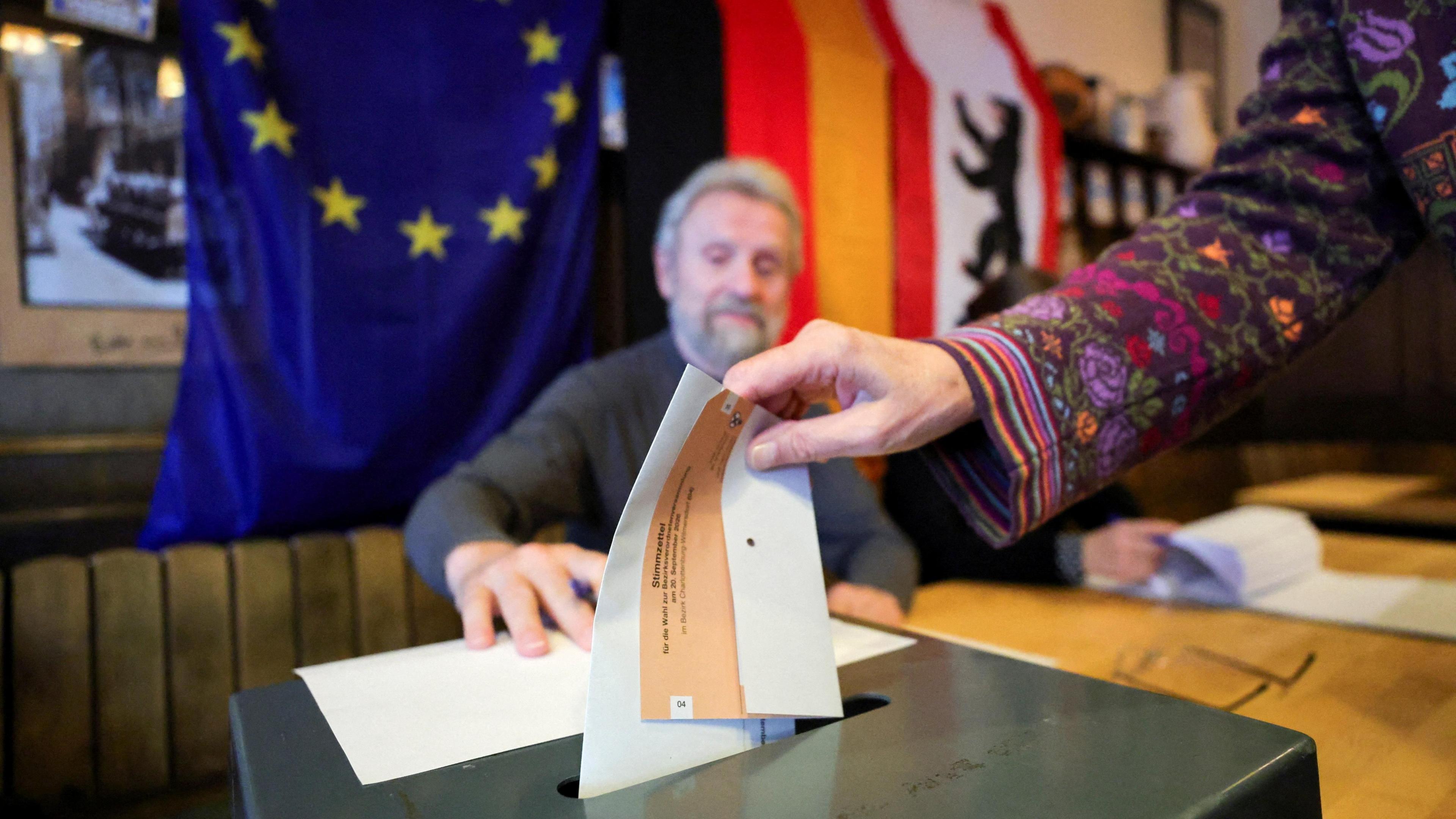
21-09-2026
German Chancellor Friedrich Merz is attempting to remain in office after the Christian Democratic Union (CDU) suffered a historic defeat in regional elections. In Mecklenburg-Vorpommern, a former CDU stronghold associated with Merz’s predecessor and rival Angela Merkel, the party failed to clear the 5 per cent threshold required to enter the state parliament. The far-right Alternative for Germany (AfD) finished first, extending a recent run of state-level successes and strengthening its claim to be a future national governing force.
The CDU also lost support in Berlin, where the left-wing Die Linke won the most seats and could lead a coalition government. Although the results do not immediately threaten Merz’s position, they have intensified concerns about his low approval ratings, the AfD’s rise and internal tensions within his governing coalition.
Merz said the centre-left Social Democrats had agreed to remain in coalition with his conservatives, providing short-term political stability. He pledged to continue pursuing reforms intended to revive Germany’s sluggish economy and preserve its global competitiveness. However, Social Democratic figures, including Mecklenburg-Vorpommern Premier Manuela Schwesig, criticised his approach and called for greater humility, particularly over pension reforms.
Germany’s economy has struggled since the pandemic amid competition from China and elevated energy costs, exposing weaknesses in its export-driven model. Merz was elected on a promise to restore growth but has faced public resistance to pension, tax and healthcare reforms, as well as criticism over repeated communication mistakes. The AfD’s hardline immigration policies and growing electoral support have also unsettled Germans with migrant backgrounds. Meanwhile, Die Linke’s Berlin campaign to nationalise housing owned by corporate landlords and cap rents reflected rising concern over housing affordability. The article presents Merz as politically weakened but determined to continue governing and advancing his unpopular reform agenda.
Entities: Friedrich Merz, Christian Democratic Union (CDU), Social Democratic Party (SPD), Mecklenburg-Western Pomerania (Mecklenburg-Vorpommern), Berlin • Tone: analytical • Sentiment: negative • Intent: inform
21-09-2026
German Chancellor Friedrich Merz has pledged to remain in office after exit polls indicated severe setbacks for his Christian Democratic Union (CDU) in elections in Mecklenburg-Vorpommern and Berlin. In Mecklenburg-Vorpommern, the CDU initially appeared likely to achieve its worst state-election result before falling below the 5% threshold required to remain in the regional parliament. The far-right Alternative for Germany (AfD) was projected to win the largest share of the vote, although other parties are expected to refuse to form a coalition with it. In Berlin, the CDU was projected to lose to Die Linke, while the AfD was also expected to increase its support.
The results came just two weeks after the CDU suffered a major defeat in Saxony-Anhalt, where its vote was reportedly halved and the AfD made substantial gains. Merz, whose approval ratings are poor, has faced speculation that he could be replaced during the current parliamentary term. However, he rejected calls to step aside and said his coalition would continue with planned economic, tax and welfare reforms. He described the reforms as necessary to move Germany forward and as an antidote to the spread of authoritarianism.
AfD co-leader Alice Weidel declared that her party had become the strongest political force and had reached the mainstream. The party’s anti-immigration, German-first and Russia-friendly positions have gained particular traction in Germany’s former communist east, despite some branches being classified as right-wing extremist by domestic intelligence.
Merz’s supporters argue that he inherited many of Germany’s problems and should be given more time. Berlin CDU politician Burkard Dregger said the chancellor should receive the full four-year term. Nevertheless, Merz’s rightward shift on immigration has failed to weaken the AfD and has alienated voters on the left, leaving the chancellor and his party under considerable pressure.
Entities: Friedrich Merz, Christian Democratic Union (CDU), Alternative for Germany (AfD), Alice Weidel, Burkard Dregger • Tone: analytical • Sentiment: negative • Intent: inform
21-09-2026
German Chancellor Friedrich Merz has pledged to preserve his governing coalition with the Social Democratic Party (SPD), arguing that maintaining the alliance is essential to Germany’s “democratic future.” His statement follows a series of damaging election results for his Christian Democratic Union (CDU), increasing pressure on his leadership and raising speculation that he could be replaced before the end of his term.
In Sunday’s state elections, the far-right Alternative for Germany (AfD) won the largest share of votes in Mecklenburg-Vorpommern, while the CDU failed to clear the threshold required to enter the state parliament. In Berlin, the CDU finished second behind the left-wing Die Linke party, while the AfD made substantial gains. Merz described the Mecklenburg-Vorpommern result as a “heavy blow” and an unprecedented turning point for his party.
Despite his poor approval ratings, Merz rejected the suggestion that his personal unpopularity was the primary cause of the defeats. He said the results reflected broader factors beyond his own leadership. However, the setbacks follow another major loss in Saxony-Anhalt, where the CDU’s vote was halved two weeks earlier and the AfD achieved a significant victory.
The continuing electoral decline has fueled rumors of a mid-term “chancellor swap.” AfD co-leader Alice Weidel told the BBC that Merz would leave office “pretty soon.” Merz nevertheless insisted that his coalition would remain together and that it must respond to the “historic challenges” facing Germany. The results underline the growing strength of both the far right and the hard left, while exposing the vulnerability of the governing CDU-SPD alliance.
Entities: Friedrich Merz, Christian Democratic Union (CDU), Social Democratic Party (SPD), German governing coalition, Germany • Tone: analytical • Sentiment: negative • Intent: inform
21-09-2026
Germany’s ruling Christian Democratic Union (CDU) suffered major losses in two state elections, increasing political uncertainty around Chancellor Friedrich Merz’s coalition government and its plans to revive the country’s weak economy. In Mecklenburg-Vorpommern, the far-right Alternative for Germany (AfD) finished first, while Die Linke led the result in Berlin. The CDU’s poor performance has intensified concerns about the party’s ability to cooperate with coalition partners and pass the first phase of Merz’s reform program through parliament.
Although the AfD is unlikely to govern in Mecklenburg-Vorpommern because other parties refuse to work with it, its electoral gains are strengthening its national position. The results also demonstrate growing support for both the far left and far right amid public frustration over high prices, energy insecurity, stagnant wages, industrial decline and dissatisfaction with Germany’s green transition.
Merz said he would remain chancellor and continue pursuing tax, healthcare and pension reforms, increased defense and infrastructure spending, and measures to reduce bureaucracy for small and medium-sized businesses. The Social Democrats, the coalition’s junior partner, have reaffirmed their commitment to the government.
Economists said the immediate market reaction was limited, but warned that the elections could worsen Germany’s longer-term growth outlook. Temporary fiscal stimulus and the fading effects of the 2022 energy crisis may support growth of about 1%, but structural problems—including high energy costs, an expensive and heavily regulated labor market, exposure to Chinese competition, demographic decline and weak preparation for technological change—remain unresolved. Analysts described the political situation as a potential deadlock and warned that continued paralysis could even lead to another German election in 2027.
Entities: Friedrich Merz, Christian Democratic Union (CDU), Alternative for Germany (AfD), Die Linke (The Left), Mecklenburg-Vorpommern • Tone: analytical • Sentiment: negative • Intent: analyze
21-09-2026
Germany’s final state elections of 2026 produced a major political realignment. In Berlin, the Left became the strongest party for the first time, winning a projected 25.7% of the vote. The CDU placed second with 18.8%, followed by the AfD, Greens and SPD. The result ended the previous CDU-SPD majority and leaves the Left facing difficult coalition negotiations with the SPD and Greens. Both potential partners have made cooperation conditional on the Left taking a firm stance against antisemitism following controversial remarks at a campaign event in Neukölln.
In Mecklenburg-Western Pomerania, the AfD narrowly led the SPD, taking 38.2% compared with the SPD’s 35.5%. The CDU suffered its worst result in the state’s history, receiving only 4.9%. If that figure holds, the CDU would fail to win seats in a state parliament anywhere in Germany for the first time. AfD candidate Leif-Erik Holm claimed the right to form a government, although SPD premier Manuela Schwesig could remain in office if she assembles a coalition.
CDU leader and Chancellor Friedrich Merz described the Mecklenburg-Western Pomerania result as a “disaster” and said his party had been squeezed out by the contest between the SPD and AfD. He used the results to warn that Germany faced economic disruption, declining institutional trust and rising authoritarianism, calling for reforms and a national “new beginning.”
The article also highlights the contrasting political themes behind the results. Schwesig’s campaign focused on opposing the AfD, while Berlin Left candidate Elif Eralp centered her campaign on rent controls, social housing and public ownership of large housing portfolios. Eralp cited New York Mayor Zohran Mamdani’s success as evidence that left-wing politics could also prevail in Berlin. Her potential election as governing mayor would make her the city’s first mayor from a migrant background. The results demonstrate growing polarization, the CDU’s weakening position and the competing appeal of left-wing social policy and far-right nationalism.
Entities: Germany’s 2026 state elections, Berlin, Mecklenburg-Western Pomerania, The Left, Alternative for Germany (AfD) • Tone: analytical • Sentiment: negative • Intent: inform
21-09-2026
Europe’s energy crisis is becoming a significant political liability for mainstream governments and an opportunity for far-right and populist parties ahead of major elections. The Alternative for Germany (AfD) emerged as the strongest party in Mecklenburg-Western Pomerania, extending its recent electoral gains and intensifying pressure on Chancellor Friedrich Merz’s coalition. The result suggests that emergency measures to lower fuel costs may not be sufficient to offset voter anger over expensive energy, climate-related taxes and regulations, and Europe’s decision to reduce its reliance on Russian energy.
The AfD has connected household financial hardship with its broader geopolitical agenda, calling for the restoration of cheap Russian gas and an end to sanctions on Russian energy. Alice Weidel has blamed Berlin and Brussels for deliberately raising fuel prices and called for reductions in carbon levies, VAT and EU energy taxes. Merz responded with fuel discounts and price caps, including a temporary tax cut of approximately 17 cents per litre, but the election outcome indicates that such relief may not prevent the crisis from damaging established parties.
The political risks extend to France, Italy, Spain and Poland, which face important elections next year. France is increasingly concerned not only about prices but also about possible shortages after damage to a Saudi pipeline. President Emmanuel Macron convened political leaders, proposed a G7 meeting on releasing additional oil reserves and sought to reassure the public about supply security. Marine Le Pen advocated sharply reducing fuel VAT.
Italy’s government, led by Giorgia Meloni, has proposed scrapping road tax for millions of vehicles and cutting diesel duties, while seeking greater flexibility from EU fiscal rules. In Slovakia, Prime Minister Roberto Fico blamed Western military rhetoric toward Russia for distracting from failures over energy prices and availability. Across Europe, costly relief measures are intended to protect consumers but also demonstrate how energy insecurity is reshaping political debate and strengthening populist narratives.
Entities: Alternative for Germany (AfD), Mecklenburg-Western Pomerania, Friedrich Merz, Emmanuel Macron, Marine Le Pen • Tone: analytical • Sentiment: negative • Intent: analyze
21-09-2026
France 24 reports another electoral setback for German Chancellor Friedrich Merz and his centre-right Christian Democratic Union (CDU), following regional elections held in two German states. According to projections cited in the report, the CDU failed to secure enough support to enter the state parliament in Mecklenburg-Western Pomerania. The far-right Alternative for Germany (AfD) emerged as the strongest party there, continuing its recent electoral momentum after winning in Saxony-Anhalt earlier in September.
The CDU also performed poorly in Berlin, where the far-left Die Linke led the vote. The AfD made significant gains in both states, indicating that support for parties on the political extremes is increasing at the expense of the mainstream centre-right. The results represent a further challenge for Merz, who is facing pressure after the CDU’s disappointing performance in the recent state elections.
The report places the results within a broader pattern of political change in Germany. Although the available article text does not provide detailed vote shares, coalition negotiations, or reactions from party leaders, it emphasizes the contrasting fortunes of the three major political currents: the CDU’s decline, the AfD’s advance, and Die Linke’s leadership in Berlin. France 24 correspondent Nick Rushworth presents the developments in a short video report, describing the elections as another setback for Merz’s government and highlighting the AfD’s growing influence in German regional politics.
Entities: Friedrich Merz, Christian Democratic Union (CDU), Alternative for Germany (AfD), Die Linke, Germany • Tone: analytical • Sentiment: negative • Intent: inform
21-09-2026
German Chancellor Friedrich Merz has pledged to keep his governing coalition together after major losses for his centre-right CDU in two regional elections. The coalition, formed by the CDU and centre-left Social Democratic Party (SPD), faces mounting pressure after voters shifted support toward both the far-right Alternative for Germany (AfD) and the hard-left Die Linke party.
The AfD won the most votes in Mecklenburg-Western Pomerania, in northeastern Germany, while the CDU suffered its worst-ever result in the state and was ejected from the regional parliament. Merz called the outcome a “heavy blow” and described it as a “dramatic, unprecedented result” for his party. In Berlin, the CDU was pushed into second place by Die Linke, while the AfD also recorded substantial gains.
The election results prompted calls from the AfD for Merz to resign, despite his having been in office for only 16 months. Merz rejected those demands and said he would continue pursuing contested economic and social-welfare reforms. He argued that the results reflected broader changes in Germany’s political party system rather than simply his personal unpopularity.
The SPD said it would remain in the coalition, although it indicated that it would seek changes to the government’s planned reforms. Both coalition parties therefore face internal and electoral challenges as they attempt to maintain cooperation while responding to voter concerns about economic conditions, social policy and political instability.
Merz framed the coalition’s survival as a matter of national importance, saying the government had a historic responsibility to protect Germany’s democratic future. His comments came amid speculation about his political future and growing concern over the strength of the governing alliance.
Entities: Friedrich Merz, Germany, Christian Democratic Union (CDU), Social Democratic Party (SPD), Alternative for Germany (AfD) • Tone: analytical • Sentiment: negative • Intent: inform
21-09-2026
Germany’s ruling centre-right Christian Democratic Union (CDU) suffered another electoral setback in two state elections, according to projections reported by France 24. The results represent a further challenge for Chancellor Friedrich Merz, whose party performed poorly in both Mecklenburg-Western Pomerania and Berlin.
In Mecklenburg-Western Pomerania, the CDU was projected to fall below the threshold required to enter the state parliament. The far-right Alternative for Germany (AfD) emerged as the leading party there. In Berlin, the far-left Die Linke led the vote, while the AfD also made substantial gains. The far-right party’s performance in both states builds on its recent victory in Saxony-Anhalt, indicating continued momentum for the party in regional elections.
The report presents the results as a broader political problem for Merz and the CDU, which are facing pressure from both the far right and the far left. Although the short video report does not provide detailed vote shares, coalition scenarios, or official final results, it highlights the weakening position of the governing party at the regional level and the growing strength of its principal political challengers.
France 24 Europe editor Armen Georgian provides further analysis of the elections and their implications for German politics. The article frames the contests as part of a continuing pattern of electoral losses for the CDU and gains for the AfD. It also places the results in the context of Germany’s shifting political landscape, where established centre-right parties are confronting stronger support for populist and left-wing alternatives.
Entities: Germany, Christian Democratic Union (CDU), Friedrich Merz, Mecklenburg-Western Pomerania, Berlin • Tone: analytical • Sentiment: negative • Intent: inform
21-09-2026
This France 24 replay covers post-vote remarks by German Chancellor Friedrich Merz and representatives of his Christian Democratic Union (CDU) following a severe defeat in a regional election in Mecklenburg-Western Pomerania on September 21, 2026. The result was described as the CDU’s worst regional election performance in postwar Germany. The party fell below the 5% electoral threshold required to enter the state parliament, marking a major setback for Merz and Germany’s governing political establishment.
During the press conference, Merz characterized the outcome as a “disaster.” The report also focuses on comments from Merz and Stefan Evers, the CDU’s candidate in Berlin. According to France 24 Europe editor Armen Georgian, neither politician offered concrete measures to respond to the historic defeat. Instead, they emphasized their intention to preserve the governing coalition, presenting coalition stability as necessary for a “democratic future.”
The report therefore portrays the press conference as a moment of political difficulty rather than a detailed policy response. It highlights the gap between the seriousness of the CDU’s electoral loss and the limited solutions offered by its leadership. The defeat raises questions about the CDU’s standing at the regional level, Merz’s political authority, and the coalition’s ability to respond to growing voter dissatisfaction. The video is presented as a replay of the leaders’ post-election comments, with analysis by Armen Georgian. The available text provides a description of the event rather than a full transcript of the press conference.
Entities: Friedrich Merz, Christian Democratic Union (CDU), Armen Georgian, Stefan Evers, Germany • Tone: analytical • Sentiment: negative • Intent: inform
21-09-2026
This France 24 Perspective segment examines the growing political pressure on German Chancellor Friedrich Merz and his centre-right CDU. The discussion follows two developments: the far-right Alternative for Germany (AfD) claims it has become Germany’s new “people’s party” after securing its second regional election victory in two weeks, while the far-left party has also made gains, winning its third regional election after its latest success in Berlin.
These results are presented as evidence of increasing support for political forces at the extremes and as a setback for the CDU, which the segment describes as performing poorly. The electoral advances have intensified scrutiny of Merz’s leadership and raised questions about the stability of his position as chancellor. Hans Stark, a professor of contemporary German civilization at Sorbonne University, tells Perspective that Merz is in a “very, very fragile situation.”
However, Stark also argues that there is no clear or obvious replacement for Merz. The segment therefore portrays German politics as unsettled: the governing centre is under pressure, the AfD is attempting to position itself as a mass political movement, and the far left is benefiting from regional electoral momentum. At the same time, the absence of an evident successor limits the immediate likelihood of a straightforward leadership change.
Presented by Stuart Norval, the 11-minute interview focuses on the implications of the regional election results for Germany’s political balance and for Merz’s future. Its central question is whether the combined rise of the far right and far left can further weaken the chancellor and the CDU, even though no alternative leader has yet emerged.
Entities: Hans Stark, Friedrich Merz, Stuart Norval, Sorbonne University, France 24 • Tone: analytical • Sentiment: negative • Intent: analyze
21-09-2026
German Chancellor Friedrich Merz is resisting calls for his resignation after the Christian Democratic Union (CDU) suffered historic defeats in elections in Mecklenburg-Western Pomerania and Berlin. The CDU received only 4.9% in Mecklenburg-Western Pomerania, failing to clear the threshold for parliamentary representation, while it finished well behind the far-left Die Linke in Berlin. The results were described as the CDU’s worst performance since World War II and came only two weeks after another major defeat in Saxony-Anhalt.
The elections also demonstrated the continued strength of the far-right Alternative for Germany (AfD), which won 38.2% in Mecklenburg-Western Pomerania and 16.3% in Berlin. Although the AfD is unlikely to find coalition partners and therefore may not enter government in Mecklenburg-Western Pomerania, its gains are increasing pressure on Merz’s federal coalition with the Social Democrats (SPD).
Merz acknowledged that the results represented a “disaster” for Germany’s political center but said he would continue pursuing tax and welfare reforms, calling them an antidote to authoritarianism. He argued that implementing the agenda would require political courage and patience. AfD leader Alice Weidel countered that Merz’s refusal to change course was benefiting her party and accused him of dragging the CDU down.
In Berlin, Die Linke achieved its strongest-ever result, with 25.7% of the vote. Its leader, Elif Eralp, pledged to make the city more affordable through measures including a rent cap and the seizure of apartments owned by large corporate landlords. Forming a government will require Die Linke to build a coalition with at least two other parties. The article concludes that Germany’s increasingly fragmented political system is producing unstable coalitions and giving the AfD an opportunity to position itself for the next federal election.
Entities: Friedrich Merz, Christian Democratic Union (CDU), Alternative for Germany (AfD), Social Democratic Party (SPD), Die Linke • Tone: analytical • Sentiment: negative • Intent: analyze
21-09-2026
Germany’s state elections have exposed the weakening of Chancellor Friedrich Merz and the broader erosion of the country’s political centre. The far-right Alternative for Germany (AfD) won the most votes in Mecklenburg-Western Pomerania, following its earlier victory in Saxony-Anhalt, while Berlin’s far-left Left Party came first and appeared poised to displace Merz’s Christian Democrats (CDU) from the mayor’s office. The CDU suffered its worst-ever result in Mecklenburg-Western Pomerania, prompting Merz to call the outcome “a disaster.”
Despite speculation about his future, Merz said he would remain in office to pursue tax and pension reforms intended to revive Germany’s weak economy. His position remains formally secure, but the results are likely to intensify tensions within his coalition with the centre-left Social Democrats (SPD), some of whom oppose parts of his reform programme.
The article attributes the electoral setbacks to economic malaise, voter frustration with established parties and Merz’s struggles to communicate with voters. His approval ratings are at record lows, the CDU has trailed the AfD in national polling, and his political authority was undermined from the beginning when he needed a second parliamentary vote to become chancellor. Critics have also pointed to remarks about longer working hours and his claim to be “middle class” while serving as a highly paid BlackRock board member.
Germany’s structural problems—including an ageing population, weak growth and pressure on its industrial base from China—make recovery difficult. These challenges are especially acute in eastern Germany, where incomes and retirement savings are lower. Meanwhile, the established parties’ refusal to cooperate with the AfD, known as the “firewall”, is facing increasing pressure as the party gains support. Analysts warn that Germany is entering a period of political instability in which coalition-building will become more difficult, potentially weakening Europe’s de facto leading power.
Entities: Friedrich Merz, Alternative for Germany (AfD), Christian Democratic Union (CDU), Social Democratic Party (SPD), Left Party • Tone: analytical • Sentiment: negative • Intent: analyze
21-09-2026
The far-right Alternative for Germany (AfD) emerged as the strongest party in elections in Mecklenburg-Western Pomerania, dealing a major political setback to Chancellor Friedrich Merz and his conservative party. According to exit polls broadcast by ARD, the AfD won about 37% of the vote, narrowly ahead of the centre-left Social Democrats at 35.5%. Merz’s conservatives received only 5.5%, barely clearing the threshold required to enter the state parliament. Although the AfD is unlikely to form a government because other major parties refuse to cooperate with it, the result represents the worst performance in a German state election for Merz’s party since 1949.
The result was another first-place finish for the AfD within a month, following its strong showing in Saxony-Anhalt. The party is also leading national opinion polls, intensifying pressure on Merz, whose approval ratings have fallen amid unpopular reforms. Merz described the outcome as “a disaster” but indicated that he would remain chancellor and continue pursuing his reform agenda. He called a party meeting to discuss the political consequences.
Berlin held elections on the same day. The far-left Linke led with 24.5%, followed by Merz’s conservatives at 20%, while the AfD increased its support to 16%. The victories have amplified concerns across Germany and Europe because the AfD seeks tougher deportation policies, renewed energy ties with Russia, and Germany’s withdrawal from the euro. Once a fringe eurosceptic movement, it has become Germany’s most popular party in just over a decade. The party views its recent state-level gains as a potential foundation for winning the 2029 federal election.
Entities: Alternative for Germany (AfD), Friedrich Merz, Merz’s conservative party, Mecklenburg-Western Pomerania, Social Democratic Party • Tone: analytical • Sentiment: negative • Intent: inform
21-09-2026
France 24 profiles Elif Eralp, a candidate from Germany’s left-wing Die Linke party who could become the first mayor affiliated with the Left Party in Berlin. The report says Eralp has attracted significant attention in the German capital in recent weeks, largely because of her campaign style and political rhetoric. These methods have prompted comparisons with Zohran Mamdani, the progressive politician and New York mayoral figure known for a grassroots, left-wing campaign approach.
The article presents Eralp’s candidacy as noteworthy within Berlin politics and suggests that her campaign may represent an important moment for Die Linke. Her potential victory would be symbolically significant for the party, particularly as it seeks to expand its influence in Germany’s capital. The report is produced by France 24 journalists Anne Mailliet, Paul-Louis Godard and Leyla Sobler, with video reporting by Mailliet and Sobler.
The supplied article text is brief and does not provide detailed information about Eralp’s policies, polling position, opponents, the election timetable, or the specific campaign techniques that have led to comparisons with Mamdani. It also does not state whether she ultimately wins the mayoral position. The surrounding page metadata references voter turnout, the centre-right CDU, and the far-right AfD, indicating that the candidacy is being discussed within a broader debate about Berlin and German electoral politics, but those subjects are not developed in the available report. Overall, the piece is an introductory news profile focused on Eralp’s political rise, the significance of her possible election, and the similarities observers perceive between her campaign and Mamdani’s progressive political style.
Entities: Elif Eralp, Die Linke (Left Party), Berlin, Germany, Zohran Mamdani • Tone: analytical • Sentiment: neutral • Intent: inform