06-11-2026
Major technology stocks in the United States and Asia suffered sharp losses after Democratic victories in the US midterm elections intensified concerns that AI development and data-centre construction could slow. The Nasdaq Composite fell more than 5.5%, wiping out an estimated $2.5tn in market value, while other US indexes also recorded steep declines. The losses added to existing investor concerns that the enormous sums being invested in AI infrastructure may not generate the expected returns.
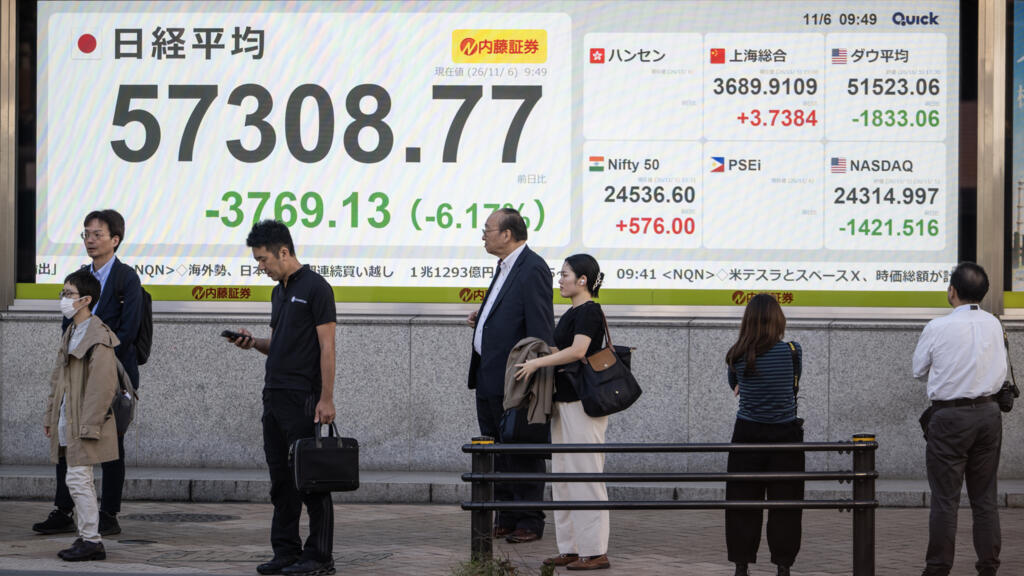
The downturn spread across Asian markets, hitting chipmakers and equipment suppliers. Japan’s Nikkei 225 fell 6% in early trading, South Korea’s Kospi dropped more than 8.5% and triggered a temporary trading halt, and Taiwan’s Taiex declined by over 8.3%. Shares in major companies including Kioxia, SK Hynix, Samsung and TSMC fell substantially. European and US semiconductor firms, including Infineon, ASML, Nvidia, AMD and Micron, also recorded large losses. The combined value of the so-called Magnificent Seven technology companies fell by about $1tn in a single trading day.
The election results gave Democrats control of both chambers of Congress for the remainder of President Donald Trump’s presidency. Many Democratic candidates had campaigned against the rapid expansion of data centres, with some proposing restrictions or a moratorium on new construction. Bernie Sanders called for a national data-centre moratorium, while Trump blamed the market decline on Democrats. The article notes that local concerns about data centres include their environmental effects, electricity costs and impact on communities.
Market analysts said tighter scrutiny of approvals could delay projects and increase costs, while the sell-off also reflected worries that AI stocks may be in a bubble. Technology leaders Greg Brockman of OpenAI and Dina Powell McCormick of Meta acknowledged that the industry needs to engage communities more effectively and make a stronger case for AI. The article presents the losses as the result of both political uncertainty over AI infrastructure and broader doubts about the profitability of AI investment.
Entities: Artificial intelligence (AI), US midterm elections, Nasdaq Composite, Democratic Party, Donald Trump • Tone: analytical • Sentiment: negative • Intent: analyze
06-11-2026
Asian technology stocks fell sharply Friday after a steep overnight sell-off on Wall Street, as investors questioned the sustainability of artificial intelligence investment and the returns from massive data-center spending. South Korea saw heavy losses: SK Hynix dropped more than 8%, Samsung Electronics fell 7%, and LG Innotek and LG Display also declined. Japanese semiconductor and technology companies were hit, including Advantest, Tokyo Electron, Kioxia Holdings, Renesas Electronics, and SoftBank Group. In Taiwan, TSMC, Foxconn parent Hon Hai Precision Industry, and Foxconn Technology fell sharply. Chinese technology shares also weakened, with the STAR Market and ChiNext Artificial Intelligence Index each losing more than 4%.
The declines followed a 5.5% drop in the Nasdaq Composite, which closed more than 10% below its recent peak and entered correction territory. The Philadelphia Semiconductor Index fell 12.2%. Investor concerns included the possibility that Democrats’ sweeping victory in U.S. midterm elections could bring tighter restrictions on data-center development, slowing demand for AI chips and related infrastructure.
Timothy Moe, Goldman Sachs’ chief Asia Pacific equity strategist, said that position unwinding, stop-loss selling, and heightened volatility had intensified the Asian sell-off. He also noted that political opposition to U.S. data-center construction could affect demand and profits for Asian AI hardware suppliers. Moe characterized the market response as reacting rapidly before fully assessing the implications, amid uncertainty about the pace and scale of U.S. data-center construction.
Entities: SK Hynix, Samsung Electronics, SoftBank Group, TSMC, Foxconn (Hon Hai Precision Industry) • Tone: analytical • Sentiment: negative • Intent: inform
06-11-2026
Tesla and SpaceX lost a combined $456 billion in market value by Thursday’s close, following sharp share-price declines after the 2026 U.S. midterm elections. Tesla shares fell about 11% and SpaceX shares about 9% Thursday afternoon, amid a broader technology sell-off and investor concerns that the companies could face new congressional investigations and tighter regulation. The article says their losses since Tuesday’s close had already exceeded $420 billion earlier in the day.
The election results were unfavorable to Elon Musk, who contributed more than $470 million to Republican candidates and causes, yet saw most candidates he backed lose. Democrats took control of both the House and Senate. In Texas, where Tesla and SpaceX are headquartered, Democratic candidates James Talarico and Gina Hinojosa defeated Musk allies Ken Paxton and Greg Abbott. Musk’s fortune, which exceeded $1 trillion after SpaceX’s June initial public offering, fell below $800 billion; Forbes estimated he had lost about $90 billion in the past week, though he remained the world’s richest person.
Analysts at Deutsche Bank said SpaceX could encounter additional headwinds. They highlighted Hinojosa’s campaign focus on data centers, including calls for a pause on new approvals until stronger safeguards address water use, electricity costs, local control, and incentives. Tesla and SpaceX are expanding AI infrastructure in Texas and plan to build Terafab, a major data-center and semiconductor-factory complex in Grimes County. SpaceX also plans a supercomputer at its Starbase facility. Tighter rules could delay these projects and raise capital costs.
The article also notes potential scrutiny of SpaceX’s restrictions on a military version of Starlink in Ukraine, which reportedly hampered the country’s defense against Russian attacks. Musk and SpaceX have been told to preserve related records. Finally, regulatory scrutiny could complicate Musk’s proposed SpaceX-Tesla merger, which would also require shareholder approval.
Entities: Elon Musk, Tesla, SpaceX, 2026 U.S. midterm elections, Democratic Party control of the House and Senate • Tone: analytical • Sentiment: negative • Intent: inform
06-11-2026
Asian technology shares plunged on Friday after a Wall Street sell-off, as investors worried that the Democrats’ victory in the US midterm elections could lead to tighter rules for artificial intelligence and slower data-centre development. Seoul and Tokyo suffered especially steep losses, while markets in Taipei, Hong Kong, Shanghai, Sydney and Singapore also fell. The declines followed a dramatic rally in technology stocks earlier in the year and came amid growing questions about whether companies’ enormous investments in AI will generate adequate returns.
Opposition to data centres has emerged among voters across the political spectrum, and many candidates who won in the midterms had pledged to constrain the projects. Investors were also unsettled by Senator Bernie Sanders’s call for a national moratorium on data-centre construction. Higher borrowing costs and elevated company valuations added to concerns. Analysts cited political uncertainty, including the possibility that Texas politicians might target Elon Musk’s Tesla and SpaceX because of his support for Donald Trump.
The Nasdaq fell 5.5 percent, its worst percentage decline since April of the previous year, while the S&P 500 lost more than four percent and the Dow fell more than three percent. The Philadelphia Semiconductor Index was down about 16 percent for the week. In Asia, South Korea’s Kospi dropped sharply, with SK hynix and Samsung among the major decliners; Tokyo-listed technology companies and Taiwan Semiconductor Manufacturing Company also recorded large losses. The report notes that the Kospi had more than doubled from the end of December to a June record, before subsequently losing nearly half its value.
Trump blamed the US market collapse on Democrats in a post on Truth Social. Market commentators described the sell-off as severe and potentially overdone, while warning that investors would first need to see signs of stability. Oil prices also rose again, reversing some of their post-election decline. Traders were watching developments in the US-Iran crisis and awaiting US jobs data later that day.
Entities: Donald Trump, Bernie Sanders, Michael Hewson, Neil Wilson, MCH Market Insights • Tone: analytical • Sentiment: negative • Intent: inform
06-11-2026
The article describes the political risks facing wealthy technology executives after Democrats’ strong performance in the US midterm elections. It says leading tech billionaires, including Elon Musk, had supported Donald Trump and sought policies favorable to artificial intelligence and business, including fewer regulations and safeguards. Their political influence had appeared substantial: executives donated to Trump-aligned causes, cultivated public relationships with him, and gained opportunities to promote their preferred vision for AI.
The election results, however, have changed the political environment. According to the article’s introductory summary, Democratic candidates campaigned against technology elites, data centres and concerns that AI could threaten jobs. Some victorious Democrats pledged to confront billionaires and large corporations. The article suggests this shift could make technology companies’ plans harder to pursue, potentially slowing AI and data-centre development, weighing on technology stocks, and exposing companies or executives to subpoenas or investigations. It also notes that a proposed California billionaire tax is unlikely to succeed.
The excerpt’s reported scene from September illustrates the access tech leaders had enjoyed: Trump hosted an AI-focused White House luncheon attended by Nvidia’s Jensen Huang, Tesla and SpaceX’s Elon Musk, Meta’s Mark Zuckerberg and other wealthy executives. They used such access to advocate for an AI future with fewer regulations or guardrails. The article says this relationship-building was accompanied by donations, public praise and gifts; it also mentions Amazon’s promotion of a film about Melania Trump.
The material provided ends after this introductory account and does not include the article’s further reporting or the sources behind its assessments. Accordingly, the possible consequences are presented as the article’s stated outlook, not as confirmed outcomes.
Entities: Donald Trump, Elon Musk, Jensen Huang, Mark Zuckerberg, The Straits Times • Tone: analytical • Sentiment: negative • Intent: analyze
06-11-2026
After Democrats made major gains in the 2026 US midterm elections and took control of both chambers of Congress, Elon Musk deleted several posts on X that had urged voters to support Republican candidates. One removed post, pinned on October 29, called for electing Republican senators; another said, “Vote red today!” The deletion reportedly coincided with Democrat James Talarico’s victory over Republican Ken Paxton in the Texas Senate race. Musk’s chatbot Grok confirmed that the posts had been removed after Republicans suffered major losses.
Musk later commented on the results with jokes and sarcastic remarks, including a reference to “election-interfering space lasers,” and said “Voter ID failed in California” after a ballot measure requiring voter identification was defeated. He then returned to posting about his technology companies, including Starlink and Grok.
The article says Musk spent at least $458 million on Republican-aligned causes during the election cycle, including about $216 million through his super PAC, America PAC. His support funded voter-turnout operations, ground campaigning and digital advertising, with contributions directed toward the Texas Senate race and contests in several other states. FEC data cited in the report put his overall spending at around $474 million, while The New York Times estimated that he spent about $224 million in Texas alone. Of 106 House and Senate candidates backed by Musk, 19 had won, 47 had lost and 40 races remained uncalled as of Wednesday around noon EST.
The election results also coincided with declines in the value of Musk’s companies and personal fortune. Forbes estimated his net worth at $878 billion after a reported $23.7 billion drop that morning. Tesla shares fell 3.3% and SpaceX shares 3.8%; Bloomberg reported that the declines erased more than $120 billion in value. The article also notes Musk’s approximately $291 million in political spending during the 2024 election cycle, according to OpenSecrets.
Entities: Elon Musk, 2026 US midterm elections, Democratic control of Congress, James Talarico, Ken Paxton • Tone: analytical • Sentiment: neutral • Intent: inform
06-11-2026
CNBC’s Jim Cramer says the sell-off in artificial intelligence stocks may continue, but he does not see it as a repeat of the dot-com crash. He attributes the recent declines to growing opposition to new data centers after the midterm elections, which has raised doubts about whether the rapid pace of AI infrastructure investment can continue. On Thursday, Micron fell 17%, GE Vernova dropped 7%, and Sandisk plunged 22%, following steep losses the previous day.
Cramer said many technology and semiconductor stocks had risen too far on expectations that data-center construction would keep accelerating. Although he sees little chart-based support for some of those shares, he considers the decline orderly because many of today’s hardest-hit businesses are profitable, unlike many speculative companies that failed during the dot-com bust.
He is especially concerned about smaller data-center developers, including CoreWeave, Iren, and Nebius. These companies borrowed to fund projects that could be delayed by regulatory opposition. Cramer noted that significant companies are not currently defaulting on debt and said the debt exposure of these “neocloud” firms alone is not enough to sink the market, though he identified it as a key risk.
Cramer said a rapid correction could clear excesses from the AI boom more effectively than a slow, drawn-out decline. He advised investors to keep sufficient cash so they can avoid panic while remaining alert to further losses. He also cited falling interest rates, signs of easing inflation, and the possibility of an end to the Iran war as potential positives. His overall message was cautious: the market may have further to fall, but investors should stay clear-headed and avoid treating the downturn as another dot-com collapse.
Entities: Jim Cramer, CNBC, Mad Money, artificial intelligence (AI) stocks, AI infrastructure spending • Tone: analytical • Sentiment: negative • Intent: analyze
06-11-2026
Asian markets fell sharply on Friday after a major selloff in US technology stocks, with companies linked to artificial intelligence infrastructure suffering some of the steepest losses. Japan’s Nikkei 225 dropped 5.5% in early trading, South Korea’s Kospi fell as much as 8.8% and triggered a 20-minute trading halt, and Taiwan’s TAIEX declined more than 8%. Among affected companies, Samsung Electronics fell nearly 10%, SK Hynix lost more than 11%, and Japanese chip-related shares such as Tokyo Electron and Kioxia also slumped. European stock futures were down about 1%, suggesting the decline could spread beyond Asia.
The Asian selloff followed Thursday’s steep declines on Wall Street. The Nasdaq fell 5.52%, wiping as much as $2.5 trillion from its market value, while the S&P 500 dropped 4.4%. The article attributes investors’ anxiety to the enormous sums being committed to AI development and infrastructure, particularly data centers, and uncertainty about whether that spending will ultimately generate profits comparable to its scale.
Political developments in the United States added to market concerns. Following the midterm elections, Democrats took control of both chambers of Congress, and some Democratic governors-elect had campaigned on slowing AI development or halting data-center construction amid local opposition. Michael McCarthy, a brokerage executive, described a marked shift in investor sentiment and said the scale of market swings can accompany turning points. His remarks underscored the possibility that investors see the selloff as part of a broader change in direction, rather than an isolated decline.
Entities: Nikkei 225, Kospi, TAIEX, Samsung Electronics, SK Hynix • Tone: analytical • Sentiment: negative • Intent: inform