06-10-2026
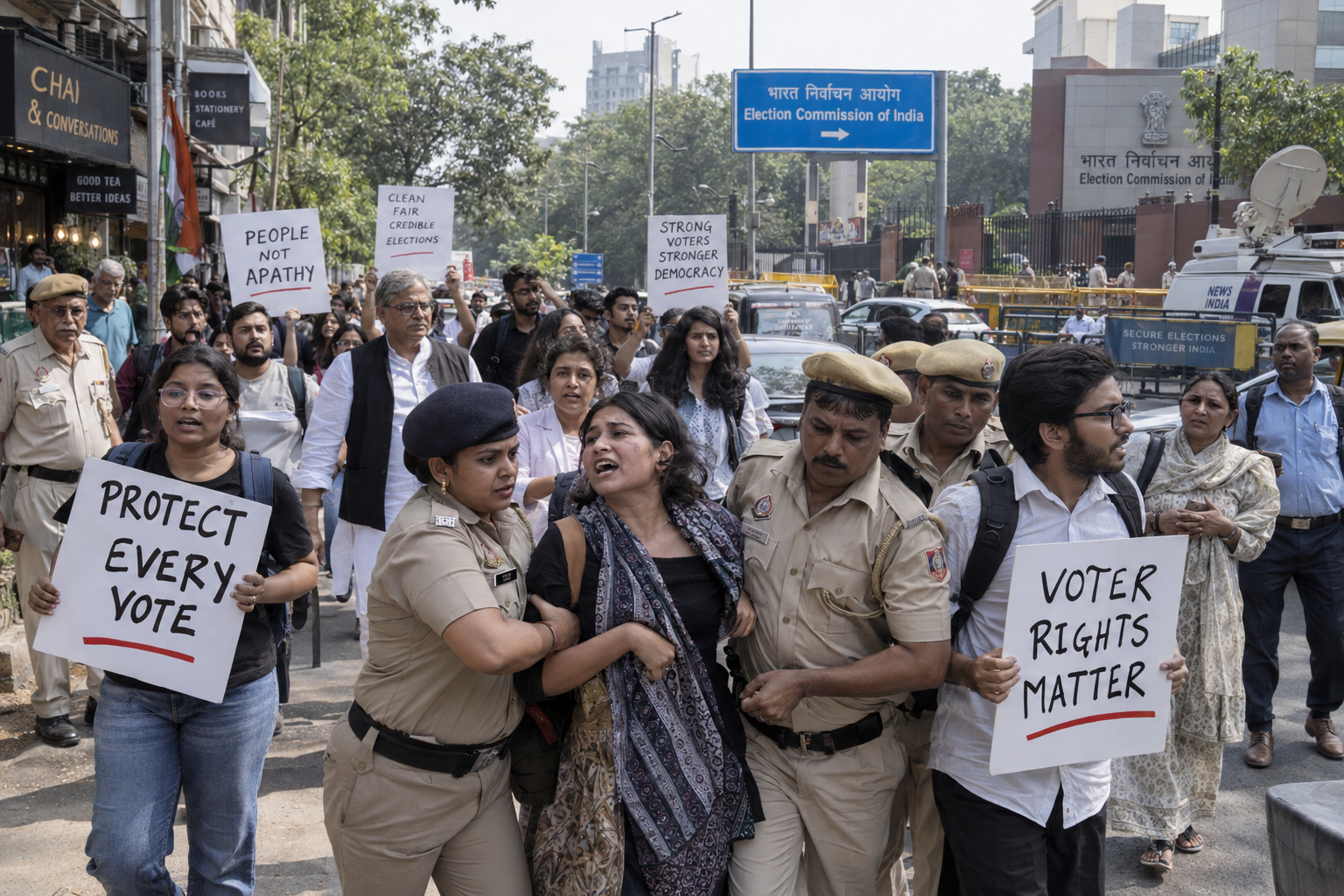
Several opposition legislators, including Congress leader Rahul Gandhi, were briefly detained in New Delhi on October 6 after attempting to breach police barricades during a march to the Election Commission headquarters. They were protesting a revision of voter lists and demanding the resignation of Chief Election Commissioner Gyanesh Kumar. Gandhi was released soon after his detention, according to news agencies and local media.
The march, which covered about one kilometre from parliament to the commission’s headquarters, is part of a series of near-daily demonstrations that began the previous week. Student groups, opposition parties and the youth movement known as “Cockroach” have joined the protests. They accuse the Election Commission of manipulating voter registrations to benefit Prime Minister Narendra Modi’s Bharatiya Janata Party (BJP). Congress President Mallikarjun Kharge called the commission a “puppet” of the government. BJP spokesperson Sambit Patra countered that Congress leaders were trying to create anarchy and attack institutions.
The dispute concerns the Special Intensive Revision of voter lists, first undertaken in Bihar ahead of state elections and subsequently expanded to most Indian states and federally administered territories. Critics say the process demands documents that are confusing and difficult to obtain, potentially excluding millions of eligible voters. Election Commission data indicates that voter rolls could shrink by as much as 30 percent in some regions.
The commission says the revision is intended to remove duplicate, deceased or otherwise ineligible entries and protect electoral integrity. On the Friday before the protest, it instructed officials to register eligible voters who had been inadvertently left off the rolls. The article presents the competing claims and the scale of concern around the revision, without resolving whether the process has been manipulated.
Entities: Rahul Gandhi, Gyanesh Kumar, Mallikarjun Kharge, Sambit Patra, New Delhi • Tone: neutral • Sentiment: neutral • Intent: inform
06-10-2026
Police in Delhi detained several opposition lawmakers on Tuesday as they marched toward the Election Commission headquarters, calling for Chief Election Commissioner Gyanesh Kumar to resign over a controversial revision of India’s voter rolls. Rahul Gandhi, Priyanka Gandhi and other MPs were taken away in police buses, then released; they resumed their march and began a sit-in near the commission’s office. The opposition said 237 MPs from several parties took part, while police did not provide a detention count.
The protest is part of a widening dispute over the Election Commission’s Special Intensive Revision (SIR) of electoral rolls. The commission says the exercise is intended to remove duplicate and ineligible voters. More than 130 million names have been removed from draft lists so far. Opposition parties and activists say eligible voters have also been wrongly excluded and allege the process could benefit Prime Minister Narendra Modi’s Bharatiya Janata Party (BJP), which, along with the commission, rejects that accusation.
Calls for Kumar’s resignation intensified after an Indian Express investigation reported that the two other election commissioners, Sukhbir Singh Sandhu and Vivek Joshi, had objected at least 14 times over 10 months to decisions issued in the commission’s name without their knowledge. The reported concerns included voter-roll changes, access to the voter database and data security. The commission said differing views are part of institutional functioning and that decisions were ultimately unanimous.
Congress president Mallikarjun Kharge called for Kumar’s resignation, cancellation of the SIR and a return to paper ballots. The BJP condemned the march, with MP Sambit Patra calling it a “sponsored attempt” to change power through “anarchy.” The dispute is also before the Supreme Court, which has asked the federal government and Election Commission to respond to a petition alleging Kumar acted without the other commissioners’ approval. The court did not suspend him, saying it would first review the response and relevant records.
Entities: Gyanesh Kumar, Rahul Gandhi, Priyanka Gandhi, Mallikarjun Kharge, Sukhbir Singh Sandhu • Tone: analytical • Sentiment: neutral • Intent: inform
06-10-2026
France 24 reports that opposition parties staged protests in New Delhi on Tuesday, October 6, 2026, calling for India’s election chief to resign. The demand is linked to a contentious revision of voter lists, although the brief report does not explain what changes were made, why they are disputed, or how the election chief has responded. Hundreds of police personnel were deployed across the heart of the capital during the demonstration.
The protest is described as the latest in a series of near-daily demonstrations that began the previous week. Those taking part in the broader wave of protests have included student groups, opposition parties and a youth movement identified in the article as India’s “Cockroach” youth movement. The report does not provide further details about the movement, the protests’ size beyond the police deployment, or whether there were arrests, injuries or clashes.
The supplied article is a short video-page description rather than a full account: it contains no interviews, detailed explanation of the voter-list revision, or additional context about the political dispute. Accordingly, the report establishes the central event and its immediate setting—the opposition’s demand for the election chief’s resignation, the contested voter-list changes, and a substantial police presence—but does not give enough information to assess the claims behind the controversy or the demonstrations’ outcome.
Entities: India, New Delhi, Indian opposition parties, India’s election chief, Voter-list revision • Tone: neutral • Sentiment: neutral • Intent: inform
06-10-2026
Protests have spread across India over a nationwide voter-list revision known as the Special Intensive Revision (SIR). Opposition parties, civil society groups, and the youth movement called “Cockroach” are demanding the resignation of Chief Election Commissioner Gyanesh Kumar and a halt to the process. The movement previously helped organize protests that led to the education minister’s resignation in July.
The Election Commission says the revision is intended to remove duplicate and ineligible registrations and ensure that eligible voters remain on the rolls. Critics argue that document requirements are confusing and difficult to meet, especially for poorer and otherwise vulnerable people who may lack older government records. They warn that eligible voters could be wrongly removed and that the changes could favor Prime Minister Narendra Modi’s Bharatiya Janata Party (BJP). The government and commission deny wrongdoing and say the process has no political motive; the BJP describes it as a way to remove “infiltrators.”
The dispute has sharpened after a revision in West Bengal removed about 9 million names—roughly 12% of the electorate—and left millions of eligible voters unable to cast ballots. Modi’s party won the state for the first time. Separately, a newspaper reported that two of the three election commissioners objected to decisions involving revisions, registration procedures, and digital systems. The commission characterized the reported differences as deliberations rather than formal objections.
Protesters seek an inquiry into Kumar, restoration of earlier voter lists for future elections, and a more independent and transparent process for appointing election commissioners. Commission data suggesting voter rolls could shrink by as much as 30% in some regions has heightened concerns. The dispute is expected to intensify as the revision expands and state elections approach early next year.
Entities: India, Special Intensive Revision (SIR), Election Commission of India, Gyanesh Kumar, Narendra Modi • Tone: analytical • Sentiment: neutral • Intent: inform