07-10-2026
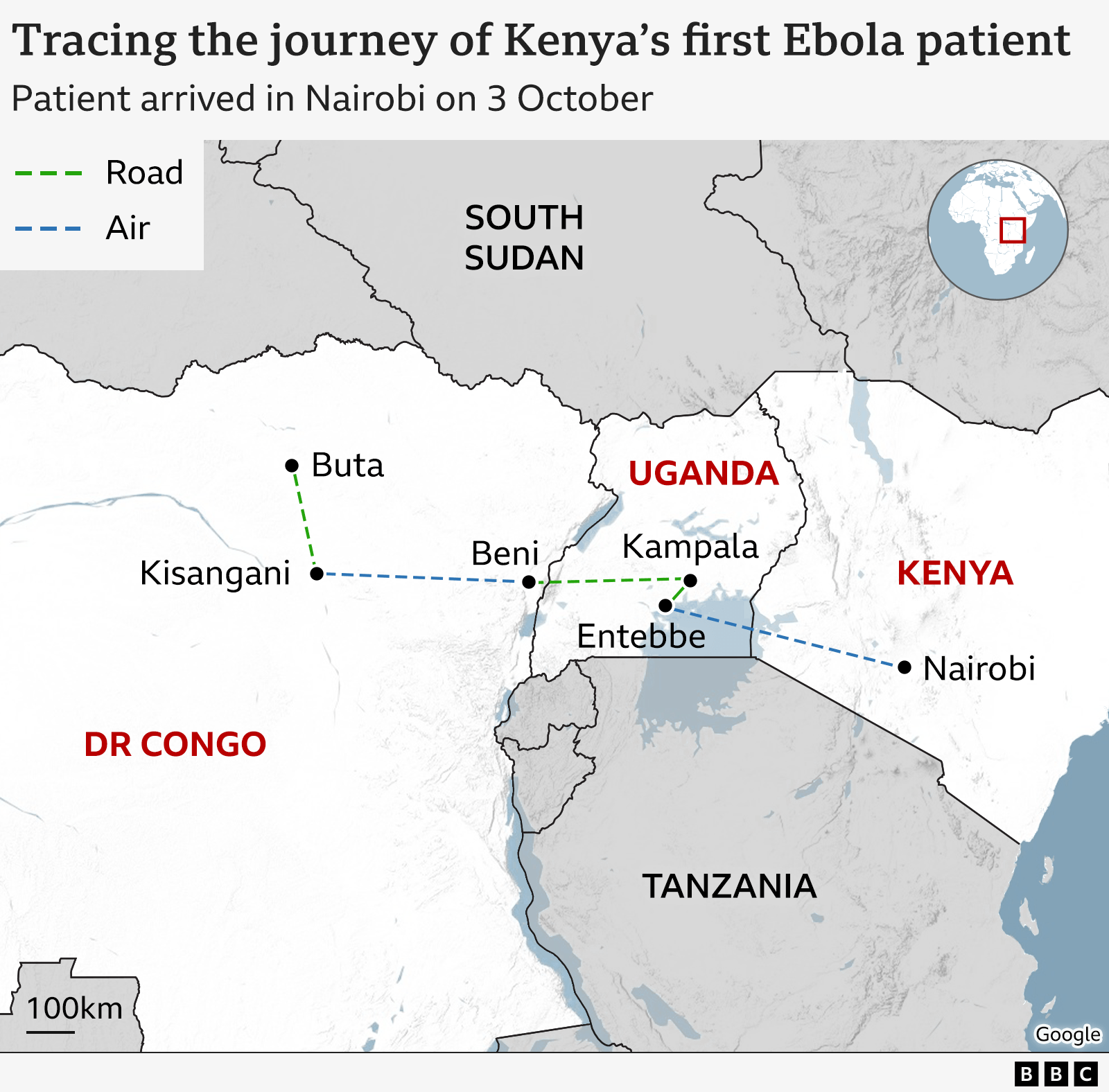
Nairobi residents expressed fear and uncertainty after Kenya announced its first-ever Ebola death. The man, a Kenyan citizen described as a 40-year-old businessman, had recently returned from the Democratic Republic of Congo (DRC), where a new Ebola outbreak was declared in May. According to Health Minister Aden Duale, the man had fallen ill about a month earlier and received treatment in the DRC. He travelled overland to Kampala, Uganda, then flew to Nairobi on October 3. He was treated in Nairobi and died on Monday; the announcement came on Tuesday.
Residents interviewed on Wednesday voiced concern about the possibility that the deceased had exposed others, and about Kenya’s preparedness. Crisps Kinyua, a nonprofit director, said people did not know how many contacts the man had had and questioned how the situation might develop. Bodyguard Edwin Orwa described being shocked, noting that Ebola is widely known as a deadly disease. Kenyan authorities have identified 28 contacts, including relatives and healthcare workers. None had tested positive at the time of the report.
The health minister urged the public to remain calm and vigilant, saying measures were in place to limit transmission. The article places the case in the context of the DRC outbreak: as of October 2, the World Health Organization had recorded 8,463 cases and 4,082 deaths associated with the Bundibugyo strain. The report says there was no vaccine or specific treatment for that strain. It also notes that the outbreak had produced more than 8,000 cases and that Ebola has killed over 15,000 people in Africa in the past 50 years. Kenya had not previously reported an Ebola case.
Entities: Aden Duale, Crisps Kinyua, Edwin Orwa, Nairobi, Kenya • Tone: neutral • Sentiment: negative • Intent: inform
07-10-2026
Kenya’s Cabinet Secretary for Health, Aden Duale, said the country is not experiencing an Ebola outbreak, describing the situation instead as an Ebola incident following the country’s first confirmed case and death from the disease. Duale said authorities could account for the patient’s journey through several locations before the patient reached a hospital in Nairobi. Part of the route in his quoted remarks is unintelligible in the source text.
Health officials have expanded efforts to identify and monitor people who may have had contact with the victim. The initial list of 55 contacts has grown to 57. Duale said ten contacts had been located and placed in a quarantine facility at the National Police Service Hospital in Nairobi, where they were receiving daily symptom monitoring. Authorities were intensifying efforts to find the remaining contacts.
The minister’s remarks came a day after the first confirmed case was reported: a Kenyan citizen who had been living in the Democratic Republic of the Congo. The article also notes that an Ebola outbreak had been declared in the DRC in May, after the disease had spread for months in an isolated area of eastern Congo. The report distinguishes Kenya’s confirmed case and contact-tracing response from an officially declared national outbreak, while describing ongoing monitoring and efforts to locate potentially exposed people.
Entities: Aden Duale, Kenya, Democratic Republic of the Congo (DRC), Kisangani, Beni • Tone: neutral • Sentiment: negative • Intent: inform
07-10-2026
Kenya’s medical professionals’ union has urged the government to strengthen protections for healthcare workers following the country’s first reported Ebola case and death. The Kenya Medical Practitioners, Pharmacists and Dentists Union said health workers should be a priority in the response, with secretary-general Dr. Divji Atellah calling for urgent, transparent and responsible action. The union also asked that medical staff exposed to the patient receive immediate monitoring, psychological support and appropriate follow-up, and called for rigorous contact tracing and well-prepared health facilities.
Health Minister Aden Duale said the deceased was a 40-year-old Kenyan businessman who had contracted Ebola while living in the Democratic Republic of Congo. After becoming ill about a month earlier and receiving treatment in the DRC, he travelled overland to Kampala, Uganda, then flew to Nairobi on October 3. He was treated in Kenya and died on Monday evening.
Authorities have identified 28 contacts, including relatives and healthcare workers, and none had tested positive at the time of the report. Officials were also trying to locate 23 passengers and four crew members from the flight; they said quarantine arrangements for people considered at risk were ready.
Kenya had not previously recorded an Ebola case. Neighbouring Uganda reported 20 cases, mostly among people who had travelled from the DRC, and two deaths before being declared Ebola-free in August. The World Health Organization reported 4,082 deaths among 8,463 cases linked to the Bundibugyo strain in the DRC as of October 2. The article notes that no vaccine or specific treatment for this strain was available.
Entities: Kenya, Kenya Medical Practitioners, Pharmacists and Dentists Union, Dr. Divji Atellah, Aden Duale, Democratic Republic of Congo • Tone: urgent • Sentiment: negative • Intent: inform
07-10-2026
Kenya has reported its first-ever Ebola case after a man who had travelled from the Democratic Republic of Congo (DRC) died in a Nairobi hospital. Ten people who had contact with him have been quarantined, and officials are tracing 57 more. The patient had been sick for about a month while travelling through several cities in the DRC, Uganda and Kenya, yet was not identified by screening systems. Africa CDC chief Jean Kaseya questioned how he had passed through these locations undetected. Kenya’s health ministry suggested medication may have masked his symptoms, while Ugandan officials said he had a normal temperature when he departed after transiting through the country for less than 24 hours.
The article describes growing concern about screening at airports and border crossings. A Kenyan doctors’ union representative said lapses had occurred at multiple border points and the country’s main airport. He also warned that screening based largely on temperature checks is limited: there is no rapid Ebola diagnostic testing at border points, and medication can suppress fever. Stigma and inadequate health education may also discourage travellers from disclosing symptoms.
Kenyan authorities say surveillance has been intensified and that rapid-response teams are operating. The government says more than 650,000 travellers have been screened and 267 samples tested; four hospitals have been designated to manage Ebola patients. President William Ruto said the response builds on systems established after the DRC outbreak began in May. The government is also considering repurposing a proposed Ebola treatment facility in Nanyuki as a regional infectious-disease hospital, although the original US-backed plan was halted by court action amid public concern.
The outbreak in the DRC is caused by the relatively rare Bundibugyo species, for which there is no approved vaccine or treatment, although trials are under way. More than 4,000 people have died in the DRC this year, and cases were also reported in Uganda before the WHO declared that country Ebola-free in August. Kaseya said Kenya was prepared to receive the case but stressed that regional cooperation is essential to contain the outbreak.
Entities: Kenya, Nairobi, Democratic Republic of Congo, Uganda, Buta • Tone: analytical • Sentiment: negative • Intent: inform
07-10-2026
Kenya’s first reported Ebola patient died two days after arriving at Nairobi airport, where relatives took him to hospital. He had already shown symptoms including fever, chills, muscle pain and bleeding beneath the skin. The Kenyan national had travelled from Beni, in northeastern Democratic Republic of Congo (DRC), through Uganda’s capital, Kampala, before flying to Kenya. His journey raised questions about how he passed a border officially closed to limit Ebola’s spread, airport temperature checks, and digital health declarations in both Entebbe and Nairobi.
Health experts and officials told Reuters that the case exposed weaknesses in screening systems that rely on proper implementation and travellers’ truthful disclosure. Uganda acknowledged that its porous border could not be made completely secure, while its government spokesperson rejected blame, saying Uganda had no Ebola cases. Ugandan officials are seeking the traveller’s Entebbe health form and reviewing airport footage. Kenyan authorities said he may have taken medication that masked symptoms during screening. Kenya reported identifying 57 contacts, with 10 quarantined, and established a dedicated screening gate at Nairobi’s Jomo Kenyatta International Airport.
Experts also described the limits of airport screening. Early Ebola symptoms can be difficult to recognize, fever-reducing medication such as paracetamol can affect temperature readings, and infrared thermometers measure surface rather than core body temperature. Health declarations and visual checks are also vulnerable if travellers do not report symptoms. A representative of Prosper Global described airport screening in Kinshasa and Nairobi as brief, involving an online form, QR code and temperature check, with no subsequent follow-up contact.
The article places the case amid the DRC’s worst Ebola outbreak on record, which has infected more than 8,000 people and killed more than 4,000. The outbreak is caused by the Bundibugyo species, for which no known treatment or vaccine is available.
Entities: Kenya, Democratic Republic of Congo (DRC), Uganda, Nairobi, Beni • Tone: analytical • Sentiment: neutral • Intent: analyze