09-09-2026
Gambian President Adama Barrow has promised a significant improvement in electricity supplies by the end of October 2026 after violent protests over prolonged blackouts. The outages, which have affected the country since June, have lasted as long as 48 hours in some areas during an exceptionally hot season, disrupting households and intensifying public frustration.
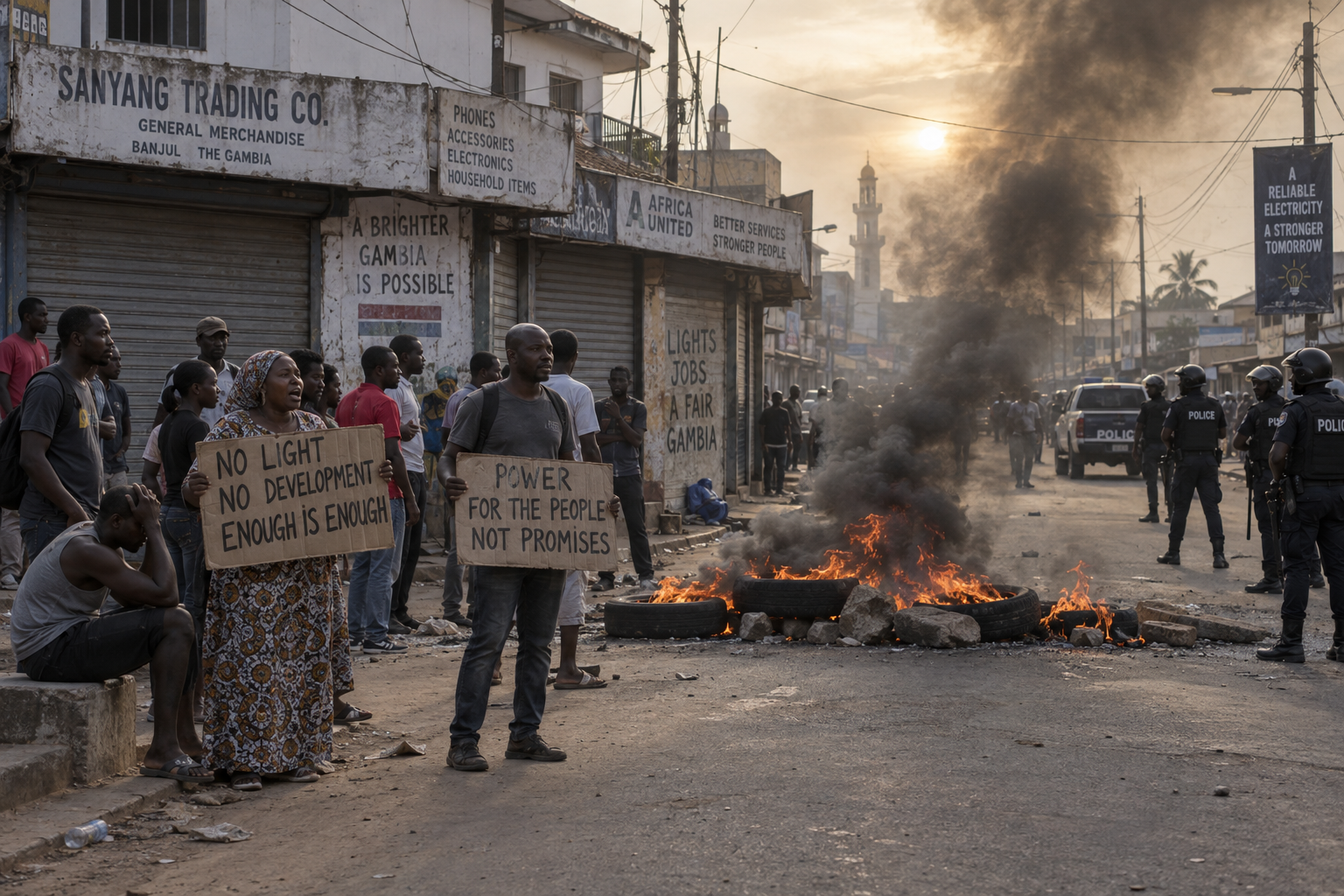
Demonstrators in Banjul and nearby cities set fires, blocked traffic and chanted “Barrow must go!” Police used tear gas in the Westfield district as protesters moved toward the headquarters of the National Water and Electricity Corporation (NAWEC), the country’s energy provider. The unrest represents a sharp escalation from earlier electricity protests and comes only months before December elections, in which Barrow is seeking a third presidential term.
During a visit to NAWEC facilities in Brikama and Kotu, two areas heavily affected by the outages and protests, Barrow described the crisis as both a national security issue and an emergency. He acknowledged the effect on ordinary people, including children studying in darkness, spoiled food and extreme heat. He said the government was completing installation of an additional 24-megawatt generation machine, which is expected to be commissioned by the end of October. He also announced that a contract had been awarded for a 50-megawatt solar power plant in Soma.
NAWEC previously attributed the outages to increased demand caused by high temperatures and constraints on electricity imports. Managing director Gallo Saidy additionally cited climate change and the war in the Middle East, while asking the public to remain patient. Information Minister Ismaila Ceesay said the government was treating the situation with urgency and working continuously to resolve it.
Entities: Adama Barrow, The Gambia, Banjul, Westfield district, Brikama • Tone: urgent • Sentiment: negative • Intent: inform
09-09-2026
Gambia is facing a worsening electricity crisis that has triggered public protests and growing frustration among residents and businesses. Persistent power outages began in June and have become longer and more frequent, with authorities attributing the disruption to increased demand caused by high temperatures, climate change, and supply-chain problems linked to the war in Iran.
Residents of Banjul and nearby areas blocked roads and burned tyres overnight, while some protesters called for President Adama Barrow to resign. The outages are having a particularly severe impact on small traders whose livelihoods depend on refrigeration. Fishmonger Nyima Sonko says the lack of electricity is causing fish to spoil and preventing the business from operating. Market trader Jula Jagne describes outages lasting six or seven hours, and sometimes an entire day, leaving vendors without the ice needed to preserve chicken meat. She says women across the country are exhausted by the situation.
President Barrow has appealed for calm and patience, describing the blackouts as both a national security issue and an emergency. The president, who is seeking re-election in December, has promised to increase electricity supply by the following month. His response comes amid mounting pressure from citizens who say the unreliable power supply is damaging businesses and undermining their ability to earn a living. The protests reflect broader anger over the government’s handling of the crisis, while the promised improvement in supply is intended to ease tensions and restore confidence.
Entities: Gambia, Adama Barrow, Banjul, Nyima Sonko, Jula Jagne • Tone: urgent • Sentiment: negative • Intent: inform
09-09-2026
Gambia is facing escalating protests over prolonged electricity outages, with demonstrators demanding that President Adama Barrow resign as he seeks a third term in December’s presidential election. On Monday and Tuesday, protesters burned tyres and erected barricades in Banjul and nearby cities, blocking traffic and gathering near Barrow’s residence and the headquarters of the National Water and Electricity Corporation (NAWEC), the country’s electricity provider. Police used tear gas to disperse the crowds.
The rolling blackouts have occurred during Gambia’s hot season and have lasted as long as 48 hours in some areas. Residents say the outages have made daily life increasingly difficult, leaving homes without fans, children unable to study comfortably, food spoiling and people struggling with intense heat. The protests turned violent as frustration grew over the continuing power crisis.
During a visit to a NAWEC power station, Barrow declared the outages an emergency and a “national security issue”. In a national address, he promised that the government would install a 24-megawatt generation machine by the end of October, saying energy supplies would improve by the following month. He also announced plans for an additional 50-megawatt solar power plant, whose construction is expected to begin soon.
NAWEC Managing Director Gallo attributed the prolonged cuts partly to climate change and the US-Israel war on Iran. In an August statement, the utility also cited an “unforeseen surge” in electricity demand caused by high temperatures. The government’s promises come amid growing public anger and significant political pressure ahead of the presidential election.
Entities: Adama Barrow, The Gambia, Banjul, Brusubi, National Water and Electricity Corporation (NAWEC) • Tone: urgent • Sentiment: negative • Intent: inform
09-09-2026
The Gambia is facing a worsening electricity crisis that has triggered protests in the capital, Banjul, and surrounding areas. Residents say power cuts have sometimes lasted as long as 48 hours, with outages becoming more frequent during the hot season as high temperatures increase demand. The country also relies on imported electricity from Guinea and Senegal, but reduced regional supplies and a technical problem affecting a major generating unit have contributed to the shortages.
Protests on Monday night saw demonstrators burn tyres and block roads while moving towards the headquarters of the national electricity company, Nawec. Police used tear gas to disperse crowds in the Westfield area. Protesters also gathered outside the vice-president’s residence in Farato, and banners at an office of President Adama Barrow’s National People’s Party were damaged. Some demonstrators called for Barrow to leave office.
In a televised address, Barrow urged citizens to remain calm and warned that damaging public infrastructure would worsen the crisis by diverting funds towards repairs. He acknowledged failures in government planning, power generation and maintenance, describing the blackouts as both a national security issue and an emergency. He promised that electricity supplies would improve by the end of October and said a new 24-megawatt generating unit at Brikama would be commissioned by the end of the following month. A contract has also been awarded for a 50-megawatt solar plant in Soma, while new generators are expected to arrive soon.
Nawec chief Gallo Saidy asked for patience, citing lower rainfall and reduced electricity imports. The unrest comes only months before a presidential election expected in December, in which Barrow is seeking a controversial third term.
Entities: Adama Barrow, The Gambia, Banjul, Westfield, Farato • Tone: analytical • Sentiment: negative • Intent: inform