11-09-2026
The article reports on somber commemorations in the United States marking the 25th anniversary of the September 11, 2001 attacks. It focuses primarily on families remembering relatives, friends, and other loved ones who were killed in the attacks. The article states that nearly 3,000 people died, underscoring the scale of the loss that continues to shape anniversary observances.
According to the report, remembrance events are taking place across the country as people honor those who died and reflect on the enduring impact of September 11. The brief item presents the anniversary as a national moment of mourning, with families at the center of the commemoration. Its emphasis is not on political debate or historical analysis, but on grief, remembrance, and public tribute.
Published on September 11, 2026, the report is framed as a news update and video feature about the day’s observances. The word “somber” establishes the emotional character of the commemorations, while the references to families, lost loved ones, and the nearly 3,000 fatalities convey the continuing human cost of the attacks. The article does not identify individual victims, describe specific ceremonies, or provide detailed accounts of the attacks. Instead, it gives a concise overview of how the United States is marking the milestone anniversary through events held nationwide.
Overall, the article informs readers about the 25th-anniversary commemorations and highlights the ongoing importance of honoring those who died on September 11, 2001. Its central message is that, a quarter-century later, families and communities continue to remember the victims through collective acts of mourning and tribute.
Entities: United States, September 11 attacks, September 11, 2001, 25th anniversary, Families of victims • Tone: emotional • Sentiment: negative • Intent: inform
11-09-2026
The article reports on commemorations across the United States marking the 25th anniversary of the September 11, 2001, terrorist attacks, which killed 2,977 people. Ceremonies are being held at the former World Trade Center site in New York City, the Pentagon in Washington, D.C., and the Flight 93 National Memorial in Shanksville, Pennsylvania. In New York, relatives are reading the names of those killed in 2001, along with the victims of the 1993 al-Qaeda bombing at the World Trade Center. The ceremony also recognizes more than 600 firefighters who later died from illnesses linked to toxic air and dust at the site. President Donald Trump addressed a Pentagon ceremony, connecting the memory of 9/11 to the United States’ ongoing conflict with Iran. The article also describes messages of solidarity from the European Union and NATO, noting that NATO invoked its collective-defense Article 5 for the first and only time after the attacks.
Beyond the commemorations, the article examines 9/11’s enduring effects on the United States and the world. The attacks prompted the “War on Terror,” the U.S. wars in Afghanistan and Iraq, expanded government surveillance, stricter airport security, and the creation of the Department of Homeland Security. The article criticizes the use of extraordinary rendition, enhanced interrogation, and indefinite detention at Guantanamo Bay, arguing that these policies damaged America’s international reputation and weakened the solidarity it initially received after the attacks. It also discusses the attacks’ impact on attitudes toward Muslims and controversy surrounding New York Mayor Zoran Mamdani’s participation in the ceremony. Mamdani recently released documents concerning officials’ failure to warn residents and cleanup workers about toxic conditions at Ground Zero. A federal medical monitoring program attributes at least 9,400 additional deaths to exposure to dust, rubble, smoke, and other hazardous materials.
Entities: September 11, 2001, terrorist attacks, al-Qaeda, Donald Trump, Zoran Mamdani, World Trade Center • Tone: analytical • Sentiment: negative • Intent: analyze
11-09-2026
The article reports on US commemorations marking the 25th anniversary of the September 11, 2001, terrorist attacks. Ceremonies took place across the country, including a solemn gathering at New York’s Ground Zero where victims’ relatives read the names of those killed, paid tribute to first responders and called for national unity. The attacks, carried out by al-Qaeda hijackers who seized four commercial aircraft, killed nearly 3,000 people at the World Trade Center, the Pentagon and near Shanksville, Pennsylvania.
President Donald Trump attended the Pentagon ceremony rather than the main New York observance. His decision drew criticism from some victims’ relatives, particularly after he connected the post-9/11 “war on terror” to the current war in Iran. In remarks at the ceremony, Trump pledged that the US would never forget the victims.
The article also examines the attacks’ enduring effects on American society. They reshaped air travel, led to the creation of the Department of Homeland Security, expanded federal surveillance and intelligence-gathering powers, and prompted new banking regulations. The attacks also intensified public debates over the balance between national security and individual freedom, while encouraging a culture of vigilance and increased patriotism.
A further legacy has been increased mistrust, prejudice and hate crimes against Muslim Americans. New York City Mayor Zohran Mamdani, the city’s first Muslim mayor, attended the Ground Zero ceremony despite a petition signed by more than 100,000 people urging him to stay away. Critics, including supporters of former Mayor Rudy Giuliani, questioned Mamdani’s alleged associations with people viewed as hostile to US institutions or sympathetic to extremist ideologies. Mamdani has also received praise for releasing documents about official knowledge of toxic air after the attacks, which has been linked to cancers among thousands of New Yorkers.
Entities: September 11, 2001 attacks (9/11), United States, New York City and Ground Zero, World Trade Center, The Pentagon • Tone: analytical • Sentiment: negative • Intent: inform
11-09-2026
France 24 reports that New York City has initiated a “massive” security operation ahead of the 25th anniversary of the September 11, 2001 terrorist attacks. City officials say the heightened measures are intended to protect a major commemorative gathering at Ground Zero, where former US presidents and other dignitaries are expected to attend. The anniversary marks a quarter-century since the attacks, which killed thousands of people and profoundly changed the United States and the wider world.
The report focuses on the security preparations surrounding the public ceremony rather than providing operational details about the measures in place. Its wording emphasizes both the scale of the response and the continued importance of the anniversary in American public life. The gathering is expected to bring together prominent political figures and other officials at the site of the former World Trade Center, making it a significant security challenge and a highly visible national event.
The article is brief and presented as a 1 minute 34 second video report. It does not identify specific threats, numbers of personnel, restricted areas, or particular security agencies involved. Instead, it conveys the general message that authorities are treating the commemoration as a major security event because of its symbolic importance, the attendance of high-profile figures, and the large public interest surrounding the anniversary.
Overall, the report is informational and restrained, while its use of the word “massive” and its reference to the attacks having changed the United States and the world give it a serious and urgent tone. The focus is on preparations for remembrance and public safety as New York commemorates 25 years since 9/11.
Entities: New York City, Ground Zero, United States, France 24, September 11 attacks • Tone: urgent • Sentiment: neutral • Intent: inform
11-09-2026
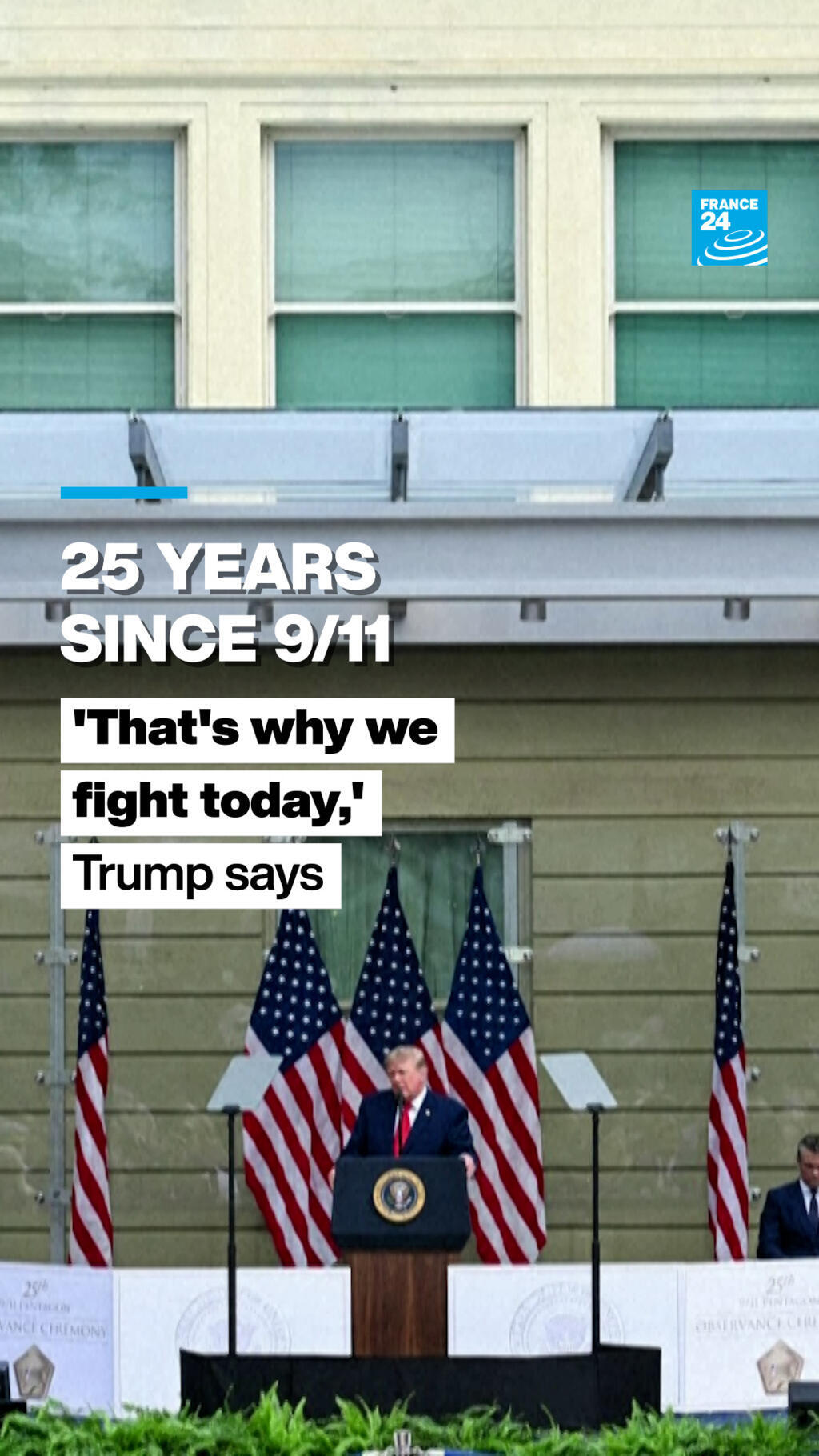
France 24 reports on President Donald Trump’s remarks at a ceremony held at the Pentagon to commemorate the 25th anniversary of the September 11, 2001 terrorist attacks. Speaking on Friday, September 11, 2026, Trump pledged that the United States would continue to remember those who died and would maintain its commitment to fighting in their name. He described the commemoration as a renewal of a “sacred oath” first made 25 years earlier, emphasizing that the country would “never, ever forget” the attacks and their victims.
The report centers on Trump’s brief commemorative message rather than providing a full transcript or extensive background about the ceremony. His remarks connect remembrance with an ongoing national duty, expressed through the statement, “That’s why we fight today.” The article does not elaborate on what specific actions or threats Trump was referring to, leaving the phrase as a broad reference to continued vigilance or national defense.
Trump attended the Pentagon ceremony but chose not to participate in the commemorations in New York City. France 24 presents the event as part of broader 9/11 anniversary coverage, which also included remarks by Defense Secretary Pete Hegseth and ceremonies held at other locations. The article itself remains focused on the president’s appearance and his pledge of remembrance. Its framing is factual but emotionally solemn, reflecting the significance of the anniversary and the continuing public memory of the attacks. The report provides no opposing statements, political analysis, or detailed discussion of the ceremony beyond Trump’s quoted remarks and his decision to skip the New York observances.
Entities: Donald Trump, France 24, The Pentagon, United States, September 11, 2001 attacks • Tone: emotional • Sentiment: neutral • Intent: inform
11-09-2026
New York is marking the 25th anniversary of the September 11, 2001 terrorist attacks with a memorial ceremony at Ground Zero, while President Donald Trump attends a separate event at the Pentagon. Vice President JD Vance and former presidents George W. Bush, Barack Obama, Joe Biden and Bill Clinton are expected at the Manhattan ceremony, where victims’ relatives will read the names of the nearly 3,000 people killed and a bell will mark key moments of the attacks. No speeches are planned.
The commemoration is also notable because it includes Zohran Mamdani, New York’s first Muslim mayor. His attendance has drawn opposition from the New York Post, former mayor Rudy Giuliani and a petition with more than 100,000 signatures, which questions his associations and views on extremist ideologies. Supporters, including City Council member Shahana Hanif, say Mamdani is being singled out because of his religion. Mamdani has received praise for releasing thousands of documents concerning what city officials knew about toxic air after the World Trade Center collapse.
The article reviews the attacks, in which 19 al Qaeda operatives hijacked four planes, killing 2,977 people at the World Trade Center, the Pentagon and near Shanksville, Pennsylvania. It also highlights the long-term toll: more than 9,400 people have reportedly died from 9/11-related illnesses, including cancers linked to toxic dust and pollution.
Large crowds and extensive security are expected in lower Manhattan. Police will deploy anti-drone technology, though officials say there is no specific threat. Al Qaeda marked the anniversary by releasing a video featuring Osama bin Laden and his son Hamza. A drone display over New York Harbor featured 2,977 lights, one for each person killed.
Entities: September 11, 2001 attacks, New York City, Ground Zero, Donald Trump, JD Vance • Tone: neutral • Sentiment: negative • Intent: inform
11-09-2026
France 24 presents a brief video report about US President Donald Trump’s participation in a Pentagon ceremony commemorating the 25th anniversary of the September 11, 2001, terrorist attacks. The report, issued on September 11, 2026, states that Trump spoke about the attacks during the ceremony and honored those who died when al-Qaeda militants hijacked commercial aircraft. Nearly 3,000 people were killed in attacks at three locations, including the Pentagon, and the events significantly altered US foreign policy and national security policy. The item is categorized under the Americas and has a listed duration of one minute and six seconds. The provided text does not include a transcript of Trump’s remarks, direct quotations, details about the ceremony’s other participants, or a fuller account of the president’s speech. Instead, it offers a concise description of the event and its historical significance. The report identifies the September 11 attacks as a defining national tragedy and connects their aftermath to major changes in American security and international policy. The article also includes keywords identifying Trump, the United States, the Americas, and the 9/11 attacks. Other headlines displayed on the page concern related US political and regional developments, but they are separate from the main report and are excluded from this summary. Overall, the item functions primarily as a factual video-news notice about Trump’s remarks and the official commemoration at the Pentagon, rather than as an extended analysis of the attacks or their continuing political consequences.
Entities: Donald Trump, Pentagon, United States, al-Qaeda, September 11 attacks (9/11) • Tone: neutral • Sentiment: negative • Intent: inform
11-09-2026
Americans gathered on Friday to mark 25 years since the September 11, 2001, terrorist attacks, remembering the nearly 3,000 people killed when hijacked planes struck New York’s World Trade Centre, the Pentagon and a field in Pennsylvania. The anniversary also prompted reflection on the attacks’ long-term effects on American society, including their influence on US foreign policy and domestic politics.
At ground zero in Lower Manhattan, relatives of the victims joined Vice-President J.D. Vance and four former US presidents for the main memorial ceremony. The event began at 8:46am, the time American Airlines Flight 11 hit the World Trade Centre’s North Tower, with a moment of silence. Family members then read the names of the 2,977 people killed on September 11, along with the names of six people who died in the 1993 World Trade Centre bombing.
The name-reading ceremony lasted for hours and illustrated the passage of time since the attacks. Some participants were children who had never met the relatives they were commemorating. Additional moments of silence marked the crashes of the other three hijacked planes and the collapses of the Twin Towers.
The ceremony was presented as both a remembrance of those lost and an opportunity to consider the continuing consequences of the attacks. The participation of victims’ families, government officials and former presidents underscored the national significance of the anniversary, while the younger readers highlighted how the events continue to shape later generations.
Entities: September 11 attacks, World Trade Center, Pentagon, Pennsylvania crash site, New York City • Tone: emotional • Sentiment: neutral • Intent: inform
11-09-2026
This South China Morning Post archive article recounts the immediate aftermath of the September 11, 2001 terrorist attacks in the United States. Originally published on September 12, 2001, it describes how two hijacked airliners struck New York’s World Trade Centre within 18 minutes of each other, while another aircraft crashed into the Pentagon, the headquarters of the US Defence Department. The attacks killed thousands of people and left Americans and viewers around the world in shock.
The report focuses on President George W. Bush’s televised address to the nation the day after the attacks. Bush confirmed the scale of the deaths, condemned the attacks as “despicable”, and sought to reassure the public by declaring that although the attacks had “shattered steel”, they could not weaken American determination. His remarks reflected the administration’s effort to project resolve during an unprecedented national crisis.
At the same time, the article portrays the US government operating under emergency conditions. Bush’s senior security officials placed the country on a war footing and worked from secure crisis bunkers. The report also notes that officials denied US responsibility for what initially appeared to be missile strikes on Kabul, Afghanistan’s capital, early on September 12. This detail illustrates the confusion and uncertainty surrounding the attacks and the rapidly developing international security situation.
The article combines a stark description of the destruction with the atmosphere of fear, grief and urgent government response. Its archival framing presents the report as a contemporaneous account of the nation’s “darkest hour,” preserving the language and perspective of the immediate post-attack period.
Entities: September 11, 2001 terrorist attacks, United States, George W. Bush, World Trade Centre, New York • Tone: urgent • Sentiment: negative • Intent: inform
11-09-2026
Twenty-five years after the September 11 attacks, Americans gathered on September 11, 2026, to honor the nearly 3,000 people killed when hijacked planes struck New York’s World Trade Center, the Pentagon and a field near Shanksville, Pennsylvania. Memorial ceremonies took place at Ground Zero, the Pentagon and the Flight 93 crash site, with family members, senior officials, Vice President JD Vance and four former presidents attending events in New York. President Donald Trump was expected to speak at the Pentagon ceremony.
At Ground Zero, victims’ relatives read the names of the 2,977 people killed in 2001, along with the six victims of the 1993 World Trade Center bombing. For the first time, an additional moment of silence was planned to honor thousands of people who have died from illnesses linked to toxic dust released after the attacks.
The article examines the attacks’ lasting effects on American society and policy. September 11 led to the so-called war on terror, the creation of the Department of Homeland Security, and prolonged U.S. wars in Afghanistan and Iraq. It also influenced domestic politics, public attitudes toward security and perceptions of Muslim Americans, who experienced increased prejudice and hate crimes after the attacks. New York Mayor Zohran Mamdani, the city’s first Muslim mayor, faced political pressure to skip the ceremony but rejected those calls.
Personal stories underscore the continuing grief. Caroline Ogonowski, whose father captained American Airlines Flight 11, brought her newborn son—named after his grandfather—to her father’s grave. Patrick Whalen discussed the death of his firefighter father from cancer associated with Ground Zero exposure and criticized official assurances that the air was safe. The New York City Fire Department lost 343 members on September 11, while more than 600 additional firefighters have since died from related illnesses.
Entities: September 11 attacks, Ground Zero, World Trade Center, Pentagon, Shanksville, Pennsylvania • Tone: emotional • Sentiment: negative • Intent: inform
11-09-2026
The article examines how New York City has changed in the 25 years since the September 11, 2001 terrorist attacks. Nearly 3,000 people were killed when hijacked aircraft struck the World Trade Centre and the Pentagon, while another plane crashed in Pennsylvania. Lower Manhattan has since been rebuilt through billions of dollars in investment, with new skyscrapers, transportation links, and the 9/11 Memorial and Museum replacing much of the former Ground Zero landscape.
For younger New Yorkers, the security measures introduced after the attacks—including cameras, concrete barriers, checkpoints, airport screening, and heightened surveillance—are an ordinary part of life. Those who experienced 9/11, however, tend to remember the fear, uncertainty, and loss more than the rebuilt skyline. Several interviewees describe how aircraft overhead, anniversary commemorations, and security concerns can revive traumatic memories.
The article also considers the wider national consequences of the attacks. The United States went to war in Afghanistan and Iraq, while immigration, counter-terrorism, surveillance, and airport-security policies changed. Interviewees describe a country that became more distrustful and divided, even as the immediate aftermath brought out extraordinary solidarity among New Yorkers.
The experiences of survivors and younger residents reveal contrasting perspectives. Sara Bitar, born in New York shortly before the attacks, views 9/11 as part of the city’s inherited history and emphasizes New Yorkers’ resilience. Dulcie Leimbach and Jonathan Wachtel, who were near the World Trade Centre, recall enduring sadness, darkness, confusion, and the struggle to find safety as the towers collapsed. The article presents New York as noisier, denser, and more security-conscious, but still energetic and resilient. Zohran Mamdani’s election as the city’s first Muslim mayor is presented as a major symbol of the social and political changes that would have seemed unimaginable in the years immediately after the attacks.
Entities: September 11 attacks, New York City, Lower Manhattan, World Trade Centre, 9/11 Memorial and Museum • Tone: analytical • Sentiment: neutral • Intent: analyze
11-09-2026
The Euronews programme “Europe Today” marks the 25th anniversary of the September 11 attacks by examining how the attacks transformed the United States and the wider world. Stefan Grobe interviews Anthony Gardner, a former US ambassador to the European Union during the second Obama administration, about the long-term consequences of 9/11 and the lessons political leaders should continue to draw from it. A related headline indicates that Gardner argues military force alone is not enough to defeat terrorism.
The programme also features reporting and interviews from the Rīga Conference in Latvia. Euronews correspondent Maria Tadeo speaks with EU economy chief Valdis Dombrovskis about Russia’s aggression and whether the Baltic states are correctly assessing the threat posed by Moscow. Dombrovskis also discusses Ukraine’s precise budgetary needs, according to a related Euronews headline. Tadeo additionally interviews Norway’s Foreign Minister Espen Barth Eide, who warns that Israeli Prime Minister Benjamin Netanyahu’s government is taking Israel in a “very dangerous” direction. Angela Skujins interviews Kyrylo Budanov, head of the Office of the President of Ukraine.
The episode includes an interview by Mared Gwyn with Brazil’s ambassador to the EU, Pedro Miguel da Costa e Silva. Their discussion follows the European Commission’s suspension of imports of Brazilian meat and other food products because of concerns about antimicrobial substances used during production.
The programme is presented as a concise weekday briefing combining major news, interviews and analysis concerning the European Union and international affairs. Viewers can watch it live on television, the Euronews website and digital platforms including YouTube, Facebook, X and Instagram at 8 a.m. Brussels time. The programme is also available as a newsletter and podcast.
Entities: Europe Today, Euronews, September 11 attacks (9/11), Valdis Dombrovskis, Anthony Gardner • Tone: analytical • Sentiment: neutral • Intent: inform
11-09-2026
The article highlights the story of Gurvinder Singh, an Indian immigrant and taxi driver who reportedly provided hundreds of free rides to New Yorkers for 40 days after the September 11, 2001, terrorist attacks. According to Shabbos Kestenbaum, Singh said he was at the World Trade Center on the morning of the attacks and continued helping people in the aftermath by transporting those who needed assistance without accepting payment.
Kestenbaum said Singh showed him a letter from then-New York City Mayor Rudy Giuliani thanking him for his service. Singh, who emigrated from India 35 years ago, also encouraged passengers to fly American flags and shared a message of unity and patriotism: “Love all people, respect all people. God bless you all, and god bless America!”
The story gained renewed attention online as the United States marked the 25th anniversary of 9/11. Thousands of users responded by praising Singh’s generosity and describing his actions as an example of the contributions made by immigrants and Sikh Americans. His Sikh identity became an important part of the online discussion, with Harmeet K. Dhillon and others emphasizing that many Sikhs are proud, law-abiding Americans who contribute to their communities.
The article also places Singh’s story within a current debate over immigration and the treatment of Indian Americans. It refers to an AI-generated post from the US Department of Homeland Security that warned immigrants to “self-deport or find out.” The message, shared during the Trump administration’s immigration crackdown, used Transformers characters and included a line telling “Mr Singh” to leave the roads because he did not know how to drive. Critics condemned the post as racist and anti-Indian, and said it appeared to target Indian and Sikh Americans. Thus, the article contrasts Singh’s widely praised civic service with contemporary hostility toward immigrants.
Entities: Gurvinder Singh, Shabbos Kestenbaum, Rudy Giuliani, Harmeet K. Dhillon, New York City • Tone: analytical • Sentiment: positive • Intent: inform
11-09-2026
France 24 presents a 4-minute, 7-second video recalling the September 11, 2001 terrorist attacks through the firsthand experience of Dulcie Leimbach. Leimbach, who is identified as the editor and co-founder of PassBlue, was working as a journalist in New York for The New York Times when the attacks occurred. In the brief description accompanying the video, she recalls the atmosphere as one of “chaos and a sense of doom” and describes witnessing people falling from the North Tower.
The item is framed as a personal memory rather than a comprehensive historical account of the attacks. Its focus is on the shock and trauma experienced by people near the events, particularly journalists attempting to work amid the unfolding disaster. The title and description emphasize the emotional intensity of Leimbach’s recollection, while the quoted memory provides a stark image of the human cost of the attack.
The page identifies France 24 as the publisher and gives an issue date of September 11, 2026, with a modification shortly afterward. The supplied content does not include a full video transcript or additional details about Leimbach’s experiences beyond her work location, employer, and recollection of the North Tower. Other headlines displayed on the page—covering 9/11 commemorations, Iran, Lebanon, Europe, and unrelated events—are related-content recommendations rather than part of the video report and have been excluded from the cleaned text.
Overall, the piece serves to inform viewers about a personal eyewitness memory of 9/11 while preserving the emotional weight of the experience. Its central themes are trauma, journalistic witness, the collapse of normality, and the human impact of the attacks.
Entities: Dulcie Leimbach, France 24, PassBlue, The New York Times, New York • Tone: emotional • Sentiment: negative • Intent: inform
11-09-2026
France 24 presents a 2-minute, 21-second video examining how the memory of the 11 September 2001 terrorist attacks is being passed on to younger generations. The video is dated 11 September 2026, marking 25 years since the attacks, and focuses on people who were not yet born or were too young to remember the events firsthand.
The article begins by recalling the collective experience of millions who watched the World Trade Centre towers being struck by airplanes. It then shifts from the immediate historical event to the question of remembrance: how can the significance of 9/11 be communicated to people without personal memories of witnessing it? This framing suggests that the video explores education, commemoration, family recollections, public memorials, or other ways the attacks continue to be remembered, although the supplied page text does not include the video transcript or details about interviewees and specific memorial activities.
The central subject is therefore intergenerational memory. The piece treats 9/11 not only as a historical event but also as an experience whose meaning may change as eyewitnesses age and a larger proportion of the population encounters it through history, media, and public remembrance. The available text is factual and reflective rather than argumentative. It does not provide new claims about the attacks or assess a particular remembrance program; instead, it introduces a question about preserving historical memory for people who did not directly experience the event.
Because the page contains mostly video-player notices and related-story links, the supplied material offers only a short description of the video rather than a full article. Its emphasis is on remembrance, historical transmission, and the challenge of keeping the events of 11 September 2001 meaningful to younger audiences.
Entities: France 24, 9/11 attacks, 11 September 2001, World Trade Centre towers, Younger generation • Tone: analytical • Sentiment: neutral • Intent: inform
11-09-2026
The article examines how the 11 September 2001 attacks reshaped intelligence, counter-terrorism and strategic planning, while arguing that major failures have continued despite extensive reforms. It begins by describing 9/11 as a catastrophic failure by the US government to protect its population. Although the CIA knew about al-Qaeda and Osama Bin Laden before the attacks, information held by the CIA and FBI was not properly assessed or shared. The 9/11 Commission later attributed the disaster to failures of imagination, policy, capabilities and management.
Since then, intelligence cooperation has improved substantially. The United States created the National Counter Terrorism Center and the Director of National Intelligence, while the UK developed regional fusion centres and the Counter Terrorism Operations Centre. Cooperation between MI5, the police, MI6, the FBI and the Five Eyes partners has also become closer.
However, the article emphasizes that institutional reform has not eliminated poor judgment. Flawed intelligence about Iraqi weapons of mass destruction was politicised before the 2003 Iraq invasion, damaging MI6’s reputation and contributing to strategic failure. The Butler Review later found that the intelligence was seriously flawed and based heavily on unverified sources. MI5 also failed to prevent the 7/7 London bombings and the Manchester Arena attack, despite having information about some individuals involved.
The security environment has also changed. According to former MI5 chief Jonathan Evans, terrorism remains a serious concern, but threats from Russia, Iran, their proxies and China are now at least as significant. The article gives the example of US policy toward Iran as a possible failure of strategic imagination. It concludes this supplied excerpt by turning to the human-rights abuses committed after 9/11, when the US and its allies detained suspects amid fears of further attacks; the provided text ends mid-sentence while discussing those detentions.
Entities: 9/11 attacks, al-Qaeda, Osama Bin Laden, Central Intelligence Agency (CIA), Federal Bureau of Investigation (FBI) • Tone: analytical • Sentiment: negative • Intent: analyze
11-09-2026
The article examines how the United States has changed its counterterrorism system in the 25 years since the September 11 attacks. Javed Ali, a former official with the Defense Intelligence Agency, Department of Homeland Security and FBI, describes witnessing the Pentagon attack and later working inside the national security apparatus created in response.
The article argues that the post-9/11 security architecture has made another attack on the scale and complexity of 9/11 much more difficult. The United States has not experienced a comparable terrorist assault, while military and intelligence operations have weakened al-Qaeda and ISIS. New agencies, surveillance authorities, watchlists and intelligence-sharing systems were designed to prevent the failures that allowed the 2001 plot to succeed.
However, the article emphasizes that terrorism has not disappeared; it has evolved. Current threats increasingly come from individuals radicalized online, small groups or lone actors who leave few warning signs, foreign terrorist organizations inspiring attacks remotely, and cyber or state-sponsored operations that can penetrate the United States without using hijacked aircraft. These threats are often more difficult to detect because they are decentralized, technologically enabled and less dependent on traditional terrorist infrastructure.
The response after 9/11 included the creation of the Transportation Security Administration and the Department of Homeland Security, which consolidated parts of 22 federal agencies and now employs more than 260,000 people. The article also discusses the 9/11 Commission’s finding that fragmented responsibilities and poor information sharing contributed to the pre-attack intelligence failure. The supplied article ends while beginning to discuss those institutional weaknesses.
Entities: Javed Ali, September 11, 2001 terrorist attacks, Pentagon, Defense Intelligence Agency, Department of Homeland Security • Tone: analytical • Sentiment: neutral • Intent: analyze