18-10-2026
The article describes the aftermath of violent protests in France’s three largest cities: Lyon, Paris and Marseille. The demonstrations, held nationwide on Saturday against the rising cost of living, escalated into riots and looting, leaving damaged buildings, shops and public spaces. By the following day, municipal workers, shopkeepers and volunteers were beginning the work of clearing debris and repairing storefronts.
In Lyon, firefighters responded to a blaze at the city’s tourist office. Its façade was scorched and smoke was still rising, while nearby businesses had been vandalised and looted. Residents photographed the destruction, and groups of young people joined efforts to clean streets that remained marked by the previous day’s violence.
In Paris, damage was visible at the Les Halles shopping centre, the Paris Opera and storefronts belonging to major retailers, including Nike, Sephora and Burger King. In Marseille, crews hosed down Rue Saint-Ferréol, where damaged shops, scattered shoe boxes and debris reflected the scale of the unrest. The city established an information point to assist affected businesses, and municipal police patrolled the area.
The report focuses on the visible consequences of the protests and the immediate response in each city. Its details show both the extent of the damage to businesses and public sites and the practical efforts underway to restore affected streets. It does not identify individual protesters, give a total estimate of losses, or explain what further measures authorities may take. Instead, it records the scene as cleanup and recovery began after demonstrations over living costs turned violent.
Entities: Lyon, Paris, Marseille, France, Les Halles shopping centre • Tone: analytical • Sentiment: negative • Intent: inform
18-10-2026
Cities across France faced the aftermath of widespread violence on Sunday after more than half a million people took part in nationwide demonstrations against the rising cost of living the previous day. Paris, Marseille, Bordeaux, Limoges and Nice were among the cities where clashes between protesters and police, looting and fires were reported. The demonstrations left storefronts smashed and buildings burned.
Prime Minister Sébastien Lecornu condemned what he called the “extreme intensity” of the violence. He said authorities had arrested 1,200 people and that 150 police officers had been hurt. In Saint-Etienne, a 17-year-old boy lost his right hand after being struck by a crowd-control grenade.
The unrest followed weeks of student protests and occurred six months before presidential elections. It also prompted political reactions beyond France. US Vice President JD Vance blamed immigration and what he called “problems of assimilation” in a social media post, although the article says he offered no evidence for that claim. Far-right leader Marine Le Pen accused the party of her far-left presidential rival, Jean-Luc Mélenchon, of having “legitimised the violence.”
Mélenchon, who had supported both the demonstrations and student protests, urged people to avoid looting, calling it “contrary to our methods.” President Emmanuel Macron said those responsible for vandalism, attacks on administrative offices or businesses, and looting—including at town halls—would be prosecuted and punished. Overall, the article reports the scale and consequences of the unrest, the official response, and competing political claims about its causes and responsibility.
Entities: France, Paris, Marseille, Bordeaux, Limoges • Tone: urgent • Sentiment: negative • Intent: inform
18-10-2026
The article reports a night of escalating unrest in France during ongoing cost-of-living protests. It describes fires, looting and the use of tear gas in Paris, while disturbances continued elsewhere in the country. In Limoges, witnesses said masked protesters set fire to the town hall. Officials described the building as “largely lost,” indicating that it had suffered extensive damage, though the report provides no further details about the extent of the damage or any response to the fire.
The brief report presents the events as part of protests that continued into the night and spread across the country. It identifies cost-of-living concerns as the context for the demonstrations but does not specify protesters’ demands, the causes or scale of the unrest, or how many people took part. It also gives no information about injuries, arrests, evacuations, or the identities of those involved. The account attributes the description of the Limoges fire to witnesses and the assessment of the town hall’s condition to officials.
Overall, the article is a concise news update focused on property damage and disorder in Limoges and Paris. It establishes that the protests were ongoing and that several forms of disruption occurred, but the supplied text does not provide additional background, official statements beyond the assessment of the town hall, or a broader account of the protests. Its central points are the reported arson at Limoges town hall and the fires, looting and tear gas accompanying unrest in Paris.
Entities: France, Limoges, Paris, Limoges town hall, Masked protesters • Tone: urgent • Sentiment: negative • Intent: inform
18-10-2026
The article reports that French President Emmanuel Macron condemned violence during protests in France, saying people who attacked government buildings should face consequences for their crimes. His remarks followed a wave of violent demonstrations in which hundreds of people were arrested across the country. The protests were driven by anger over the rising cost of living and poor conditions in schools. The report links Macron’s address to the arrests and attacks but provides no further detail about the locations, scale of property damage, number of buildings targeted, or the specific measures authorities may take. It also does not include responses from protesters or additional statements from the government. The article is a brief Al Jazeera video-news item, published on 18 October 2026, rather than an extended account. Its focus is on the president’s condemnation and the immediate context of the unrest: attacks on government buildings, mass arrests, and public grievances about living costs and school conditions. Overall, it presents a concise account of the official response to protests that turned violent, without offering broader background or analysis of the underlying issues.
Entities: Emmanuel Macron, France, French government, Al Jazeera, attacks on government buildings • Tone: neutral • Sentiment: negative • Intent: inform
18-10-2026
France is assessing the damage after a nationwide protest on Saturday drew hundreds of thousands of people, amid student-led demonstrations that began in mid-September over overcrowded classrooms, teacher shortages, inequality and limited opportunity. Authorities estimated turnout at 550,000, while unions and organisers put it at 800,000. In Paris, residents described feeling distressed and angry as they viewed smashed shop windows, looted businesses, burned structures and graffiti around Place de la Republique. One student said the march she attended was peaceful, but that spectacular violence had eclipsed the protesters’ underlying grievances.
The unrest was not limited to the capital. In Marseille, shops were looted and people briefly broke into city hall; in Limoges, fire engulfed the historic city hall; and public buildings were damaged in Bordeaux and elsewhere. Interior Minister Laurent Nunez said nearly 1,800 people had been arrested and more than 500 police officers, gendarmes and firefighters injured. He distinguished the right to protest from coordinated violent disorder. President Emmanuel Macron was due to address the nation on Sunday.
Police tactics have also become contentious. France’s police inspectorate had opened 36 investigations into alleged police violence since the school protests began, a count released before Saturday’s events. Lawyers cited severe injuries among young demonstrators, while a representative of the Paris Young Lawyers’ Union argued that forceful crowd-control tactics risk escalating tensions.
The protests confront a government already trying to contain social discontent while reducing France’s public deficit. Prime Minister Sebastien Lecornu’s proposed spending restraint and tax measures could provoke further opposition, particularly given resistance to cuts to the welfare system. With political divisions hardening ahead of next year’s presidential election, left-wing France Unbowed leader Jean-Luc Melenchon blamed the government for creating conditions for chaos. Lecornu responded by accusing far-left groups of orchestrating the violence.
Entities: Paris, France, Place de la Republique, Emmanuel Macron, Sebastien Lecornu • Tone: analytical • Sentiment: negative • Intent: inform
18-10-2026
The article reports that residents of Paris told Al Jazeera they were dismayed by the damage caused during protests on Saturday, after demonstrations turned violent. It says riots and looting broke out and that French police arrested more than 1,000 people. The report’s central focus is the effect of the unrest on residents and their reaction to the scale of the damage, rather than a detailed account of the protests’ causes, locations, or consequences. The supplied article text does not identify the residents interviewed, describe specific damaged property, or provide further information about the arrests or police response. It also does not specify what prompted the protests. The item is dated 18 October 2026 and is presented as an Al Jazeera video news report. Overall, it conveys residents’ dismay at the destruction while briefly noting the violence, looting, and large number of arrests. Because the provided text is brief, conclusions beyond these points would require information not present in the article.
Entities: Paris, Paris residents, Al Jazeera, French police, Saturday’s protests • Tone: neutral • Sentiment: negative • Intent: inform
18-10-2026
France’s school protests have grown into a nationwide political crisis by bringing together students’ complaints about underfunded high schools with workers’ concerns about wages, public services and government spending cuts. The movement began in Paris’s working-class northern suburbs over teacher shortages and poor facilities, then spread to cities including Bordeaux, Rennes, Nantes, Lyon, Lille and Marseille. About 550,000 people demonstrated on Saturday, according to the Interior Ministry. Most protests were peaceful, although a small minority engaged in looting, property damage and clashes with police. Prime Minister Sébastien Lecornu said 1,200 people were arrested and 150 police officers injured.
The immediate student demands include smaller classes, more teachers, better school buildings and less exhausting schedules. The demonstrations coincided with a public-sector strike against a proposed 2027 budget containing €54 billion in cuts and tax measures. Unions object to a proposed freeze in civil servants’ pay scales, while demonstrators have connected the school dispute to broader concerns about inequality, public investment, social welfare and democratic rights. Commentators see the movement as continuing grievances associated with the 2018 yellow-vest protests and growing frustration with France’s political system.
The government has emphasized public order, with President Emmanuel Macron promising prosecution for those responsible for violence. Critics argue that this approach overlooks the grievances fuelling the mobilization. Political fragmentation following the 2024 parliamentary elections has left no bloc with an outright majority and, experts say, few parties able to channel public discontent. The unrest is also a challenge to Macron’s political standing. Researchers point to strained relations between protesters and police and cite injuries to two young teenagers during demonstrations; Human Rights Watch condemned excessive force against children.
The protests’ political beneficiaries remain uncertain. Some analysts believe Marine Le Pen and the far right could gain from public concern about disorder; others caution that this outcome is not inevitable. The supplied article ends mid-sentence while describing Le Pen’s response to protesters’ grievances.
Entities: France, Emmanuel Macron, Sébastien Lecornu, Caolán Magee, Emile Chabal • Tone: analytical • Sentiment: negative • Intent: analyze
18-10-2026
France awoke to extensive damage on Sunday after demonstrations over rising fuel prices, the cost of living and deteriorating public services, including schools, were accompanied by riots and looting in Paris and other cities. About 550,000 people took part in Saturday’s protests, which were largely peaceful, while police arrested approximately 1,800 people. Groups of masked or hooded rioters set fires, damaged buildings and vehicles, and looted businesses in cities including Paris, Marseille and Lille. In Paris, demonstrators clashed with riot police, who used tear gas and water cannon; the BBC also witnessed police charging a crowd and striking people with batons. Residents described the destruction as frightening and likened the scene to war.
The Interior Ministry said more than 500 police officers, gendarmes and firefighters were injured. A retail federation reported damage to around 1,500 shops and retailers. In Paris, shopkeepers began clearing glass and debris on Sunday, while businesses near Place de la République described ransacking and extensive losses. One shop owner said looters had taken advantage of the demonstrations and were not genuine protesters. Looting and damage were also reported in Marseille and Lille, including a fire at a McDonald’s and a break-in at an Apple store.
Serious incidents occurred elsewhere: Lyon’s tourist office was burned, while a fire at Limoges town hall caused part of the building to collapse. A young man in Saint-Étienne lost a hand in an explosion. Interior Minister Laurent Nuñez distinguished the right to demonstrate from violence he attributed to far-left groups and looters. The article places the unrest amid student protests that began late the previous month, calling for more investment in schools and criticizing staff shortages, overcrowded classrooms and deteriorating buildings. It also reports damage in several other French cities.
Entities: France, Paris, Marseille, Lille, French Interior Ministry • Tone: analytical • Sentiment: negative • Intent: inform
18-10-2026
French President Emmanuel Macron has appealed for calm after protests against rising fuel prices, the cost of living and deteriorating public services escalated into rioting and looting. Around 550,000 people demonstrated on Saturday, mostly peacefully, but groups of masked rioters set fires, damaged buildings and looted businesses in Paris, Marseille, Lille and other cities. Macron said protesters’ legitimate demands must be distinguished from violence, which he said could not be justified, and warned those involved that they would face justice. Police had arrested about 2,400 people, according to the interior ministry.
Disorder continued on a smaller scale on Sunday in parts of Paris and Lyon. Police used tear gas and stun grenades as some people threw bottles and rocks. The unrest caused extensive damage, including the destruction of Limoges’s ornate 19th-century town hall, which was gutted by fire; its roof and clock tower collapsed. Residents described the damage as upsetting and said rebuilding would take a long time. Shopkeepers in Paris began clearing shattered glass as rubbish trucks removed debris.
Macron said local officials would draw up measures to protect businesses and civic buildings, and promised full transparency about the police response. The interior ministry reported that about 1,000 officers were injured on Saturday, seven seriously. The demonstrations began with students the previous month and grew on Saturday when trade union members and other anti-government groups joined.
The unrest is unfolding amid deep political divisions ahead of an April election that could pit the hard right against the hard left. Interior Minister Laurent Nuñez accused several thousand far-left demonstrators of targeting public buildings and police, and said looters later joined them. Left-wing leader Jean-Luc Mélenchon attacked the authorities’ handling of the protests, while National Rally leader Marine Le Pen condemned political forces she said were exploiting public anger to encourage violence.
Entities: Emmanuel Macron, France, Paris, Limoges, Marseille • Tone: analytical • Sentiment: negative • Intent: inform
18-10-2026
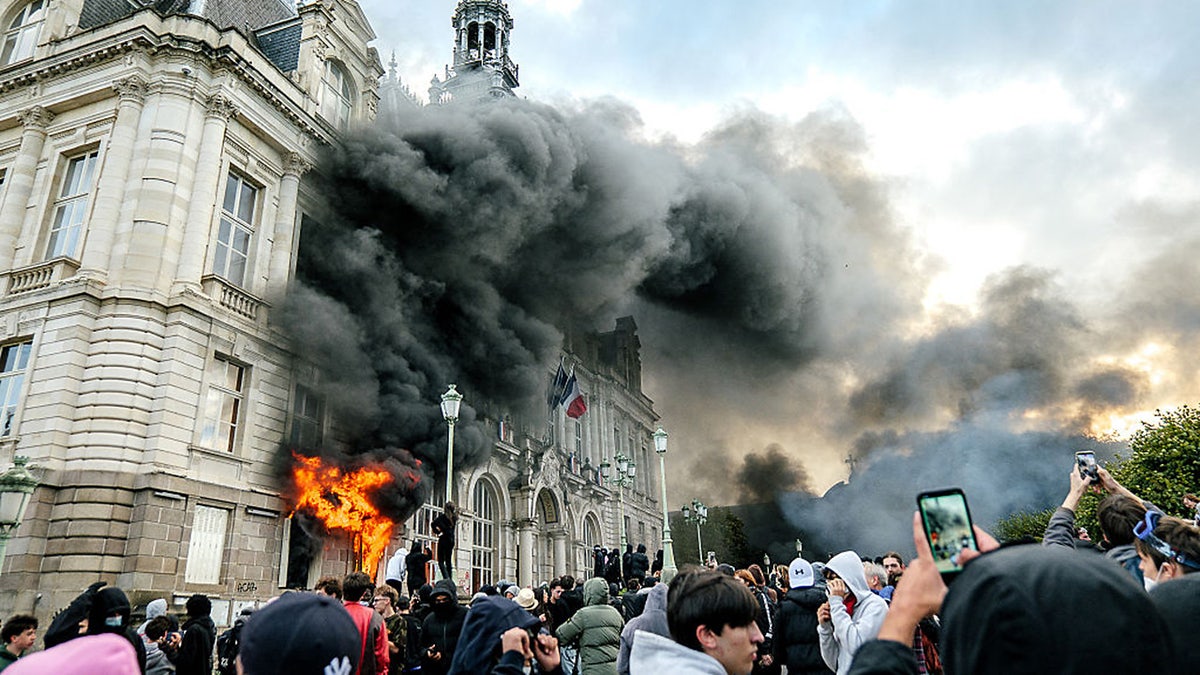
French authorities said at least 1,800 people were arrested after nationwide demonstrations against rising living costs and poor school conditions turned violent. Authorities estimated that about 550,000 people participated, while organizers put attendance at roughly 800,000. The Interior Minister said more than 500 police officers, gendarmes and firefighters were injured, and police reported one death from a heart attack. Masked groups set fires, attacked public buildings and looted businesses in several cities, including Paris, Marseille, Lyon and Bordeaux. In Limoges, a fire deliberately set at the 19th-century City Hall nearly destroyed the building and caused its roof to collapse; it was under control by Sunday.
In the Paris region, police reported 855 arrests, with 557 people held in custody. The morning after the unrest, damage around Place de la République included broken storefronts, shattered glass and dislodged cobblestones. Residents expressed shock and fear, while some supporters of the protest movement said the violence undermined its cause.
President Emmanuel Macron planned an emergency meeting with senior officials before delivering a televised address. Political figures used the unrest to criticize opponents ahead of the following spring’s presidential election. Marine Le Pen blamed rioters for disrupting demonstrations, while Jordan Bardella called for a lasting restoration of order. Jean-Luc Mélenchon condemned looting, criticized Prime Minister Lecornu, and argued that government policy had united young people and unions.
U.S. President Donald Trump linked the unrest to immigration in a social-media post and called for France to close its borders. The article notes that French authorities and police had not linked immigrants to the rioting; officials instead attributed some violence to radical far-left groups and people who joined to loot.
Entities: France, Emmanuel Macron, Laurent Nuñez, Marine Le Pen, Jean-Luc Mélenchon • Tone: analytical • Sentiment: negative • Intent: inform
18-10-2026
More than 1,800 people were arrested across France after demonstrations over the cost of living and fuel prices turned violent on Saturday, Interior Minister Laurent Nunez said. Clashes, arson and looting were reported in several cities. Paris police recorded 855 arrests, which they described as a record, and prosecutors said 517 people—including 171 minors—were still in custody. Authorities said more than 600 officers were injured, while demonstrators were also reported hurt. In Limoges, rioters set fire to the historic town hall, leaving much of the building gutted. Public buildings and shops were also attacked in Marseille, Lyon, Avignon and Grenoble, and police used tear gas, batons and water cannon. A newspaper reported that a 17-year-old in Saint-Etienne lost a hand after being struck by a police-fired grenade.
President Emmanuel Macron condemned the attacks and promised prosecution, saying there was “no room for violence” in the Republic. Opposition figures used the unrest to criticize one another ahead of the 2027 presidential election. Marine Le Pen accused Jean-Luc Melenchon’s party of legitimizing violence, while Melenchon, who had supported the demonstrations, urged protesters not to loot. US President Donald Trump attributed the unrest to immigration.
The protests brought together people with varied grievances, including high fuel prices, low wages, difficulties facing farmers and firefighters, and demands from students for improved schools and universities. The Interior Ministry estimated national participation at 550,000, including 110,000 in Paris; the CGT trade union put the total at 800,000. France’s high public debt and budget deficit constrain the government’s ability to increase spending. Authorities are also concerned that online calls to revive the Yellow Vest movement could broaden the unrest. The movement began in 2018 in opposition to planned fuel tax increases and developed into wider demonstrations over living costs and inequality.
Entities: France, Paris, Limoges, Marseille, Lyon • Tone: analytical • Sentiment: negative • Intent: inform
18-10-2026
Nearly 2,400 people were arrested across France after demonstrations over the cost of living, fuel prices and public services turned violent on Saturday. Clashes, fires and looting were reported in several cities. Paris police reported 855 arrests, a record, while prosecutors said 517 people remained in custody, including 171 minors. Arrests were still continuing early Sunday, so the figures were provisional. The Interior Ministry said about 1,000 officers were injured. In Limoges, rioters set fire to the historic town hall, leaving much of the building gutted; authorities also reported attacks on public buildings and shops in Marseille, Lyon, Avignon and Grenoble. Police used tear gas, batons and water cannon, and demonstrators were reportedly injured. Le Figaro reported that a 17-year-old lost a hand after a police-fired grenade injured them in Saint-Etienne.
President Emmanuel Macron condemned the violence, saying it was unjustifiable, while distinguishing protesters with legitimate demands from people who looted and destroyed property. He promised full transparency about the police response. Political leaders also weighed in as France looks toward the 2027 presidential election. Marine Le Pen blamed the far-left party of Jean-Luc Melenchon for legitimizing violence and pledged to protect the public from the extreme left. Melenchon, who had supported the demonstrations and earlier student protests, urged people not to loot.
The protests brought together concerns about fuel prices, low wages and the difficulties facing farmers and firefighters, alongside student demands for better learning conditions. The Interior Ministry estimated national turnout at 550,000, including 110,000 in Paris; the CGT trade union estimated 800,000 nationwide. France's high debt and budget deficit constrain the government's ability to increase spending. Online calls to revive the Yellow Vest movement, which began in 2018 over planned fuel tax increases and widened into protests about living costs and inequality, have heightened concern that student demonstrations could expand into broader unrest.
Entities: France, Paris, Limoges, Marseille, Lyon • Tone: neutral • Sentiment: negative • Intent: inform
18-10-2026
After cost-of-living protests spread across France on Saturday, 17 October 2026, masked groups looted and damaged businesses in Paris and cities including Lyon, Marseille, Bordeaux, Rennes, Strasbourg, Grenoble, Nice and Limoges. The targets ranged from supermarkets and convenience stores to luxury boutiques, bars and vape shops. By Sunday morning, broken glass and litter remained on Paris streets as residents saw the aftermath.
Carrefour Group chairman and CEO Alexandre Bompard said 50 of the company’s shops had been targeted, including 19 Carrefour convenience stores and supermarkets. He expressed sympathy for other affected retailers and shopkeepers, and warned of substantial consequences: some employees at franchise partners would be placed on short-time working, while repair costs for Carrefour alone were expected to exceed €10 million. One shopkeeper near Place de la République told Brut that he had invested his savings in his business and feared he had lost everything. A neighbour began a fundraiser to help him recover.
Paris Mayor Emmanuel Grégoire pledged support for affected businesses and requested an emergency task force to assess damage and help shopkeepers with support, administrative matters and insurance claims.
The article also reports that looters assaulted a Euronews crew near Place de la République as the journalists covered a nearby supermarket being looted. Correspondent Estelle Nilsson-Julien said masked people struck and surrounded the crew and tried to take the cameraman’s microphone. A separate march on Boulevard de Clichy remained peaceful, according to another Euronews journalist. Interior Minister Laurent Nuñez said more than 600 police officers, gendarmes and firefighters were injured and more than 2,000 people were arrested on Saturday.
Entities: Alexandre Bompard, Emmanuel Grégoire, Estelle Nilsson-Julien, Laurent Nuñez, Euronews • Tone: neutral • Sentiment: negative • Intent: inform
18-10-2026
France experienced widespread violence during Saturday’s cost-of-living protests, even though many of the estimated 550,000 to 800,000 people who joined demonstrations across the country were peaceful and may not have known the scale of unrest elsewhere. Government figures cited in the article report around 1,200 arrests and 150 injured police officers and gendarmes.
Major damage was reported in several cities. Limoges city hall and Lyon’s tourist office were set ablaze, while town halls in Marseille, Lille and Angers were broken into. In Bordeaux, the prefect’s residence was ransacked. Paris saw clashes between police and rioters, tear gas, burning emergency vehicles, looting and extensive damage to shops and streets. Groups of masked people attacked shop shutters and looted businesses, leaving broken storefronts, burned bicycles and stolen goods. Clashes also reached areas near the Élysée Palace and the National Assembly.
Political leaders condemned or attributed the violence in sharply different ways. President Emmanuel Macron said there was no place for violence and promised prosecution for vandalism, attacks and looting. Interior Minister Laurent Nuñez blamed groups he described as far-left instigators. Marine Le Pen argued that the protesters’ legitimate social demands had been taken over by the far left and accused Jean-Luc Mélenchon’s MPs of legitimising disorder. Mélenchon, meanwhile, criticised the leadership’s handling of events but said people who shared his political struggle had no place in looting or vandalism. The article presents both the scale of destruction and the competing political interpretations of the unrest.
Entities: France, Paris, Limoges, Lyon, Marseille • Tone: urgent • Sentiment: negative • Intent: inform
18-10-2026
Cost-of-living demonstrations across France turned violent on Saturday, 17 October 2026, with protesters clashing with police, looting businesses and setting vehicles and buildings alight. The protests also included grievances raised by students. More than half a million people were estimated to have taken part, including 110,000 in Paris. Violence was reported in several cities, among them Lyon, Marseille, Bordeaux, Rennes, Strasbourg, Grenoble, Nice, Toulouse and Limoges. In Limoges, the town hall was almost completely destroyed by a fire. French Interior Minister Laurent Nuñez said on Sunday that more than 500 police officers, gendarmes and firefighters had been injured, and that 1,800 people had been arrested. President Emmanuel Macron responded in a social-media post on Saturday evening, saying there was “no place for violence” in France. The article presents the events through a collection of ten photographs and captions. Images show a burning car at Paris’s Republique square, a tourism office burning and being attacked in Lyon, a looted store in Paris, police detaining a protester and officers confronting demonstrators. Other photographs depict burning bicycles, police guarding a looted shop in Lyon, protesters facing police in Paris, and demonstrators leaving Republique square. The article’s focus is on the scale and destructive impact of the demonstrations, illustrated by scenes of fires, looting and confrontations, alongside figures on injuries and arrests.
Entities: Emmanuel Macron, Laurent Nuñez, France, Paris, Lyon • Tone: urgent • Sentiment: negative • Intent: inform
18-10-2026
French President Emmanuel Macron said those responsible for looting and efforts to undermine the Republic would be held accountable, after protests over the cost of living and worsening student conditions turned violent in major cities. In a televised address on Sunday, he condemned the destruction, including a fire that engulfed a historic town hall in Limoges, and said nothing justified the unrest. Macron described the violence as involving radical-left insurrectionist elements and criminals, while acknowledging public frustration and urging politicians to condemn the attacks. He also called on the public to distinguish peaceful demonstrators making what he termed legitimate demands from people using protests as cover for destruction and looting.
The president’s response came amid scrutiny of how the government and police handled the operation. Marine Le Pen, the far-right leader who was leading in polls ahead of the following April’s presidential election, accused Macron of being too soft. Progressive and Green groups, in contrast, criticised what they viewed as excessive police force. Jean-Luc Mélenchon, leader of La France Insoumise, faced accusations from critics that he had fuelled chaos and further violence.
The article reports that more than 2,000 people were arrested and over 600 police officers, gendarmes and firefighters were injured, according to official figures. Macron announced no new security measures before travelling to Kuwait, but said local authorities would work with police to protect cities, public buildings and shops. The unrest has intensified France’s political tensions ahead of a contentious presidential election. Macron said the country deserved a “beautiful election” shaped by debate rather than violence.
Entities: Emmanuel Macron, Marine Le Pen, Jean-Luc Mélenchon, France, Limoges • Tone: analytical • Sentiment: negative • Intent: inform
18-10-2026
Hungarian Prime Minister Péter Magyar said violent anti-austerity protests in France reinforced his government’s strict approach to migration. In a social media post on Sunday, he pointed to footage of burning buildings and described the scenes as “senseless destruction and unjustified violence,” arguing that Hungary would not ease its efforts to protect its external borders or change its immigration policy. He also claimed that most European countries now favor tougher migration policies and warned that Europe was in serious trouble.
The protests had turned violent in several French cities on Saturday, with looting reported in Paris, Lyon and Marseille. Buildings were set on fire, including the historic town hall in Limoges. The article does not establish that migrants caused the unrest; instead, it notes that most protesters were French nationals and reports that some had immigrant backgrounds.
Polish Prime Minister Donald Tusk also advocated a strict approach, saying Poland would not repeat or pay for other countries’ mistakes. He said Warsaw would defend its border against illegal migration, maintain its asylum policy and deport people who break Polish law. His remarks did not explicitly refer to France.
Magyar’s comments drew criticism from Hungarian left-wing activist and Budapest councillor András Jámbor, who accused him of using footage of the riots for political gain and of diverting attention from protesters’ demands and the violence by labeling protesters as migrants. Jámbor acknowledged that some demonstrators had immigrant backgrounds but argued that the protest was about more than migration.
The article also places the remarks in a broader European debate: at a recent summit, Denmark, Italy and Hungary sought stronger language on migration, while French President Emmanuel Macron warned against stigmatizing immigrants and Spanish Prime Minister Pedro Sánchez praised their contributions. Macron was scheduled to address the French nation on Sunday evening.
Entities: Péter Magyar, Donald Tusk, András Jámbor, Emmanuel Macron, Pedro Sánchez • Tone: analytical • Sentiment: neutral • Intent: inform
18-10-2026
The article reports on Marine Le Pen’s response to renewed unrest in France, the day after riots and looting shook the country. The National Rally leader describes the situation as a “crisis of confidence” and a “threat to democracy,” blaming the far left and President Emmanuel Macron, whom she says lacks credibility and authority. She spoke shortly before Macron was due to address the nation. Jordan Bardella, also speaking for the National Rally during a visit to a Paris police station, said that France had been humiliated and that order no longer existed.
Violence and looting resumed in Paris on Sunday afternoon, less than a day after the previous day’s disorder. Riot police unit CRS-8 was deployed for a second consecutive day as clashes involving several hundred rioters and police centred around Place de la République. The Paris police prefecture said an undeclared gathering at the square had been promoted on social media. Hooded groups attacked and looted shops.
The article also cites a striking estimate from the Bouches-du-Rhône prefecture: more than 30,000 looters were counted in Marseille on Saturday. It says the figure astonished observers specialising in policing and justice. Overall, the piece combines political reactions with reports of ongoing unrest, emphasizing the scale of the violence, the dispute over responsibility, and the authorities’ response.
Entities: Marine Le Pen, Jordan Bardella, Emmanuel Macron, National Rally (RN), Paris • Tone: urgent • Sentiment: negative • Intent: inform
18-10-2026
A historic town hall in Limoges was largely destroyed by fire during major cost-of-living protests across France on Saturday. The Haute-Vienne prefecture said masked protesters broke into the building at about 6 p.m. and set it alight. Firefighters responded in large numbers, but the roof was engulfed and footage showed the town hall’s spire collapsing. The building, a local heritage site, was constructed between 1879 and its inauguration in 1883. Businesses near Rue Jean Jaurès were also looted.
Authorities said about 2,000 people gathered in Limoges, including more than 500 who were seeking confrontation. Some threw projectiles at security forces; four police officers suffered more serious injuries and four police vehicles were destroyed. Protesters later blocked the A20 motorway before heading into the city centre. Nineteen people were detained in the region, and investigations are ongoing. Limoges Mayor Guillaume Guérin condemned the destruction while affirming that protest is a right and grievances deserve to be heard.
The violence was part of nationwide demonstrations that the French Interior Ministry estimated drew 550,000 people, including around 110,000 in Paris. The protests coincided with ongoing student demonstrations. In the capital, there was looting, and police used tear gas and water cannons to disperse crowds. A Euronews crew was assaulted near Place de la République, although reporting from other parts of Paris described peaceful conditions. President Emmanuel Macron said violence had no place in France and promised prosecution for those who vandalised or looted public buildings and businesses.
Entities: Limoges town hall, Limoges, Haute-Vienne prefecture, Maurice Barate, Guillaume Guérin • Tone: neutral • Sentiment: negative • Intent: inform
18-10-2026
Paris woke on Sunday, 18 October 2026, to widespread damage after violence overshadowed protests held the previous day over the cost of living. Streets were littered with debris, burnt bicycles and damaged vehicles. Shops across the city had smashed windows, and some showed signs of looting. Among the businesses reported damaged were Nike, Sephora and Burger King; windows at the Paris Opera ticket office were also shattered. The unrest took place amid nationwide demonstrations against rising prices. As the city assessed the aftermath, cleaning crews cleared debris from the streets while workers began repairing damaged shopfronts. The article focuses on the visible destruction and the early cleanup in Paris, rather than detailing the demonstrations’ organizers, the scale of arrests or injuries, or the circumstances that led to the violence. Its video-page headline foregrounds the damage—burnt bicycles, smashed windows and looted shops—while the accompanying report connects it to Saturday’s cost-of-living protests. The article thus records the immediate effects of the unrest on streets, businesses and a public cultural venue, and the response underway the following morning.
Entities: Paris, France, Nike, Sephora, Burger King • Tone: neutral • Sentiment: negative • Intent: inform
18-10-2026
The article reports the aftermath of violent protests in central Lyon, where streets were left damaged by Sunday morning. The unrest broke out during Saturday’s demonstrations over the rising cost of living. Debris covered parts of the city, shop windows had been smashed, and some stores had been looted. The city’s tourist office was also burnt out, and graffiti appeared on nearby streets. On Sunday, cleaning crews were clearing wreckage along Rue de la République while workers boarded up damaged storefronts. The report places the events in the context of nationwide demonstrations over rising prices and notes that France’s presidential election is scheduled for the following year. It does not provide estimates of damage, describe the causes of the violence in detail, or report arrests, injuries, or statements from protesters or officials. The article’s focus is on the visible destruction and the cleanup underway in Lyon after the demonstrations.
Entities: Lyon, France, Rue de la République, Saturday’s cost-of-living protests, Nationwide demonstrations • Tone: neutral • Sentiment: negative • Intent: inform
18-10-2026
The Euronews video report describes continued tension in Paris following several days of violent unrest across France. The protests are linked to the cost of living, and the article says concerns remain about further confrontations. On Sunday evening, people gathered near Place de la République, where a fire broke out. Police secured the area while firefighters worked to put out the flames. Footage also showed a clothing store being looted and bicycles being set alight nearby. Euronews crews were present as events unfolded. The report provides a brief on-the-ground account rather than a broader explanation of the protests, their organizers, or the scale of damage. Its emphasis is on the immediate security situation and visible incidents in the neighbourhood.
Entities: Paris, France, Place de la République, Euronews, Cost-of-living protests • Tone: neutral • Sentiment: negative • Intent: inform
18-10-2026
A Fox News report describes a sharp critique of French leadership published by Vincent Trémolet de Villers in the conservative newspaper Le Figaro after protests across France erupted into riots, looting and arson. The column blamed years of political failures for creating conditions for the unrest and criticized France’s justice system, far-left groups, immigration and security policies. It singled out President Emmanuel Macron, arguing that his calls for greater police empathy would remain an “indelible stain” given the violence officers faced.
The report says masked groups clashed with police and attacked businesses and public buildings. Macron condemned the violence in a televised address, saying perpetrators should be held accountable, while also acknowledging young people’s anxieties about their economic prospects and place in society. He said he had ordered increased security around public buildings and businesses and that protests could be restricted in some areas.
According to figures attributed to The Associated Press, at least 2,400 people were arrested nationwide, including 855 in the Paris region. More than 500 police officers, gendarmes and firefighters were injured, the report said, citing Interior Minister Laurent Nuñez. The article also notes that Macron faced scrutiny over attending a Celine Dion concert as unrest escalated, but its final sentence is cut off, leaving the detail incomplete.
Entities: Emmanuel Macron, Vincent Trémolet de Villers, Le Figaro, France, Paris • Tone: analytical • Sentiment: negative • Intent: inform
18-10-2026
A fire set during demonstrations in Limoges, France, has left the town’s historic town hall largely destroyed. The building, constructed in 1883 and designated a historic landmark in 1975, suffered a collapsed roof and extensive damage to its exterior. Local prefect Maurice Barate described the fire as a deliberate act by “hooligans” and called the destruction a catastrophe for France’s heritage.
The blaze occurred amid weeks of protests over the cost of living, with demonstrations and clashes reported across the country. Outgoing President Emmanuel Macron condemned violence and said those responsible for attacks, looting, and damage to public buildings and businesses would be prosecuted. He also voiced support for law enforcement and for the right to demonstrate peacefully.
Interior Minister Laurent Nuñez said around 400 people were arrested on Saturday, when more than half a million people participated in over 100 marches. He reported attempted break-ins at city halls in Lille and Calais and a police station in Brest, as well as violence in several other cities. Nuñez attributed the unrest to radical far-left groups. The article notes that many demonstrations remained peaceful, while some escalated into riots. In Paris, police used tear gas and water cannons after masked demonstrators threw fireworks and other objects at officers near Place de la République.
Entities: Limoges Town Hall, Limoges, France, Paris, Maurice Barate, Emmanuel Macron • Tone: neutral • Sentiment: negative • Intent: inform
18-10-2026
French President Emmanuel Macron is facing criticism for attending a Celine Dion concert with his wife, Brigitte, on Friday night, just before nationwide demonstrations that turned violent. The concert took place after Macron attended a European Council meeting in Brussels, where he had called for calm and respect ahead of the protests.
The demonstrations began with student concerns about school conditions and teacher shortages in working-class suburbs, then expanded into protests over inequality, public spending cuts, rising living costs and declining public services. On Saturday, clashes, fires, looting and attacks on public buildings were reported in multiple cities. French authorities said nearly 1,800 people were arrested nationwide, including 855 in the Paris region, and more than 500 police officers, gendarmes and firefighters were injured. One protester died after suffering cardiac arrest during demonstrations in Paris. Authorities estimated turnout at more than 550,000, while organizers put it at about 800,000.
In Limoges, a deliberately set fire caused serious damage to the historic city hall. Businesses were looted in Paris, Bordeaux, Marseille and Lyon, among other locations. Macron condemned the destruction and said those responsible for property damage, attacks on public buildings and looting would be prosecuted. He also backed law enforcement and warned against attempts to undermine French institutions.
Prime Minister Sébastien Lecornu blamed the unrest on the “ultra-left” and criminals. Opposition leaders criticized the government’s handling of the violence ahead of next year’s presidential election. The article frames Macron’s concert appearance as a focus of scrutiny amid questions about the government’s preparation for, and response to, the unrest. The supplied article text ends during a sentence about right-wing leader Marine Le Pen condemning looting and destruction.
Entities: Emmanuel Macron, Brigitte Macron, Celine Dion, Sébastien Lecornu, Laurent Nuñez • Tone: analytical • Sentiment: negative • Intent: inform
18-10-2026
The France 24 video report, published on 18 October 2026, examines whether the French government made the wrong decisions in response to protests. The accompanying description reports that Paris police arrested 855 people over violence connected to protests in the capital on the previous day, calling the number a “record.” The prosecutor’s office said that more than 500 people were still being held in custody. France 24 journalist Shirli Sitbon is credited with analyzing the events in the video.
The supplied page text does not include a transcript or the substance of Sitbon’s analysis. It therefore does not establish what decisions the government made, what alternatives were available, or whether the report concludes that officials acted wrongly. Nor does it provide details about the nature or extent of the violence beyond its connection to the protests and the reported arrests and detentions. The headline frames the issue as a question rather than stating a conclusion. The article’s available text is thus mainly a brief factual introduction to a video analysis, with the unusually large arrest figure as its central reported detail. Related-link headlines on the page refer to other coverage of the demonstrations, including who participated and who was behind the violence, but those items are not part of this article’s actual content.
Entities: France, Paris, France 24, Shirli Sitbon, Paris police • Tone: analytical • Sentiment: neutral • Intent: analyze
18-10-2026
The France 24 item, titled “France protests: ‘There’s a constant back and forth over who’s actually responsible’,” concerns the attribution of violence during protests in France. Its available description says the government blamed hard-left and ultra-left groups, along with criminals it said had instigated looting. The item presents this as a contested question of responsibility and indicates that the issue is discussed with international affairs commentator Matthew-Mary Caruchet and France 24 reporter Antonia Kerrigan.
The supplied page content does not include a transcript or a fuller account of what either guest says. It therefore does not establish whether they agree with the government’s account, offer competing explanations, or provide additional evidence about the events. The title signals that responsibility is being debated, but the article text provided here does not explain the “back and forth” in detail.
The page lists other related France protest coverage, including reports about renewed clashes in Paris, protest grievances, the aftermath, and the costs of violent protests. Those headlines provide context for the broader news coverage, but they are not part of the main item’s substantive description and do not establish further facts about this discussion. Overall, the available material identifies the central issue—who is responsible for violence and looting associated with the protests—and names the participants in a France 24 discussion, while leaving the discussion’s conclusions and supporting details unavailable.
Entities: France, France 24, Matthew-Mary Caruchet, Antonia Kerrigan, French government • Tone: analytical • Sentiment: neutral • Intent: analyze
18-10-2026
France 24 reports that demonstrations took place across France on Saturday, with hundreds of thousands of people marching against the rising cost of living and poor conditions in schools. The protests were marred by violent clashes, fires, vandalism and looting. According to the French Interior Ministry, about 400 people were arrested nationwide. The article says France 2, a partner television station, examined who was involved in the violence. However, the provided text does not include the video’s findings or identify particular groups or individuals responsible, so it is not possible to say who was behind the violence based on this article text alone. The report was published on 18 October 2026 and credited to video journalist Shirli Sitbon. Its brief description distinguishes the large demonstrations and their stated causes from the disorder that occurred during them, while leaving the central question of responsibility to the accompanying video.
Entities: France, France 24, France 2, French Interior Ministry, Shirli Sitbon • Tone: neutral • Sentiment: negative • Intent: inform
18-10-2026
The France 24 Spotlight segment “French Riots: A Gift for Le Pen?” examines the political consequences of unrest in France. Its description frames the events as a protest movement rooted in genuine grievances that has been overtaken by rioting, violence and vandalism. The program asks how much damage that shift has done to the movement and whether the unrest could benefit Marine Le Pen, described as a far-right leader and presidential frontrunner. It also considers a broader possibility: that the unrest signals further trouble in a deeply polarised society and an increasingly poisonous political atmosphere. France 24 journalist Gavin Lee discusses these questions with French analyst Renaud Foucault and a senior professor of economics. The segment, issued on 18 October 2026, runs for 25 minutes and 10 seconds. The provided page content contains a program description and production credits, but not a transcript or detailed account of the discussion, so it does not establish the guests’ conclusions or provide specific examples of the unrest.
Entities: France, France 24, Spotlight, Gavin Lee, Renaud Foucault • Tone: analytical • Sentiment: negative • Intent: analyze
18-10-2026
France was assessing the damage on Sunday, October 18, after violent protests the previous day caused widespread destruction. The brief France 24 report says that 1,800 people were arrested, a historic town hall was set on fire, and looting occurred across a broad area. Its headline, “Like we had a war,” conveys the scale of the damage as described in the report, but the supplied article text does not identify who made that comparison or provide further details about the protests.
The item is presented as a short video report, with a stated duration of 1 minute and 45 seconds. The text provided does not give the town hall’s location, explain the protesters’ grievances, identify those responsible for the violence, or describe the government or police response. It also does not provide estimates of property damage, injuries, or the number of people involved beyond the arrest figure. As a result, the available material supports a concise account of the immediate aftermath—large-scale damage, looting, a burned historic municipal building, and mass arrests—but not a fuller explanation of the events or their causes. Related-link headlines on the page mention Paris and questions about the protests, but they are not substantive reporting included in this article.
Entities: France, France 24, violent protests, October 17, 2026, October 18, 2026 • Tone: analytical • Sentiment: negative • Intent: inform
18-10-2026
France was assessing the damage on Sunday after nationwide demonstrations over the cost of living and school conditions turned violent in several cities. Police arrested about 1,800 people during Saturday’s protests, including 557 in Paris, where officials described the arrest total as a record. Around 1,500 businesses were damaged, with losses estimated at hundreds of millions of euros, according to the Retail and Trade Federation. Hundreds of shops were looted in cities including Paris, Marseille, Bordeaux, Nice and Strasbourg. A historic 19th-century town hall in Limoges was set on fire, as was a tourist office in Lyon. One person died during the Paris march, though authorities said the death was health-related and not connected to the violence. The interior minister also reported that about 500 police officers, firefighters and paramedics were injured; a 17-year-old in Saint-Étienne lost his right hand when a crowd-control grenade exploded. Residents and tourists described fear and extensive destruction, with one Paris resident comparing the aftermath to a war. The demonstrations drew an estimated 550,000 people according to the interior ministry, while the CGT union put participation at 800,000. The article says most demonstrations were peaceful, with violence attributed by analyst Mujtaba Rahman to a fringe of the ultra-left and looting to opportunistic gangs. The unrest raises political stakes for President Emmanuel Macron, whose final months in office precede elections in six months. The government and Marine Le Pen blamed ultra-left groups, while Jean-Luc Mélenchon accused authorities of worsening tensions. Prime Minister Sébastien Lecornu was due to chair a crisis meeting to discuss support for affected businesses and prosecutions. The protests were called by the Yellow Vest movement and focused chiefly on living costs, which have risen amid inflation linked in part to the war in the Middle East.
Entities: France, Paris, Emmanuel Macron, Laurent Nuñez, Marine Le Pen • Tone: urgent • Sentiment: negative • Intent: inform
18-10-2026
The France 24 article reports renewed clashes in France during protests over the cost of living and austerity measures. On October 18, 2026, President Emmanuel Macron condemned what he called “unbridled” violence. In Paris, police faced protesters and looters, while incidents of looting and vandalism were reported at businesses around the country, including bakeries, supermarkets, and technology stores.
The article cites the interior ministry’s figures of nearly 2,400 arrests and at least 1,000 injured police officers and gendarmes. It also notes that an estimated 800,000 people took part in nationwide demonstrations. The protests brought together students, unions, and Yellow Vest demonstrators in opposition to austerity measures and the rising cost of living. One protester suffered a severe injury when a police crowd-control grenade blew off their hand.
Presented as a live-news report, the page summarizes key developments from the previous day and directs readers to a live blog for a fuller account. The supplied text does not provide further detail about the causes of particular clashes, the identities of those arrested or injured, or the government’s response beyond Macron’s condemnation. It ends with a “Page not found” notice, which appears to be a website error rather than part of the article. Overall, the report focuses on the scale and violence of the protests, the response by law enforcement, and the range of groups and grievances involved.
Entities: Emmanuel Macron, France, Paris, French police, French interior ministry • Tone: neutral • Sentiment: negative • Intent: inform
18-10-2026
French President Emmanuel Macron condemned the violence that accompanied nationwide protests over the cost of living and poor school conditions, saying that “nothing justifies” the destruction. The demonstrations brought together unions, Yellow Vests activists and students. After clashes, looting and fires, police arrested nearly 2,400 people on Saturday, and the Interior Ministry reported almost 1,000 police officers and gendarmes injured, seven seriously.
In a televised address, Macron distinguished protesters with legitimate demands from those who destroyed property, and promised an uncompromising response to violent groups. He said local authorities could ban some upcoming rallies if needed, but did not announce a state of emergency or curfew. He also promised support for affected businesses and transparency about the security forces’ response. Interior Minister Laurent Nuñez was asked to draw lessons, particularly about intelligence and anticipating unrest.
Clashes continued on Sunday. In Paris, police used tear gas and stun grenades against a crowd gathered after calls on social media for an unauthorized assembly; authorities reported 42 arrests. Stores were looted or damaged, and police also confronted youths in Lyon. Other serious incidents included the burning of Limoges’s historic town hall and a Lyon tourist office, as well as injuries to two teenagers caused by crowd-control grenades.
The unrest has become a political issue ahead of the presidential election. Far-right candidate Marine Le Pen said the government was exhausted, while France Unbowed leader Jean-Luc Mélenchon warned the situation could become uncontrollable. Macron called for a presidential campaign defined by debate rather than street violence. US President Donald Trump also commented, blaming immigration for the unrest. The article reports the competing political responses alongside the protests’ immediate human, property and public-order consequences.
Entities: Emmanuel Macron, Marine Le Pen, Jean-Luc Mélenchon, Laurent Nuñez, Donald Trump • Tone: neutral • Sentiment: negative • Intent: inform
18-10-2026
French police clashed with protesters and looters in Paris on Sunday, a day after nationwide demonstrations over the cost of living led to widespread arrests, damage and injuries. Authorities said 550,000 people joined Saturday’s protests across France, while the CGT union estimated 800,000. The article gives differing arrest figures: its introduction says nearly 2,400 people were arrested nationwide, while the body refers to 2,000; in Paris, 855 were arrested and 550 remained in detention, according to a lawyers’ group. On Sunday, several hundred people gathered at Place de la République after calls on social media for an unauthorized rally. Police used tear gas and stun grenades as objects were thrown and arrests were made; a clothing shop was looted and bicycles were set alight.
President Emmanuel Macron condemned what he called “unbridled” violence, distinguishing people with legitimate grievances from those who destroyed and looted property, and promising consequences for rioters. The unrest has intensified political disputes ahead of a presidential election six months away. Marine Le Pen said the government was exhausted and disoriented, while Jean-Luc Mélenchon accused authorities of inflaming tensions. US President Donald Trump blamed immigration in a social media post.
Damage was reported in Paris and cities including Marseille, Bordeaux, Nice, Strasbourg, Limoges and Lyon. The Retail and Trade Federation estimated that about 1,500 businesses were damaged, with losses in the hundreds of millions of dollars. Limoges’s 19th-century town hall burned, and Lyon saw a tourist office set ablaze and further looting. A person died during the main Paris march, though officials said the death was health-related. Interior Minister Laurent Nuñez said about 500 police, firefighters and paramedics were injured; teenagers in Saint-Étienne and Mulhouse suffered severe injuries from crowd-control weapons. The protests were called by the Yellow Vest movement, which had previously mobilized against planned fuel-tax increases.
Entities: Paris, France, Emmanuel Macron, Marine Le Pen, Jean-Luc Mélenchon • Tone: analytical • Sentiment: negative • Intent: inform
18-10-2026
France 24’s video report, titled “Paris protests: A look at the aftermath,” follows demonstrations in Paris that took place the previous day. The accompanying description says the demonstrations saw violent clashes between police and protesters. Reporter Antonia Kerrigan returns to Place de la République to examine the aftermath. The item is presented as a 14-minute, 47-second video, issued and modified on 18 October 2026.
The text provided does not include a transcript or further reporting details. It does not specify what the protests were about, how many people participated, whether anyone was injured or arrested, what damage occurred, or what the reporter observes at the square. The video player itself is not available in the supplied page content, so those details cannot be established from this material. Related-story headlines on the page refer to who took part in the protests, who was behind the violence, and whether the government made the wrong decisions, but they are links to separate coverage rather than findings stated in this video description.
The item’s stated purpose is to provide a reporter’s on-location look at the aftermath of the clashes. Its framing is brief and factual: it identifies the location, the reporter, and the preceding events without assigning responsibility or expressing a view about the demonstrations. The provided material therefore supports only a limited account of the report, not a fuller description of what happened at Place de la République.
Entities: Paris, Place de la République, France 24, Antonia Kerrigan, Police • Tone: neutral • Sentiment: negative • Intent: inform
18-10-2026
France 24 reports that fresh clashes broke out in Paris on Sunday, October 18, 2026, following a day of severe unrest in France. The report places the renewed confrontations in the context of protests over high prices that had spread across the country. According to the article’s description, the unrest left one demonstrator dead, led to thousands of arrests, and resulted in shops being looted or damaged. The headline quotes a description of events on the ground: “We've seen numerous CRS charges to disperse protesters.” CRS refers to France’s riot police, the Compagnies républicaines de sécurité, and the headline indicates repeated police efforts to break up demonstrations. France 24 correspondent Antonia Kerrigan provides further reporting in the video, which runs for four minutes and thirty seconds. However, the supplied text does not include a transcript or further details about the clashes, the circumstances of the demonstrator’s death, the number of people injured, or the specific locations affected. It also does not explain the protesters’ individual grievances beyond the reference to high prices. The report’s focus is therefore the renewed clashes in Paris and the broader scale of the preceding unrest, rather than a detailed account of its causes or consequences. Overall, the article presents a concise, news-oriented account of a developing situation involving protests, police dispersal operations, arrests, and damage to businesses. Its description conveys the seriousness of the events while offering only limited information in the text available; additional reporting is attributed to Kerrigan’s video.
Entities: Paris, France, France 24, Antonia Kerrigan, CRS (Compagnies républicaines de sécurité) • Tone: neutral • Sentiment: negative • Intent: inform
18-10-2026
France 24 presents a replay of French President Emmanuel Macron addressing the nation on Sunday, October 18, 2026, following a weekend of unrest and protests that turned violent. The article’s brief description says Macron promised “full transparency” regarding security forces’ response. His pledge came amid criticism that police preparations for the protests had been inadequate.
The available page text does not include a transcript or a fuller account of Macron’s remarks, the events that led to the unrest, or any specific measures he announced. It identifies the subject as a presidential address after unrest and highlights the question of how authorities and security forces handled the protests. The central issue reported is therefore accountability and scrutiny of the security response, rather than detailed policy or a complete explanation of the violence.
The page labels the item as a replay and gives its issue and modification times, but the remaining text consists largely of video-player notices, site navigation, related headlines and an unavailable-content message. Those elements do not provide additional reporting about the address. Based on the article text supplied, the report’s main point is limited but clear: Macron promised transparency about the security forces’ handling of violent protests, while facing criticism over whether police preparations were sufficient.
Entities: Emmanuel Macron, France, Paris, France 24, French presidency • Tone: analytical • Sentiment: neutral • Intent: inform
18-10-2026
French President Emmanuel Macron condemned rioting and looting during nationwide protests against rising living costs and poor conditions in schools. In a televised address on Sunday, he expressed the public’s “anger” and “shame,” and said those responsible for damage or attempts to undermine the Republic would be held accountable. Macron blamed much of the violence on radical far-left activists and criminals, and said he had directed local prefects to work with mayors to protect public buildings and businesses, including by prohibiting protests where necessary.
The protests followed a day of demonstrations organized by a labor union, student groups and activists seeking to revive the “yellow vest” movement, which began in 2018 in response to social injustice. Authorities estimated Saturday’s marches drew about 550,000 people; organizers estimated 800,000. While mass demonstrations in France often include violence on the fringes of largely peaceful marches, the arrest total—at least 2,400 nationwide—approached the nearly 2,000 arrests made during one day of yellow vest protests in December 2018.
Violence and damage were reported across the country. In Limoges, fire engulfed the 19th-century city hall, causing its roof to collapse and nearly destroying the building. In Paris, hundreds gathered again at Place de la République on Sunday amid a heavy police presence. Officers used tear gas as small groups tried to set bicycles and rubbish bins alight. Shops and public spaces were damaged, and looting was reported in tourist and shopping districts. Paris police reported 855 arrests in the capital region, while prosecutors said 557 people remained in custody. Police also reported that a person died of a heart attack in Paris; prosecutors opened an investigation. Residents described shock at the destruction, while some people who had intended to join the protest said police lines and fires prevented them from doing so.
Entities: Emmanuel Macron, Laurent Nuñez, Sylvie Corbet, Alexander Turnbull, France • Tone: neutral • Sentiment: negative • Intent: inform
18-10-2026
Police arrested at least 1,800 people across France after violence and looting erupted during nationwide demonstrations against rising living costs and poor conditions in schools. The protests drew an estimated 550,000 participants, according to authorities, while organizers put attendance at about 800,000. In the Paris region alone, police reported 855 arrests. Authorities said masked groups set fires and attacked public buildings, including city halls. In Limoges, a fire deliberately set at the 19th-century City Hall nearly destroyed the building and caused its roof to collapse; it was under control by Sunday. Fires and damage were also reported at a tourist office in Lyon, while protesters briefly entered the Marseille City Hall lobby and masked people damaged a police station there.
Interior Minister Laurent Nuñez and Prime Minister Sébastien Lecornu blamed some violence on radical far-left groups, saying others joined later to loot. Nuñez reported that hundreds of businesses were looted in cities including Paris, Marseille, Lyon, Bordeaux, Rennes, Strasbourg, Grenoble, Nice and Limoges. He stressed that peaceful protest is a fundamental right but condemned deliberate violence. Police said unauthorized marches formed in central Paris, and that by late afternoon, groups intent on stealing and looting took advantage of the unrest.
More than 500 police officers, gendarmes and firefighters were injured, according to Nuñez. One person died of a heart attack, Paris police said, without providing further details; prosecutors are investigating. The morning after the demonstrations, damaged storefronts, broken glass and displaced cobblestones were visible around Place de la République and other central Paris areas. The mayors of Paris, Marseille and Lyon asked to meet with Prime Minister Sébastien Lecornu over the scale of the damage. President Emmanuel Macron scheduled an emergency meeting with senior officials and was due to address the nation Sunday evening.
Entities: Emmanuel Macron, Laurent Nuñez, Sébastien Lecornu, Maurice Barate, Paris • Tone: urgent • Sentiment: negative • Intent: inform
18-10-2026
The article reports that protests in France over education and the cost of living have escalated into weeks of unrest and widespread looting. It says luxury and retail businesses have been targeted in several cities: rioters reportedly raided Galeries Lafayette in Paris and stores belonging to Louis Vuitton, Hermès, Dior and Apple, among others. In Marseille, looters targeted shops selling jewelry, makeup and clothing, and firefighters put out a blaze at a designer shoe store. The article also describes vandalism in Lille and Nice, and reports that a city hall in Limoges and Lyon’s tourist office were set on fire. Dior was said to have hired private security to protect a Paris flagship store, while an image of the security team circulated online.
According to the article, about 1,800 people were arrested nationwide on Saturday and more than 500 police officers were injured. President Emmanuel Macron addressed the country on Sunday, condemning the violence while distinguishing rioters from protesters with what he called legitimate demands. He said those responsible would be held accountable and pay for the damage, and attributed the violence to radical far-left groups and criminals. The article also reports that Vice President JD Vance blamed mass immigration and failures of assimilation for the unrest, in comments posted on X. Its presentation uses forceful and sometimes inflammatory descriptions of rioters and other groups, framing the events as a threat to public order, businesses and cultural landmarks.
Entities: Emmanuel Macron, JD Vance, Dior, Galeries Lafayette, Louis Vuitton • Tone: emotional • Sentiment: negative • Intent: inform
18-10-2026
Rioters set fire to Limoges City Hall, a 19th-century neo-Renaissance landmark in southwestern France, during a nationwide night of looting and violence. The building, which had stood since 1883 and was declared a historic landmark in 1975, was largely destroyed. Limoges Mayor Guillaume Guerin described the attack as deliberate and premeditated, saying people inside feared for their lives. He criticized the lack of police protection after national officers were deployed to manage protests and threatened to resign unless the city received more than $1 million for repairs.
The fire and collapse of the town hall’s 140-foot belfry and clock tower deeply affected residents. Françoise Faurie, who had planned to hold her granddaughter’s baptism there, said the destruction reminded her of the 2019 Notre Dame Cathedral fire. In Paris, rioters smashed shop windows, threw rocks at police and firefighters, and defaced buildings. The unrest, which the article says had begun as student protests the previous month, had broadened into widespread rioting.
Nearly 1,800 people were arrested nationwide on Saturday, including a record 855 in Paris. One protester died after suffering cardiac arrest during demonstrations, and France’s interior minister said more than 500 police officers were injured. The violence unfolded amid political tension, with the far-right National Front leading polls a year before presidential elections. President Emmanuel Macron was scheduled to address the nation on Sunday. The article presents the destruction and unrest as a serious national crisis, while conveying the mayor’s and residents’ anger and grief.
Entities: Limoges City Hall, Limoges, France, Guillaume Guerin, Françoise Faurie • Tone: urgent • Sentiment: negative • Intent: inform
18-10-2026
A synagogue in Paris’s 19th arrondissement was vandalized during a weekend of riots across France, while businesses were looted in several cities, including Marseille. Footage released by the Combat Antisemitism Movement showed the synagogue’s interior offices in disarray, with tables, chairs, prayer books and other items scattered. A congregant said the temple may have been targeted because looters assumed a Jewish institution would have money, and another member argued that choosing a Jewish place of worship could not be coincidental. Sacha Roytman, the group’s CEO, described the attack as a warning about the dangers of violence and antisemitism.
In Marseille, rioters reportedly vandalized dozens of shops and stole goods ranging from luxury Hermes items to bread. Ariel Goldmann of the Unified Jewish Social Fund confirmed that some affected businesses were Jewish-owned. However, he said there was no evidence that Jewish-owned shops had been specifically targeted, and that his organization was working with local authorities to establish the motives behind the looting. Journalist Paul Amar alleged that Jewish-owned stores were targeted while Muslim-owned stores were spared, but the article presents this as a claim rather than a verified finding.
Amid continuing student protests and unrest, Jewish community leaders called on President Emmanuel Macron to declare a state of emergency. Bruno Benjamin, a leader of the Marseille-Provence branch of CRIF, called for the army, more law enforcement and arrests, saying police were overwhelmed. Former lawmaker Meyer Habib also urged Macron to protect citizens and take action against rioters, criticizing the looting of businesses and public spaces in Paris. The article reports the community’s alarm and competing accounts of the attacks, while noting that the specific motives behind the looting remain under investigation.
Entities: Paris, Marseille, France, 19th arrondissement, Sacha Roytman • Tone: urgent • Sentiment: negative • Intent: inform
18-10-2026
France faced its worst unrest in years on Oct 17 and 18 after demonstrations over the rising cost of living, public services and inequality escalated into violence. More than half a million people took part in marches across the country. Although many demonstrations were peaceful, violent groups clashed with police, looted shops and attacked public buildings and vehicles. A protester died of cardiac arrest in Paris, more than 2,000 people were arrested and over 600 police officers were injured, according to Interior Minister Laurent Nunez. The article’s opening summary gives lower figures of about 1,800 arrests and more than 500 injured officers.
Damage was reported in cities including Paris, Bordeaux and Limoges, as well as across a wider sweep of the country. In Limoges, the 143-year-old town hall was set ablaze and partially destroyed. The mayor said the fire was deliberate and warned that the city needed €1 million for repairs. In Bordeaux, up to 100 stores were looted; Carrefour said 50 of its shops were damaged, 20 of them looted. The losses were estimated to total tens of millions of euros. Business owners and affected cities were promised assistance, and a large clean-up operation began.
The protests had started in September with concerns about school conditions and teacher shortages in working-class suburbs, then widened into opposition to inequality, public spending cuts and high prices. The unrest has put additional pressure on President Emmanuel Macron and his government ahead of the 2027 presidential election. Prime Minister Sebastien Lecornu said the government would not be intimidated by violence and attributed it to the ultra-left and criminals. Macron was due to address the nation on Oct 18, while ministers pledged that perpetrators would be held accountable and businesses supported.
Entities: France, Paris, Limoges, Bordeaux, Marseille • Tone: analytical • Sentiment: negative • Intent: inform
18-10-2026
Limoges residents were left shocked after a masked mob set fire to the city’s 19th-century town hall during a period of severe unrest in France. The blaze tore through the roof, brought down the building’s clock tower and caused the roof to collapse onto lower floors. According to local prefect Maurice Barate, only the west wing was spared, while large parts of the exterior were destroyed. The building, which opened in 1883 and was inspired by Paris City Hall, was a listed monument. Barate called its destruction a “heritage catastrophe.”
The fire evoked memories of the 2019 Notre Dame cathedral blaze for people who watched the town hall burn. Resident Francoise Faurie said the sight reminded her of Notre Dame and mourned the loss of a place where her family had planned to celebrate her granddaughter’s baptism. She condemned the attack while distinguishing peaceful protest from violence. Other residents expressed anger and grief, with one calling for those responsible to be punished and to pay for the damage themselves. Retired nurse Edith Lorcen said she was disgusted and hurt, but warned against responding to violence by adding more hatred.
Mayor Guillaume Guerin said several hundred rioters overwhelmed local police, smashed windows and used a battering ram to force open the main entrance. He described the attack as organised and premeditated, and said the town hall had not been protected because national police officers were deployed to a street protest. His remarks also reflected broader concerns about the state of the country and the capacity of local authorities to protect public buildings amid unrest. Specialists surveyed the damage as crowds gathered nearby.
Entities: Limoges, Limoges town hall, Notre Dame Cathedral, France, Francoise Faurie • Tone: emotional • Sentiment: negative • Intent: inform
18-10-2026
Looting and vandalism broke out in several French cities on Saturday during nationwide demonstrations against inflation and falling purchasing power. In Marseille, businesses including a Hermès boutique were damaged and a shoe shop caught fire. In Paris, people broke into skincare and telecommunications shops, raided a supermarket, and a nearby bar burned. An Apple Store was among the businesses targeted in Lille, while shops and other businesses were vandalised in Nice and numerous other cities. Masked groups were seen disabling security cameras before smashing windows and stealing goods.
The unrest extended beyond businesses. Fires and attacks affected public buildings, including a blaze that largely destroyed Limoges’s historic town hall; municipal buildings in Marseille and Lille were also vandalised. A police compound in Bordeaux was attacked, and a tourist office in Lyon was set ablaze. Police used tear gas and water cannons against demonstrators throwing projectiles and fireworks. Prime Minister Sébastien Lecornu reported 1,200 arrests and 150 injured police officers. The interior ministry estimated that 550,000 people joined the protests, while the CGT union put attendance at 800,000. In Saint-Etienne, a 17-year-old boy lost his right hand after being struck by a crowd-control grenade.
The demonstrations reflect public frustration over inflation, rising fuel costs and declining purchasing power, alongside anger about inequality, political leadership and alleged police brutality. The report links the unrest to student protests and France’s approach to the 2027 presidential election. The Yellow Vest movement also supported the mobilisation. President Emmanuel Macron promised prosecution and punishment for those responsible for vandalism and looting. Far-right presidential hopeful Marine Le Pen condemned rioters and criticised left-wing rival Jean-Luc Mélenchon, who had supported the demonstrations but urged protesters not to loot. The article describes the violence as increasing pressure on a government facing economic discontent and public anger over policing.
Entities: France, Paris, Marseille, Lille, Nice • Tone: analytical • Sentiment: negative • Intent: inform
18-10-2026
US Vice-President J.D. Vance blamed immigration and what he described as inadequate assimilation for violence during protests in France. On Oct 17, he posted on X alongside a video showing Limoges city hall on fire. He argued that Western liberals had brought people from other countries to France and elsewhere in the name of diversity and compassion, while neglecting questions of assimilation and compatibility. Vance said he hoped France would halt the unrest before more landmarks were damaged.
Vance also connected the French unrest to US politics ahead of the Nov 3 congressional midterm races. He urged Americans to pay attention, describing the events in France as the future Democrats supposedly wanted for the United States. The article notes that Republicans were not expected to perform well in those elections and that Vance is viewed as a potential candidate in the 2028 presidential election.
The protests took place nationwide on Oct 17. Marches over soaring inflation escalated into clashes between police and demonstrators, as well as street violence, looting and fires. The article characterizes Vance as representing the Republican Party’s most nationalist and identitarian wing and notes his frequent criticism of European immigration policies, which he regards as too permissive. It also recalls his February 2025 speech in Munich, where he lectured Europeans on immigration. The report attributes Vance’s statements to him and provides context about the French protests and his political positioning; it does not independently establish that immigration caused the violence.
Entities: J.D. Vance, France, Limoges, United States, X • Tone: analytical • Sentiment: neutral • Intent: inform
18-10-2026
The Euronews video report shows shopkeepers in several French cities confronting groups of masked looters during a day of unrest on Saturday. Business owners pleaded with people to leave their stores and tried to defend their premises as confrontations escalated into pushing and fighting. Despite these efforts, shops were attacked, looted and damaged. The report also shows shopkeepers sitting in front of their businesses in tears amid the wreckage, struggling to absorb the destruction. It presents local business owners as caught between trying to protect their livelihoods and the violence spreading through city centres. The footage captures both direct confrontations and the aftermath for those whose businesses were affected. The article does not identify the cities or provide details about the causes of the riots, the number of shops damaged, or any injuries or arrests connected with these incidents. Its focus is on the experience of shopkeepers and the damage to their businesses during the unrest.
Entities: France, French cities, Euronews, Shopkeepers, Masked looters • Tone: neutral • Sentiment: negative • Intent: inform
18-10-2026
France 24 reports that approximately 800,000 people demonstrated in cities across France over the weekend of October 17–18, 2026. The largely peaceful protests brought together a diverse range of participants, including students, railway workers and members of the Yellow Vest movement. According to the article, the demonstrations began with a month of high school student protests focused on educational inequality and deteriorating school facilities. They subsequently broadened into a wider expression of public discontent about the cost of living, public spending and what protesters view as inadequate action on climate change. The article describes people across France as feeling they have reached their “breaking point,” while the headline characterizes the protests as bringing the population together around a shared purpose. The report is presented as a short video item, credited to France 24 journalist Shirli Sitbon. The supplied article text does not provide further detail about specific protest locations, government responses, organizers, or the outcome of the demonstrations.
Entities: France, France 24, Shirli Sitbon, Yellow Vest movement, high school students • Tone: neutral • Sentiment: negative • Intent: inform
18-10-2026
The France 24 video page presents a discussion about the causes of anger surrounding protests in France. Its central question is whether public frustration is driven mainly by declining living standards or by a perception that economic burdens are being distributed unfairly. The program’s guest is Joseph Downing, a senior lecturer in politics and international relations at Aston University. The video is credited to Antonia Kerrigan and was issued on October 18, 2026.
The supplied page text does not include a transcript or the guest’s actual answers, so it does not establish which grievance he considers more important or provide further details about the protests, their participants, or government policy. The headline’s wording—“There’s a whole range of grievances at play”—suggests that the discussion considers multiple sources of discontent rather than reducing the protests to a single cause, but the page does not provide enough material to explain those grievances in detail. The article is therefore best understood as an introduction to an interview focused on economic conditions and perceptions of fairness in France. Emmanuel Macron appears among the page’s keywords, but the supplied content does not explain his role in the discussion.
Entities: France, France protests, Joseph Downing, Aston University, Antonia Kerrigan • Tone: analytical • Sentiment: neutral • Intent: analyze
18-10-2026
The France 24 video report examines who participated in demonstrations held across France on Saturday, October 17, 2026. The article’s description says that weeks of student protests over poor conditions in schools, combined with rising anger about the cost of living, helped fuel calls for a nationwide demonstration. The protest brought together youth activists and supporters of the Yellow Vest movement. According to France 24’s Shirli Sitbon, the cost of living was the demonstrators’ main grievance, but those protesting over it “didn't get what they wanted.” The supplied page provides only this brief description of the video; it does not include a fuller account of the participants, the protesters’ specific demands, or the events and outcomes of the demonstration. The video is credited to Shirli Sitbon and was issued on October 18, 2026, with a later modification time that day.
Entities: France, France 24, Shirli Sitbon, Paris, October 17 demonstration • Tone: analytical • Sentiment: negative • Intent: analyze
18-10-2026
The France 24 video report, issued on October 18, 2026, covers US President Donald Trump’s comments about unrest and protests in France. Trump blamed immigration for the unrest, described France as “burning” and “shattered,” and urged the country to tighten its migration rules. The report’s brief description says Washington bureau chief David Smith provides further information. The supplied page text does not include the video transcript or additional details about Trump’s remarks, the protests, or the response in France, so the specific events and evidence behind his claims cannot be established from this material alone. The headline foregrounds Trump’s forceful characterization, while the description identifies immigration as the issue he linked to the unrest. The page also lists several related France 24 reports about clashes, protests, grievances, and their aftermath, but these are separate items and do not provide further article content here. Overall, this is a short news-video item reporting Trump’s statements rather than a full account of the protests or an assessment of the relationship between immigration and unrest.
Entities: Donald Trump, David Smith, France 24, France, Paris • Tone: neutral • Sentiment: neutral • Intent: inform