19-09-2026
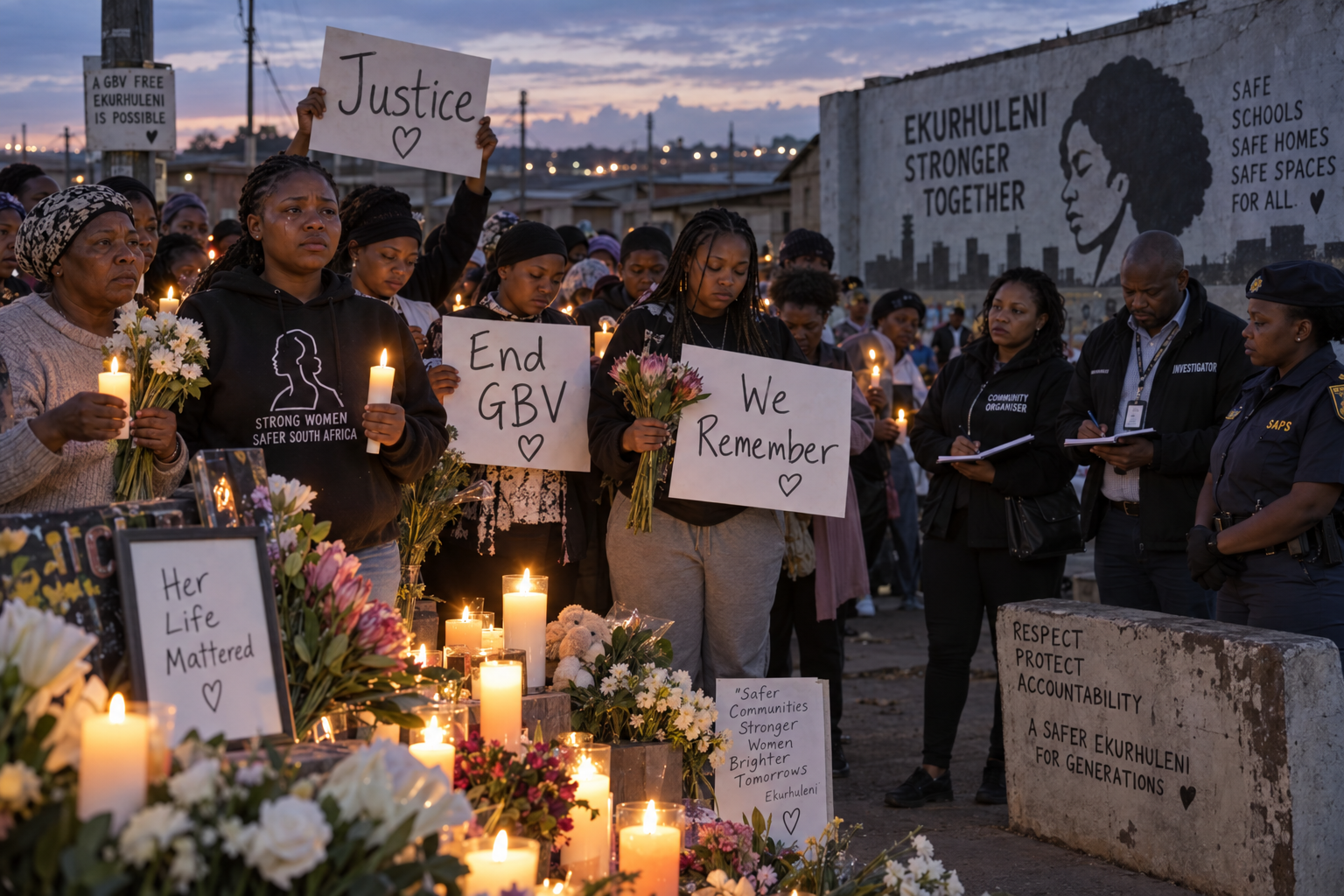
Residents of Olifantsfontein gathered for a candlelit vigil to remember a woman whose body was found floating in a river near Clayville, east of Johannesburg. The woman, believed to have been in her late 20s, was discovered near the Mall of Thembisa on September 7, but police have not released her identity.
Residents travelled in convoy from a police station to the river site, where they prayed, sang hymns and lit candles. The gathering served both as a memorial and as a public demand for stronger action from the government and police. Community members urged authorities to identify those responsible and ensure they are brought to justice.
The woman’s death has been incorporated into a broader investigation into the deaths of women whose bodies have been found in and around Ekurhuleni over the past two months. Police are examining whether the cases are connected. The discoveries have prompted fears that a serial killer may be operating in the area, although authorities have stressed that they have not established that one perpetrator is responsible.
The investigation now covers nine women whose bodies were found in locations including Kempton Park, Clayville, Olifantsfontein, Rhodesfield, KwaThema and Dawn Park. Police have formed a specialised multidisciplinary team to investigate the cases and have appealed to families of missing people to come forward, potentially helping authorities identify the victims.
The vigil reflected growing anxiety about women’s safety in the area, while also highlighting residents’ frustration over the lack of answers and the need for accountability.
Entities: South Africa, Olifantsfontein, Clayville, Ekurhuleni, Johannesburg • Tone: urgent • Sentiment: negative • Intent: inform
19-09-2026
The article reports on a femicide vigil held at the University of Cape Town, where hundreds of people gathered to honor women killed in South Africa and express anger over continuing violence against women. The event reflects growing public concern about femicide, the killing of women because of their gender, and the perceived failure to prevent such crimes or adequately protect women.
The vigil took place as anger was rising across the country following the discovery of the bodies of nine women near Johannesburg over a period of just two months. Although the article does not provide details about the victims, suspects, or the circumstances of the deaths, the number of bodies found has intensified national alarm and prompted public mourning and protest.
The gathering at the university served both as a memorial for victims and as a visible expression of frustration. Its focus on collective grief and anger highlights the broader social impact of femicide beyond individual cases. The event also indicates that concern about gender-based killings is being voiced publicly by communities and activists, with people demanding attention to the safety of women and accountability for violence against them.
Published by Al Jazeera on September 19, 2026, the piece is presented as a short news report or video item under the women’s rights section. It provides a concise account of the vigil and the wider context of the nine deaths near Johannesburg, emphasizing the scale of public emotion and the continuing urgency of femicide in South Africa.
Entities: South Africa, South Africans, University of Cape Town, Johannesburg, Al Jazeera • Tone: urgent • Sentiment: negative • Intent: inform
19-09-2026
A series of murdered women found in South Africa’s Ekurhuleni region has renewed national alarm over gender-based violence and femicide. Nine women’s bodies have been discovered in similar circumstances since July, including three in the week before the article was published. Many of the victims were in their 20s or 30s and had suffered severe violence. Their bodies were reportedly dumped in fields, on bridges or in other public places.
The article focuses on the families of two victims. Dineo Motapane, a 38-year-old mother of two, was last seen alive on a Sunday before her battered and partly burned body was found. Her aunt, Nokwanda Matshikiza, described the family’s grief and the painful prospect of explaining Dineo’s death to her daughter. Itumeleng Kekana, a 32-year-old shopkeeper, disappeared in July and was found 17 days later, badly bruised and partially clothed. Her brother, Themba Kekana, said her death had left her young daughter without a mother.
Only one arrest has been made in connection with the killings, and police have not established whether the cases are linked or involve a serial killer. Official crime data recorded 5,427 murders between April and June, while South Africa’s Human Rights Commission reported that 569 women were killed during that period—an average of six per day—and that 1,052 women survived attempted murder.
The killings have increased pressure on a government that declared gender-based violence a national disaster in 2025 after widespread protests. Amnesty International is calling for femicide to be recognised as a distinct crime, arguing that better classification would force the state to track and confront gender-motivated killings. President Cyril Ramaphosa pledged a thorough investigation. Activists and residents, however, say women remain unsafe in homes, streets and public spaces, and that the crisis reflects deeper historical legacies of colonialism, apartheid and unresolved social trauma.
Entities: Ekurhuleni, Johannesburg, Dineo Motapane, Nokwanda Matshikiza, Itumeleng Kekana • Tone: urgent • Sentiment: negative • Intent: inform
19-09-2026
South Africans held memorial runs and protests during the week of September 19 after police discovered the bodies of nine women in Ekurhuleni, east of Johannesburg, over a two-month period. Authorities are investigating whether the killings are connected. Most of the victims were in their 20s and 30s, and some were found naked and showing signs of sexual assault.
One memorial run in Johannesburg honoured Elizabeth Moselakgomo, who disappeared after going for a run and was found dead several days later. Participants wore black, lit candles and carried a banner reading “Enough. Stop Femicide.” Their statements reflected widespread fear among women, who said they feel unsafe not only while exercising but also at workplaces, on dates, in their homes and when using ride-hailing services.
The killings have renewed anger over South Africa’s broader crisis of gender-based violence, which the government declared a national disaster in 2025. Activists argue that increased public attention and official promises have not substantially improved women’s safety. The Uyinene Mrwetyana Foundation called for women to be able to live and move through society without fear.
President Cyril Ramaphosa pledged that investigators would leave no stone unturned and said the country could not become accustomed to such violence. However, the article highlights serious weaknesses in policing, including corruption and a lack of resources. Only about one in 10 murders is reportedly solved. Merlize Jogiat of Women for Change said the nine bodies were found largely because additional police were present in the area, suggesting that the problem extends across the country.
Activists also criticised police advice telling women to take extra precautions when walking or exercising alone. Women for Change said responsibility for preventing violence should not be shifted onto women, who should not have to organise their lives around avoiding attack.
Entities: South Africa, Johannesburg, Ekurhuleni, Cape Town, Elizabeth Moselakgomo • Tone: urgent • Sentiment: negative • Intent: inform