20-09-2026
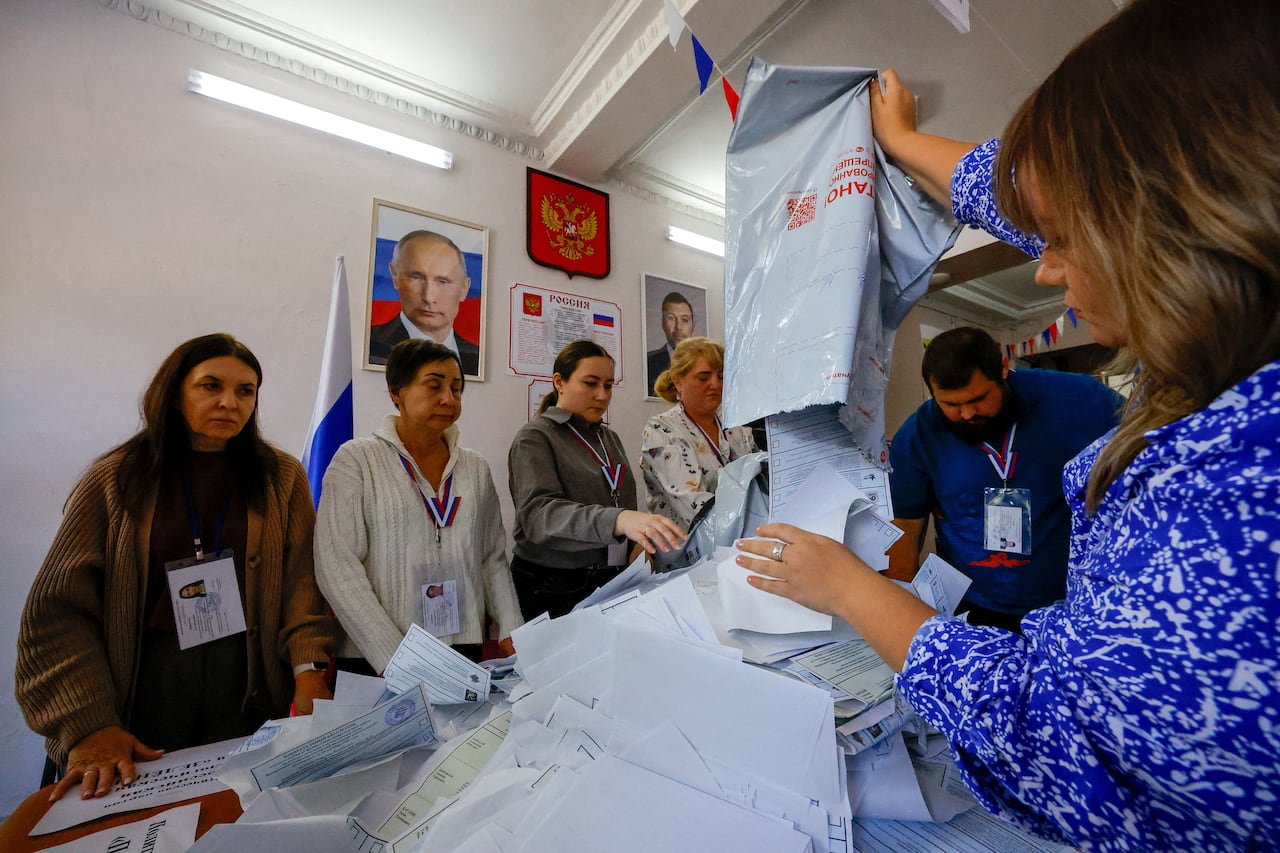
Russia’s ruling United Russia party was projected to win a comfortable majority in the country’s parliamentary election, according to partial official results. With about 57.5 per cent of the vote, the party was far ahead of the Communist Party, the ultranationalist LDPR, New People and Just Russia. Although these parties are formally separate, the article notes that they generally support the Kremlin on major issues. Former president Dmitry Medvedev described the result as evidence that Russians had entrusted United Russia with continued governance.
The election was held amid the ongoing war in Ukraine and a major Ukrainian drone assault on Moscow and other Russian regions. Russian officials said the attack killed three people in the Moscow region and two in Russian-occupied Kherson, including an election official, and damaged a facility at a Moscow oil refinery. Russia’s Defence Ministry also claimed to have intercepted nearly 2,000 drones and eight cruise missiles, while warning that it would intensify strikes on Ukrainian military targets.
Russian authorities accused Ukraine of trying to disrupt the vote, while election officials said cyberattacks had not significantly affected the process. Opposition supporters in exile urged dissenters to gather at polling stations at noon, but the effect of the protest was unclear. Turnout was reported at nearly 57 per cent by early evening.
The article emphasizes that most anti-war candidates were barred from participating and that critics face severe penalties for statements deemed to discredit the military or spread false information. The liberal Yabloko party remained on the ballot, but its candidates expressed fears about repression. Ukraine called the election a “pseudo election,” while analysts suggested that war-related economic strain and public frustration could produce stronger-than-expected support for permitted opposition parties. Nevertheless, the Kremlin is expected to present the result as evidence of public backing for President Vladimir Putin, his policies and the war.
Entities: Vladimir Putin, United Russia, Russian State Duma parliamentary election, Russia, Ukraine • Tone: analytical • Sentiment: negative • Intent: inform
20-09-2026
Russians are voting on the final day of parliamentary elections, with the pro-Kremlin United Russia party widely expected to retain its dominance. The party has won every parliamentary election since 2003. The 2026 election is the first since Russia launched its full-scale invasion of Ukraine in February 2022, making the result a potential indicator of public attitudes toward the war and its growing effects inside Russia.
The electoral environment has been criticized by opposition figures. In August, Russia’s Supreme Court removed Yabloko, described in the article as the only party opposing the war, from the ballot. Although some Yabloko candidates can reportedly still run for individual seats, cofounder Grigory Yavlinsky condemned the decision and called for a ceasefire, diplomacy and peace. The party also alleged that police had used force against an election observer in St. Petersburg and that its observers had been denied access to polling stations or had their movements restricted.
Russia’s Central Election Commission reported more than 1,000 waves of distributed denial-of-service attacks against election infrastructure. Commission chair Ella Pamfilova said the attacks were highly coordinated and may have involved artificial-intelligence tools.
The election took place amid a major wave of drone attacks targeting Moscow and other parts of Russia. Moscow Mayor Sergey Sobyanin said Russian air defenses had destroyed more than 1,600 drones nationwide since Saturday, including 450 headed toward the capital. He reported damage to a Moscow refinery and a residential building, while the governor of Moscow Oblast said two people had been killed in the wider region. Sobyanin accused Ukraine of trying to disrupt the election.
Ukrainian President Volodymyr Zelenskyy confirmed that Ukraine had targeted the Moscow region, saying a key oil facility and a logistics site were hit. He also said Russia had launched more than 2,000 attack drones, 1,700 aerial bombs and 19 missiles against Ukraine during the week.
Entities: Russia, 2026 parliamentary elections, United Russia, Vladimir Putin, Ukraine war and Russia’s full-scale invasion • Tone: analytical • Sentiment: negative • Intent: inform
20-09-2026
Russia’s ruling United Russia party was projected to win the country’s parliamentary elections by a wide margin, according to partial official results and exit polls. With nearly 57.5% of the vote, United Russia was far ahead of the Communist Party, the ultra-nationalist LDPR, New People and Just Russia. Although these parties are formally in opposition, they generally support the Kremlin on major issues and were also expected to gain seats in the State Duma.
The election took place amid the continuing war in Ukraine and was presented by President Vladimir Putin as a test of public support for his policies and the conflict. On the final day of voting, Ukraine launched what Russian officials described as its largest drone assault since the full-scale invasion began in February 2022. Three people were killed in the Moscow region and two others died in Russian-controlled parts of Ukraine’s Kherson region, including an election official. A Moscow oil refinery was damaged, while Russian authorities said they had intercepted thousands of drones and several cruise missiles.
Russian officials accused Ukraine of trying to disrupt the vote, while Moscow Mayor Sergei Sobyanin said the attack had failed to prevent the election. Authorities also reported cyberattacks against voting systems but said the process was largely smooth. Turnout was reported at nearly 57% by early evening.
Critics described the election as tightly controlled and lacking meaningful competition. Most anti-war candidates were barred, while candidates from the liberal Yabloko party said they feared prosecution. Opposition activists in exile encouraged voters to gather at polling stations at noon as a symbolic protest. Ukraine dismissed the election as a “pseudo election.”
The Kremlin is expected to portray the result as evidence of national unity and support for Putin and the war. However, analysts said economic strain, war-related anxiety and public frustration could produce stronger-than-expected results for the permitted systemic opposition parties.
Entities: United Russia, Vladimir Putin, Russian parliamentary elections, State Duma, Ukraine • Tone: analytical • Sentiment: negative • Intent: inform
20-09-2026
Russia’s ruling United Russia party secured a large majority in parliamentary elections held amid wartime conditions, cyberattacks and a major wave of Ukrainian drone strikes, according to results reported by Russian state media. The party was projected to win enough seats to retain a two-thirds majority in the 450-member State Duma, strengthening President Vladimir Putin’s political control.
The vote was the first Russian parliamentary election since Moscow launched its full-scale invasion of Ukraine in 2022. The electoral environment was heavily restricted: no party explicitly opposed to the war was permitted to compete, and Russia’s Supreme Court removed the anti-war Yabloko party from the ballot several weeks before voting began. Elections were also conducted in Ukrainian territories occupied and annexed by Russia, a move that is internationally disputed.
The election took place as Russia and Ukraine continued their broader conflict. Ukrainian drone strikes reportedly targeted Russia on election day, while cyberattacks also affected the voting process. The headline frames the attacks as a major disruption accompanying a result that nevertheless favored the Kremlin’s ruling party. The available article excerpt does not provide detailed figures on turnout, the number or location of drone attacks, or the precise seat totals, but it portrays United Russia as firmly on course for continued dominance in the lower house.
Overall, the report presents the election as both a political victory for Putin’s party and a vote conducted under wartime and highly controlled conditions. It emphasizes the absence of meaningful anti-war opposition, the participation of occupied Ukrainian territories, and the security threats surrounding the election.
Entities: Vladimir Putin, United Russia, State Duma, Russia, Ukraine • Tone: analytical • Sentiment: negative • Intent: inform
20-09-2026
Russia’s parliamentary election entered its third and final day on September 20, with President Vladimir Putin presenting the vote as a measure of public support for his policies and the war in Ukraine. The ruling United Russia party was widely expected to retain its dominance in the State Duma, amid criticism that Russia’s political system does not permit meaningful dissent. The election is the first parliamentary vote since Russia launched its full-scale invasion of Ukraine in February 2022.
Most explicitly anti-war candidates were excluded from the ballot. Candidates from the liberal Yabloko party said they feared for their freedom after two senior party figures received lengthy prison sentences over comments about the war that authorities deemed illegal. Russian laws criminalize what officials define as discrediting the army or spreading false information. The Kremlin argues that censorship and national unity are necessary during its “special military operation,” which it portrays as part of an existential confrontation with the West.
Although the outcome appeared predictable, analysts said the election could still reveal public frustration. The NEST think-tank suggested that economic strain, war-related anxiety and accumulated discontent might benefit permitted opposition parties, particularly the Communist Party and New People. However, both parties have generally supported United Russia on major issues.
Putin accused Ukraine of attempting to interfere in the election, citing an alleged strike that killed election official Elena Astanina in Russian-controlled Zaporizhzhia. Reuters could not independently verify the claim. Russian officials also reported a cyberattack on Moscow’s online voting system, while Kyiv dismissed the election as a “pseudo election.” Initial results were expected Sunday evening, with fuller results due Monday.
Entities: Russian parliamentary election, Vladimir Putin, State Duma, United Russia, Russia’s war in Ukraine • Tone: analytical • Sentiment: negative • Intent: inform
20-09-2026
Ukraine launched what Moscow described as its largest-ever drone attack on the Russian capital on Sept 20, coinciding with the final day of Russia’s parliamentary and regional elections. Moscow Mayor Sergei Sobyanin said the attack was intended to disrupt voting but was repelled, with Russian authorities claiming that more than 1,600 drones were shot down. Two people were killed in the Moscow region, while two others, including an election official, died in the Russian-controlled part of Ukraine’s Kherson region. A facility at Moscow’s oil refinery was damaged.
The State Duma election is the first since Russia began its full-scale invasion of Ukraine in February 2022. The ruling United Russia party is expected to retain its dominance, and the Kremlin is likely to portray the results as evidence of public support for President Vladimir Putin, the war and his broader policies. Most anti-war candidates were excluded from the ballot, while candidates from the liberal Yabloko party said they feared imprisonment after senior party figures received lengthy sentences for comments about the conflict.
Voting authorities reported that the three-day election proceeded smoothly despite alleged cyberattacks against Moscow’s online voting system. Turnout had exceeded 45 per cent by late morning on the final day. Yabloko leader Nikolai Rybakov spoiled his ballot by writing the party’s name and the slogan “For peace.”
Although the result is considered predictable, analysts said public frustration over wartime economic pressures could increase support for permitted opposition parties, particularly the Communist Party and New People party. Both generally support United Russia on major issues but could receive protest votes that the Kremlin would prefer to go to the ruling party. Ukraine has dismissed the election as a “pseudo election,” while Reuters said it could not independently verify some Russian accounts of attacks and noted there had been no comment from Kyiv.
Entities: Ukraine, Moscow, Russia, Russian State Duma election, Russian parliamentary and regional elections, Russian drone attack on Moscow • Tone: analytical • Sentiment: negative • Intent: inform