24-10-2026
Jordan’s King Abdullah has ordered security forces to respond firmly and find those responsible for a deadly attack at a Greek Orthodox church in Karak governorate. Eight people were killed and 40 wounded when gunmen opened fire during a funeral on Friday. Jordanian authorities described the shooting as an act of extremist terrorism, but no group had claimed responsibility at the time of publication. The kingdom declared three days of national mourning and increased security at malls, foreign embassies and other locations while the search for the attackers continued.
King Abdullah visited Karak hours after the attack and said those responsible would be punished “with an iron fist.” Prime Minister Jafar Hassan called the attack the result of “terrorist ideology and blind extremism” and said Jordan would not allow society to follow that path. Officials said it was too early to establish whether the attackers had links to known groups in Jordan or abroad.
Survivor Nasser al-Burqan told Reuters that one attacker pointed a handgun at him and fired from close range. His son, who had also attended the funeral, was later treated in hospital for a gunshot wound to the leg. Tarek Ammarin, whose relative was injured, described the event as a massacre. Local officials condemned the attack and expressed hope that Jordan would remain safe.
The article notes that attacks of this kind are rare in Jordan, though authorities say they have foiled plots by violent groups in recent years. Karak has a minority Christian population, and Jordan’s biblical sites draw Christian pilgrims from around the world.
Entities: King Abdullah, Jafar Hassan, Nasser al-Burqan, Tarek Ammarin, Bahjat al-Rushda • Tone: neutral • Sentiment: negative • Intent: inform
24-10-2026
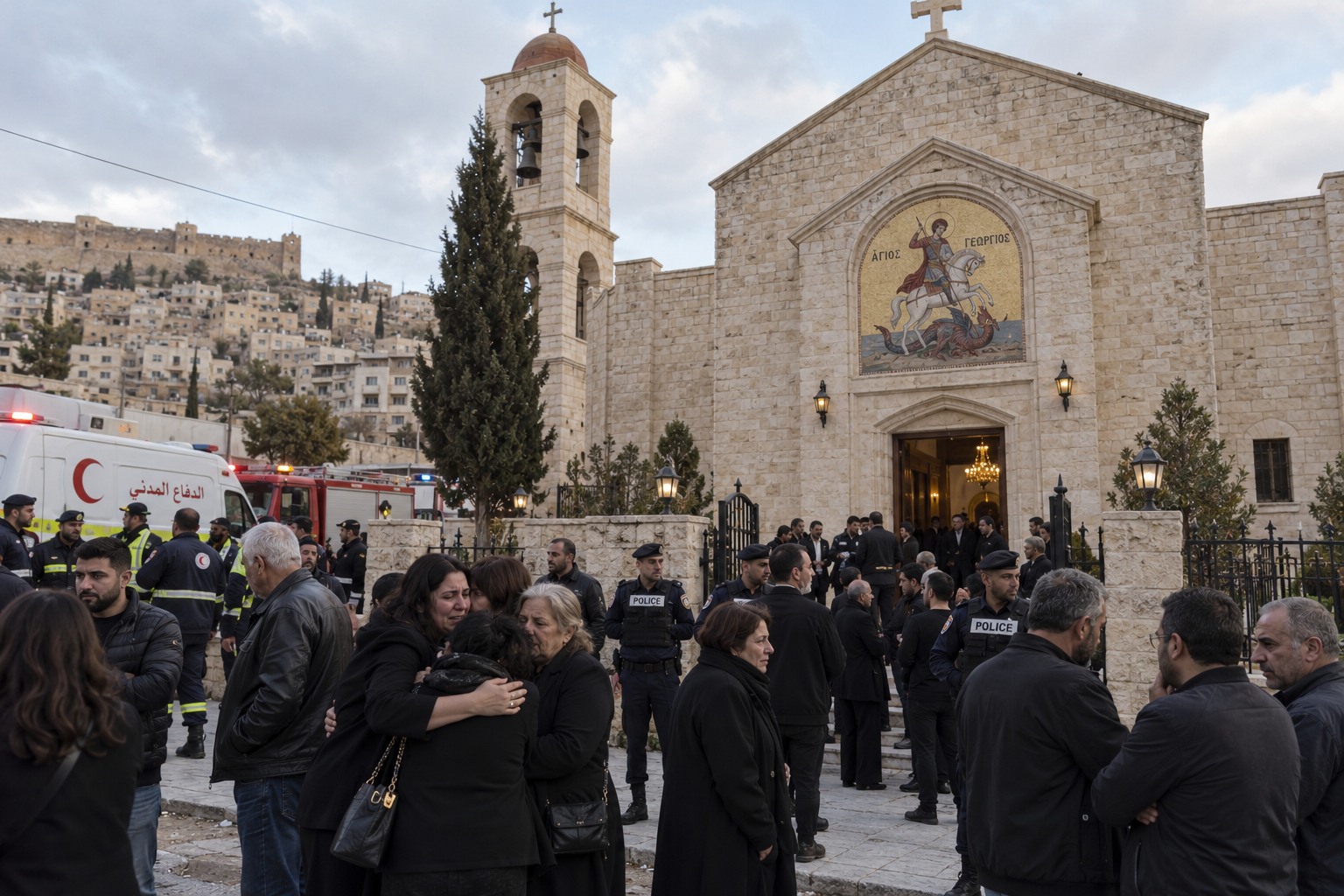
Three masked gunmen opened fire during a funeral at Saint George’s Greek Orthodox Church in Hamoud, in Jordan’s Karak governorate, on Friday, October 23, 2026. Eight people were killed and 40 injured, according to Jordanian authorities and state media; 27 of the injured remained in hospital, with one person in critical condition. Survivors described hearing an explosion before the attackers entered and fired for several minutes. One survivor told Reuters that an assailant pointed a handgun at him and shot, and his son was also wounded.
The attackers have not been identified, and authorities have not established a motive. Jordan’s Interior Minister described the perpetrators as extremists, while Prime Minister Jafar Hassan attributed the attack to terrorist ideology and “blind extremism” without naming a group. Footage circulating online reportedly shows three people firing outside the church and at people trying to flee. Security forces are searching for the suspects, and King Abdullah II has ordered a review of security procedures for responding to terrorist attacks and promised the perpetrators the “harshest penalties.”
The attack has prompted condolences and condemnation from Jordanian officials, foreign governments, the United States embassy, and the grand imam of Al-Azhar. Jordan declared three days of mourning. The article notes that Karak, about 120km south of Amman, has a substantial Christian community, and that Christians and Muslims have lived alongside one another there for generations. A regional correspondent suggested that an attack intended to divide the community could instead strengthen its solidarity. Attacks of this kind are rare in Jordan, though ISIL carried out a deadly series of attacks in Karak in 2016, including a siege that killed 10 people.
Entities: Jordan, Karak governorate, Hamoud, Saint George’s Greek Orthodox Church, King Abdullah II • Tone: analytical • Sentiment: negative • Intent: inform
24-10-2026
Gunmen opened fire during a funeral at a Greek Orthodox church in Karak, Jordan, on Friday, killing seven people and wounding 40, according to authorities. The church is about 90 kilometres south of Amman. Jordanian state television footage appeared to show two men with pistols approaching the church and firing, followed by a third man carrying what appeared to be a semiautomatic rifle. The three then ran toward the church. Witness video showed broken glass and blood inside. A mourner, Dorgham Halasa, said intense gunfire began about 15 minutes after the funeral started, causing people to flee. He did not see the attackers; other witnesses reportedly described four assailants. The Associated Press said it could not independently confirm the number, and security services had not released further details. The government described the attackers as unknown and said investigations were proceeding. Jordan declared three days of national mourning. Health Minister Ibrahim al-Budour said two wounded people were in critical condition. King Abdullah II condemned the attack and promised the harshest penalties, while Prime Minister Jafar Hassan attributed it to terrorist ideology and extremism and said those responsible would face punishment. Condemnations and expressions of solidarity came from across the region, including Lebanon, Syria, Egypt, Oman and Iraq. The grand imam of Al-Azhar called the shooting a heinous terrorist attack, and U.N. Secretary-General Antonio Guterres called it especially heinous and urged that those responsible be held accountable. The article notes that Karak was the site of deadly attacks in 2016, when gunmen killed 10 people, including seven police officers.
Entities: Karak, Jordan, Amman, Greek Orthodox church, Jordanian state television, Dorgham Halasa • Tone: neutral • Sentiment: negative • Intent: inform
24-10-2026
Seven people were killed and 40 wounded when gunmen opened fire during a funeral at a Greek Orthodox church in Karak, Jordan, on Friday, according to authorities. The church is about 90 kilometers south of Amman. Jordanian state television footage showed two men approaching the church with what appeared to be pistols and firing, followed by a third man carrying what appeared to be a semiautomatic rifle. Witness footage showed broken glass and blood inside the church. A mourner, Dorgham Halasa, said gunfire erupted about 15 minutes after the funeral began, prompting people to flee. He did not see the attackers; reports from others at the scene differed on whether there were three or four assailants. The Associated Press said it could not independently verify the number, and Jordan’s security services had not immediately provided details. The government described the perpetrators as unknown and said investigations were underway. Jordan declared three days of national mourning. Health Minister Ibrahim al-Budour said two wounded people were in critical condition. King Abdullah II vowed harsh penalties for the attack and expressed condolences, while Prime Minister Jafar Hassan blamed terrorist ideology and extremism and said those responsible would face punishment. Officials and religious leaders across the region, including representatives from Lebanon, Syria, Egypt, Oman and Iraq, condemned the killings. U.N. Secretary-General António Guterres also denounced the attack as especially heinous and called for those responsible to be found and held accountable. The report notes that Karak has a minority Christian population and was the site of deadly attacks on police in 2016, when gunmen killed 10 people, including seven officers, before security forces killed them after a standoff.
Entities: Karak, Jordan, Greek Orthodox church, Amman, Dorgham Halasa, King Abdullah II • Tone: neutral • Sentiment: negative • Intent: inform
24-10-2026
A gun attack during a prayer service at the Greek Orthodox Hamoud church in Jordan’s Karak governorate killed eight people and wounded 40, according to Jordanian authorities and Reuters. The shooting took place on Oct. 23, while a funeral for a relative of survivor Nasser al-Burqan was being held at the church. Burqan said he initially mistook the sound of gunfire for an exploding air-conditioner. After the shooting stopped, he saw two assailants outside a window: one masked and the other carrying a handgun. He said the unmasked attacker, about two metres away, pointed the gun at him and fired. Shattered glass cut his face, but Burqan declined medical treatment. His son, who had also attended the service, later called to say that he had been shot in the leg and was receiving hospital treatment.
The attack shocked the Christian minority community in Jordan, where such violence is rare. The church is about 120km southwest of the capital, Amman. King Abdullah visited Karak hours after the shooting and vowed the perpetrators would be punished “with an iron fist.” Authorities said they were still searching for the attackers and that it was too early to determine whether they were connected to known groups inside or outside the country. No group had claimed responsibility at the time of publication.
Security was increased at malls, foreign embassies and other locations across Jordan, the US Embassy in Amman said on Oct. 24. The article notes that Jordanian authorities have repeatedly foiled plots by Islamist militants in recent years, despite the rarity of attacks of this kind in the country.
Entities: Nasser al-Burqan, King Abdullah, Hamoud, Jordan, Karak governorate, Amman • Tone: neutral • Sentiment: negative • Intent: inform
24-10-2026
Jordan’s Christian community was shaken after eight men were killed in an attack at St George’s Orthodox Church in Hamoud during a funeral on Friday. Authorities described the attack as terrorism, raised the death toll from seven to eight, and said the three assailants had not been captured. The victims were mostly members of the prominent Halasah family, whose ancestral home is in Hamoud, about 80 kilometres south of Amman. Three of those killed were doctors. A member of the family said the attack appeared intended to drive Christians from the country and called Hamoud a stronghold of the community.
The attack was described as the largest against Jordan’s Christians since the mid-1950s. Christians number about 250,000 in a population of 11 million, and Orthodox Christians are the largest denomination. Church leaders condemned the attack while affirming Christians’ connection to Jordan and their loyalty to the state and King Abdullah II. The Archbishop of Jerusalem called it an ugly terrorist act and said it would not undermine national unity.
The article places the attack amid Jordan’s economic difficulties, its role as a regional bastion of stability, and tensions surrounding Islamist politics. Jordan banned the Muslim Brotherhood in 2025, while the linked Islamic Action Front—renamed the Umma Party this year—remains represented in parliament. Comments by some Islamists about Christians’ place in Jordan drew criticism on social media for encouraging sectarian tension. The Umma Party itself condemned the church attack as a terrorist crime targeting national cohesion. No group claimed responsibility, and authorities did not identify a culprit. The attack came as Jordan was promoting a nearby Christian pilgrimage site associated with Jesus’s baptism to help revive tourism.
Entities: Jordan, Hamoud, St George’s Orthodox Church, Halasah family, King Abdullah II • Tone: analytical • Sentiment: negative • Intent: inform