30-09-2026
The United States has completed the withdrawal of its troops from Iraq, ending a 12-year mission focused on defeating the Islamic State group. The final contingent left an air base in Irbil, in Iraq’s semi-autonomous Kurdish region, under an agreement between Baghdad and Washington. Pentagon spokesperson Sean Parnell described the departure as orderly and said the mission had defeated ISIS as an organised military threat. He framed the change as a shift from a wartime coalition operation to an Iraqi-led security effort supported by a regular bilateral relationship.
Iraqi Prime Minister Ali al-Zaidi presented the handover as a new phase for Iraq, emphasizing sovereignty, stronger institutions, military readiness and partnerships. The Baghdad government has portrayed the withdrawal as evidence of the country’s growing strength. However, Kurdish officials are concerned about the loss of US air-defence systems amid regional conflict. The Kurdish Peshmerga Ministry says the region suffered more than 1,000 drone and ballistic-missile attacks during the recent US-Iran conflict, and warned that the US departure without a defence system was concerning.
The withdrawal also coincides with unresolved efforts to disarm armed groups outside the state. Baghdad had initially linked the September 30 withdrawal deadline to militia disarmament, but powerful Iran-aligned groups rejected or conditioned disarmament. Al-Zaidi later said the deadline had been postponed to June 2027. Iran-allied Kataib Hezbollah celebrated the US departure as an end to an occupation and threatened the government if it did not serve the public’s interests.
US forces first invaded Iraq in 2003 and left in 2011. Iraqi authorities invited a smaller US-led force back in 2014 to fight ISIS, which had captured large areas of the country. After the group was reduced to scattered sleeper cells, Washington and Baghdad agreed in 2024 to wind down the mission. Most US troops left Iraqi bases last year, while several hundred remained in the Kurdish region, where bases have faced attacks since the US and Israel began their war against Iran on February 28.
Entities: United States military withdrawal from Iraq, Iraq, Irbil, Iraqi Kurdistan, Ali al-Zaidi • Tone: analytical • Sentiment: neutral • Intent: inform
30-09-2026
The departure of US forces from their remaining bases in Iraq on September 30, 2026, ends the Global Coalition to Defeat ISIL’s mission in the country and concludes a phased withdrawal agreed by Baghdad and Washington in 2024. Iraq is marking the occasion with four “Sovereignty Days,” but the transition raises questions about whether Iraqi forces can manage security challenges without coalition support.
Iraqi officials say responsibilities had already shifted to national forces: the air force now conducts daily reconnaissance, Iraqi drones have replaced coalition aircraft for that task, and Iraqi F-16s have flown missions without outside assistance. However, the withdrawal also removes equipment and support, including air-defence systems, intelligence, logistics and drones. These losses are particularly concerning for the Kurdistan Region, which reports more than 1,000 drone and missile attacks since the US-Israeli war on Iran began. Iraq says it is close to acquiring air-defence systems from South Korea, Türkiye and the United States, but one expert doubts the country can currently defend its airspace effectively.
ISIL is far weaker than it was a decade ago, with only a few hundred fighters, and US officials describe the transition as a move to Iraqi-led security. Nevertheless, the group retains cells and reportedly planned attacks around the withdrawal, highlighting the possibility of security gaps. Iran-aligned armed groups have hailed the US exit as a victory, while rejecting an earlier deadline to surrender their weapons; Baghdad has postponed that deadline to June 2027.
The withdrawal does not end US involvement in Iraqi security. The two countries have planned a shift toward bilateral cooperation, including liaison officers, training and security programmes. The supplied article cuts off while describing further areas of cooperation, so its final account is incomplete.
Entities: Iraq, United States, Global Coalition to Defeat ISIL, ISIL (ISIS), Baghdad • Tone: analytical • Sentiment: neutral • Intent: inform
30-09-2026
The article reports that Iraq marked National Sovereignty Day with security-force parades in Baghdad and Najaf. The holiday commemorates the withdrawal of US troops from Iraq. According to the article, the remaining US soldiers left the country on Wednesday, bringing the US-led coalition’s operation against ISIL to an end. The report therefore connects a national commemoration with a significant change in the coalition’s military presence in Iraq.
The article provides only a brief account. It does not give details about the size of the parades, the number of soldiers who departed, the circumstances of their departure, or what security arrangements may follow. It also does not include comments from Iraqi officials, residents, or coalition representatives. Its focus is limited to the public celebrations in Baghdad and Najaf, the meaning of the holiday, and the reported conclusion of the coalition operation against ISIL. The report does not describe wider political or security consequences, so no further outcomes can be established from the text provided.
Entities: Iraq, Baghdad, Najaf, Iraqi security forces, United States (US) • Tone: neutral • Sentiment: neutral • Intent: inform
30-09-2026
The last British and American troops have left Iraq, ending the military mission of the international coalition that was formed in 2014 to help defeat the Islamic State (IS). The departure of roughly 100 remaining British personnel from Irbil was coordinated with US forces and follows a withdrawal agreement reached by Washington and Baghdad two years ago. Iraqi Prime Minister Ali al-Zaidi described the change as a transition to full Iraqi responsibility for national security, and Iraq plans to mark it with four national “Sovereignty Days.”
The UK Ministry of Defence said Iraqi Security Forces and the Kurdish Peshmerga had achieved IS’s territorial defeat in Iraq and were equipped to take primary responsibility for security. US President Donald Trump called the withdrawal a victory, while the Pentagon said Iraq must now address remaining threats, including IS remnants and Iranian-aligned militias. Although Iraq declared IS militarily defeated in 2017, the group remains active: a recent UN assessment estimated it had several hundred fighters in Iraq, capable of limited operations.
The withdrawal comes amid heightened regional tensions. Iranian-backed militias have attacked coalition forces at Irbil, and the article describes drone and missile attacks on the base during the US-Israel war with Iran. British personnel reportedly shot down more than 100 drones in the war’s first six weeks. The UK says its personnel trained and supported over 111,000 Iraqi and Peshmerga forces, while the RAF struck more than 2,300 IS targets. UK aircraft are expected to continue operations over Syria, and the US will retain targeted training and intelligence support for Iraqi partners. The coalition taskforce is now based in Jordan, and US forces will continue counter-IS operations in Syria.
The article places the exit in the context of earlier US and UK deployments to Iraq, including the 2003 invasion and the 2011 withdrawal. Foreign forces returned in 2014 when IS threatened to take control of the country. With their departure, Iraq’s government also faces the challenge of bringing powerful Iranian-backed militias under state control.
Entities: Iraq, Irbil, Kurdistan Region, Ali al-Zaidi, Donald Trump • Tone: analytical • Sentiment: neutral • Intent: inform
30-09-2026
The U.S. military has declared its Iraq-based Operation Inherent Resolve mission against ISIS complete, following the withdrawal of coalition forces and equipment from Erbil Air Base. The Pentagon describes the departure as the end of a 12-year campaign that removed ISIS’s ability to operate as an organized military force in Iraq and as a shift to a bilateral security relationship. The United States says it will continue targeted training and intelligence support for Iraqi partners, while responsibility for security now rests primarily with Iraq’s government and forces, including the Peshmerga.
The withdrawal was planned under a 2024 U.S.-Iraq agreement that set out the end of the international coalition mission and a transition by 2026. U.S. forces had also served in Syria, where roughly 1,500 troops withdrew earlier in the year. The article notes that the end of the mission does not eliminate ISIS: the group has carried out deadly attacks, and U.S. personnel have faced threats from Iran-backed militias. The Pentagon said those militias launched more than 600 attacks against U.S. citizens and facilities between February and April 2026.
Iraqi officials have welcomed the withdrawal and expressed confidence in their security forces, but the move comes amid regional instability and concern that ISIS could regain strength or that Iran-aligned militias could draw Iraq deeper into the broader conflict. Analyst Saman Noah says many Iraqis doubt the government can control armed groups operating outside state authority, and points to weaknesses such as limited air defenses and reliance on U.S. weapons. Kurdish leaders, whose Peshmerga forces have long fought alongside the United States, also want the Kurdistan Region included in the countries’ future security arrangements. The article presents the transition as a significant sovereignty milestone, while emphasizing that major security challenges remain.
Entities: Operation Inherent Resolve, ISIS, Iraq, Erbil Air Base, U.S. Department of Defense • Tone: analytical • Sentiment: negative • Intent: inform
30-09-2026
The United States has completed the withdrawal of its forces from its remaining military bases in Iraq, ending the Iraq phase of Operation Inherent Resolve after more than a decade. The Pentagon said the coalition mission had concluded in line with a September 2024 agreement between Washington and Baghdad. It described the campaign as having defeated ISIS as an organized military threat in Iraq and the region, while saying the United States would continue targeted training and intelligence support for Iraqi partners. The change is framed as a shift from a wartime coalition mission to an Iraqi-led security effort and a more conventional bilateral security relationship.
Iraqi Prime Minister Ali al-Zaidi and the heads of Iraq’s executive, legislative and judicial branches welcomed the departure as a milestone in the country’s path toward sovereignty. They designated October 1, the day after the coalition’s departure, as Sovereignty Day. Coalition troops had arrived in Iraq and Syria in 2014 to fight the Islamic State group, which had seized large areas of both countries. ISIS was defeated territorially in Iraq in 2017 and Syria in 2019, though coalition forces remained to confront its remnants. The withdrawal comes 23 years after the US-led invasion toppled Saddam Hussein and contributed to years of upheaval preceding ISIS’s rise.
The article also describes regional and security concerns. Iran and allied groups welcomed the withdrawal as a victory for Iran’s “axis of resistance,” while the departure has prompted worries that security could weaken and that Iran-backed Shiite militias or ISIS remnants might gain ground. In Iraq’s Kurdistan region, where many remaining US bases were located, residents fear drone attacks could become harder to defend against without US air-defense systems. The Kurdish regional government’s Peshmerga Ministry likewise expressed concern about the departure under current regional conditions and without a replacement defense system.
Entities: United States, Iraq, Operation Inherent Resolve, Pentagon, Sean Parnell • Tone: analytical • Sentiment: neutral • Intent: inform
30-09-2026
US forces are withdrawing from their remaining bases in Iraq, completing a pullout agreed in 2024 under then-President Joe Biden and carried out by President Donald Trump’s administration. Iraqi officials and analysts fear the departure could create a security vacuum, strengthen Iran-backed militias, and give Islamic State (IS) sleeper cells an opportunity to rebuild. Although the withdrawal is broadly popular among Iraqis, concerns persist about whether Iraqi security forces can independently protect the country and maintain capabilities previously supported by the US, including intelligence, aerial surveillance, and reconnaissance.
The article places the withdrawal in the context of the long US military presence in Iraq. US-led forces toppled Saddam Hussein in 2003, after which Iraq experienced upheaval and years of conflict. American forces withdrew in 2011, returned in 2014 to help Iraqi forces fight IS, and supported the campaign that defeated the group’s territorial caliphate by 2017. The article also notes the American deaths incurred across the wars in Iraq and Afghanistan, as well as US service members killed in this year’s conflict with Iran, including one who died near Erbil.
Iran and its regional allies portray the US departure as a victory for Tehran’s “axis of resistance.” Analyst Ahmed Younis warns that Iranian-backed groups may feel emboldened to expand their influence in Iraqi state institutions and policymaking. Separately, Iraqi security officials worry that IS retains a sleeper-cell network despite losing its territory. Retired General Mohammed al-Jubouri highlights the need for a viable post-coalition security plan and warns that armed or improvised explosive drones could pose a serious threat while Iraq lacks adequate air defences. The central concern is whether Iraq’s institutions can address these risks without the coalition’s support.
Entities: Iraq, United States, Iran, Donald Trump, Joe Biden • Tone: analytical • Sentiment: negative • Intent: inform
30-09-2026
The France 24 video report, “Why is the US withdrawing its troops from Iraq?”, examines the end of a US-led coalition mission in Iraq and the security questions surrounding that change. The supplied article text says the coalition, which deployed to Iraq more than a decade ago to fight jihadists, concluded its mission on Wednesday, September 30, 2026. Iraqi leaders celebrated the move, while some observers feared that the withdrawal could embolden pro-Iran armed factions. France 24 correspondent Angela Diffley looks at the security challenges facing Iraq and considers why the United States has chosen this moment to take its troops out.
The available page text does not include the video transcript or a fuller account of the report’s arguments. It therefore does not specify the US government’s stated rationale, the precise timetable or scale of any troop movements, or the expected effects on Iraqi security institutions and armed groups. The headline frames the video around the reasons for the withdrawal, but the accompanying description only establishes the mission’s conclusion, the contrasting reactions, and the central security concern. Accordingly, the article can be summarized as a brief introduction to a report analyzing a significant shift in the coalition’s role in Iraq—not as a detailed explanation of the withdrawal’s causes. Its focus is the tension between Iraqi leaders’ welcome for the mission’s end and concern that armed factions aligned with Iran may gain influence as the US-led military presence changes.
Entities: Iraq, United States, US-led coalition, France 24, Angela Diffley • Tone: analytical • Sentiment: neutral • Intent: analyze
30-09-2026
The U.S. military says it has completed the withdrawal of all American troops from Iraq, ending a 12-year mission focused on fighting the Islamic State group (ISIS). The final troops and equipment left an air base in Irbil, in Iraq’s semi-autonomous Kurdish region, under an agreement reached by Baghdad and Washington two years earlier. The departure comes amid continuing conflict between the United States and Iran, which has at times spilled into Iraq through attacks by Iran-backed militias and U.S. strikes against those groups.
Iraqi officials presented the end of the mission as a sign of greater national sovereignty and institutional strength. Prime Minister Ali al-Zaidi presided over the handover ceremony and described a new phase built around Iraqi-led security, unified decision-making and balanced international partnerships. The government says Iraqi forces will continue fighting ISIS and that it will work to ensure non-state groups give up their weapons. U.S. officials said the departure marks a shift from a coalition wartime mission to a more typical bilateral security relationship, while targeted training and intelligence support for Iraqi partners will continue.
The withdrawal was welcomed by Iran-backed groups, but it has also prompted concern among some Iraqis, especially in the Kurdish region, about a possible ISIS resurgence and further attacks by Iran-linked groups. The future and disarmament of Iraqi militias remain unresolved issues. The article also places the departure within a broader, uneven U.S. effort to redirect attention from the Middle East toward Asia, even as new conflicts draw American forces back into the region. It notes that U.S. troops invaded Iraq in 2003 to topple Saddam Hussein and left in 2011, before Iraqi authorities invited a smaller force back three years later; the supplied article text ends before completing that account.
Entities: United States military, Iraq, Islamic State (ISIS), Baghdad, Washington • Tone: analytical • Sentiment: neutral • Intent: inform
30-09-2026
The United States has withdrawn its last troops from Iraq, more than two decades after the U.S.-led invasion. Iraq is presenting the departure as a restoration of its sovereignty, but retired Lt. Gen. H.R. McMaster argues that the timing could create serious security risks. In an interview with NPR’s Morning Edition, McMaster said the withdrawal could embolden Iran and leave Iraq exposed to a resurgence of ISIS, whose defeat he says may not be enduring.
McMaster served 34 years in the U.S. Army and commanded the 3rd Armored Cavalry Regiment in 2005 during a counterinsurgency campaign against al-Qaida in Iraq in Tal Afar, near the Syrian border. He later helped shape U.S. military strategy in Iraq and Afghanistan and served as President Donald Trump’s national security adviser during Trump’s first term. He said a continued U.S. presence had helped gather intelligence and support Iraqi forces confronting ISIS. He also identified Iranian-backed militias that operate beyond Baghdad’s control as a continuing threat to Iraq’s sovereignty.
The article places the withdrawal against the long and devastating aftermath of the invasion. According to Iraq Body Count, at least 200,000 Iraqi civilians were killed, and millions more were displaced during the war and its aftermath. Asked how the soldiers he led might regard the departure, McMaster said he hoped they would feel tremendous pride, describing their campaign against al-Qaida in Iraq as a “righteous mission.” The report presents McMaster’s warning alongside Iraq’s claim of restored sovereignty and the enormous human cost of the conflict.
Entities: H.R. McMaster, Iraq, United States, Iran, ISIS • Tone: analytical • Sentiment: neutral • Intent: inform
30-09-2026
The U.S. military has withdrawn its final forces from Iraq, ending a presence that began with the 2003 invasion and continued through a 2014 return to help fight ISIS. U.S. Central Command said the last troops left Erbil Air Base in Iraq’s Kurdistan Region. Most U.S. forces had departed earlier in the year; about 1,500 remained in the region. The anti-ISIS coalition headquarters is moving to Jordan, while U.S. forces will continue counterterrorism operations in Syria.
The withdrawal follows the territorial defeat of ISIS in Iraq in 2017 and in Syria two years later, but the group still has sleeper cells. Iraqi forces say they are improving their ability to coordinate with Kurdish forces, including through two joint brigades, though they have relied on U.S. intelligence and surveillance capabilities. A recent attack near Kirkuk, where Iraqi forces killed two suicide bombers and a civilian also died, underscores the continuing threat.
Iraqi officials have framed the departure as a milestone for sovereignty and said they are seeking a more equal bilateral relationship with the United States. President Trump also celebrated the withdrawal, calling it the end of a costly excursion. Yet the change raises concerns, particularly among Kurdish leaders, who fear greater vulnerability to Iran and Iran-backed militias. Iraq says it will defend the Kurdistan Region and is discussing air-defense purchases from South Korea, Turkey and the United States.
The article also describes enduring regional tensions. Iran has long pushed for the removal of U.S. troops and has expanded its influence in Iraq since Saddam Hussein’s overthrow. Washington is pressing Iraq to disarm Iran-backed militias, but the Iraqi prime minister has sought to extend a September deadline until next June, and several powerful militias say they will not surrender their weapons. The withdrawal thus ends a major chapter of the U.S. military mission while leaving security and political challenges unresolved.
Entities: Jane Arraf, Ali al-Zaidi, Donald Trump, Marco Rubio, Sabah al-Numan • Tone: analytical • Sentiment: neutral • Intent: inform
30-09-2026
A US-led coalition that was deployed to Iraq in 2014 to fight Islamic State has concluded its mission in the country, according to the article. Iraqi leaders welcomed the end of the mission, while some observers fear that the departure could create room for pro-Iran armed factions to expand their influence. The coalition had been sent to Iraq and Syria after Islamic State seized extensive territory and carried out massacres and the enslavement of women and children. Although the group was defeated territorially in Iraq in 2017 and in Syria in 2019, coalition forces remained in the region to pursue its remnants. The United States and Iraq agreed in 2024 to wind down the coalition’s mission. Troops then left Iraqi bases gradually, with their presence eventually restricted to the autonomous Kurdistan region in northern Iraq. The article reports that the mission concluded on Wednesday and that Baghdad planned to mark Sovereignty Day on October 1. It presents the withdrawal as both a milestone in Iraq’s assertion of sovereignty and a development that raises security concerns. The available article text does not detail the planned celebrations or explain what arrangements will replace the coalition’s role. Its central contrast is between Iraqi leaders’ public celebration of the mission’s conclusion and concerns that armed groups aligned with Iran could benefit from the change. The report therefore places the end of the coalition deployment in the context of Islamic State’s territorial defeat, the continuing threat posed by its remnants, and the broader balance of influence within Iraq.
Entities: United States, Iraq, Baghdad, Syria, Kurdistan region • Tone: analytical • Sentiment: neutral • Intent: inform
30-09-2026
The United States has officially concluded Operation Inherent Resolve in Iraq, ending a 12-year campaign against ISIS that began in August 2014. The operation helped dismantle ISIS’s self-proclaimed caliphate, and coalition estimates say more than 80,000 of the group’s fighters were killed. However, the end of the mission does not guarantee a simpler security environment for Iraq or the United States.
The withdrawal follows a September 2024 agreement between Washington and Baghdad. It could reduce attacks on US forces by removing a prominent target for Iran-backed militias, potentially easing one source of instability in the short term. At the same time, US departure removes a check on Tehran’s influence. Iran has spent years building connections with Iraqi political groups, security forces and the Popular Mobilisation Forces, and analysts expect its role to grow as American attention recedes.
Analysts describe the consequences as mixed. Michael Knights says the widening gap between sustained Iranian interest and declining US engagement is generally unfavorable. Jason Campbell notes that leaving may weaken the militias’ stated rationale for retaining weapons, but could also deliver a public-relations gain to Iran and its allies. He cautions that Kurdish forces around Erbil will be more exposed without US bases and the air defences protecting American troops. The withdrawal may not eliminate US influence, which also rests on Baghdad’s and Erbil’s desire to maintain good relations with Washington.
Iraq’s effort to disarm Iran-backed militias has been delayed: Prime Minister Ali Al Zaidi’s initial September 30 deadline was pushed to June 2027. US policy may remain pragmatic so long as militias do not attack American interests, though attacks on Saudi Arabia or US targets could draw renewed attention from the Trump administration.
The article also highlights the risk of an ISIS resurgence. Kurdish commander Sirwan Barzani said reduced access to US intelligence, logistics and drones could give the group room to regroup. He reported increased movement by sleeper cells after the withdrawal was announced, suggesting the end of the mission could embolden militants even as ISIS remains far weaker than it once was.
Entities: Operation Inherent Resolve, ISIS, Iraq, United States, Iran • Tone: analytical • Sentiment: neutral • Intent: analyze
30-09-2026
The supplied material is a brief excerpt rather than the full Washington Post article. Its headline says that the United States is withdrawing forces from Iraq as the regional balance of power shifts toward Iran. The excerpt dates the withdrawal from Iraqi bases to Wednesday and places it after roughly two decades of U.S. involvement in Iraq. It characterizes the consequences of that involvement in stark terms, citing the deaths of hundreds of thousands of Iraqi civilians and thousands of U.S. troops. It then presents Iran, despite being “battered,” as increasingly influential and central to the region’s future.
The report is datelined Baghdad and credited to Mustafa Salim and Alex Horton. The available text does not explain the scale or timetable of the withdrawal, identify the bases involved, or describe reactions from Iraqi, U.S., or Iranian officials. It also does not provide evidence or further details for the headline’s assessment of Iran’s growing regional influence. Because the article body provided here ends after its opening sentence, those issues cannot be summarized without information beyond the supplied material. The excerpt’s central point is therefore limited but clear: the departure of U.S. forces marks a major change after decades of American presence, while the authors frame Iran as a more consequential actor in the region that follows. The remaining article content is not included in the prompt.
Entities: Mustafa Salim, Alex Horton, The Washington Post, United States, Iraq • Tone: analytical • Sentiment: negative • Intent: inform
30-09-2026
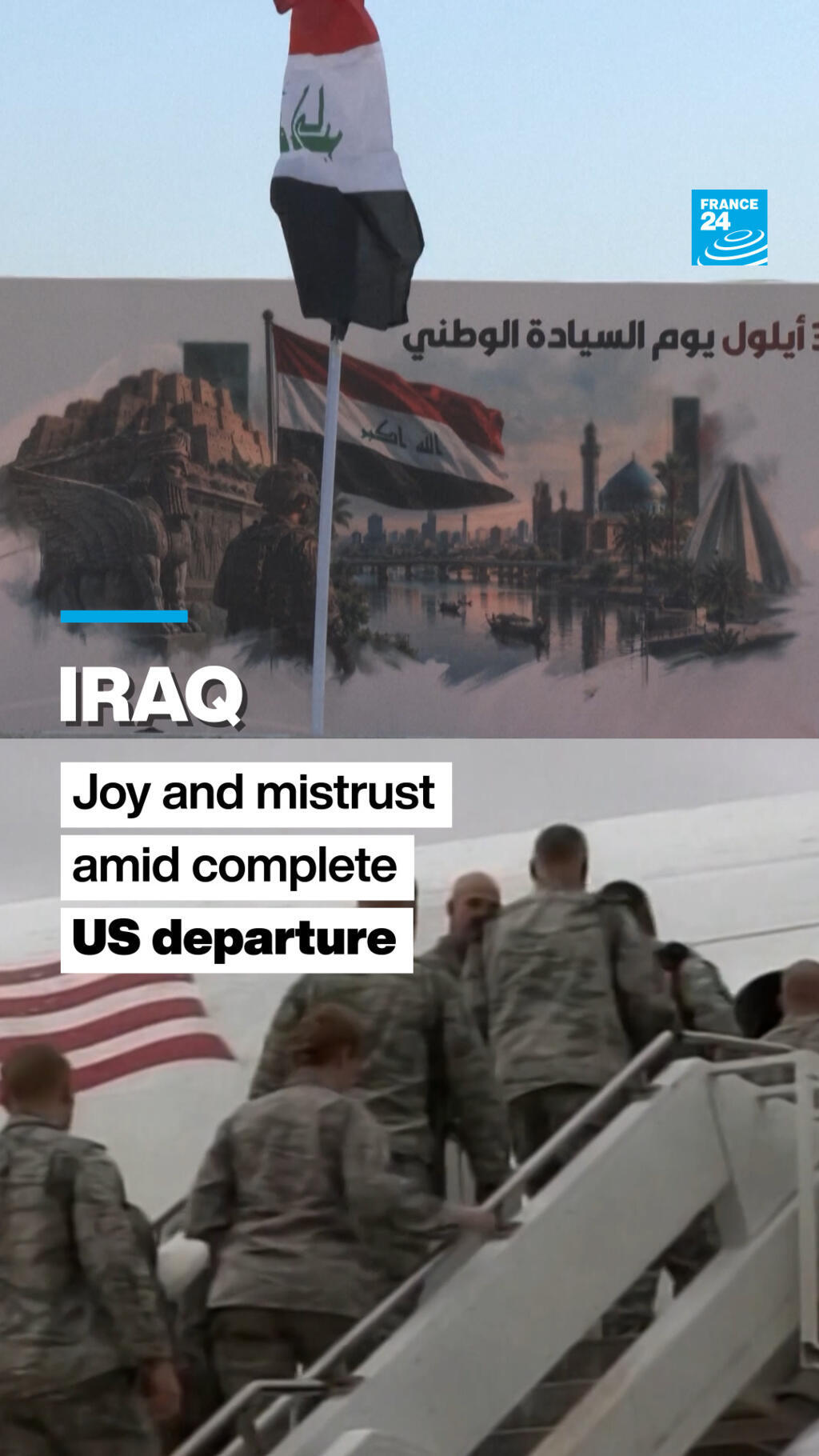
The France 24 video report says the US military announced on Wednesday, September 30, 2026, that all American troops had completed their withdrawal from Iraq. The departure ends a 12-year US mission focused on fighting the Islamic State group. According to the accompanying description, the final US troops left an air base in northern Iraq under an agreement between Baghdad and Washington. The report’s headline indicates that reactions in Iraq to the withdrawal were mixed, but the text provided does not include specific views, quotations, or details about which groups or individuals welcomed or opposed the move. It also does not explain the terms of the agreement, whether other coalition forces remain in Iraq, or what security arrangements will follow the US departure. The item is presented as a short video, with a stated duration of one minute and 28 seconds, but the supplied page text contains no transcript of its footage or interviews. It identifies Juliette Montilly as the video journalist and credits Reuters and France 24 for the cover image. Overall, the article reports the completion of a major military withdrawal and its stated connection to the US-led campaign against Islamic State, while offering little detail in the available text about the political or security consequences. The headline frames the response within Iraq as divided, but the supporting article text does not elaborate on those differing reactions.
Entities: Iraq, United States, US military, US-led coalition withdrawal, Baghdad • Tone: neutral • Sentiment: neutral • Intent: inform
30-09-2026
The US military says it has completed the withdrawal of American troops from Iraq, ending a 12-year mission focused on defeating the Islamic State group. The final troops and equipment left an air base in Irbil, in Iraq’s semi-autonomous Kurdish region, under an agreement between Baghdad and Washington. The withdrawal follows a 2024 decision to wind down the US-led mission after ISIS was reduced to scattered sleeper cells, and comes amid an ongoing US-Iran war that has also affected Iraq.
Iraqi Prime Minister Ali al-Zaidi described the handover as a new phase for Iraqi sovereignty and security institutions. The Pentagon characterized the departure as an orderly transition from a coalition wartime mission to an Iraqi-led security effort backed by a more conventional bilateral relationship. US forces first invaded Iraq in 2003, left in 2011, and returned in a smaller, invited mission in 2014 to fight ISIS. Most US troops had already left Iraqi bases last year, with several hundred remaining in the Kurdish region.
The withdrawal has drawn mixed reactions. Iran-backed groups celebrated it, with a Kataib Hezbollah official calling it the expulsion of occupation forces and warning Iraq’s government against serving US interests. Meanwhile, Kurdish officials voiced concern about losing US air-defense systems. The Kurdish Peshmerga Ministry said the region had endured more than 1,000 drone and ballistic-missile attacks during the recent US-Iran conflict.
The article also notes that Baghdad had linked the withdrawal deadline to disarming non-state armed groups, but powerful Iran-aligned militias rejected disarmament or imposed conditions. Al-Zaidi later postponed the deadline to June 2027. The immediate effects of the US departure may be limited because American forces had already been substantially reduced, but the security implications remain uncertain.
Entities: United States military, Iraq, Iran, Islamic State (ISIS), Baghdad • Tone: analytical • Sentiment: neutral • Intent: inform
30-09-2026
The U.S. military has completed its withdrawal of personnel and equipment from Erbil Air Base in northern Iraq, ending the Iraq phase of Operation Inherent Resolve, the U.S.-led campaign launched in 2014 to fight ISIS. U.S. Central Command said the final departure took place on September 30 and completes a transition agreed upon by Washington and Baghdad toward a bilateral defense relationship. U.S. and coalition forces had begun leaving federal Iraq the previous October. Erbil had served as the main operational hub for the mission and hosted most of the approximately 1,500 American and coalition personnel supporting counter-ISIS operations in Iraq.
CENTCOM commander Adm. Brad Cooper praised the service members, diplomats, and civilian personnel involved. He said ISIS no longer poses a systemic threat to Iraq’s national security and that Iraqi forces, including the Peshmerga and other Kurdistan Region security forces, can manage threats independently. Primary responsibility for Iraq’s security now rests with the Iraqi government and its forces.
The broader counter-ISIS campaign continues. Combined Joint Task Force–Operation Inherent Resolve has relocated its headquarters to Jordan, and U.S. forces continue operations against ISIS in Syria with coalition partners and the Syrian government. CENTCOM said forces elsewhere in the region remain ready to respond to future threats from the group.
The withdrawal ends a U.S. military presence that was reestablished in 2014, after Iraqi authorities requested international assistance as ISIS seized territory. U.S. troops had previously left Iraq in 2011, following the 2003 invasion that toppled Saddam Hussein.
The article also describes security concerns accompanying the departure. Iraq faces pressure from powerful Iran-backed militias, some of which have resisted Baghdad’s efforts to bring non-state weapons under government control. Reactions to the withdrawal are divided: Iran-aligned groups welcomed it, while officials in the Kurdish region expressed concern about losing U.S. air-defense capabilities amid drone and missile threats. The article says Iraq could be entering its most dangerous period since ISIS captured Mosul in 2014.
Entities: Operation Inherent Resolve, ISIS, Erbil Air Base, Iraq, U.S. Central Command (CENTCOM) • Tone: analytical • Sentiment: neutral • Intent: inform
30-09-2026
NPR’s Up First briefing covers three major developments. The final U.S. troops have withdrawn from Iraq, more than two decades after the U.S.-led invasion that toppled Saddam Hussein. Iraq marked the departure as “Sovereignty Day,” but the withdrawal comes amid attacks connected to the U.S.-Iran war and concerns—particularly among Kurdish leaders—about the country’s ability to defend itself without U.S. air defenses. The newsletter notes that U.S. forces also left in 2011 before returning to help fight ISIS in 2014, and that Iran-backed militias are celebrating the latest departure.
The Supreme Court temporarily allowed the Trump administration to resume deporting migrants to countries other than those named in their removal orders. The justices will hear full arguments in December. They asked whether lower courts could intervene and whether the policy violates due-process rights or protections against torture. Immigration advocates warn of potentially irreparable harm; one person challenging the policy fears being sent somewhere he cannot receive treatment for severe mental illness.
The briefing also reports that President Trump favors allowing technology companies to largely regulate their own artificial-intelligence practices. After meeting with executives from six AI companies, he signed an executive order and the companies pledged to monitor their models and prevent harmful uses. Trump called their agreement “morally binding,” though NPR notes there are no new AI laws behind the meeting.
Other newsletter features describe flexible evening classes for young shepherds in Lesotho and a Durham, N.C., program that sends unarmed responders to some 911 calls. The latter has grown substantially since 2020, but responders often lack long-term solutions to problems such as homelessness. The newsletter closes with items on student podcasts, embryo gene editing and the MacArthur fellows.
Entities: Brittney Melton, Jane Arraf, Linda Kenyon, Emily Feng, Iraq • Tone: analytical • Sentiment: neutral • Intent: inform