03-10-2026
The article reports on the final stretch of Brazil’s presidential campaign ahead of the October 4 election. President Lula da Silva held his final campaign rally in Rio de Janeiro on Friday, while his opponent, Flavio Bolsonaro, drew thousands of people to the streets of Montes Carlos, described as being in the country’s interior. The report says the candidates are in a virtual tie as election day approaches, underscoring the closely contested state of the race. It offers no polling figures, candidate statements, policy details, or further information about the rallies, so the account is limited to the events, locations, crowd turnout, and the reported closeness of the contest. Published on October 3, 2026, the brief item presents the competing rallies as the campaigns’ concluding public events before voters go to the polls the following day.
Entities: Brazil, Lula da Silva, Flavio Bolsonaro, Rio de Janeiro, Montes Carlos • Tone: neutral • Sentiment: neutral • Intent: inform
03-10-2026
The United States suspended consular services in Brazil beginning Friday, citing security concerns, and Australia announced that it would close its embassy in Brasilia on the same day. The moves came two days before Brazil’s presidential election. The US embassy advised American citizens needing help not to visit its diplomatic facilities, while Australia’s ambassador, Sophie Davies, cited the US alert and urged Australians to avoid US facilities. Neither government disclosed details about the threat or established a connection to the election.
Brazil’s federal police conducted preventive searches and seizures in Sao Paulo and the Federal District as part of an investigation into suspected plans to threaten US diplomatic facilities. Police said the operation involved cooperation with foreign intelligence agencies. They reported finding no evidence to confirm the initially reported threat and had not identified suspects linked to criminal organisations. The investigation continued after communications equipment was seized. The US State Department said it was working with Brazilian counterparts and noted that diplomatic missions regularly issue alerts about local threats.
The election pits incumbent Luiz Inacio Lula da Silva against Senator Flavio Bolsonaro, the son of former President Jair Bolsonaro. If no candidate receives more than half the vote, a runoff is scheduled for October 25. Lula’s Workers’ Party president, Edinho Silva, called the diplomatic closures unprecedented and alleged they were an attempt by US President Donald Trump to influence Brazilian public opinion. Lula’s allies have also cited US tariffs and a proposed visit by US officials to discuss electoral integrity as signs of foreign interference. Brazilian intelligence officials reportedly briefed French and German delegations about alleged US and Russian interference. Trump has praised Flavio Bolsonaro but has not formally endorsed him.
Entities: United States, Australia, Brazil, Brasilia, Sao Paulo • Tone: neutral • Sentiment: neutral • Intent: inform
03-10-2026
The BBC explainer examines why Brazil’s coming presidential election has become entangled with accusations of foreign interference and concerns about US influence. President Luiz Inácio Lula da Silva is facing a right-wing challenger, Flavio Bolsonaro, who is identified as an ally of Donald Trump and the son of former Brazilian President Jair Bolsonaro. The article says Washington has supported closer ties with Brazil’s right wing, while Lula has accused Bolsonaro’s camp of encouraging foreign interference.
Rather than presenting detailed evidence or a full account of the accusations, the brief description frames the issue through several questions about the election’s wider stakes. These include the role of the United States, trade tariffs, organised crime, and Brazil’s sovereignty. The BBC’s Ione Wells explains the situation in a video report, placing the dispute in the context of relations between Brazil and the US as well as the domestic contest between Lula and Bolsonaro.
The article’s central focus is the tension between Brazil’s electoral politics and perceived outside influence. Its description highlights competing political alignments and identifies sovereignty as a key concern, but does not provide further specifics about the alleged interference, Washington’s actions, or the candidates’ policies. Overall, it serves as a concise introduction to the questions surrounding the election and its international implications.
Entities: Luiz Inácio Lula da Silva, Flavio Bolsonaro, Jair Bolsonaro, Donald Trump, Brazil • Tone: analytical • Sentiment: neutral • Intent: inform
03-10-2026
Brazil’s first-round presidential election pits incumbent Luiz Inácio Lula da Silva against right-wing candidate Flavio Bolsonaro, and Wall Street expects sharply different market outcomes depending on who wins. If Bolsonaro prevails, investors anticipate gains in Brazilian stocks, bonds, and the currency, partly because he has pledged greater fiscal discipline. Brazilian equities have risen as his polling position improved, although prediction-market odds favoring him may overstate his actual prospects; betting markets are prohibited in Brazil and may not reflect local opinion.
The fiscal challenge is substantial. Public debt is 81.9% of GDP, while economists say Brazil needs a lasting adjustment of roughly 3% to 3.5% of GDP to stabilize it. Cutting spending or raising taxes would be difficult: about 90% of the budget is mandatory, and Brazil already has Latin America’s highest tax burden. JPMorgan nevertheless sees significant upside if Bolsonaro wins and delivers a robust reform program. It points to pension reform under his father, Jair Bolsonaro, as a precedent, and estimates that a new reform period could lower interest rates and lift the MSCI Brazil index by 21% to 41%. The currency could also diverge depending on the result, with JPMorgan projecting USD/BRL at 5.50 under Lula or 4.90 under Bolsonaro.
The election also determines the makeup of Congress, which will affect whether reforms can pass. Analysts caution that some expected gains may already be reflected in Brazilian asset prices. Other risks include higher global interest rates and El Niño-related crop damage, particularly for agricultural exporters. If neither presidential candidate receives more than half the vote, a runoff is scheduled for October 25.
Entities: Luiz Inácio Lula da Silva, Flavio Bolsonaro, Jair Bolsonaro, Brazilian presidential election, Black Toro Global Investments • Tone: analytical • Sentiment: neutral • Intent: analyze
03-10-2026
The United States has suspended consular services at its embassy and consulates in Brazil, citing security concerns, while Australia’s embassy in Brasilia also announced it would close on Friday. The US announcement did not specify the nature of the concerns or explicitly connect them to Brazil’s presidential election, scheduled for Sunday. Australia cited the US alert and advised its citizens to avoid US diplomatic missions. The US State Department said it was working with Brazilian counterparts to address the security concerns, according to the Associated Press.
The closures come amid a tense political climate and strained US-Brazil relations, as Brazilians prepare to vote in an election expected to be closely contested. The article describes the race as a statistical tie between left-wing incumbent Luiz Inacio Lula da Silva and right-wing Senator Flavio Bolsonaro, son of former president Jair Bolsonaro. Jair Bolsonaro, an ally of US President Donald Trump, was sentenced to 27 years in prison for attempting to overturn the previous election results.
Although Trump has not endorsed a candidate, his possible influence has prompted concern. Democratic lawmakers wrote to Secretary of State Marco Rubio in September, expressing “grave concern” about what they characterized as efforts by the administration to threaten the US-Brazil alliance and undermine Brazilian democracy. Lula and his allies have also warned of foreign interference, citing US tariffs and a proposed visit by US officials to discuss electoral integrity. Trump said his administration was watching the election closely.
The outcome could shape Brazil’s foreign policy as right-wing governments gain ground in neighboring countries. If no candidate wins a majority in Sunday’s vote, a runoff is expected on October 25.
Entities: United States, Australia, Brazil, Brasilia, US State Department • Tone: analytical • Sentiment: neutral • Intent: inform
03-10-2026
Brazilian President Luiz Inácio Lula da Silva and Senator Flávio Bolsonaro held their final campaign events on the eve of a closely contested presidential election, with both seeking support from undecided voters. Lula, an 80-year-old left-wing incumbent running for a fourth and final term, made Brazilian sovereignty a central theme. He warned that US pressure threatened the country and opposed tariffs imposed by the Trump administration, as well as the designation of Brazilian drug-trafficking gangs as foreign terrorist organisations. His campaign also released a Portuguese version of Bad Bunny’s song “Lo que le pasó a Hawaii,” invoking US colonisation of Hawaii as a cautionary example.
Flávio Bolsonaro, 45 and the son of former president Jair Bolsonaro, campaigned on hardline security policies and fiscal austerity while criticising Lula over competence and the cost of living. He appeared at a bikers’ rally in São Paulo state before holding his final rally in Rio de Janeiro; Lula’s closing event was in São Paulo city. Bolsonaro’s events featured US flags and inflatable figures of Donald Trump, although Trump has not endorsed the senator. His father, a Trump ally, is serving a 27-year sentence for attempting a coup after his failed 2022 re-election bid.
The campaign has been marked by polarisation, scandals, insults and online attacks. Flávio Bolsonaro was reported to be under investigation over alleged corruption connected to financing a biopic about his father. The financing involved jailed banker Daniel Vorcaro, who is also under investigation in a major financial scandal that has drawn in powerful figures and prompted controversy at Brazil’s Supreme Federal Court. Both campaigns have used gaffes, accusations and rumours in polished videos and AI-generated social media images.
Although twelve candidates are running, Lula and Bolsonaro are considered the only serious contenders. Nearly 160 million registered voters are also choosing lawmakers, governors and some senators. Polls indicate neither front-runner is likely to win outright on 4 October, making a second round, scheduled for 25 October, highly likely.
Entities: Luiz Inácio Lula da Silva, Flávio Bolsonaro, Jair Bolsonaro, Donald Trump, Brazil • Tone: analytical • Sentiment: neutral • Intent: inform
03-10-2026
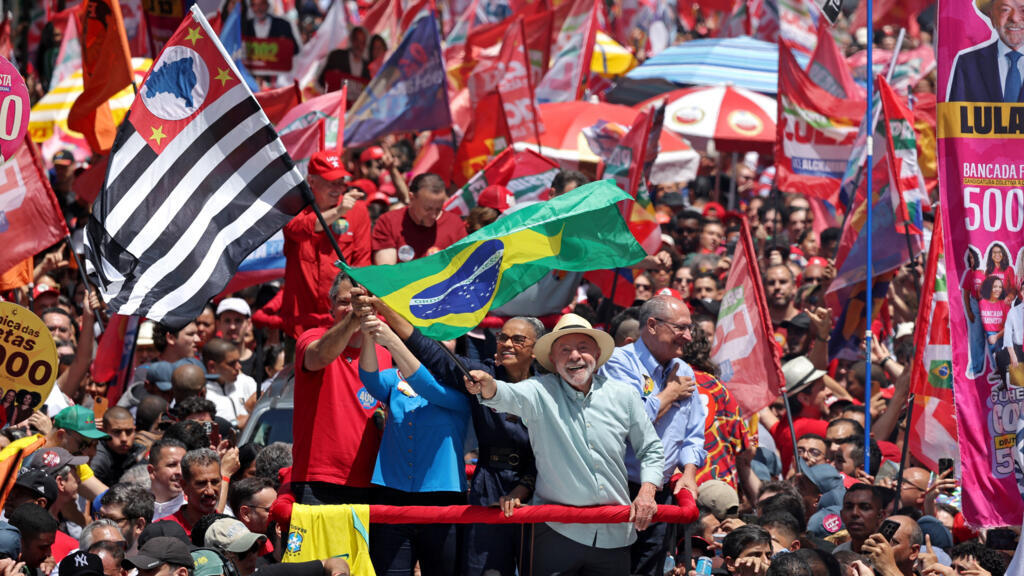
Brazilian President Luiz Inacio Lula da Silva and his challenger, Senator Flavio Bolsonaro, held their final campaign events in Sao Paulo on October 3, the day before a closely contested presidential election. Sao Paulo accounts for about a fifth of the national vote. Opinion polls suggested neither candidate would secure a first-round victory, with the two effectively tied ahead of a likely October 25 runoff.
Lula, 80, campaigned from a truck before supporters dressed in red, vowing to defeat the far right. Seeking a fourth and final term, he warned that Brazil’s sovereignty was at stake and criticized US President Donald Trump for possible interference. Supporters echoed that concern, while some described the contest as a choice between democracy and authoritarianism. Others praised Lula for concern for ordinary people.
Flavio Bolsonaro, 45, campaigned on hardline security policies and fiscal austerity, attacking Lula over the cost of living and what he called incompetence. He led a motorcycle parade in the state, recalling the campaign style of his father, former president Jair Bolsonaro. Some supporters said they wanted economic improvement and welcomed Trump’s involvement if it could help bring change. Trump had not endorsed Flavio, but said he was watching the election closely.
The campaign has been marked by scandals, personal attacks and online misinformation, with both camps circulating polished videos and AI-generated images. Flavio Bolsonaro faced scrutiny over an investigation into the financing of a biopic about his father. The project was funded by jailed banker Daniel Vorcaro, who is himself under investigation in a major financial scandal involving powerful figures. The close contest follows Lula’s narrow 1.8-point victory over Jair Bolsonaro in 2022. Nearly 160 million registered voters will also elect lawmakers, governors and some senators.
Entities: Luiz Inacio Lula da Silva, Flavio Bolsonaro, Jair Bolsonaro, Donald Trump, Brazil • Tone: neutral • Sentiment: neutral • Intent: inform
03-10-2026
Brazil’s October 4, 2026, presidential election revisits the polarized 2022 contest, but President Luiz Inácio Lula da Silva now faces Senator Flávio Bolsonaro, son of former president Jair Bolsonaro. Flávio presents himself as more moderate than his father, yet has offered few clear policy departures. He has promised to pardon Jair, who is serving a 27-year sentence for plotting a coup to overturn the 2022 result. Lula, 80, is seeking a fourth term. Polls indicate a close race, and if no candidate wins more than half of valid votes, the top two will compete in a runoff on October 25. Brazil’s electronic voting system generally produces results within hours.
Entities: Luiz Inácio Lula da Silva, Flávio Bolsonaro, Jair Bolsonaro, Brazil, United States • Tone: analytical • Sentiment: neutral • Intent: inform
03-10-2026
As Brazilians prepare to vote, NPR reports that the election is also a referendum on the influence of U.S. President Donald Trump in Brazil. Trump has claimed credit for a rightward political shift across Latin America, where the article says the last seven presidential elections since his return to office have produced conservative or far-right leaders. His administration has taken steps affecting Brazil, including revoking visas for officials it says treated the conservative Bolsonaro family unfairly, while steep U.S. tariffs remain on some Brazilian exports.
The tariffs have had direct consequences for the Dupps Company, a small machinery maker outside São Paulo. Plant manager Leandro Ferreira says exports to the United States fell from about $15 million annually to zero, forcing the company to close a shift and lay off 40% of its workforce. Ferreira objects to a small business being caught up in U.S. politics, but also faults President Luiz Inácio Lula da Silva’s economic policies, especially high interest rates, which make borrowing difficult. Those grievances place Ferreira in Bolsonaro’s camp.
Trump’s involvement has different effects among voters. His support is welcomed at Bolsonaro rallies, and Flavio Bolsonaro says he would bring Brazil closer to the United States if elected. But the prospect of closer alignment also energizes Lula’s supporters. At a market in Mauá, retiree Joel Pedro says he and nearly all the men gathered there support Lula because they believe he will defend Brazil from Trump. Pedro warns that a Bolsonaro victory could leave Brazilians “slaves to the U.S. and at their mercy,” like Venezuela.
Reporter Carrie Kahn says the results will indicate how divided Brazil has become and how disillusioned voters are with the political class, dynamics she says may feel familiar to Americans. The report was filed before polls opened and frames the election as a contest shaped by domestic economic concerns as well as competing views of Brazil’s relationship with Trump and the United States.
Entities: Donald Trump, Brazilian presidential election, Brazil, United States, Luiz Inácio Lula da Silva • Tone: analytical • Sentiment: neutral • Intent: analyze
03-10-2026
Brazilian voters are preparing to choose a president in a closely contested election between incumbent Luiz Inácio Lula da Silva and Flávio Bolsonaro, son of former president Jair Bolsonaro. The vote also determines governors, senators and members of the lower house, but the presidential race has drawn the greatest attention. Lula, nearly 81, is seeking a fourth, nonconsecutive term and has campaigned energetically while addressing concerns about his age. Flávio Bolsonaro was selected by his father to carry on the conservative movement after Jair Bolsonaro was convicted of attempting a coup and barred from participating in the election.
Reporting from Rio de Janeiro and São Paulo, NPR’s Carrie Kahn describes a polarized country where campaign crowds appear smaller and voter enthusiasm is subdued. Corruption is a major concern, sharpened by revelations about a jailed banker’s financial support for the Bolsonaros and scrutiny of Supreme Court justices, including one viewed as close to Lula. Some voters say they dislike both leading candidates and regard their choice as a matter of selecting the “lesser of two evils.”
Pollster Yuri Sanches says Lula no longer generates the excitement of his 2022 comeback and has difficulty connecting with younger voters and people online. Flávio Bolsonaro, meanwhile, was not the preferred choice of either political insiders or many Bolsonaro supporters, and is seen as less charismatic than other members of the family. Sanches estimates that about 80% of voters have settled on a candidate, leaving a smaller group of undecided or movable voters potentially decisive.
One such voter, Camila de Zuani, has usually supported conservatives but is alienated by the campaign’s negativity. She says the candidates seem to be attacking each other rather than engaging in democratic debate, and wants to hear how they will address crime and robberies in her working-class neighborhood. The report portrays an election shaped by polarization, corruption concerns and voters’ dissatisfaction with both options.
Entities: Luiz Inácio Lula da Silva, Flávio Bolsonaro, Jair Bolsonaro, Eduardo Bolsonaro, Carrie Kahn • Tone: analytical • Sentiment: negative • Intent: inform
03-10-2026
Brazilian President Luiz Inacio Lula da Silva and Senator Flavio Bolsonaro concluded their presidential campaigns on Saturday, the day before Brazil’s first-round election. Both expressed confidence that they could win, although polls indicated that the contest was likely to proceed to a runoff.
Lula’s campaign ended with a march in Sao Paulo that drew large crowds. Organizers estimated that about 150,000 supporters filled a two-kilometer stretch of Augusta Street, from Paulista Avenue to Roosevelt Square, and said the turnout exceeded that at the close of Lula’s 2022 campaign. Speaking from a campaign vehicle, Lula framed the election as a choice between “democracy and barbarism.” Workers’ Party leader Edinho Silva interpreted the crowd as evidence that Lula was gaining momentum, contrasting Brazil’s political mood with right-wing gains elsewhere in Latin America.
Bolsonaro campaigned with a motorcycle caravan through Santa Barbara d’Oeste and Americana in Sao Paulo state before holding a rally in Rio de Janeiro. He urged supporters to vote and said he believed the conditions were in place for a first-round victory. He was photographed holding a placard depicting his father, former President Jair Bolsonaro. The article notes that Jair Bolsonaro is under house arrest after being convicted of attempting to overturn the result of the 2022 election, which he lost to Lula.
The report explains that a candidate must receive more than 50% of valid votes to win outright; blank and null ballots are excluded from that calculation. If no candidate reaches that threshold, the two leading candidates advance to a runoff scheduled for October 25.
Entities: Luiz Inacio Lula da Silva, Flavio Bolsonaro, Jair Bolsonaro, Edinho Silva, Workers' Party • Tone: neutral • Sentiment: neutral • Intent: inform
03-10-2026
Brazil’s closely contested presidential election is presented as a test of whether Latin America’s remaining major left-wing governments can resist growing US influence under Donald Trump. Incumbent Luiz Inácio Lula da Silva faces far-right senator Flávio Bolsonaro, son of former president Jair Bolsonaro, in a race polls show is too close to call. If no candidate wins more than half the vote, the election will go to a runoff on 25 October.
The article describes a regional shift to the right following a string of conservative electoral victories and the US capture of Venezuela’s Nicolás Maduro. Analysts argue that a Flávio Bolsonaro victory would weaken the left, bolster Trump’s political agenda, and bring Brazil into closer alignment with Washington. The candidates also differ over Trump’s regional “war on drugs”: Bolsonaro has pledged to join the Shield of the Americas and take a hard-line approach to crime, while Lula has emphasized sovereignty and criticized leaders who join the US-led coalition.
Natural resources are another point of contention. Washington has sought access to Brazil’s rare earths and critical minerals, while Lula rejected that condition in tariff negotiations. Bolsonaro has presented those resources as a way for the US to reduce its dependence on China. Analysts also frame the election as a matter of democratic norms: Flávio is running because his father is barred from office after being convicted of attempting a coup to overturn the 2022 election.
Despite falling unemployment, poverty, and inflation and rising average incomes, household debt has increased. Betting, corruption allegations involving people linked to Lula, and broader political scandals have shaped the campaign. Flávio’s support appears to draw both on his father’s voter base and on opposition to Lula, with some voters backing him strategically despite preferring another candidate.
Entities: Luiz Inácio Lula da Silva, Flávio Bolsonaro, Jair Bolsonaro, Donald Trump, Brazil • Tone: analytical • Sentiment: neutral • Intent: analyze
03-10-2026
The supplied material introduces Brazil’s presidential election as a contest shaped less by voter enthusiasm than by fear and frustration. Its headline promises four forces influencing the election and identifies former U.S. President Donald Trump as one of them, but the excerpt provided does not explain those forces. The article’s opening, by Marina Dias, places the election in Brasília and says that for millions of voters the central question is not which candidate inspires them most, but which one frightens them least. It presents the two leading candidates as familiar figures who have left many voters weary. President Luiz Inácio Lula da Silva, 80, is described as seeking an unprecedented fourth four-year term. The excerpt also notes that, because his earlier terms were nonconsecutive, he has already served more terms than any other president in Brazil’s young democracy. The supplied text ends at this point, before giving further details about the candidates, the other fears and frustrations, Trump’s role, or the election’s likely outcome. Therefore, the article’s broader arguments cannot be reliably summarized from the excerpt alone. The summary is limited to the headline and the visible opening, rather than inferring missing reporting or context.
Entities: Brazil, Brasília, Luiz Inácio Lula da Silva, Donald Trump, The Washington Post • Tone: analytical • Sentiment: negative • Intent: analyze
03-10-2026
As Brazil prepares for the first round of its 2026 presidential election, former president Jair Bolsonaro’s eldest son, Flavio Bolsonaro, is running against incumbent Luiz Inacio Lula da Silva and polling neck-and-neck with him. Flavio’s candidacy is closely tied to his father: he has promised to pardon Jair if elected, and the Bolsonaro name has helped propel him into contention despite his reputation as a less charismatic and less confident politician. His campaign has also faced controversy, including a Supreme Court inquiry into an AI-generated video depicting his jailed father endorsing him, and an investigation into alleged corruption and money laundering connected to a planned biopic about Jair Bolsonaro.
The article describes Flavio’s campaign as a balancing act. He must appeal to the Bolsonaro family’s committed supporters while appearing more acceptable to undecided voters, particularly women. Unlike his father, he presents himself as less aggressive and more willing to compromise, and he has avoided some of Jair’s inflammatory public rhetoric. Analysts quoted in the article caution, however, that this change in presentation does not represent a meaningful ideological shift. They characterize it as a tactical effort to broaden his electoral base while retaining the support of Bolsonarism.
The campaign is presented as a family enterprise, with Flavio’s brothers assigned distinct political roles: Carlos on social media and Eduardo on international far-right connections. Flavio’s record as a Rio de Janeiro state senator, the article says, reflects continuity with his father’s positions, including a hard-line security policy, socially conservative values, Milei-inspired economics, and opposition to environmental regulation. He has also faced allegations involving paramilitary groups and a public-payroll embezzlement case that was closed without convictions. The article concludes that the election carries heightened stakes for Brazilian democracy because voters now have a clearer idea of what a Bolsonaro presidency could entail.
Entities: Flavio Bolsonaro, Jair Bolsonaro, Luiz Inacio Lula da Silva, Brazil, Brazilian presidential election (2026) • Tone: analytical • Sentiment: negative • Intent: analyze