03-10-2026
The eviction of 87-year-old Maricarmen Abascal from the Madrid apartment where she had lived for more than 70 years has become a rallying point in Spain’s worsening housing crisis. After an investment firm, Urbagestión, took over her lease in 2018, her rent rose from €500 to €1,650 a month—more than her €1,350 monthly benefits. Courts rejected several eviction attempts, and the UN Committee on Economic, Social and Cultural Rights called for the eviction to be halted. But a court eventually ruled in the company’s favour, and police removed Abascal from her home as demonstrators gathered outside. Images of the wheelchair user being taken away on a stretcher helped galvanize public anger. Protests and a tent encampment in Madrid’s Puerta del Sol connected her case to broader problems: rental prices have nearly doubled over a decade, Spain is estimated to lack 700,000 homes, and social housing accounts for less than 2 per cent of the country’s housing stock. Following five days of protests, Urbagestión offered Abascal an eight-year contract with rent capped at 30 per cent of her net income. Prime Minister Pedro Sánchez proposed measures including restrictions on bulk property purchases by investment funds, an eviction ban for vulnerable tenants through 2030, and a tax on seasonal rentals. Congress rejected the measures, raising the possibility of an early election. Protests are continuing in Madrid and other Spanish cities. From hospital, Abascal said she had fought so others could learn to defend what is theirs.
Entities: Maricarmen Abascal, Urbagestión, Madrid, Spain’s housing crisis, Eviction of vulnerable tenants • Tone: analytical • Sentiment: negative • Intent: inform
03-10-2026
Thousands of people marched in cities across Spain on Saturday to demand stronger tenant protections and action on the housing crisis, after parliament rejected emergency measures proposed by Prime Minister Pedro Sánchez’s minority coalition. Around 50 demonstrations were planned, including in Madrid, Valencia and Barcelona. In Valencia, some protesters clashed with police near a real estate summit; Spanish media reported that officers responded to objects thrown by demonstrators with rubber bullets. Estimates for the Madrid march varied sharply, from 70,000 according to government officials to 500,000 according to the city’s Tenants’ Union. Protesters have also camped in Puerta del Sol, and the union has called for a general strike.
The legislation followed public anger over the September eviction of 87-year-old Maricarmen Abascal, who could not afford a steep rent increase. The backlash led the company owning her flat, Urbagestión, to negotiate her return at a lower rent, but demonstrations continued. Protesters have called for lower rents, an end to evictions and restrictions on investment funds purchasing homes.
The proposed package was split into two decrees. One included suspending evictions of vulnerable tenants until 2030, extending certain rental leases by two years, raising taxes on tourist apartments and restricting purchases by so-called “vulture funds.” The other would have automatically renewed rental contracts. MPs rejected the decrees by 178–172 and 184–166. The conservative People’s Party, far-right Vox and centre-right, pro-independence Together for Catalonia opposed the measures, while Sánchez’s coalition lacked a parliamentary majority. The defeat has intensified speculation about an early general election, although one was not due until next summer.
The demonstrations reflect wider affordability pressures. The Bank of Spain estimates a housing shortfall of 700,000 homes. House prices rose 12.2% in the year to the second quarter of 2026, while rental costs increased 8.5% in 2025. Madrid and Barcelona were the country’s most expensive cities to rent, according to Idealista.
Entities: Pedro Sánchez, Maricarmen Abascal, Spain, Madrid, Valencia • Tone: analytical • Sentiment: negative • Intent: inform
03-10-2026
Tens of thousands of people demonstrated across Spain on Saturday, calling for affordable housing, after parliament narrowly rejected two emergency bills intended to support renters and prevent evictions. The measures, proposed by Prime Minister Pedro Sanchez, would have automatically renewed tenancy contracts and restricted evictions of vulnerable tenants. Their defeat by opposition parties on Friday angered people who had already been protesting throughout the week against Spain’s increasingly unaffordable housing market.
The latest wave of demonstrations began after the eviction of 87-year-old Maricarmen Abascalin from her home in Madrid. Protesters said the response to the housing crisis reflected a gap between political decisions and public demands. Valeria Racu, a spokesperson for the Tenants’ Union, which organized Saturday’s Madrid protest, described a renewed sense of popular energy and argued that collective action could achieve change.
Police estimated that around 70,000 people joined the Madrid demonstration, while organizers put attendance at nearly 500,000. Protests also took place in about 50 other cities. In Valencia, police used tear gas and rubber bullets after demonstrators entered the City of Arts and Sciences; police subsequently removed them from the landmark.
Demonstrators called for decent housing, stability and the ability to build a secure life. Spanish media reported that Sanchez might call a snap election in November following the defeat of the bills. His office declined to comment, and reports said the government would monitor the protests before deciding what to do next.
Entities: Spain, Madrid, Valencia, Maricarmen Abascalin, Pedro Sanchez • Tone: analytical • Sentiment: negative • Intent: inform
03-10-2026
Tens of thousands of people protested across Spain on Saturday over the housing crisis, a day after parliament rejected two government decrees intended to strengthen tenant protections. In Madrid, organisers estimated that around 500,000 people joined the demonstration, while authorities put attendance at about 70,000. Protesters called for a general strike, lower rents, open-ended rental contracts and the expropriation of homes held by investment funds. The Tenants’ Union said the parliamentary votes showed a disconnect between public demands and political decisions. It is negotiating with other organisations over a possible general strike, though no date has been set.
The Madrid demonstration was peaceful, but tensions escalated in Valencia, where protesters approached a property investment conference. Some removed barriers and threw objects at police, who responded with rubber bullets and tear gas; several demonstrators reached the venue. Rallies also took place in cities and islands including San Sebastián, Cádiz, Barcelona, Las Palmas de Gran Canaria, Lanzarote, Fuerteventura and Tenerife, with a demonstration planned in Teruel for Sunday.
The protests followed Congress’s rejection of the government’s two housing decrees, opposed by the PP, Vox and UPN, while Junts withheld support. Prime Minister Pedro Sánchez warned lawmakers that history would judge their decision and began considering whether to call early elections. Opposition parties have called for elections, while Junts has urged negotiations and criticised the decrees as poorly drafted. The PSOE says the proposals already incorporated Junts’ suggestions. Vice-President Yolanda Díaz blamed opposition leaders for responsibility for evictions.
The Madrid encampment at Puerta del Sol reached its seventh night, with around 2,000 people present. The protests began after the eviction of 87-year-old Maricarmen Abascal. Campaigners say an investment company had bought her longtime home and sought a 275% rent increase. Following public backlash, the new owners agreed to let her return at a low rent.
Entities: Madrid, Spain’s housing crisis, Tenants’ Union, Puerta del Sol, Pedro Sánchez • Tone: analytical • Sentiment: negative • Intent: inform
03-10-2026
Protests are planned in more than 50 Spanish cities after parliament rejected two government decrees intended to strengthen tenant protections. The vote has intensified public anger over housing costs and put further pressure on Prime Minister Pedro Sánchez’s minority government. The Tenants’ Union, which is coordinating the demonstrations, said there is a disconnect between public demands and parliamentary decisions. In Madrid, marchers are expected to converge on Plaza de Cibeles, while activists have been camped at Puerta del Sol.
The immediate trigger for the protests was the eviction of 87-year-old Maricarmen Abascal from the Madrid flat where she had lived for about 70 years. Campaigners said an investment company that bought the property tried to raise her rent by 275 percent. Following public backlash, the new owners agreed to let Abascal return at a low rent.
The rejected package would have automatically renewed rental contracts when they expired, restricted evictions of vulnerable tenants, and addressed so-called vulture funds—investment firms that acquire properties cheaply in pursuit of higher returns. The decrees failed after Junts, a Catalan separatist party whose support was required, opposed them, saying they lacked rigour.
The defeat has renewed questions about whether Sánchez’s government can remain in office until the next scheduled election in 2027. Popular Party leader Alberto Núñez Feijóo urged the prime minister to call an early election, arguing that he no longer had support in either parliament or the streets. Opinion polls have generally put the opposition PP ahead of the Socialists.
Housing has long been a major concern in Spain. The article attributes the pressure to housing supply falling short of demand and rising costs. Data from property website Idealista indicate that average rents have nearly doubled in a decade, while asking prices for homes have risen by about 90 percent.
Entities: Pedro Sánchez, Maricarmen Abascal, Alberto Núñez Feijóo, Tenants’ Union, Junts • Tone: analytical • Sentiment: negative • Intent: inform
03-10-2026
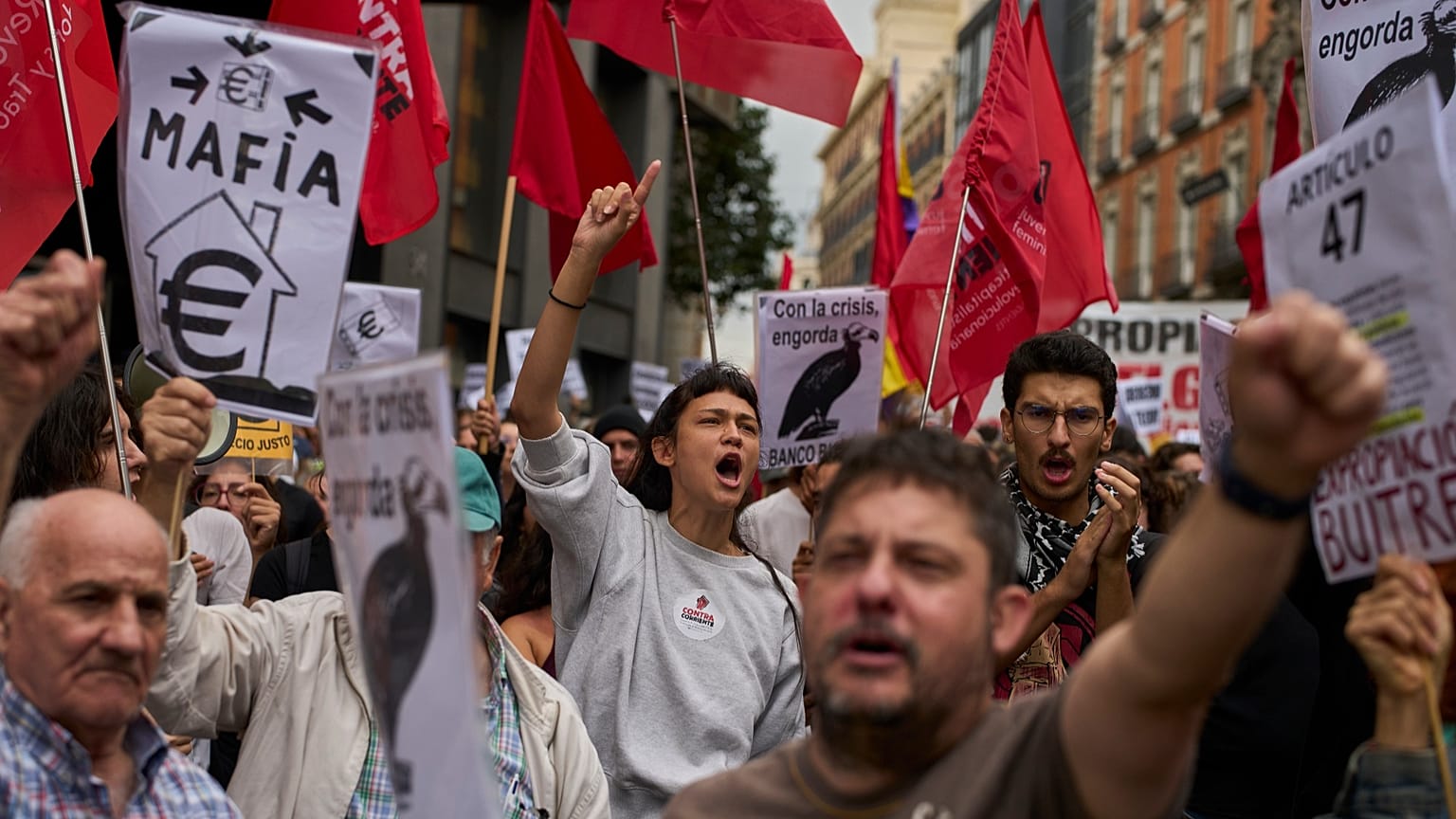
Tens of thousands of people marched through Madrid on Saturday to demand affordable housing and stronger protections for renters. The demonstration followed the rejection by Spanish lawmakers, the previous day, of emergency measures intended to address the country’s housing affordability crisis. Protesters carried banners, chanted and rattled their house keys. Some demonstrators also called for a general strike over housing.
The article connects rising public anger to the eviction of 87-year-old María del Carmen Abascal from her Madrid home last month. Her eviction sparked protests and an encampment in Puerta del Sol, a central square in the capital. The march took place amid continuing political disagreement over proposed housing laws and measures, with the latest rejection prompting people to take to the streets.
The report describes the demonstration and its immediate context, rather than detailing the rejected measures or presenting responses from lawmakers, renters, landlords or housing experts. It offers no estimates beyond describing the crowd as tens of thousands and does not report arrests, injuries or other incidents during the march. Its central focus is the public demand for more affordable housing and stronger renter protections, alongside the growing anger associated with Spain’s housing crisis.
Entities: Madrid, Spain, María del Carmen Abascal, Puerta del Sol, Spanish lawmakers • Tone: neutral • Sentiment: neutral • Intent: inform
03-10-2026
Tens of thousands of people protested in Madrid and more than 50 other Spanish cities on Saturday, demanding affordable housing after parliament narrowly rejected government measures intended to strengthen tenant protections. The demonstrations followed weeks of anger over housing costs and the September 23 eviction of 87-year-old Maricarmen Abascal from the Madrid flat where she had lived for about 70 years. Her removal on a stretcher became a catalyst for nationwide protests; campaigners said the property’s new owner, an investment company, had sought to raise her rent by 275 percent. Following the backlash, the owners reached an agreement allowing her to return at a low rent.
The defeated package, introduced by Prime Minister Pedro Sanchez’s government, would have automatically renewed rental contracts upon expiry and restricted the eviction of vulnerable tenants. It also included measures targeting so-called vulture funds, investment firms that purchase properties cheaply in search of higher returns. The Catalan separatist party Junts, whose votes were needed to pass the measures, opposed them, saying they lacked rigour.
The defeat is another setback for Sanchez’s minority Socialist government and has raised questions about whether it can remain in office until the next scheduled general election in 2027. Popular Party leader Alberto Nunez Feijoo called on Sanchez to hold elections, arguing that he had the support of neither parliament nor the public. Polls have generally put the opposition Popular Party ahead of the Socialists.
The Tenants’ Union, which coordinated the demonstrations, described a disconnect between public demands and political decisions. Housing has long been a major concern in Spain: rents have almost doubled over the past decade, while asking prices for homes have risen by about 90 percent, according to Idealista. The article situates the protests within a broader shortage of housing and soaring costs across Spain and the European Union.
Entities: Pedro Sanchez, Maricarmen Abascal, Alberto Nunez Feijoo, Madrid, Puerta del Sol • Tone: analytical • Sentiment: negative • Intent: inform
03-10-2026
Tens of thousands of people protested in Madrid and other Spanish cities on October 3, demanding government action on the country’s worsening housing crisis. The demonstrations followed the Spanish parliament’s rejection on October 2 of proposed measures intended to address housing problems, including evictions. The proposals came amid public anger over the eviction of an 87-year-old woman in Madrid and wider concerns about housing access and affordability.
Some protesters in Madrid carried signs calling for a general strike. Demonstrator Nando de Anguulo, 26, said the parliamentary rejection showed that people were being expected to adapt to political parties rather than politicians responding to public demands. The Spanish government estimated that about 70,000 people joined the Madrid demonstration. Protests were also held in 50 other Spanish cities, most of them peacefully.
In Valencia, in southeastern Spain, some demonstrators clashed with police. Officers used rubber bullets and tear gas to disperse the protest. Around 30 protesters entered the City of Arts and Sciences, a prominent cultural landmark, before police removed them.
Spanish media reported that Prime Minister Pedro Sanchez might call a snap election in November after the legislation failed. Those reports said Sanchez would assess the size and strength of the October 3 protests before deciding. His office declined to comment. The demonstrations put renewed public pressure on the government over housing policy and the failure of its proposed response to pass parliament.
Entities: Spain, Madrid, Valencia, Spanish Prime Minister Pedro Sanchez, Nando de Anguulo • Tone: neutral • Sentiment: neutral • Intent: inform