08-10-2026
The article reports that hundreds of people protested outside Spain’s Parliament, demanding action over soaring rents and the shortage of affordable housing. The demonstrations followed the eviction of 87-year-old Maricarmen Abascal, which had already fueled days of protests. Her subsequent death intensified public anger as Spain approached snap elections. The report presents her eviction and death as a focal point for broader frustration over housing conditions, rather than describing the protests as an isolated response to one case. It identifies the protesters’ main concerns as rising rental costs and inadequate access to affordable homes, and notes the politically significant timing of the demonstrations. The available article text does not provide further details about the circumstances of Abascal’s death, the location or timing of her eviction, the organizers or political affiliations of the demonstrators, or any response from government officials. It also does not specify what policy measures protesters are seeking beyond action on rents and affordable housing. The article’s central point is that Abascal’s case has sharpened an already active housing protest movement and brought renewed attention to Spain’s housing affordability problems ahead of an election. The report was published on October 8, 2026.
Entities: Maricarmen Abascal, Spain, Spain’s Parliament, housing protests, eviction • Tone: urgent • Sentiment: negative • Intent: inform
08-10-2026
Spain’s housing crisis has prompted hundreds of people to camp in Madrid’s Puerta del Sol, where protesters blame a shortage of homes, rising rents, property investors they call “vulture funds,” and short-term tourist rentals. The movement gathered momentum after 87-year-old Maricarmen Abascal was evicted following a sharp rent increase by a firm that had bought her home. The public outcry led the company to offer her the home back, but she did not return and died in hospital. Other residents describe being priced out of rentals and experiencing serious effects on their health and security.
Rents have risen sharply: by an average of 84% in Spain over the past decade, according to Idealista, with larger increases in Málaga and Marbella. Public opinion favours measures including higher taxes on owners with many properties and limits on short-term tourist accommodation. Prime Minister Pedro Sánchez proposed emergency housing measures, but Congress rejected them, after which he called a snap election.
The article also examines whether investment funds and empty properties are the central cause. Esade economist Jorge Galindo says available data do not show a notable concentration of rental properties among a small number of owners: companies own only 8% of properties for rent, according to 2024 Bank of Spain figures. He identifies the deeper problem as demand outstripping supply. The Bank of Spain estimates a shortfall of around 750,000 homes, potentially rising to one million by 2028. Although Spain has 3.8 million empty properties, many are in depopulated areas or unavailable because they need renovation or are tied up in legal disputes.
Household growth, including that associated with migration, has outpaced construction: about 1.2 million households formed between 2021 and 2025, while fewer than half a million homes were built. A weakened construction sector, higher material costs, and political and legal obstacles constrained building. Short-term rentals may worsen conditions in particular urban areas, while lagging wages and inflation further undermine affordability. The article concludes that Abascal’s case has made housing an urgent national debate, but it remains unclear whether political consensus can produce a solution.
Entities: Pierina Nicuray, Jorge Moreno, Maricarmen Abascal, Pedro Sánchez, Carmen Pérez • Tone: analytical • Sentiment: negative • Intent: analyze
08-10-2026
Maricarmen Abascal, an 87-year-old woman whose forced eviction became a focal point for Spain’s housing crisis, has died in hospital, according to the Madrid Tenants’ Union. Abascal had lived in her family’s Madrid apartment for more than 70 years. After the property changed ownership, its rent rose from €500 to €2,650 a month, far beyond what she could afford on her pension. She was removed from the flat on a stretcher on 23 September. The owner later offered a lower rent, but Abascal was already hospitalized and could not sign an agreement.
Her eviction prompted protests and became a symbol of soaring rents and housing insecurity. At Puerta del Sol, where demonstrators had gathered to demand affordable housing, people responded to news of her death with silence, candles and messages honoring her. Protesters later marched to parliament, chanting against evictions and accusing police of facilitating removals carried out under court orders. Unions also called a general strike for 11 November to demand housing reforms.
The Socialist-led government’s two proposed emergency housing decrees were rejected in Congress. Prime Minister Pedro Sánchez subsequently called a snap election for 29 November, saying he needed a broader progressive majority to overcome opposition to reform. Critics said his government had already had eight years to address housing problems. The political right argued that intervention in the rental market could reduce the supply of homes and push prices higher. Sánchez and opposition leader Alberto Núñez Feijóo both expressed condolences, with Feijóo warning against exploiting Abascal’s death for political purposes.
The article describes how the case exposed Spain’s political divisions amid soaring rents, broader cost-of-living and immigration pressures, and corruption scandals linked to Sánchez’s party. Polls suggest the conservative People’s Party may win the most seats in the coming election, but could need support from the hard-right Vox party to form a government. Abascal had said from her hospital bed that although she had not defended her own home, she hoped her struggle would help others fight for theirs.
Entities: Maricarmen Abascal, Pedro Sánchez, Alicia del Río, Alberto Núñez Feijóo, Madrid Tenants' Union • Tone: analytical • Sentiment: negative • Intent: inform
08-10-2026
María del Carmen Abascal, widely known as Maricarmen, died in hospital on Wednesday at age 87, according to her lawyer and housing activists. Her eviction from the Madrid apartment where she had lived for seven decades had become a national flashpoint over Spain’s housing affordability crisis. On 23 September, police cordoned off the street and removed protesters as the wheelchair-using woman was carried out on a stretcher. She was taken to hospital because of her fragile health. Television coverage of the eviction prompted protests in Madrid and other Spanish cities, contributing to a political crisis that culminated in the government calling for snap elections.
Prime Minister Pedro Sánchez expressed condolences. Demonstrators outside Spain’s Parliament responded with grief and anger, chanting, “Maricarmen lives, the fight goes on!” Her lawyer, Beatriz Duro, did not disclose the cause of death. She said the case had exposed the violence of evictions and their potential effects on people’s health. Maricarmen had been expected to return home after leaving hospital: under public pressure, the real estate company had agreed to let her return after initially evicting her to rent the apartment at a much higher price. The Madrid Tenants’ Union said the agreement came too late and called the outcome avoidable.
The article places her case in the wider context of rising housing costs. Average rents in Spain have nearly doubled over the past decade. Government figures cited in the article say 26% of Spanish renters spend an average of 40% of their income on rent and utilities, compared with 18% of renters across the European Union. Protesters held a minute of silence in Puerta del Sol.
Maricarmen had spent nearly her entire life in the apartment, first living there with her family. After working as a secretary for a pharmaceutical company’s board, she retired in 1998 and remained closely connected to her neighbourhood and belongings. Protesters said they would continue demonstrating in her memory, while one attendee accused those involved in her eviction of responsibility for her death and called for them to face trial.
Entities: María del Carmen Abascal (Maricarmen), Pedro Sánchez, Beatriz Duro, Iciar López, Eugenio Melchor • Tone: emotional • Sentiment: negative • Intent: inform
08-10-2026
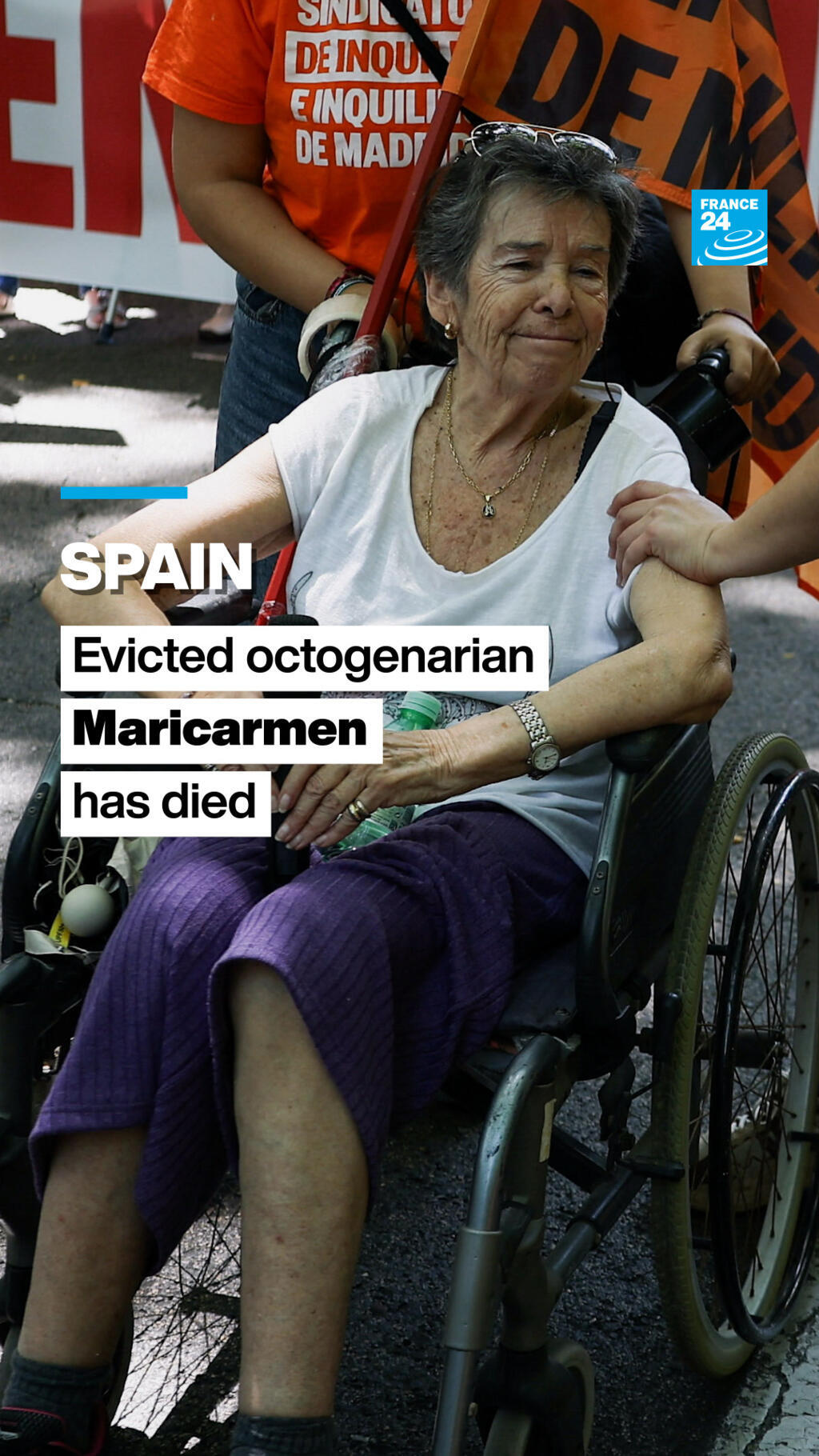
France 24 reports that María del Carmen Abascal, an 87-year-old pensioner known as Maricarmen, died on Wednesday while in hospital. Her eviction from the Madrid home where she had lived for many years had sparked protests across Spain and contributed to a political crisis. The report identifies the eviction and its wider public reaction as the central context for her significance, but the supplied article text gives no further details about the circumstances of her death, the eviction, the protests, or the political crisis. The page presents the item as a short video, with a listed duration of 1 minute and 44 seconds, and credits Juliette Montilly for the video. It also includes the keywords Spain, housing, and Europe. A related headline listed on the page says a tenant union reported the death of the evicted pensioner who had sparked Spain’s housing protests. Because the provided text contains only a brief description rather than a full transcript, additional claims or details about Abascal’s life and the events surrounding her case cannot be established from this source. The article’s focus is both personal—the death of an elderly woman—and public: the protests and political repercussions that followed her eviction.
Entities: María del Carmen Abascal (Maricarmen), Madrid, Spain, France 24, Reuters • Tone: neutral • Sentiment: negative • Intent: inform
08-10-2026
France 24 reports on the death of Maricarmen Abascal, an 87-year-old woman whose eviction became a prominent symbol of Spain’s housing crisis. The report says protests and public anger have grown across Spain following her death, which came in the wake of her removal from the home where she had lived for seven decades. Her case became a “cause celebre” in the wider debate over housing in Spain. The article’s brief description frames the eviction and its aftermath as a story connecting an individual tragedy with broader housing-related protest. France 24 correspondent Sarah Morris reports from Madrid. The supplied page content does not include the video’s transcript or further reporting, so it provides no additional detail about the circumstances of Abascal’s eviction or death, the people or institutions involved, or the specific demands made by protesters. It also does not provide statistics or policy analysis of Spain’s housing market. Accordingly, the central account is limited to the reported facts that Abascal was 87, had lived in her home for seven decades, was evicted, and became a focal point of housing protests. The headline and article description present her death as a moment of mourning and the public response as evidence of anger surrounding housing in Spain.
Entities: Maricarmen Abascal, Spain, Madrid, France 24, Sarah Morris • Tone: neutral • Sentiment: negative • Intent: inform
08-10-2026
France 24 reports that Maricarmen Abascal, an 87-year-old woman whose eviction became a focus of housing protests in Spain, has died. She was evicted from the home where she had lived for more than 70 years after the property was bought by an investment fund. The eviction took place the previous month and sparked nationwide demonstrations, according to the report.
The article says that after news of Abascal’s death spread, some people who had joined the protests said they believed the stress of the eviction had contributed to her death. The headline, “They killed her,” reflects that accusation, but the article presents it as a view expressed by protesters rather than as an established finding. No medical cause of death or independent evidence linking the eviction to her death is provided in the supplied text.
The report therefore connects an individual housing loss with broader public concern about housing and evictions in Spain, while offering only a brief account of the events. It identifies Abascal’s age, the length of time she had lived in her home, the purchase of the property by an investment fund, the subsequent eviction, and the nationwide protests it provoked. The supplied article does not include further details about the fund, the legal process, the protests’ organizers, or the circumstances of Abascal’s death. Its central point is that her eviction became a catalyst for demonstrations and that her death intensified protesters’ criticism and grief.
Entities: Maricarmen Abascal, Spain, France 24, Investment fund, Eviction • Tone: neutral • Sentiment: negative • Intent: inform
08-10-2026
María del Carmen Abascal, known as Maricarmen, died in hospital on Wednesday at age 87, after her September eviction from the Madrid apartment where she had lived for seven decades ignited protests and intensified Spain’s housing debate. She had been removed from the home on a stretcher after police cleared protesters from the street. Her fragile health required hospitalization, and although the real estate company later agreed to let her return under pressure from the public, she had not yet gone home. Her lawyer, Beatriz Duro, did not disclose the cause of death and said the case exposed the violence and health consequences associated with evictions.
Maricarmen had become a symbol for renters facing unaffordable housing. Her death prompted condolences from Prime Minister Pedro Sánchez and other political leaders, while protesters near Parliament chanted that her fight would continue. Protesters and activists expressed grief and anger, with some arguing that the ordeal had contributed to her death. The Madrid Tenants’ Union said the agreement allowing her return came too late and described the outcome as avoidable.
The case unfolded amid rising rents and broader public frustration. The article reports that average rents in Spain have nearly doubled over the past decade. Government figures cited in the story say 26% of Spanish renters spend an average of 40% of their income on housing and utilities, compared with 18% of renters across the European Union. Maricarmen had spent almost her whole life in the apartment and wanted to die at home.
Her eviction galvanized a social movement, led unions to announce a general strike for the following month, and increased pressure on political leaders. Sánchez called an early election after his government failed to pass emergency housing measures, hoping the issue would help his Socialist Party in the Nov. 29 vote. Opposition leader Alberto Núñez Feijóo also offered condolences, while cautioning against using her death for political advantage.
Entities: María del Carmen Abascal (Maricarmen), Madrid, Spain, Pedro Sánchez, Beatriz Duro • Tone: neutral • Sentiment: negative • Intent: inform
08-10-2026
Maricarmen Abascal, an 87-year-old woman whose eviction from her Madrid home of more than 70 years became a rallying point in Spain’s housing protests, has died in hospital. Police and social workers removed her by stretcher on September 23, and she was hospitalized with severe anxiety and exhaustion. Her case drew attention to Spain’s housing crisis, marked by housing shortages and rising rents, and helped fuel demonstrations that spread beyond Madrid to Barcelona.
After the tenants’ union announced her death, thousands marched from Madrid’s Puerta del Sol toward parliament, chanting that her death was “murder.” No cause of death was announced. A marcher called it an avoidable death that symbolized the housing crisis. Trade unions announced a nationwide general strike over housing for November 11.
The protests came as parliament rejected decrees intended to curb evictions and limit rent pressures. The article says the demonstrations and parliamentary rejection prompted Prime Minister Pedro Sánchez to call an early election for November 29. Sánchez is seeking to shift political attention from controversies involving migration in Ceuta and corruption cases connected to his Socialist Party and family toward public frustration over housing costs.
Abascal was evicted after an investment fund bought her house. Her lawyer later said she had reached an eight-year agreement with her landlord that would have allowed her to return at her previous rent, but she planned to sign it only after recovering and never left hospital. The tenants’ union praised her struggle and urged people to keep fighting. Sánchez expressed condolences, while opposition leader Alberto Núñez Feijóo cautioned against politicizing her death. Demonstrators and neighbors remembered Abascal as a fighter with a strong sense of justice and solidarity, and some vowed to continue mobilizing for dignified housing.
Entities: Maricarmen Abascal, Madrid, Puerta del Sol, Barcelona, Pedro Sánchez • Tone: analytical • Sentiment: negative • Intent: inform
08-10-2026
The death of 87-year-old Maricarmen Abascal has intensified Spain’s political dispute over housing, evictions and rising rents ahead of a snap general election scheduled for November 29. Abascal died on Wednesday after being hospitalized with severe anxiety and exhaustion following her eviction from her Madrid home on September 23. No cause of death has been announced. Her eviction had already prompted protests over housing shortages and rent increases, and news of her death further angered demonstrators in major Spanish cities. In Madrid’s Puerta del Sol, mourners left flowers and candles, while protesters blamed landlords’ greed and denounced the privatization of housing.
Political leaders quickly used the case to criticize their opponents. Left-leaning parties faulted conservatives for rejecting government decrees that included measures intended to restrain rents. Right-wing politicians countered that the leftist central government had failed to resolve the housing crisis after eight years in power. Prime Minister Pedro Sanchez had called the snap election after protests triggered by Abascal’s eviction.
The dispute was especially heated in Madrid, where the conservative People’s Party (PP) controls regional and local assemblies. The PP declined to hold a minute of silence for Abascal, prompting hard-left deputies to observe one outside City Hall. During a tense regional assembly debate, those deputies gave her a 60-second standing ovation while PP lawmakers remained seated.
Madrid regional leader Isabel Diaz Ayuso blamed Sanchez, noting that the eviction occurred under his government. Manuela Bergerot of the leftist Mas Madrid party accused people who prioritize profit over human life, and said Ayuso had laughed at Abascal. Bergerot referred to Ayuso’s earlier quip about when she would be allowed to stop paying her own landlords. The article describes the case as a flashpoint in an increasingly contentious election-season debate, while noting that Abascal’s cause of death has not been disclosed.
Entities: Maricarmen Abascal, Pedro Sanchez, Isabel Diaz Ayuso, Manuela Bergerot, People’s Party (PP) • Tone: analytical • Sentiment: negative • Intent: inform
08-10-2026
María del Carmen Abascal, known as Maricarmen, died in hospital at age 87 after her September 23 eviction from the Madrid apartment where she had lived for seven decades. Police removed protesters who had gathered to oppose the eviction, and Abascal was taken to hospital because of her fragile health. Her lawyer, Beatriz Duro, and housing activists confirmed her death; the cause was not disclosed. Spanish Prime Minister Pedro Sánchez and other political figures offered condolences.
Her death reignited demonstrations over Spain’s housing crisis. Protesters near Parliament chanted, “Maricarmen lives, the fight goes on,” while about 1,000 people had camped in central Madrid’s Puerta del Sol during the preceding week. Activists and her lawyer said the case exposed the human and health consequences of evictions. Although the Madrid Tenants’ Union said an agreement had been reached that would have allowed Abascal to return home, it came too late. The property company had sought to rent the apartment for a substantially higher price before agreeing to her return amid public pressure.
Abascal had spent most of her life in the apartment, first with her family and later on her own. The article places her case in the context of rising rents and limited rental supply: average Spanish rents nearly doubled over a decade, and government figures indicate many renters spend a substantial share of their income on housing and utilities. Public rental housing makes up less than 2% of Spain’s available stock, compared with an EU average of 8%.
The protests have also increased political pressure. Sánchez called an early election for November 29 after his government failed to secure parliamentary support for emergency housing measures addressing evictions and real estate speculation. Protesters have made Abascal a symbol of the broader struggle for affordable housing, though political leaders from across the spectrum urged respect for her and her family.
Entities: María del Carmen Abascal (Maricarmen), Beatriz Duro, Pedro Sánchez, Isabel Rodríguez, Alberto Núñez Feijóo • Tone: analytical • Sentiment: negative • Intent: inform