17-10-2026
During nationwide demonstrations over rising prices in France, protesters broke into Marseille’s town hall on Saturday, 17 October 2026, and clashed with police. The report says demonstrators forced their way through the building’s doors, overturned a bust of Marianne—a symbol of the French Republic—and damaged furniture in the entrance hall. Police later intervened to clear the building. Earlier, masked protesters attacked the façade of a municipal police station, set fire to rubbish bins and threw smoke devices inside. The article attributes its description of events at the town hall to AFP journalists at the scene. It presents the incidents as part of a wider wave of demonstrations in France, while focusing on the escalation and property damage in Marseille. The report does not provide information about injuries, arrests, the number of protesters, or the authorities’ response beyond the police intervention to clear the town hall.
Entities: Marseille, France, Marseille town hall, AFP, Marianne • Tone: neutral • Sentiment: negative • Intent: inform
17-10-2026
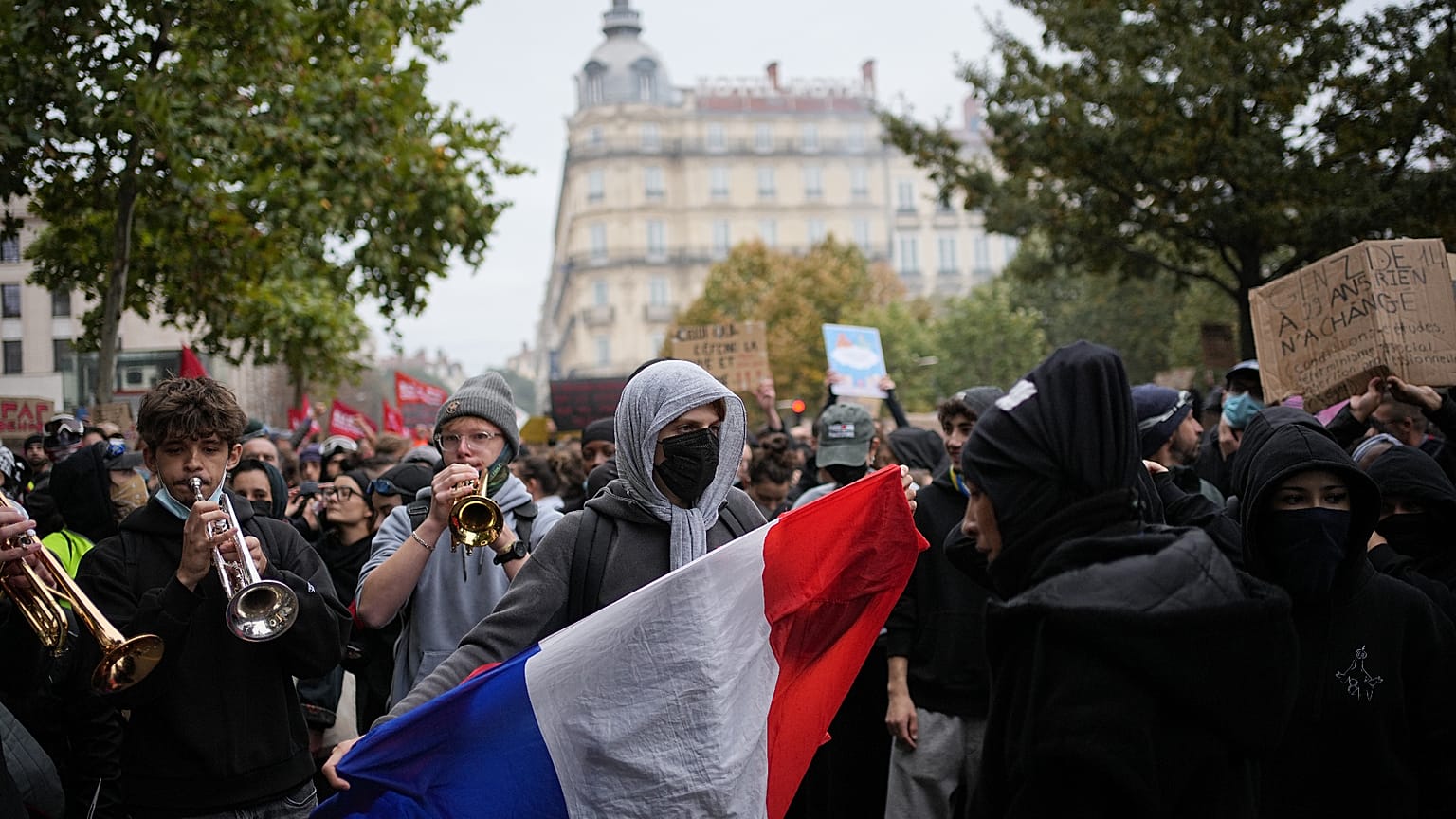
The article reports on nationwide protests in France on October 17, 2026, against the rising cost of living and conditions in schools. It says the demonstrations became violent, with one protester suffering a hand injury after being struck by a police crowd-control grenade. The article attributes an estimate of about 800,000 participants to the CGT, France’s largest trade union. Its headline describes chaotic scenes, and a photograph caption places demonstrators on Paris’s Champs-Élysées Avenue. The story was presented as a liveblog, but the page states that it is no longer being updated. The supplied text does not provide further details about the number or location of incidents, the injured protester’s condition, police accounts, or the demonstrations’ wider political consequences. It also does not give a breakdown of the attendance estimate or independent confirmation of the CGT’s figure. The article’s brief report therefore centers on the scale of the protests and a serious injury amid clashes, rather than offering a detailed account of the day. France 24 credits its coverage to reporting with AFP, AP and Reuters. The available page text is limited, so this summary reflects only the information it contains.
Entities: France, Paris, Champs-Élysées Avenue, CGT, France 24 • Tone: urgent • Sentiment: negative • Intent: inform
17-10-2026
France 24 reports that protests are taking place across France on Saturday, October 17, 2026. The demonstrations are described as responses to the high cost of living and what protesters see as poor working and studying conditions. The report’s short video segment, titled “France: What's different about today's protests?”, examines the protests and their distinguishing features through a discussion with France 24 journalist Jamie Smith-Maillet.
The supplied article text does not provide further details about the size or locations of the demonstrations, the groups involved, specific demands, or the response from authorities. It also does not include the substance of Smith-Maillet’s discussion, so the particular ways these protests differ from earlier demonstrations cannot be established from the text provided. Related headlines listed on the page refer to students, unions and Yellow Vests opposing austerity, as well as reports of high tensions between protesters and law enforcement; these are separate linked items and are not detailed in the article’s main description.
Overall, the item is a brief news introduction to a video discussion. It identifies the protests’ broad economic and workplace or education-related grievances, while directing viewers to the interview for further context. The available text is informational and does not itself make a clear argument about the protests or express an explicit judgment about the demonstrators or authorities.
Entities: France, France 24, Jamie Smith-Maillet, French protests, High cost of living • Tone: analytical • Sentiment: neutral • Intent: inform
17-10-2026
The France 24 video report concerns a mobilisation taking place in France on Saturday, 17 October 2026. According to the article description, the demonstration follows calls on social media to revive the Yellow Vests movement, which began in 2018 in opposition to social injustice. The report also connects the mobilisation to student protests that have been underway since mid-September: student groups have urged supporters to join the Saturday action.
France 24 discusses the protests with journalist Antonia Kerrigan, reporting from the scene, and Paul Smith, head of Modern Languages at the University of Nottingham. The title, “Protests in France: ‘Living conditions are too harsh’,” foregrounds the cost and hardship motivating protest, while the description emphasizes the convergence of different strands of mobilisation: renewed interest in the Yellow Vests, student activism, and broader calls for participation.
The supplied page text does not include a transcript or further details from the interview, so it does not establish the size or precise composition of the crowd, the specific demands raised at the event, or the guests’ fuller assessments. It presents the protests primarily as a response to social injustice and difficult living conditions, and as a possible revival or extension of earlier protest movements. The report’s purpose is to explain the context behind the mobilisation and discuss it with a correspondent on the ground and an academic guest.
Entities: France, Yellow Vests movement, Antonia Kerrigan, Paul Smith, University of Nottingham • Tone: analytical • Sentiment: negative • Intent: inform
17-10-2026
France 24 reports that tens of thousands of people are expected to take part in protests across France on Saturday, October 17, 2026. The anticipated demonstrations bring together students, trade unionists and people associated with the Yellow Vest movement. According to the article, participants are protesting high prices and what it describes as the country’s “fraying social model.” The report presents the planned demonstrations as a convergence of several groups and movements, rather than an event led by one organization alone.
The article gives only a brief account of the expected protests. It does not provide details about the planned routes, locations, organizers, specific demands, police preparations or any incidents during the demonstrations. Its wording describes the Yellow Vest participants as “remnants” of the movement, suggesting that the movement continues to have a presence but is not necessarily represented at its earlier scale. The page also lists related coverage, including reports about France preparing for protests and the Yellow Vests joining students, but those headlines are not additional reporting within this article.
Overall, the report informs readers about the expected scale and composition of the protests and identifies the economic and social concerns behind them. Because the demonstrations are described as upcoming, the article reports expectations rather than confirmed attendance or outcomes.
Entities: France, Students, Trade unionists, Yellow Vest movement, Tens of thousands of expected protesters • Tone: analytical • Sentiment: neutral • Intent: inform
17-10-2026
A fire engulfed Limoges’s historic town hall in central France on Saturday, 17 October 2026, after a group set the 143-year-old building alight amid unrest connected to nationwide cost-of-living protests. The blaze occurred as demonstrations escalated into violence in several French cities. Local prefect Maurice Barate reported that the roof had collapsed onto the lower floors, with the west wing the exception, and that around two-thirds of the building’s exterior had already disappeared. Authorities were still assessing the full extent of the damage when the report was published. The article establishes the fire’s connection to the wider protest unrest but provides no further detail about how the fire began, who was responsible, whether anyone was injured, or the response by emergency services. Its focus is the destruction of a historic public building and the scale of visible damage, alongside the broader context of demonstrations that turned violent in multiple cities. The report was updated at 23:01 GMT+2. It offers a brief factual account rather than a detailed investigation or broader analysis of the protests.
Entities: Limoges, Limoges town hall, Central France, Maurice Barate, Cost-of-living protests • Tone: neutral • Sentiment: negative • Intent: inform
17-10-2026
A branch of the tourist office in Lyon was vandalised and set on fire during nationwide protests over the cost of living, according to the Euronews report, updated on 17 October 2026. The article describes hooded individuals pulling letters from the building’s sign and damaging the premises while flames spread along one side of the structure. Burning debris was later seen on Place Bellecour, the square in front of the building. The report places the incident within a wider period of demonstrations and says the protests are adding pressure on President Emmanuel Macron’s government. That pressure follows weeks of student protests, which the article notes have sometimes turned violent. The story focuses on the damage and fire at the tourist office and provides only brief context about the broader unrest. It does not identify those responsible, report injuries, specify the extent of the damage, or explain how the fire was extinguished. It also does not provide statements from authorities, protesters, or the tourist office. The article’s presentation is concise and factual, describing visible events rather than offering analysis of the protests’ causes or political consequences. Its central subject is the escalation of a cost-of-living demonstration into vandalism and arson at a public-facing tourism facility in Lyon.
Entities: Lyon, Lyon tourist office, Place Bellecour, France, Emmanuel Macron • Tone: neutral • Sentiment: negative • Intent: inform