20-10-2026
Paris police imposed an overnight curfew in two parts of the French capital after a weekend of violent rioting and looting. The restrictions apply to Place de la République, where unrest began on Saturday, and the Les Halles shopping district, which was affected by looting. The curfew is in force from 11 p.m. Monday until 6 a.m. Tuesday, while gatherings and demonstrations are prohibited from 8 p.m. Police said the measures are intended to protect people and property from further violence and looting.
Officers were stationed in both areas on Monday evening, directing pedestrians along alternative routes and checking the identities of people nearby. A police helicopter flew over Les Halles. Despite the security presence, the streets were reported to be largely empty and calm.
The curfews follow unrest described as France’s worst rioting in years. City halls, other public buildings, and thousands of businesses have been targeted across the country. Earlier on Monday, Prime Minister Sébastien Lecornu called for curfews to be “very limited” and “localized,” indicating that authorities intended to focus restrictions on specific areas rather than impose them broadly. Officials are seeking to prevent further violence while keeping the measures concentrated on the locations most affected.
Entities: Paris, France, Paris police, Place de la République, Les Halles • Tone: neutral • Sentiment: negative • Intent: inform
20-10-2026
French Prime Minister Sébastien Lecornu says local authorities may impose new curfews where necessary as the government works to restore order after demonstrations over living costs and education conditions turned violent. More than 500,000 people gathered across France on Saturday. The protests brought together students seeking better educational conditions and people opposing the high cost of living, but were followed by looting and arson in several locations and more than 2,500 arrests. Police reported that Monday night passed without major incidents.
The government plans a series of meetings to address the unrest, which followed weeks of student protests over education standards. Digital Minister Anne Le Henanff is scheduled to meet social media executives to discuss the demonstrations. She has urged platforms to remove listings for goods reportedly looted over the weekend. Further protests have been called for Saturday, although France’s main trade unions have not endorsed the call. Union officials are due to meet Lecornu on Wednesday, and he will hold talks with political parties on Thursday.
The unrest is unfolding ahead of presidential elections scheduled for April and May next year. Far-right National Rally leader Marine Le Pen leads current polls, followed by Jean-Luc Mélenchon of La France Insoumise. President Emmanuel Macron cannot run again because of the two-term limit. Both Le Pen and Mélenchon have been accused of exploiting the protests for political advantage.
Alice Cohen-Morzadec, a spokesperson for the French Student Union, described the demonstrations as an outburst of anger over Macron’s policies. She said students’ living conditions had been badly damaged, citing difficulties affording food and housing: “One student out of two cannot eat properly. One student out of three doesn’t have a permanent house to live in. We cannot study in these conditions.”
Entities: Sébastien Lecornu, France, Paris, Emmanuel Macron, Marine Le Pen • Tone: neutral • Sentiment: negative • Intent: inform
20-10-2026
Marseille is recovering from a weekend of severe unrest in France, where protests escalated into widespread looting and destruction. Local business leaders say more than 500 premises in the city were damaged, most of them looted. A police union reported 118 officers injured and described the violence as unprecedented; 101 arrests have been made, with about a quarter involving children. Authorities banned demonstrations and gatherings for eight hours on Monday, and an overnight curfew for minors is due to begin in parts of the city on Tuesday. The restrictions brought a temporary lull, but further demonstrations are planned for the weekend.
The protests began in September over poor school conditions and expanded to encompass issues such as the cost of living. Student Maryame described the initial march as a source of solidarity, but said the subsequent violence was frightening. She expressed uncertainty over whether violence can ever be legitimate, while noting France’s revolutionary history and the desire to make a major impact.
Police union representative Arnaud Blaise blamed far-left Black Bloc agitators for provoking disorder and said young people took advantage of the chaos to loot. He argued police were overwhelmed after firing 4,000 tear-gas grenades and running out of ammunition. Marseille Mayor Benoît Payan disputed the handling of events, calling the response a fiasco and warning that further looting could follow unless police tactics changed. He said authorities should not focus only on high-school students.
Interior Minister Laurent Nuñez visited Marseille and met Payan after President Emmanuel Macron rejected Nuñez’s resignation. Residents voiced broader concerns about failing public services, neglected neighborhoods, poverty, and young people being drawn into crime through anger and despair. The article portrays a city facing immediate security concerns alongside deeper social problems, with a fragile calm ahead of planned protests.
Entities: Marseille, France, Maryame, Arnaud Blaise, UN1TE police union • Tone: analytical • Sentiment: negative • Intent: inform
20-10-2026
A 34-year-old suspect linked by French media to a far-left movement has been arrested in connection with a fire that severely damaged Limoges’s 19th-century city hall during widespread disorder. The building’s clock tower and roof were engulfed in flames and collapsed. The suspect was reportedly already known to police for violence against public officials and was on a national security watchlist.
The fire occurred amid protests that began with students seeking better school conditions and grew to encompass anger over rising fuel prices, the cost of living and deteriorating public services. Demonstrations have been accompanied by looting, fires and damage to public buildings and businesses. Officials said more than 2,500 people had been arrested since the disorder began, 149 were in detention after the weekend’s demonstrations, and about 1,000 police officers were injured. One demonstrator reportedly lost a hand to a police crowd-control grenade, while more than 2,000 businesses were affected.
Authorities have introduced or extended overnight curfews in parts of Paris, Marseille, Lyon, Nice, Lille and Bordeaux, alongside restrictions on gatherings and young people. Prime Minister Sébastien Lecornu promised a large police presence for protests planned for Saturday, while local officials said further restrictions would be determined according to conditions on the ground. Interior Minister Laurent Nuñez acknowledged that police had lost control in some cities; his offer to resign was rejected by President Emmanuel Macron.
Political tensions have also risen. Lecornu accused far-left groups of pursuing an insurrectionary plan, prompting La France Insoumise leader Jean-Luc Mélenchon to demand proof or an apology. Mélenchon later called for restraint. Meanwhile, a far-right group was reported to prosecutors over alleged Islamophobic and xenophobic remarks at a gathering in Lyon. The yellow vests have announced a new round of protests, and the CGT union has called for strikes on 5 November.
Entities: Limoges, Sébastien Lecornu, Jean-Luc Mélenchon, Emmanuel Macron, Laurent Nuñez • Tone: analytical • Sentiment: negative • Intent: inform
20-10-2026
French authorities imposed localized curfews and banned gatherings Monday as the country dealt with widespread rioting that followed weeks of protests. Demonstrations began with high school students objecting to deteriorating school conditions, including overcrowded classrooms and teacher shortages, and expanded into broader anger over inflation, stagnant salaries, and declining public services. More than 500,000 people took to the streets Saturday, and the Justice Ministry said more than 2,500 people had been arrested.
Violence and vandalism caused extensive damage in Paris and other cities. Rioters looted shops, set vehicles and buildings on fire, clashed with police, and damaged historic landmarks. Limoges’ nearly 150-year-old town hall was destroyed by fire; Lyon’s tourist office was also set alight, and Marseille’s historic city hall was vandalized. Paris residents woke to debris and burned vehicles, while demonstrations continued outside the Louvre.
President Emmanuel Macron said those seeking to undermine the republic would be held accountable. Prime Minister Sébastien Lecornu blamed some of the violence on an alleged ultra-left movement seeking to create disorder before the April presidential election. He urged regional authorities to impose partial, localized curfews, said police had lost control during the unrest, and warned that the government could declare a national state of emergency if necessary. Lecornu also acknowledged the legitimacy of students’ concerns, while saying violence was undermining the freedom to demonstrate. The Yellow Vests movement called for another round of demonstrations Saturday.
The U.S. State Department advised Americans to avoid protest areas. The article also reports that Donald Trump claimed, without a link being suggested by French officials, that immigration was connected to the unrest. Protesters described varied grievances, including distrust of politicians, inequality, financial insecurity, and concern about the planet.
Entities: Emmanuel Macron, Sébastien Lecornu, Donald Trump, Paris, Marseille • Tone: analytical • Sentiment: negative • Intent: inform
20-10-2026
France imposed overnight curfews in parts of several cities after a weekend of mass protests, looting and violence. Prime Minister Sébastien Lecornu said the measures had helped produce a “calm” night, while noting that local officials could introduce further curfews where needed. The demonstrations followed weeks of public frustration over the cost of living, education and deteriorating public services. Although hundreds of thousands marched peacefully, some protesters smashed shopfronts and set fire to Limoges Town Hall.
The unrest is unfolding amid political and financial strain. France has a divided parliament without a majority, presidential elections scheduled for April 2027, and a government trying to reduce its deficit as borrowing costs rise. Critics have also questioned President Emmanuel Macron’s decision to travel to Kuwait, the UAE, Bahrain and Qatar while France faces severe disorder at home. Macron said the trip was intended to address fuel prices, secure energy supplies and strengthen defense and security cooperation. Commentators and newspapers criticized his absence as the crisis deepened.
Police handling of the unrest has become another point of public anger. Interior Minister Laurent Nuñez offered to resign, taking responsibility for events, but Macron refused the resignation. Business group MEDEF said more than 3,000 shops had been ransacked and warned that the damage had weakened confidence in the state’s ability to provide basic security. The government plans a support fund for affected businesses and discussions with insurers to accelerate claims. A Verisk Maplecroft analyst said the losses could exceed those from the 2023 unrest following the death of Nahel Merzouk, which produced about 1 billion euros in insured losses.
French markets came under pressure after the violence, with bonds, stocks and the euro selling off. Debate over the 2027 budget continues, with the government aiming to reduce the deficit from 5.4% to 5% of GDP. Analysts expect protests rooted in economic and public-service grievances to persist, keeping pressure on the government to restore order.
Entities: Sébastien Lecornu, Emmanuel Macron, France, Paris, Lyon • Tone: analytical • Sentiment: negative • Intent: inform
20-10-2026
Kalshi trading markets indicate that Marine Le Pen’s perceived chance of winning France’s 2027 presidential election has risen sharply amid escalating protests over school conditions, the cost of living and public services. Her odds climbed to 53% from 39% over the past month. Trading activity on the next-president contract increased after student-led demonstrations began in Paris in September and spread into broader national unrest. Authorities reported that more than 500,000 people demonstrated across France over the weekend.
The article also describes a short-lived rise in the odds for David Lisnard, the mayor of Cannes, whose probability reached 44.7% on Sept. 26, a day after a major campaign rally, before falling to 11% by Tuesday afternoon. The Kalshi contract asks who will win the next French presidential election and is to be verified by the French government next year.
Le Pen has made the unrest a central campaign issue, criticizing the demonstrations and blaming conditions in part on President Emmanuel Macron’s centrist government. In social media posts following severe unrest, she described cities and streets as battered and ransacked and warned of a crisis of trust and authority. The article reports more than 2,000 arrests and nearly 1,000 police officers and gendarmes injured, according to the French ministry. It also describes a town hall in Limoges set on fire during a demonstration.
The unrest coincides with financial pressures: France’s CAC 40 stock index fell 2.8% over the past month and nearly 6% over six months, while the 10-year government bond yield rose above 4.9%. Goldman Sachs strategist Sharon Bell said reducing the budget deficit would be difficult without painful measures. The article discloses that CNBC and Kalshi have a commercial relationship, including customer acquisition and a minority investment.
Entities: Marine Le Pen, David Lisnard, Emmanuel Macron, Sharon Bell, Kalshi • Tone: analytical • Sentiment: negative • Intent: inform
20-10-2026
Hundreds of thousands of people have protested across France, Italy, Spain, Portugal and Albania over the cost of living and deteriorating public services. France experienced the largest demonstrations, with more than 500,000 people marching. While most protests were peaceful, some participants looted shops, set fires and attacked police. The specific causes differed by country: French protests began with students objecting to poor school conditions and expanded to broader economic grievances; housing costs were prominent in Spain and Portugal; and Albanian demonstrators focused on university conditions, tuition fees and the government. Protests in Milan also turned violent.
Analysts caution that no single factor explains the unrest. Higher energy prices, partly linked to the wars in Iran and Ukraine, contribute to pressure on households, but economists say the increases are smaller than in 2022, when comparable violence did not occur. In France, inflation, weak economic growth, declining purchasing power, unemployment and the approaching 2027 presidential election have combined with student protests and political tensions. A proposed budget to reduce the deficit includes measures such as freezing civil service pay and tightening sick-leave reimbursement. French data show rising unemployment, especially among young people, higher consumer prices and a projected fall in purchasing power.
The protests also expose a common dilemma for European governments: improving living standards and public services while controlling debt and supporting households. Portugal’s finance minister says Europe’s slow growth limits wage increases and public resources, while noting Portugal’s comparatively stronger fiscal position despite sharp rises in house prices. In France, unrest has unsettled financial markets, with bond yields rising and the euro weakening. Market analysts warn that reducing the deficit may require tax increases or spending cuts, and one strategist describes a risk of sovereign debt crisis. Proposals such as raising France’s retirement age could prove especially contentious amid the demonstrations.
Entities: France, Italy, Spain, Portugal, Albania • Tone: analytical • Sentiment: negative • Intent: analyze
20-10-2026
French authorities have arrested a 40-year-old man suspected of involvement in the burning of Limoges’s historic town hall during rioting on the sidelines of nationwide protests. Officers from the RAID police unit detained him in nearby Val d’Issoire on Tuesday. A source close to the case said he had previously been flagged for surveillance as a potential threat and was linked to ultra-left movements; these claims have not been presented as established findings.
The fire engulfed the 19th-century building on Saturday, causing its roof and belfry to collapse. France’s Counter-Terrorism Sub-Directorate has been called in to investigate the suspected arson. Justice Minister Gérald Darmanin said anti-terror prosecutors would soon decide whether to handle the case as a suspected terrorist attack, adding that such a decision would imply investigators believed the destruction had been organised. The article also recalls the 2019 Notre-Dame fire, which investigators believe began accidentally.
The town hall’s destruction has become a symbol of violence that occurred alongside protests against grievances including the rising cost of living and conditions in schools. Limoges Mayor Guillaume Guerin criticised the police response, saying officers lacked resources and backed down in the face of rioters. He called for government funding to rebuild the building and said the state had failed. Prime Minister Sébastien Lecornu is due to visit Limoges on Friday.
Authorities said about 5,000 people, including 700 described as radicalised and extremely violent, attended Saturday’s demonstration in Limoges. Around 7,000 people took part in a protest against the violence on Sunday evening.
Entities: Limoges, Val d’Issoire, France, RAID police unit, Counter-Terrorism Sub-Directorate (SDAT) • Tone: neutral • Sentiment: negative • Intent: inform
20-10-2026
Damage from France’s weekend riots has reached at least 3,000 shops, double the number reported the previous day, but insurers have not yet estimated the total cost or the number of claims. France Assureurs says its members are mobilised to help policyholders. Carrefour had reported damage at 50 stores, including 20 looted, while its chief executive previously estimated industry losses in the hundreds of millions of euros. French shares, insurance stocks and government bonds fell or came under pressure as markets responded to the unrest.
The 2023 riots offer a comparison: insurers paid €793 million for about 17,000 claims, with two-thirds of insured losses involving shops and business premises. A Senate inquiry later put property damage closer to €1 billion, noting that some destruction was uninsured, undeclared or only partly covered. This weekend’s reported count of affected businesses already exceeds the roughly 2,500 vandalised businesses recorded during the 2023 unrest.
A new insurance scheme created by France’s 2026 budget law is intended to make riot cover compulsory in certain property policies and establish a national fund to help insurers meet major losses. It is not yet in effect, pending European Commission approval and a government decree. For now, compensation depends on existing contracts. Policies commonly cover physical damage such as fire, theft and vandalism, but compensation for lost trade generally requires optional business-interruption cover and usually applies only when insured physical damage forces a closure. Policyholders typically have five days to notify insurers, and some claims require a police complaint.
Prime Minister Sébastien Lecornu said affected businesses could use the state-funded furlough scheme and announced targeted curfews, with a state of emergency possible if needed. President Emmanuel Macron declined to accept Interior Minister Laurent Nuñez’s resignation as arrests passed 2,400. The eventual public cost remains uncertain, against a backdrop of a projected 5.4% budget deficit and public debt at 119% of GDP. The article concludes that the financial impact will extend beyond the directly attacked shops.
Entities: France, Piero Cingari, France Assureurs, Carrefour, Alexandre Bompard • Tone: analytical • Sentiment: negative • Intent: inform
20-10-2026
France experienced some of its worst rioting in recent years on Saturday, with clashes and public buildings set on fire or vandalised. The unrest occurred six months before the country is due to elect a successor to President Emmanuel Macron. Images of the violence circulated internationally, and the United States, China and Germany issued travel advisories for their citizens in France. The damage has also angered local residents and business owners: at least 3,000 shops across the country were reportedly vandalised or looted.
Odelia, a pharmacy owner in Paris, told Euronews that her shop had been devastated. She said its stock had been burned and described damage to the building’s water heater and light fixtures. She also questioned why anyone would set fire to a building with homes above it and challenged the idea that such destruction was a form of protest against the high cost of living.
The government announced that new curfews would be imposed on Tuesday in areas where needed. Prime Minister Sébastien Lecornu said measures introduced in several cities the previous day had helped keep the night calm. Amid pressure over the unrest, the government also scheduled another set of emergency meetings for Tuesday, including discussions with representatives of major social media platforms.
Entities: France, Paris, Odelia, Sébastien Lecornu, Emmanuel Macron • Tone: neutral • Sentiment: negative • Intent: inform
20-10-2026
Fox News correspondent Greg Palkot describes recent rioting in France as unusually violent and potentially consequential, drawing on decades of reporting in the country and conversations with people in Paris. He reports that clashes over the preceding weekend led to roughly 2,500 arrests and about 1,000 injured police officers, with activists also hurt and approximately 3,000 businesses damaged, looted, or otherwise affected. Authorities estimate the damage at more than $1 billion. Attacks on public buildings—including a city hall in Limoges, a police headquarters in Marseille, and a tourist office in Lyon—stood out as signs of a broader challenge to government authority.
Palkot says protests rooted in student concerns and economic worries among working- and middle-class people were taken over by participants bent on disorder, including opportunistic looters. While some immigrants, foreigners, and people reportedly connected to ultra-left groups were among those involved, he characterizes the unrest as fundamentally French. He links the country’s vulnerability to years of division and unfulfilled promises under President Emmanuel Macron, while noting that violence has at times left parts of Paris and other cities beyond effective control and forced shopkeepers to defend themselves.
With presidential elections six months away, the unrest presents political opportunities for both left- and right-wing figures, who have variously sympathized with protesters or demanded tougher law enforcement. Palkot says the government appears to be emphasizing security, in part because France’s finances are strained. Prime Minister Lecornu has announced that a planned large protest will be met with a “massive police operation” supported by the military. The article questions whether a forceful response will address the underlying problems, and frames France’s turmoil as a potential lesson for other countries facing inequality and dwindling resources.
Entities: Greg Palkot, Emmanuel Macron, French Prime Minister Lecornu, France, Paris • Tone: analytical • Sentiment: negative • Intent: analyze
20-10-2026
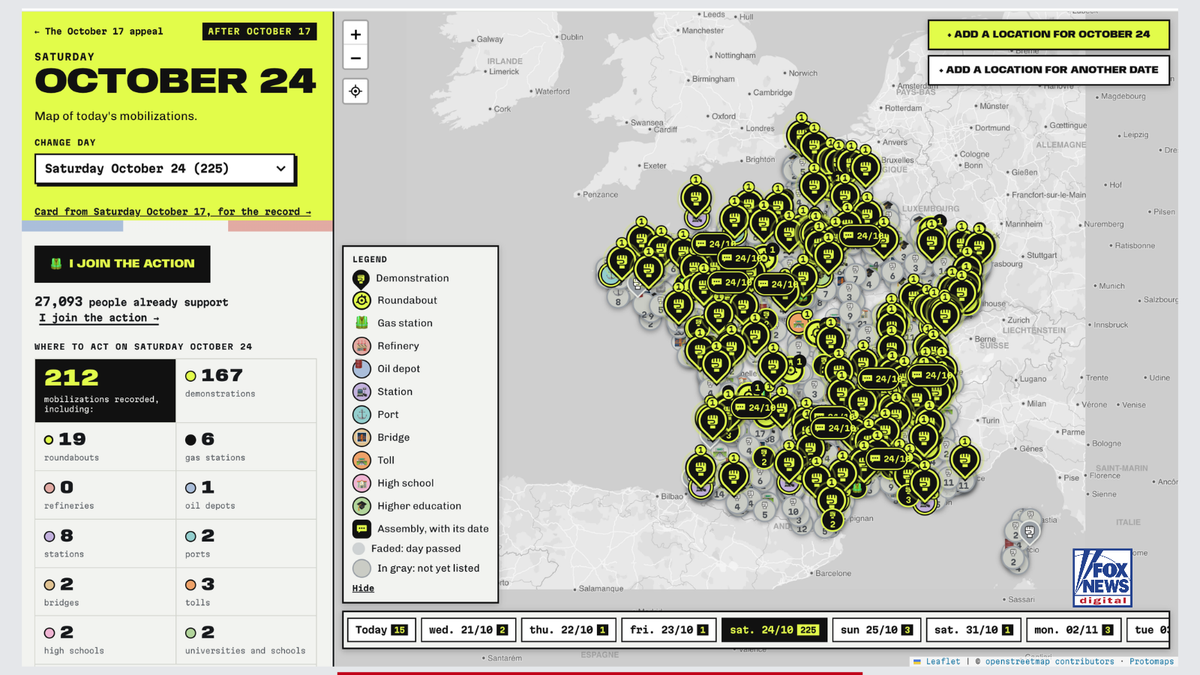
The article reports that French activists are planning a second round of demonstrations, called “Acte II,” for Oct. 24, following protests in which an estimated 500,000 people took to the streets and clashes caused fires in Paris and other cities. It also describes a planned European youth strike on Nov. 20. Citing its own investigation, Fox News Digital says it identified 101 organizations in nine countries, including the United States, that are coordinating, organizing, or amplifying protests—up from 54 groups identified earlier in the week. The article says most of the groups are adult-led and characterizes the network as a “red-green” alliance linking far-left groups with Islamist organizations. It notes that some participants use the Antifa label.
The article names University of California, Berkeley academic Hatem Bazian as an American-based figure who shared protest videos. It says he connected the Oct. 17, 2026, Paris riots with events on Oct. 17 in 2023 and 1961, and reports that he did not respond to a request for comment. The account also describes sympathetic coverage from pro-communist outlets, including BreakThrough News, CodePink, and the Party for Socialism and Liberation, which it says are funded or supported by Neville Roy Singham. BreakThrough News framed the events as a youth uprising against austerity, high rents, and government spending on weapons and war, and planned an online discussion featuring journalist Rafael Karoubi and hosts Rania Khalek and Zoe Alexandra.
Finally, the article says French organizers are using a website to coordinate protest logistics and communication. It reports that the site’s domain was registered anonymously on Sept. 15, but the supplied article ends before completing the sentence. Overall, the piece presents the protests not just as domestic unrest but as part of an international activist network, while emphasizing alleged far-left and Islamist connections.
Entities: Acte II demonstrations, European youth strike, France, Paris, “Chaos Inc.” • Tone: analytical • Sentiment: negative • Intent: analyze
20-10-2026
The article reports that some Jewish communities in France took extra precautions during violent demonstrations on October 17, including canceling Sabbath afternoon prayers and advising people to conceal visible signs of Jewish identity. Samuel Arrouas, a French Jewish community member who divides his time between Paris and Israel, said synagogues sent warnings urging congregants to stay home, avoid wearing kippahs or tzitzit in public, and leave promptly after services. He described the messages as unprecedented in his experience and said seeing masked demonstrators carrying Palestinian flags near Paris was frightening.
The protests drew about 550,000 people across France over fuel prices, the cost of living and declining public services. The article says some demonstrations turned violent, with clashes with police, looting and fires in Paris, Marseille and other cities; the Interior Ministry reported about 2,400 arrests. President Emmanuel Macron called for calm, distinguished legitimate grievances from criminal violence and pledged accountability. Interior Minister Laurent Nuñez offered to resign, but Macron rejected the offer.
Shannon Seban of the Combat Antisemitism Movement argued that Palestinian flags at demonstrations focused on domestic issues heightened Jewish concerns. She condemned violence and cited the organization’s documentation of 1,384 antisemitic online posts in two days, including conspiracy theories blaming Jews and Israel for the unrest. Seban also warned about rhetoric calling to “globalize the intifada.” The article closes by introducing concerns from Bruno Benjamin, head of CRIF’s Marseille-Provence branch, about looted and vandalized businesses and community anxiety, but the supplied text cuts off before his remarks are complete.
Entities: Samuel Arrouas, Shannon Seban, Bruno Benjamin, Emmanuel Macron, Laurent Nuñez • Tone: urgent • Sentiment: negative • Intent: inform
20-10-2026
The article reports that French President Emmanuel Macron attributed part of the anger behind protests and riots in France to higher fuel and living costs, which he linked to the U.S.-Iran conflict and disruption to energy markets. In a televised address, Macron said France was not involved in the conflict but was suffering its consequences. He said he understood demonstrators’ concerns, described steps he had taken to secure fuel and gas, and announced a trip to Gulf countries to discuss the energy crisis. He also warned that people seeking to undermine the republic would be held accountable.
The report places Macron’s remarks alongside criticism from experts who question whether fuel prices adequately explain the scale and character of the unrest. Iran expert Lisa Daftari argued that Iran’s closure of the Strait of Hormuz contributed to expensive fuel, but said arson, looting and mass arrests point to organized lawlessness rather than an ordinary cost-of-living protest. The article says nearly 2,400 people were arrested in a single day. French Prime Minister Sébastien Lecornu blamed the ultra-left for orchestrating disorder ahead of the presidential election.
The story also includes comments from Barak Seener of the Henry Jackson Society, who links immigration and pro-Palestinian slogans to threats to Western civilization. Those claims are presented as his views, not as independently established facts. U.S. President Donald Trump criticized Macron’s border policies, saying he had warned the French leader that they would damage the country. The article thus frames the unrest as a dispute over its causes: economic hardship and energy shocks, versus domestic political movements, crime and migration. Its language and selection of critical commentators give the piece a strongly skeptical view of Macron’s explanation, while emphasizing the violence and political controversy surrounding the protests.
Entities: Emmanuel Macron, Donald Trump, Sébastien Lecornu, Lisa Daftari, Barak Seener • Tone: analytical • Sentiment: negative • Intent: analyze
20-10-2026
France 24 introduces an interview with political scientist and researcher Damien Lecomte of Paris Panthéon Sorbonne University, hosted by Genie Godula, about France’s escalating sociopolitical and economic unrest. The article description presents a contradiction in the state’s response: force is used disproportionately against peaceful demonstrators, while widespread violence has not been contained. Lecomte warns that a repressive approach cannot resolve the underlying social crisis.
The unrest is described as connected to public grievances over education, public services and the cost of living. The description also notes that competing narratives about the protests risk pushing those grievances out of focus. Its headline characterizes a large portion of the population as sympathetic to the protesters, although the supplied text does not provide polling figures or further evidence for that claim.
With presidential elections approaching, the response to unrest is framed as more than a matter of restoring public order. It is also bound up with political legitimacy, civil liberties and debate over the future direction of French society. The article presents the interview as an analysis of how government policy, protest, violence and public opinion intersect during a period of crisis. The supplied page text contains no further interview transcript or detailed evidence beyond this description.
Entities: France, Damien Lecomte, Genie Godula, Paris Panthéon Sorbonne University, France 24 • Tone: analytical • Sentiment: negative • Intent: analyze
20-10-2026
France 24 reports that French Prime Minister Sébastien Lecornu announced new targeted curfews to take effect on Tuesday, October 20, 2026. The announcement followed unrest over the preceding weekend and came after overnight measures had helped maintain calm. The report is presented as a short video, with a listed duration of 1 minute and 32 seconds, and is credited to Emerald Maxwell and Delano D’Souza.
Although the headline says the report concerns public reactions to the prime minister’s announcement, the supplied article text does not include interview excerpts, specific reactions, or details about which areas would be subject to the new curfews. It also does not describe the nature or scale of the weekend unrest, specify the earlier overnight measures, or provide further remarks from Lecornu or other officials. The linked page text includes a cover-image caption describing the introduction of targeted curfews after weekend unrest, but the video itself is not transcribed in the provided material.
The central information available is therefore limited to the government’s plan for additional, targeted curfews and the report’s statement that preceding measures had helped keep conditions calm overnight. Related headlines listed on the page refer to curfews, protests, riots, public concerns, and possible effects on tourism, but these are links to separate stories and are not evidence or additional content from this article. Overall, this is a brief news update about the French government’s response to unrest, rather than a detailed account of public opinion or the curfew policy.
Entities: France, Sébastien Lecornu, French Prime Minister, France 24, targeted curfews • Tone: neutral • Sentiment: neutral • Intent: inform
20-10-2026
French Prime Minister Sébastien Lecornu said on Tuesday that authorities would deploy a “massive” police presence for new demonstrations expected over the coming weekend. His announcement came amid criticism of the government’s handling of recent street violence. The protests follow Saturday’s unrest, when rioting affected France and was described in the article as among the country’s worst in recent years. The unrest comes at a politically sensitive moment: France’s voters are due to elect a successor to President Emmanuel Macron in six months.
The report focuses on Lecornu’s promise of a substantial security response and the political pressure surrounding that decision. It does not provide details about the planned number of officers, the locations where they will be deployed, or the organizers’ specific demands. The article’s accompanying image caption describes a fire burning as riot police stood guard in Paris on October 18, a day after a national protest over the cost of living and rising fuel prices. That caption supplies context for the demonstrations, while the main report identifies the recent riots and the upcoming weekend protests as the immediate backdrop to the prime minister’s pledge.
France 24’s Ellen Gainsford reports on the announcement. Related headlines on the page refer to trials for people accused of ransacking city centres, local curfews, and the justice minister’s promise of firm punishment, but these are separate linked stories rather than details developed in the article itself. The central message is that the government is preparing a large police deployment as it faces renewed demonstrations and scrutiny over its response to violence.
Entities: Sébastien Lecornu, Emmanuel Macron, France, Paris, France 24 • Tone: analytical • Sentiment: negative • Intent: inform
20-10-2026
French Prime Minister Sébastien Lecornu said the government would deploy a “massive” police presence for demonstrations planned for Saturday, according to remarks made during a session at the National Assembly on Tuesday. Interior Minister Laurent Nunez subsequently announced that military forces would also reinforce the security operation. The government says the deployment is intended to bring about an “immediate return to order” after violent riots over the weekend.
The article’s account of the previous day’s developments describes protests over the rising cost of living and in support of high school students’ demands for education funding. The demonstrations escalated into clashes in which both protesters and law-enforcement officers were injured. Public buildings were set on fire, and businesses were looted.
Authorities also imposed a nighttime curfew covering Place de la République and streets around Les Halles in central Paris. The restriction was scheduled to run from 11 p.m. Monday until 6 a.m. Tuesday. Nunez acknowledged that police had “lost control” of protests in several cities over the weekend. Meanwhile, the Yellow Vest movement called for another round of demonstrations on Saturday, the same day the government plans its reinforced police operation. The article presents these developments as a response to continuing unrest and an uncertain security situation; it does not provide further details about the military forces or the planned demonstrations.
Entities: Sébastien Lecornu, Laurent Nunez, France, National Assembly, Paris • Tone: neutral • Sentiment: negative • Intent: inform
20-10-2026
The available France 24 page presents an interview with Dr Joseph Downing, Senior Lecturer in International Relations and Politics at Aston University, hosted by Annette Young. The interview concerns political unrest in France and criticism of how President Emmanuel Macron and his government communicate with the public. Its headline characterizes them as “very poor communicators” who fail to address what it calls the “genuine concerns of the French people.”
The page description says Downing discusses several connected issues: political accountability, police exhaustion, and the increasingly confrontational relationship between citizens and the state. He argues that France needs to reconsider how state authority is exercised and how authorities respond both to violent unrest and to legitimate social movements. The description also highlights France’s centralized policing culture and revolutionary traditions, as well as the broader risk posed by Russian information warfare.
The supplied page text does not include a full interview transcript or the arguments and evidence developed in the video. It therefore supports only a summary of the stated themes, not a detailed account of Downing’s reasoning. The page lists related coverage of curfews, protests, riots, arrests, and political responses, but those headlines are recommendations rather than part of the interview itself. The article’s framing is critical of the government’s communication and emphasizes tensions around public concerns, policing, and state authority. The video is credited to Annette Young and was issued on 20 October 2026, with a modification time later that day.
Entities: Emmanuel Macron, Annette Young, Dr Joseph Downing, Aston University, France • Tone: analytical • Sentiment: negative • Intent: analyze
20-10-2026
The U.S. Embassy in France has urged Americans to avoid violent protests and monitor local conditions as unrest spreads across the country, prompting localized curfews and raising concerns about travel disruptions. The embassy said partial curfews were introduced in several cities for October 19 and 20, including Lille, and that further restrictions and scattered protests could follow. In Paris, overnight curfews were imposed in areas including Place de la République and the Les Halles shopping district. Riot police used tear gas near Place de la République as clashes intensified, while burning vehicles and street fires filled the area with smoke. A Dutch visitor, Tije De Boer, described the scene as “like a war zone” after evacuating his hotel with his children.
The demonstrations have affected public spaces and tourism. The Louvre closed after protesters blocked its entrances, and travelers were advised to avoid well-known gathering points such as Place de la République, Place de la Bastille and Place de la Nation, as well as Boulevard Voltaire. Elsewhere, Lyon’s tourism office was vandalized and set ablaze, while Limoges’ historic town hall was also set on fire. Bordeaux’s mayor said up to 100 stores had been looted. The article reports that the nationwide unrest followed October 17 protests and was fueled by grievances including rising living costs and mass migration. It also says approximately 2,500 people were detained and more than 1,000 security and emergency personnel were injured.
Flights to and from Paris were largely operating, but the embassy warned that ground transportation could be disrupted. It advised travelers to check for Metro closures, confirm flight schedules with airlines, allow extra time, monitor local news and authorities, and plan alternative routes. The State Department had not provided comment by publication time.
Entities: U.S. Embassy in France, France, Paris, Lille, Lyon • Tone: urgent • Sentiment: negative • Intent: inform
20-10-2026
A 34-year-old man described by police as an “ultra-left militant” has been arrested in connection with a fire that destroyed much of Limoges’s historic city hall during nationwide protests in France. The suspect was already on France’s national security watchlist and was known to police for violence against public officials. French media reported that he was detained Tuesday in Val d’Issoire, about 30 miles from Limoges, and that authorities consider him the main suspect in Saturday’s arson attack. The fire consumed the building’s roof and clock tower, which collapsed. Limoges Mayor Guillaume Guerin said the listed, 140-year-old building will require a complete reconstruction on the scale of Notre Dame’s restoration. He has threatened to resign unless the national government provides funding for the rebuilding. The arson took place amid demonstrations against the high cost of living, part of a nationwide mobilization involving former Yellow Vests, students, climate activists and farmers. The protests have included clashes, arson and looting. More than 1,800 people were arrested during and after the nationwide unrest, and officials said nearly 150 people detained over the weekend had already been convicted and sentenced to prison for violence or property damage. Some French towns and cities introduced curfews on Monday amid concern that violence could recur the following Saturday.
Entities: Limoges, Val d’Issoire, France, Guillaume Guerin, Limoges city hall • Tone: urgent • Sentiment: negative • Intent: inform
20-10-2026
France experienced a calm night under curfews imposed after a weekend of riots and looting, but the government is preparing for renewed demonstrations scheduled for the coming Saturday. Prime Minister Sebastien Lecornu said targeted curfews had helped restore calm and could be extended where needed. The government is also facing criticism over security failures that left city centers, including those in Paris, Marseille and Lyon, exposed to rioters and looters after demonstrations.
The protests began with high-school strikes and demonstrations over declining standards and deteriorating school facilities, then broadened into anger about rising prices and perceived failures to meet health, housing and welfare needs. The unrest has intensified an already febrile political climate ahead of France’s presidential election next April and May, with far-right and far-left candidates leading the field.
Justice Minister Gerald Darmanin said 123 people arrested over the weekend were in detention awaiting trial. He separately reported that around 2,500 people remained in custody for questioning. The relative calm gives police and public authorities some respite after weeks of protests, but student groups say they will continue pressing President Emmanuel Macron’s government to address what they describe as a broken, underfunded education system. Groups identifying as yellow vests have also called for scattered protests against rising fuel costs, reviving a movement that began in 2018 in opposition to planned petrol tax increases and was followed by months of blockades and street violence.
Lecornu pledged that the government would learn from the weekend’s events, acknowledging that some aspects of its response went well while others failed. He said his determination to restore order was absolute. France’s main labor unions, including the CGT, have not joined calls for Saturday’s protests.
Entities: France, Sebastien Lecornu, Emmanuel Macron, Gerald Darmanin, Paris • Tone: analytical • Sentiment: negative • Intent: inform
20-10-2026
The article reports on a televised exchange involving Lola-Fleur Whittaker, a left-wing French political influencer and student at Sciences Po Paris, who defended rioters during a debate about recent violence in France. When bakery-chain owner Jhemima Sheilha described having her businesses looted and asked what justified the damage and intimidation, Whittaker replied, “Your little shops, that’s real cute.” Whittaker then said her mother was a teacher who could not afford school cafeteria meals, portraying her family as financially constrained. The article contrasts that claim with Whittaker’s social-media photos of trips to destinations including Sicily, Greece, Malaysia, Egypt, and Oman, and characterizes her lifestyle as privileged.
It notes that Whittaker previously ran as a candidate for the far-left party France Unbowed in Paris and earned a bachelor’s degree from the University of Manchester. During the broadcast, she also appeared to suggest a connection between the current unrest and French police attacks on Algerian immigrants in October 1961, according to La Dépêche. Whittaker was not immediately available for comment.
The article places the exchange amid widespread unrest: it says roughly 2,500 arrests were made over the weekend as mobs looted luxury shops and set fire to historic monuments. Curfews were imposed in several French cities on Monday. Prime Minister Sébastien Lecornu said they would remain in place “for as long as necessary” and later credited them with helping maintain overnight calm. The government was also preparing to deploy the military to support police ahead of further protests expected that weekend, which would coincide with an NFL game in Paris between the New Orleans Saints and Pittsburgh Steelers.
Entities: Lola-Fleur Whittaker, Jhemima Sheilha, Sébastien Lecornu, Sciences Po Paris, France Unbowed • Tone: emotional • Sentiment: negative • Intent: inform
20-10-2026
Paris police imposed an overnight curfew on Monday in two central areas after a weekend of severe rioting across France. The restrictions cover the Place de la République, where violence occurred Saturday, and the Les Halles shopping district, which was looted. They run from 11 p.m. Monday to 6 a.m. Tuesday; demonstrations and gatherings are also prohibited from 8 p.m. Other local authorities introduced curfews for minors, including in Lille and Nice, while Marseille banned protests and gatherings for part of Monday.
The unrest followed nationwide protests over rising living costs and poor conditions in schools. Authorities reported at least 2,400 arrests and estimated that 3,000 businesses had been damaged or looted. Groups also targeted public buildings, and a fire severely damaged the 19th-century City Hall in Limoges. The violence recalled earlier unrest after a fatal police shooting in 2023 and during the yellow vest movement that began in 2018.
Prime Minister Sébastien Lecornu called for limited, localized curfews and defended the police response, noting that no one had been killed. Interior Minister Laurent Nuñez offered to resign, accepting responsibility for the events, but President Emmanuel Macron rejected the resignation. Macron called for transparency about failures in planning and intelligence-gathering and for new policing tactics. Nuñez acknowledged that authorities had lost control in some major cities and said police needed to adapt to highly mobile groups.
Shopkeepers described looting and criticized the police response. Ouri Zagoury, who owns a video game shop near Place de la République, said he watched looters enter his store on surveillance cameras after police told him not to intervene but did not arrive. Jordan Bardella, leader of the far-right National Rally, blamed the government and urged voters to use their electoral power. He is campaigning with Marine Le Pen, whose polling has made her a leading contender in the next presidential election.
Entities: Paris Police, Paris, Place de la République, Les Halles, Sébastien Lecornu • Tone: analytical • Sentiment: negative • Intent: inform
20-10-2026
France announced partial overnight curfews in four northern cities, including Lille, after weekend demonstrations over the cost of living escalated into severe violence and looting. The restrictions were set to run from 8 p.m. to 6 a.m. on Monday and Tuesday, with officials saying they were intended to protect businesses. Prime Minister Sebastien Lecornu said he was determined to restore public order and did not rule out declaring a state of emergency. Organisers were already calling for another round of protests the following Saturday.
The unrest prompted an admission of shortcomings from President Emmanuel Macron, despite the deployment of approximately 60,000 law-enforcement personnel on Saturday. Interior Minister Laurent Nunez offered to resign, saying the measures had not been proportionate to the scale of the participants and failed to contain rioters, looters and far-left activists. Macron declined to accept the resignation. More than 2,330 people were taken into police custody over the weekend, and officials said at least 3,000 shops were affected, with damage estimated in the hundreds of millions of euros.
The government also moved to address the online resale of looted property. Digital Minister Anne Le Henanff asked platforms to remove listings for stolen goods and summoned representatives of companies including Vinted and eBay; representatives of Amazon, Leboncoin, Meta and TikTok were also invited.
The demonstrations come six months before France is due to elect a successor to Macron. Similar protests over rising prices have occurred elsewhere in Europe, with clashes reported in Milan and Belgium and demonstrations continuing in Spain, Portugal and Albania. The European Union condemned the violence while stressing that peaceful protest must be protected. Germany updated its travel advice, warning that further demonstrations and outbreaks of violence could not be ruled out.
Entities: France, Sebastien Lecornu, Emmanuel Macron, Laurent Nunez, Anne Le Henanff • Tone: analytical • Sentiment: negative • Intent: inform
20-10-2026
A viral video showing French riot police striking and dragging a street medic in Paris led to false claims that the 26-year-old had died. The medic, identified as Antoine, is alive and spoke to FRANCE 24’s Observers about the incident. He said he stepped in front of a water cannon to show that he was a medic, wearing an armband marked “medic,” and was then hit on the head from behind with a baton. He lost consciousness briefly and remembered being struck in the back. He regained consciousness in a fire engine, where emergency responders assessed him for concussion. Antoine continued to experience severe headaches, planned further hospital examinations and said he intended to file a complaint. He was also unable to work because of his injuries.
The false death reports appear to have spread partly because a different man died of cardiac arrest in Paris on the same day. French media and Paris police headquarters confirmed that the death occurred on Boulevard Magenta, in the 10th arrondissement. The medic’s encounter with police was filmed near Place de la République, close to Rue du Faubourg du Temple. Because the incidents happened in the same general area and details about the death were initially limited, social media users confused the two men and events.
One widely shared clip, taken from a six-hour livestream of Saturday’s protests, accumulated more than five million views. Its original caption described the man being dragged away as unconscious; subsequent posts escalated this into claims that police had killed him or that he had died from his injuries. The article uses the case to illustrate how misinformation can grow: authentic footage circulates with incomplete context, speculation builds, and separate events become wrongly linked. A confirmed death elsewhere in Paris helped lend credibility to the false claim, although the street medic remains alive.
Entities: Antoine, Vedika Bahl, FRANCE 24, FRANCE 24 Observers, Paris • Tone: analytical • Sentiment: neutral • Intent: inform