24-10-2026
Thousands of people joined demonstrations across Italy on Saturday, with protests in Rome, Milan, Turin, Bologna and Florence turning violent in several locations. Protesters threw bottles, stones, firecrackers and smoke bombs; police used water cannons and tear gas. In Bologna, paramedics treated an injured young protester. In Milan, two marches involving students, activist groups and pro-Palestinian demonstrators combined into a procession of about 10,000 people. The protests addressed rising living costs, low wages, military spending and government policies, as well as demands concerning housing, education and healthcare. Other demonstrations opposed rearmament and plans for a migrant detention and repatriation centre near Naples.
Authorities had heightened security amid fears of renewed disorder following violent clashes in Milan and Turin on 17 and 18 October. The government deployed an additional 500 soldiers to Milan, where drone surveillance, railway station checks and rapid-response units were also introduced. Police conducted more than 150 searches in Milan, Monza and other cities, targeting people suspected of involvement in the previous unrest, including students and minors. Interior Minister Matteo Piantedosi said the earlier disturbances may have been coordinated, and authorities are examining messages exchanged in online groups.
The newly formed 17 October Movement, associated with recent mobilisation, cancelled previously announced gathering points and said it would provide new locations shortly before marches began. Police warned that this could lead to spontaneous gatherings and complicate preparations. The previous weekend’s unrest involved around 2,000 young people and resulted in 45 arrests, including 34 minors. Prime Minister Giorgia Meloni condemned the violence and promised a tougher response to attacks on police and businesses. The protests have intensified debate over economic inequality, social exclusion and public-order policy. They also form part of a broader wave of demonstrations taking place in several other European countries.
Entities: Giorgia Meloni, Matteo Piantedosi, Italy, Rome, Milan • Tone: analytical • Sentiment: negative • Intent: inform
24-10-2026
Protests over pensions, housing, education, corruption and opposition to war took place in cities across Europe on Saturday, including Milan, Madrid, Lisbon and Tirana. The demonstrations reflected a range of grievances, and in several places they escalated into clashes despite security precautions, protest restrictions and heavy policing. The article reports that earlier unrest had prompted authorities to deploy large numbers of police and, in some capitals, soldiers.
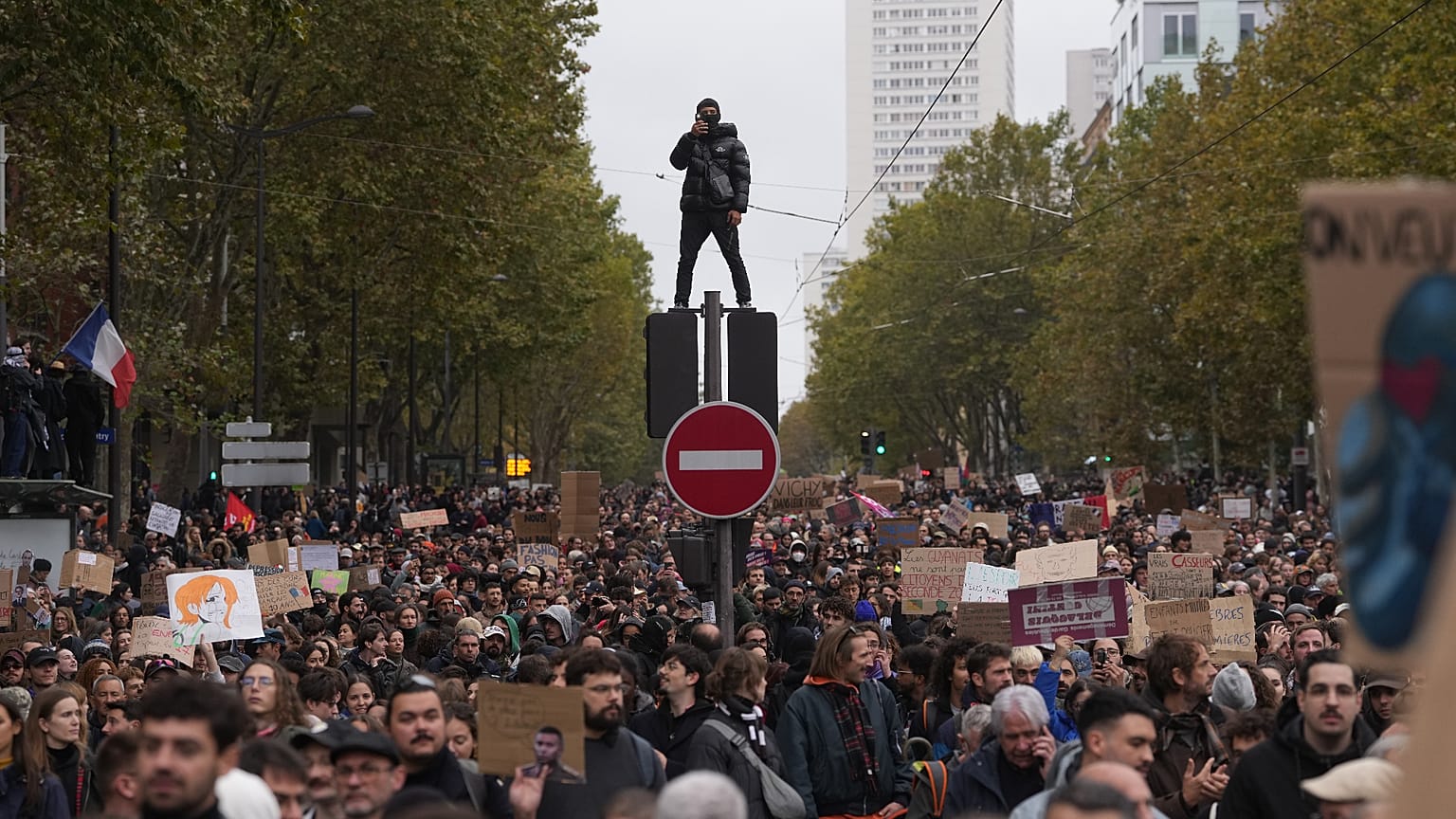
France saw violent clashes and extensive arrests. Around 2,400 people were arrested, while nearly 1,000 security-force members were injured; the report also says 100 protesters and residents were injured in Paris alone. Demonstrations included protests against rising living costs in Strasbourg and Lyon.
In Tirana, thousands joined another anti-government rally. Police fired tear gas, and clashes followed attacks on government buildings. Dozens of demonstrators were detained. Authorities reported more than 300 injuries among protesters and police. The protests involved students, artists and opposition parties and were among several confrontations since mid-October.
In Italy, demonstrations took place in Milan, Rome, Turin, Naples, Bologna and Florence. Some protesters threw bottles, stones and firecrackers. Police said they made nine arrests and briefly detained 371 people in eight cities; 110 of those taken to police stations were minors. Rome’s demonstration included anti-war activists opposing rearmament and Italy’s involvement in wars.
In Madrid, pensioners and supporters demanded that pension increases reflect actual inflation, that the minimum pension match the minimum wage, and that the gender pension gap be closed. They also called for protection of the public pension system from privatisation. In Lisbon, protesters focused on affordable housing. Overall, the article presents a continent-wide mix of policy and cost-of-living protests, with violence and policing prominent in several locations.
Entities: Anna Kirchheim, Euronews, France, Albania, Tirana • Tone: analytical • Sentiment: negative • Intent: inform
24-10-2026
Milan has increased security ahead of fresh protests scheduled for Saturday, 24 October 2026. Italian soldiers and police are patrolling the city, a week after clashes and looting affected Milan, described in the report as a fashion and finance capital. Authorities have deployed an additional 500 soldiers to support forces already present. Businesses, including luxury boutiques and major retailers, have boarded up their windows in anticipation of possible renewed violence.
The security measures extend beyond visible patrols. They include surveillance drones, checks at railway stations and rapid-response units. Officials are also concerned that demonstrators may move into neighbourhoods outside the areas receiving the heaviest police attention, potentially making it harder to contain unrest. The report presents these preparations as precautionary measures in response to last week’s violence and fears of further disorder. It does not specify the cause of the protests, the organizers, or the number of people expected to attend. The article is a brief video-news item and provides no further details about injuries, arrests, or damage from the earlier clashes.
Entities: Milan, Italy, Italian soldiers, Italian police, Saturday protests • Tone: neutral • Sentiment: negative • Intent: inform
24-10-2026
Young protesters clashed with police in Rome on Saturday, 24 October, as demonstrations over the cost of living, wages and public services continued across Italy. Security forces were deployed in large numbers as tensions rose in the capital. The article presents the Rome clashes as part of a wider wave of youth-led protests calling for better living conditions and higher wages. It also reports demonstrations in Milan, where around 3,000 people took to the streets and traffic in the city centre came to a standstill. The report does not provide details about injuries, arrests, the scale of damage, or the specific events that led to the clashes. Its focus is on the spread and context of the protests, rather than on individual participants or police actions. The article’s brief, factual account describes unrest in Rome and disruption in Milan while connecting both events to public concerns about living costs, pay and public services.
Entities: Rome, Milan, Italy, Young protesters, Police • Tone: neutral • Sentiment: negative • Intent: inform
24-10-2026
Milan saw renewed cost-of-living protests on Saturday, one week after demonstrations in the city had escalated into looting and clashes with police. In response to the previous week’s violence, Italian Prime Minister Giorgia Meloni announced additional security measures, including the deployment of 500 more soldiers and tougher penalties for minors. Police said minors had made up a large proportion of those involved in the earlier violent protests.
Security was highly visible in central Milan. Surveillance helicopters circled Piazza del Duomo, while groups of soldiers patrolled alongside military vehicles and a water cannon. Luxury boutiques were boarded up ahead of the protests, reflecting concern about further unrest. Some visitors said they would leave the city centre if violence broke out again.
The report describes a city preparing for possible renewed disorder after recent demonstrations linked to the rising cost of living. It focuses on the security response and on the concerns of people in the city, rather than explaining the causes of the cost-of-living pressures or detailing the protesters’ demands. The segment is reported from Rome by France 24 correspondent Seema Gupta. The article provides no further account of the Saturday protests’ size, whether clashes occurred, or the effects of the newly announced measures.
Entities: Italy, Milan, Piazza del Duomo, Giorgia Meloni, Seema Gupta • Tone: neutral • Sentiment: negative • Intent: inform