26-10-2026
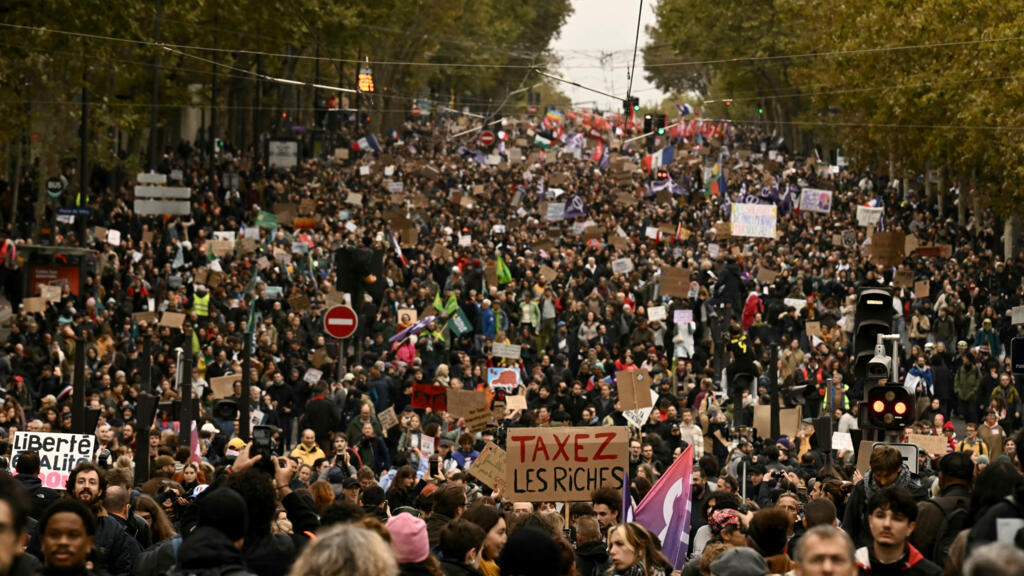
French police arrested 1,314 people during nationwide demonstrations on Saturday, according to Interior Minister Laurent Nuñez. The protests, which addressed the cost of living and the education system, were largely peaceful earlier in the day, but clashes later broke out in Paris and several other cities. Nuñez said 53 officers were injured and that some shops and businesses were looted, though damage was considerably lower than during unrest the previous week. Authorities said tighter preparations—including checks before demonstrations and better protection for businesses—helped limit damage. The Interior Ministry estimated 410,000 people attended about 298 protests, while labor union organizers put participation at 800,000. In Paris, police reported 110,000 marchers and unions estimated 250,000. The march’s route was changed at short notice, prompting criticism from a union representative, though demonstrators complied. Later clashes lasted about two hours; 64 people were arrested and more than 3,000 were stopped and checked. In other cities, police used tear gas, water cannons and other crowd-control measures. Clashes and street fires were reported in Lyon, Nantes and Marseille, among other places. Nuñez reported serious injuries in Clermont-Ferrand and Toulouse. Authorities also described confrontations involving far-right activists in Cannes and Montpellier; in Nice, 11 people were arrested after far-right extremists fought with demonstrators. Separately, thousands marched in Orleans against a National Rally congress where Marine Le Pen was launching her campaign to succeed President Emmanuel Macron. The article also notes that protests began in September with high-school students demanding better conditions and spread nationally. The Yellow Vests have called for another round of demonstrations on October 31, including rallies and sit-ins opposing what they call the government’s authoritarian drift.
Entities: Laurent Nuñez, Emmanuel Macron, Marine Le Pen, French Interior Ministry, General Confederation of Labor • Tone: analytical • Sentiment: negative • Intent: inform
26-10-2026
Protests over rising living costs, inequality and public services drew large crowds across France on Saturday, October 24, 2026, and some demonstrations turned violent. The Interior Ministry counted 410,000 participants nationwide, including about 110,000 in Paris. The CGT union put the turnout much higher, estimating 800,000 nationwide and 250,000 in Paris. Most marches were peaceful, and although confrontations occurred in several cities, the unrest was less intense than the previous weekend.
Authorities increased security after earlier violence, which included the burning of Limoges’ historic city hall and looting in Lyon. In Paris, riot police used tear gas and water cannon against a group of hooded youths who threw stones. In Marseille, youths blocked a street with metal sheets, set rubbish bins on fire and threw rocks and bottles at police; police also reported looting at two jewelry shops. Clashes or tear-gas deployments were reported in Lyon, Bordeaux, Grenoble, Clermont-Ferrand, Lille, Nantes and Nice.
The movement began last month with high school students in suburban Paris protesting teacher shortages and inadequate school facilities. It has since broadened into nationwide demonstrations involving students, unions, politicians, Yellow Vests and families. Protesters have called for better education funding, relief from the cost-of-living squeeze, stronger public services, purchasing power and social and fiscal justice.
The demonstrations are unfolding amid economic and political difficulties that have pushed up French government borrowing costs. The yield on France’s 10-year bond rose above 5% for the first time since 2002, settling at about 5.03% on Friday. Some investors are concerned that France’s debt problems could affect the wider euro zone. The accompanying photographs show both confrontations and peaceful expressions of protest, including signs about education, democracy, inequality and hopes for change.
Entities: France, Paris, Marseille, Limoges, Lyon • Tone: neutral • Sentiment: negative • Intent: inform
26-10-2026
French President Emmanuel Macron said the government would soon announce “strong measures” in response to protests and unrest that have affected France in recent weeks. Speaking in Marseille, he described demonstrations planned for the coming Saturday as risky and said protest routes would remain outside city centers to protect public order. The announcement followed violence in several cities, including an October 17 incident in which protesters briefly entered Marseille’s city hall. Macron acknowledged that authorities had not anticipated the scale of the demonstrations, which involved widespread violence and looting.
Macron also criticized social media, arguing that online platforms helped bring people to locations where attacks and looting took place and could mobilize harmful impulses. Officials described threats from more than one political direction: Macron said security forces had underestimated how early extreme-left groups would gather, while Interior Minister Laurent Nunez said organized far-right nationalist groups had confronted left-wing activists and targeted the ultra-left in some cities.
The government said it had restored order during the most recent demonstrations. Macron credited curfews, and authorities deployed 70,000 police officers nationwide on October 24, making 1,435 arrests. Government spokeswoman Maud Bregeon said the state had prevailed, while a presidential aide said Macron wanted to show that the state was present and protecting the public.
At the same time, Macron said the government must address what he called legitimate demands behind the social movement. Prime Minister Sebastien Lecornu’s government is preparing concrete measures focused on student concerns about education and university admissions, following consultations with high school and university representatives. Bregeon said those demands must be heard, but argued that calm must return before meaningful social dialogue can take place.
Entities: Emmanuel Macron, France, Marseille, Elysee Palace, Laurent Nunez • Tone: analytical • Sentiment: neutral • Intent: inform
26-10-2026
French President Emmanuel Macron said the government would soon announce “strong measures” in response to protests and unrest that have affected France in recent weeks. Speaking in Marseille, where protesters briefly stormed city hall on October 17, Macron said demonstrations planned for the following Saturday were risky and that protest routes would stay outside city centers to protect public order. He acknowledged that authorities had failed to anticipate the scale of the demonstrations, which involved widespread violence and looting in several major cities.
Macron criticized social media, arguing that online networks helped mobilize people to locations where criminal acts, attacks and looting took place. He called the platforms “tools for mobilizing the worst impulses.” He also said security forces had underestimated how early extreme-left groups would gather. Interior Minister Laurent Nunez separately described organized far-right groups confronting left-wing activists, saying nationalist and identity-based movements had assembled in cities including Nice and Montpellier, principally to target the ultra-left.
The government said curfews and the deployment of 70,000 police officers helped maintain relative order during protests on October 24; authorities made 1,435 arrests. Government spokeswoman Maud Bregeon said the state had prevailed but stressed that calm was necessary for social dialogue.
Alongside security measures, Macron instructed Prime Minister Sebastien Lecornu’s government to address what he called the movement’s legitimate demands. Officials said planned measures would respond to student concerns about education and university admissions, following consultations with high school and university representatives. Bregeon said those demands needed to be heard, but argued that meaningful dialogue required a return to calm after the violence.
Entities: Emmanuel Macron, France, Marseille, Elysee Palace, Laurent Nunez • Tone: analytical • Sentiment: negative • Intent: inform
26-10-2026
France 24 reports that French Prime Minister Sébastien Lecornu was scheduled to meet high school student representatives on Monday afternoon, October 26, 2026. The meeting was intended to ease tensions after nearly a month of protests in France. The article links Lecornu’s planned discussion to an earlier meeting with President Emmanuel Macron, who had promised a concrete response to students’ demands for better education standards and increased funding. The report does not specify the students’ representatives, the precise reforms or funding they are seeking, or what response the government intends to offer. It also does not report the outcome of Lecornu’s meeting, since the article describes it as forthcoming. The central focus is therefore the government’s planned engagement with students amid sustained demonstrations, rather than any confirmed resolution. The item is presented as a short news update, with no extended analysis or direct quotations from the students or officials. Its stated purpose is to inform readers about the upcoming meeting and its context: ongoing protests and the president’s prior commitment to respond to education-related demands.
Entities: Sébastien Lecornu, Emmanuel Macron, France, French Prime Minister, French president • Tone: neutral • Sentiment: neutral • Intent: inform
26-10-2026
France 24 reports that President Emmanuel Macron said the French government would announce “concrete measures” on Monday, October 26, in response to demands from school students. The announcement follows weeks of unrest and protests. Prime Minister Sébastien Lecornu was scheduled to meet with students later that day, though the article does not specify what measures the government might propose or how the meeting went.
The report places the students’ demands within a wider context of public anger over the rising cost of living. A caption accompanying the video describes a demonstration in Paris on October 24 that called for greater purchasing power, protection of public services, and fiscal and social justice. It also says the movement had spread nationwide, fueled by broader cost-of-living concerns.
The item is a short video report by France 24’s Luke Shrago, identified as reporting from the ground. The supplied page content does not include further details about the students’ specific requests, the scale or course of the unrest, the government’s planned response, or reactions from participants and officials. Its central focus is therefore the promised government response and the forthcoming meeting between the prime minister and student representatives, rather than a detailed account of the protests or their causes.
Entities: Emmanuel Macron, Sébastien Lecornu, Luke Shrago, France 24, France • Tone: neutral • Sentiment: neutral • Intent: inform
26-10-2026
On October 26, 2026, French President Emmanuel Macron said France could maintain public order without declaring a state of emergency. Speaking during a visit to Marseille, he added that such a measure was not “off-limits or taboo” if circumstances deteriorated, leaving open the possibility of using emergency powers if unrest worsened. Macron also promised “concrete” measures in response to demands from high school students. Their protests had triggered weeks of unrest across the country. The article’s opening report presents Macron’s remarks as the central development and says a live blog would carry further updates. It does not provide details about the students’ demands, the measures being considered, the scale or specific incidents of the unrest, or responses from other officials. The report is attributed to FRANCE 24, with AFP, AP and Reuters credited as contributing sources. The page text supplied also includes a notice that the requested content does not exist or is no longer available, so the live updates themselves cannot be recovered from the provided material.
Entities: Emmanuel Macron, Marseille, France, French presidency, FRANCE 24 • Tone: neutral • Sentiment: neutral • Intent: inform
26-10-2026
French President Emmanuel Macron said the government would announce “concrete and strong” measures to address high school students’ demands for better education conditions, after weeks of protests and unrest across France. Prime Minister Sébastien Lecornu was due to meet student-union representatives and hold a news conference on Monday. Macron said the demands behind the movement were legitimate, but warned that further protests—and possible unrest—were expected the following Saturday.
The demonstrations began with students calling for improved learning conditions, including through school blockades. The police response has been criticized as heavy-handed, and the movement broadened amid anger over the cost of living and police violence. Protests have involved looting, vandalism and clashes. Authorities acknowledged security and intelligence failures ahead of major rioting on October 17, and increased security for subsequent demonstrations. Although Interior Minister Laurent Nunez described the latest rallies as more positive than the previous week, violence still occurred in Paris, Marseille and other cities. He reported 1,435 arrests, 267 injured police officers and gendarmes, and 150 injured protesters, three of them seriously.
Macron visited Marseille, where he inspected damage to city hall and met shopkeepers affected by looting and vandalism. The visit was presented by an aide as a demonstration that the state was present and committed to protecting the public. Many storefronts remained boarded up. Student representatives had left an earlier meeting with Macron urging continued protests until the government offered concrete proposals.
The unrest is unfolding six months before France’s presidential election. Far-right leader Marine Le Pen has sought to capitalize on public disorder, pledging to restore the rule of law; polls indicate the protests have boosted her support. The article also notes a recent shooting outside Paris that killed one person and injured five, including a 12-year-old girl. Macron called it a racist terrorist attack.
Entities: Emmanuel Macron, Sébastien Lecornu, Marine Le Pen, Laurent Nunez, Édouard Geffray • Tone: analytical • Sentiment: negative • Intent: inform
26-10-2026
French President Emmanuel Macron said his government would announce measures in response to weeks of protests driven by grievances over the cost of living, public services, and education. Speaking in Marseille after inspecting damage from earlier demonstrations, he said he had asked the government to address the movement’s “legitimate demands.” Prime Minister Sebastien Lecornu was expected to hold a news conference after meeting high school student unions, which are seeking more education funding and changes to a university admissions system they say perpetuates inequality.
The protests have expanded beyond students to include trade unions and “yellow vest” activists. After violence spread across dozens of cities earlier in the month, authorities deployed 70,000 police for Saturday’s demonstrations. Interior Minister Laurent Nunez said the heavy deployment prevented a repeat of the earlier violence, but expected further disturbances at demonstrations planned for October 31. He reported 1,435 arrests on Saturday and said organized far-right groups had confronted far-left activists in several cities, including Nice and Montpellier.
Officials described the weekend as evidence that the state had restored control, though sporadic clashes continued, particularly in Paris, Marseille, and Lyon. Government spokeswoman Maud Bregeon said the state had been strong, while also acknowledging that protesters’ grievances needed to be heard and that calm was necessary for negotiations. Authorities have imposed curfews, movement restrictions, and demonstration bans in some places following violence and looting at the edges of mostly peaceful protests.
Macron faces constraints in responding: his presidential mandate is due to expire in April, and public finances are under severe strain, limiting the scope for costly concessions. Business representatives said the unrest was continuing to hurt commerce. Alain Di Crescenzo, head of the CCI France network, said many retailers stayed closed as a precaution after the October 17 violence and reported sales down about 80%, warning that local commerce was being damaged.
Entities: Emmanuel Macron, Sebastien Lecornu, Laurent Nunez, Maud Bregeon, Alain Di Crescenzo • Tone: analytical • Sentiment: negative • Intent: inform
26-10-2026
The article reports on renewed protests across France over the rising cost of living and conditions in the education system. It focuses on footage from Sciences Po Paris, where riot police charged into a group of students who had blocked the institution. Officers pushed protesters toward a railing, knocked a man carrying a megaphone to the ground, and used batons as people backed away. The intervention was described as an effort to evacuate students from the blocked institution.
The account places the incident within a broader wave of demonstrations and clashes in several French cities. French police arrested more than 1,000 people during the nationwide protests. Interior Minister Laurent Nuñez said 53 police officers were injured during demonstrations on Saturday. Estimates of the size of the protests differed: the Interior Ministry put participation at about 410,000 people across 298 protests, while the General Confederation of Labour estimated turnout at approximately 800,000.
Although many marches remained peaceful, clashes occurred in Paris and elsewhere. Authorities said they had increased security measures and checks following violence and damage to businesses during earlier protests. The article presents the police intervention and the competing turnout estimates as part of continuing tensions, without offering an extended analysis of the protesters’ demands or the government’s response beyond the security measures reported.
Entities: France, Sciences Po Paris, French riot police, Aastha Jha, Laurent Nuñez • Tone: neutral • Sentiment: negative • Intent: inform