27-09-2026
Tens of thousands of people marched in Madrid to protest Spain’s housing crisis, calling for stronger tenant protections, rules against fraud and a ban on evictions when no alternative housing is available. The demonstration followed the eviction of 87-year-old María del Carmen Abascal from the apartment where she had lived for decades. She was taken from the upscale Retiro neighborhood on a stretcher and taken to hospital; the eviction has become a focal point for wider public anger over housing affordability and insecurity.
According to the Madrid Tenants’ Union, which organised the protest, Abascal’s family first rented the apartment in 1956. After the building changed ownership in 2018, she was offered the chance to buy it but could not afford to do so. Urbagestión, an investment fund that later bought the unit, increased her monthly rent from 500 euros to 2,650 euros, then reduced it to 1,650 euros. The union said she still could not afford the rent on her pension, and courts had blocked three earlier attempts to evict her.
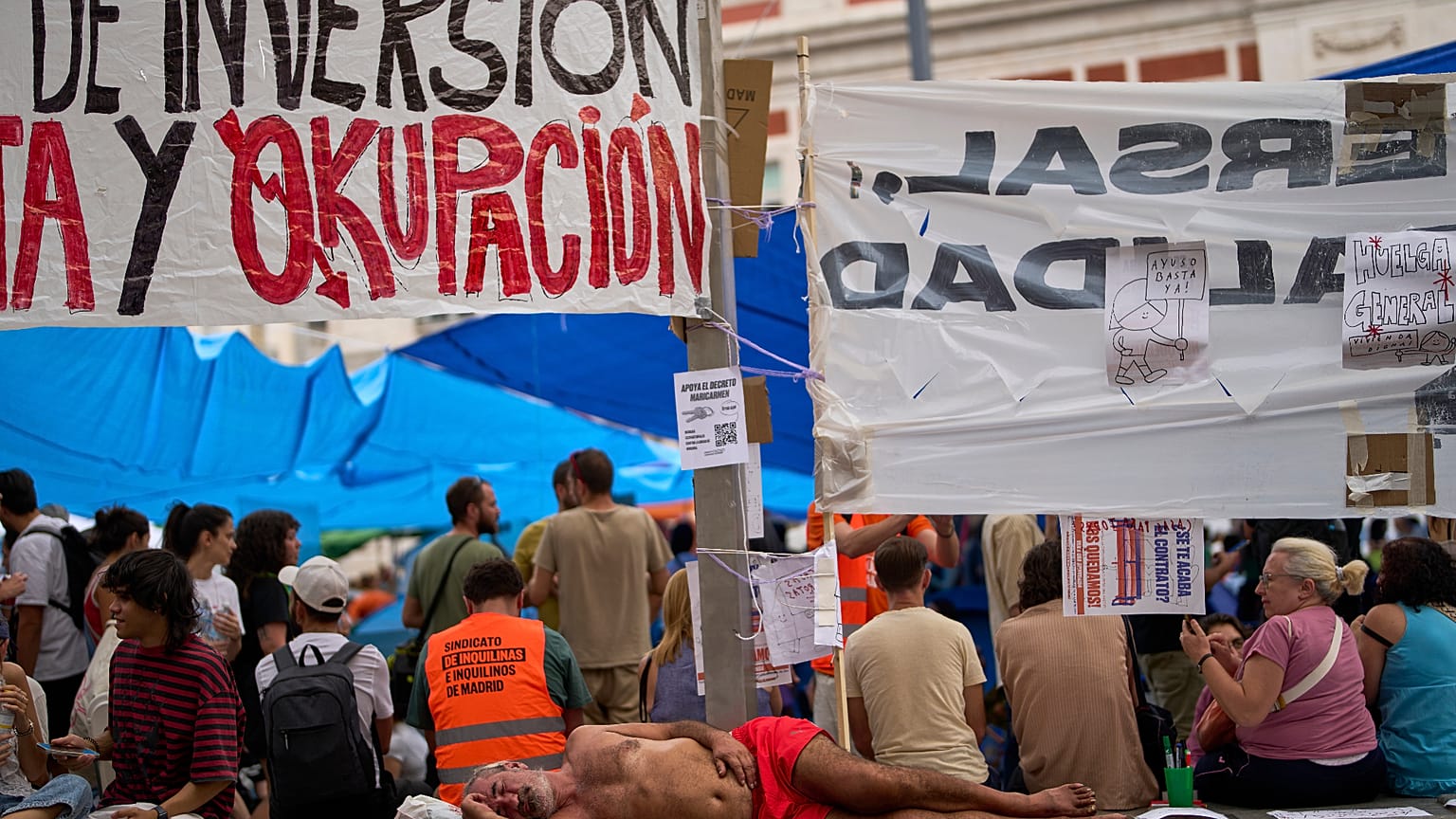
Protesters described the eviction as a breaking point in a crisis affecting people across ages and income groups. They also criticised investment funds buying homes and the displacement of families. Some demonstrators camped overnight in Puerta del Sol after the march.
The article links the crisis to rising costs, limited housing supply and incomes that have not kept pace. Analysts say tourism and population growth driven by immigration have added pressure in cities. The Bank of Spain estimated a shortfall of about 550,000 homes last year, with Madrid, Barcelona and Valencia accounting for a substantial share. Public rental housing makes up less than 2 per cent of Spain’s available supply, compared with an EU average of 8 per cent. Abascal said she had been unable to defend her own home but hoped her struggle would help others fight for theirs.
Entities: María del Carmen Abascal, Dora Garcia, Simón de la Riva, Madrid, Retiro neighborhood • Tone: neutral • Sentiment: negative • Intent: inform
27-09-2026
Around 150 tents were set up in a Madrid square on Sunday as families joined a sit-in protesting the eviction of Maricarmen and Spain’s broader housing crisis. Demonstrators said they planned to stay at least until Tuesday, when the Spanish government was due to meet. Their banners called for affordable housing and a fair right to housing, as well as an end to evictions without alternative accommodation. Protesters also demanded measures including rent freezes and stronger tenant protections.
Maricarmen had lived in the same flat for about 70 years; her father began renting it in 1956. According to the Madrid Tenants’ Union, an investment fund later acquired the property and raised her rent from €500 to €2,650 a month, before lowering it to €1,650. Police evicted her on Wednesday after several attempts. She was taken to hospital after becoming exhausted during the operation. Her case has become a symbol of housing pressures facing Spain.
The article places the protest in the context of a housing shortage and limited public rental housing. The Bank of Spain estimated that the country was short around 550,000 homes last year. Subsidised public rental housing makes up less than 2% of Spain’s housing stock, compared with an EU average of 8%. Attendance figures for Saturday’s march differ sharply: authorities estimated about 25,000 participants, while the Madrid Tenants’ Union put the turnout at more than 300,000.
Entities: Maricarmen, Madrid, Spain, Spanish government, Madrid Tenants’ Union • Tone: neutral • Sentiment: negative • Intent: inform
27-09-2026
Thousands of people marched through Madrid to demand action on Spain’s housing crisis, according to the Al Jazeera report. The protest focused on the need for solutions to housing difficulties in the city and renewed public calls for the government to respond. The article links the latest wave of anger to the forced eviction of an 87-year-old woman from her home on Wednesday. Her eviction has become a catalyst for public concern and demands for government action. The report does not provide details about the protest’s organizers, the march route, specific policy proposals, or the government’s response. It also gives no further information about the woman or the circumstances of the eviction. Its central point is that thousands joined a demonstration in Madrid, and that the eviction has intensified anger around the housing crisis and calls for solutions. The article is a brief news report rather than an in-depth account: it identifies the protest, its broad demand, and the event that has renewed public attention, without offering additional context or commentary.
Entities: Madrid, Spain, Thousands of protesters, Housing crisis, Forced eviction • Tone: neutral • Sentiment: negative • Intent: inform
27-09-2026
Tens of thousands of people marched through central Madrid on Saturday to protest Spain’s housing crisis, calling for stronger tenant protections, anti-fraud rules and a ban on evictions when no alternative housing is available. Authorities estimated that about 25,000 people attended; the Madrid Tenants’ Union, which organized the rally, claimed participation exceeded 300,000. After the march, activists established a camp in Puerta del Sol, where some protesters pitched tents and planned to remain, potentially until police removed them.
The protest was prompted by the eviction of 87-year-old Maricarmen Abascal from the Madrid apartment where she had lived for decades. Her removal on a stretcher and transfer to an ambulance drew public attention to the pressures on long-term tenants. Abascal’s family had rented the flat in the upscale Retiro neighborhood since 1956. After the building changed ownership in 2018, investment fund Urbagestion raised her rent from €500 to €2,650 a month. It later reduced the rent to €1,650, which she still could not afford. Abascal had previously been unable to afford an offer to buy the apartment, and courts had blocked her eviction three times.
The case has become a symbol of wider concerns about soaring rents, gentrification and a shortage of affordable housing in Spanish cities. Analysts cited tourism and population growth linked to immigration as pressures on limited supply. The Bank of Spain estimated a nationwide shortfall of 550,000 homes last year. Protesters described housing as a right and warned that evictions and investment-fund purchases affect people across ages and social classes. With a general election due next year, the crisis has become a prominent source of public discontent.
Entities: Maricarmen Abascal, Madrid, Spain, Madrid Tenants’ Union, Puerta del Sol • Tone: neutral • Sentiment: negative • Intent: inform
27-09-2026
Around 150 tents were pitched in Madrid’s Puerta del Sol on Sunday after a Saturday demonstration against Spain’s housing crisis. The encampment was organised by the Madrid Tenants’ Union in response to the eviction of Maricarmen Abascal, an 87-year-old woman who had lived in her rented Retiro flat for 70 years. Campers described a calm atmosphere, with food and water available, while police maintained a presence and no incidents were reported.
The eviction has become known as the “Maricarmen effect” and prompted demonstrations in 40 cities under the slogan “Not one more Maricarmen”. Saturday’s march from Puerta del Sol to the Congress of Deputies drew about 25,000 people, according to the Government Delegation, while the Tenants’ Union estimated as many as 300,000. Demonstrators of different generations called for stronger renter protections and for housing to be treated as a basic necessity rather than a financial asset.
The union’s central demand is that the Government approve a housing decree on Tuesday, including a rent freeze. Union representatives warned that failure to pass it should prompt left-wing government partners, including Sumar, to reconsider their support for the Government. The article also describes disagreements within the left: Podemos MEP Irene Montero opposes negotiating the decree with Junts and advocates expropriating 650,000 homes owned by investment funds for social rentals, while Podemos leader Ione Belarra says street pressure must continue.
The encampment has evoked the 15-M movement, which began in Madrid in 2011 and popularised the slogan “Sí se puede”. Pablo Iglesias compared Maricarmen’s case to Rosa Parks and expressed hope that the movement would spread nationally.
Entities: Madrid, Puerta del Sol, Maricarmen Abascal, Madrid Tenants’ Union, Gonzalo Álvarez • Tone: analytical • Sentiment: neutral • Intent: inform
27-09-2026
Spanish Prime Minister Pedro Sánchez has pledged to bring a housing decree to the Council of Ministers on Tuesday, following the eviction of 87-year-old Maricarmen from the Madrid home where she had lived for 70 years. Sánchez spoke at a Socialist Party rally in Getafe, calling the housing crisis “a matter of humanity” and urging parliamentary groups to make a final effort to approve the measures. Maricarmen had appealed to him in a video after being removed from her home on a stretcher; she remains in hospital.
Her case has intensified public anger over housing costs and tenant protections. Tens of thousands of people demonstrated in Madrid on Saturday, and protesters then set up about 100 tents in Puerta del Sol. The camp has hosted communal activities, and solidarity gatherings have been announced in other Spanish cities. Filmmaker Pedro Almodóvar visited and called the crisis unbearable. The demonstrations have also highlighted political divisions: Sumar supports expropriating the property so Maricarmen can return, while Socialist minister Félix Bolaños says the proposal does not clearly fit within the Constitution. Sumar says it will continue to back expropriation.
The government is negotiating to secure parliamentary support for the decree. Measures reportedly under discussion with Junts include restricting evictions from properties owned by investment funds and limiting those funds’ purchases of residential property. The Tenants’ Union has warned it will reject a watered-down package, and it is uncertain whether protesters will leave the square even if the decree is approved. The protests have evoked the 15-M movement, whose demonstrators camped in Puerta del Sol in 2011 amid anger over evictions, unemployment, austerity and corruption. Political scientist Estefanía Molina contrasted that period’s difficulty buying a flat with today’s struggle to afford even a room in someone else’s home.
Entities: Pedro Sánchez, Maricarmen, Madrid, Puerta del Sol, Retiro neighbourhood • Tone: analytical • Sentiment: negative • Intent: inform
27-09-2026
Madrid protesters spent a second night camping in Puerta del Sol after the eviction of 87-year-old María del Carmen Abascal, known as “Maricarmen.” Around 150 tents filled the square on Sunday, with people from several generations taking part. Demonstrators said they planned to stay at least until Tuesday, when the Spanish government was due to meet. Their banners called for affordable housing, fair rents and an end to evictions without alternative accommodation. Protesters also demanded rent freezes and stronger protections for tenants.
Maricarmen had lived in the same Madrid apartment for about 70 years; her father began renting it in 1956. According to the Madrid Tenants’ Union, an investment fund later acquired the property and raised her monthly rent from €500 to €2,650, before lowering it to €1,650. Police evicted her on Wednesday after several attempts. She was taken to hospital after becoming exhausted during the operation. Her case has become a symbol of Spain’s broader housing crisis.
The article cites a Bank of Spain estimate that the country was short around 550,000 homes last year. It also reports that publicly subsidised rental housing makes up less than 2% of Spain’s housing stock, compared with an EU average of 8%. Attendance estimates for Saturday’s march varied substantially: authorities put the crowd at around 25,000, while the Madrid Tenants’ Union estimated more than 300,000. The report presents the protest as both a response to Maricarmen’s eviction and part of a wider campaign for housing affordability and tenant rights.
Entities: María del Carmen Abascal (“Maricarmen”), Madrid, Puerta del Sol, Madrid Tenants’ Union, Bank of Spain • Tone: neutral • Sentiment: neutral • Intent: inform
27-09-2026
A France 24 report describes a protest in Madrid over Spain’s worsening housing affordability and the need for stronger tenant protections. Tens of thousands of people gathered in the capital on a Saturday to make that call. The protest was prompted by the eviction of an elderly woman from the home where she had lived for her entire life. Her rent had nearly quadrupled, forcing her out. Her experience has resonated with many Spaniards, who see it as an example of the pressures facing renters.
The report links rising rents, in part, to tourism and says the increases are making cities increasingly unaffordable. It presents the woman’s eviction as the immediate catalyst for the demonstration, while also placing the protest in the broader context of housing costs and tenant security. Morgan Ayre reports from Madrid for France 24. The supplied article text does not provide further details about the protesters’ demands, the woman’s identity, responses from officials or landlords, or any policy proposals. The focus is on the scale of the gathering, its trigger, and public concern that rent increases are eroding people’s ability to remain in their homes.
Entities: Madrid, Spain, France 24, Morgan Ayre, elderly evicted tenant • Tone: analytical • Sentiment: negative • Intent: inform
27-09-2026
A protest over Spain’s housing affordability crisis expanded in Madrid after the eviction of 87-year-old Maricarmen Abascal from the apartment where she had lived for seven decades. Police removed her on Sept 23 after the property’s new owner, a real estate firm, raised the rent by 275 per cent to €2,650, according to the Madrid Tenants’ Union. Images of Abascal being carried out on a stretcher prompted widespread outrage and helped turn her case into a focus for longstanding anger over rising rents and housing insecurity.
Tens of thousands marched through Madrid on Sept 26, rattling keys and blowing whistles. Authorities estimated that 25,000 people attended, while the Tenants’ Union claimed more than 300,000. Hundreds subsequently camped in Puerta del Sol, pledging to stay until access to housing improves or the government falls. Protesters described an increasingly impossible rental market and fear of being forced from their homes. Idealista estimates rents have nearly doubled in the past decade.
Prime Minister Pedro Sanchez pledged swift action at a Socialist Party rally on Sept 27 and urged other parties to support a proposed housing law. The bill is expected to include automatic rental-contract renewals and further restrictions on evictions. However, Sanchez’s party lacks a parliamentary majority, and an earlier similar bill was defeated in 2026, leaving the proposal’s prospects uncertain. The issue is politically significant ahead of Spain’s 2027 general election.
The wider crisis includes a national shortfall of about 700,000 homes, according to the Bank of Spain, alongside limited public housing and rent increases attributed by analysts to growing demand, including from tourism and population growth linked to immigration. The protest camp adds to Puerta del Sol’s history as a site of demonstrations, including a 2011 occupation by young protesters.
Entities: Maricarmen Abascal, Pedro Sanchez, Sergio, Enrique Ortega de Miguel, Madrid • Tone: analytical • Sentiment: negative • Intent: inform