28-08-2026
Nuwakot district in central Nepal has suffered extensive destruction after flash floods and landslides struck the region on 26 August. The disaster followed a glacial collapse near the Nepal-Tibet border the previous day, sending torrents of mud, debris and water through communities in the Trishuli River basin. Bidur, Devighat and Trishuli Bazaar were among the affected areas, with images showing partially buried buildings, submerged vehicles and severely damaged infrastructure.
Nuwakot, along with neighbouring Rasuwa district, is one of the worst-hit areas. Hundreds of residents, tourists and security personnel remain unaccounted for as emergency teams continue search-and-rescue operations. The scale of the destruction and the isolation of some communities have complicated efforts to locate missing people and provide medical assistance.
The Nepal Army has deployed MI-17 helicopters to create an emergency airlift corridor to the District Hospital in Trishuli. The helicopters are being used to evacuate critically injured survivors and support rescue teams operating in areas cut off by the floods and landslides.
Authorities have issued high-alert warnings to communities along the Trishuli and Narayani rivers because unstable debris upstream could trigger additional flooding and landslides. Several bridges and major roads connecting Nuwakot with neighbouring districts and Kathmandu have been swept away or badly damaged, further restricting access and delaying relief operations. The continuing risk, combined with the large number of people still missing, makes the disaster an ongoing humanitarian and emergency-response crisis.
Entities: Nuwakot district, Central Nepal, Rasuwa district, Trishuli River basin, Bidur • Tone: urgent • Sentiment: negative • Intent: inform
28-08-2026
The supplied AP News page concerns a deadly flooding disaster along the Nepal-China border, where the death toll is rising and a newly formed lake is creating an additional threat of flooding. The visible page headline says rescuers recovered survivors who were heavily covered in mud, while the main live-update headline warns that the lake could produce more flooding in an already devastated area.
Related AP reporting included in the supplied text attributes the disaster to the collapse of bedrock and a glacier. Satellite imagery reportedly showed the collapse before rivers were flooded, suggesting that a sudden glacial or geological failure triggered the disaster. Another related headline says that floods caused by the glacial collapse killed at least 160 people and left hundreds missing, although the live article’s latest death toll is not included in the provided extract.
The newly formed lake is a central concern because water accumulating behind unstable terrain could overflow or fail, sending another surge downstream. This creates a continuing emergency for communities, rescuers and people who may already have been displaced by the initial floods. The page also references concerns for the Mount Kailash pilgrimage area and the wider Nepal-Tibet region.
The available content does not include the live article’s full chronology, eyewitness accounts, official statements, evacuation information or detailed rescue updates. Therefore, this summary is limited to the headlines and related AP descriptions contained in the supplied page text. Overall, the report presents the disaster as both a major humanitarian emergency and an ongoing environmental hazard, with rescue operations continuing while authorities and residents face the possibility of further flooding.
Entities: Nepal-China border, Nepal, China, Tibet, Mount Kailash • Tone: urgent • Sentiment: negative • Intent: warn
28-08-2026
The supplied page capture does not include the AP article’s narrative body. It contains the article headline, extensive navigation menus, promotional material, and links to related coverage. Based on the available text, the story concerns a major flood disaster along the Nepal-China border, in the Himalayan region near Tibet. The headline reports that rescuers recovered survivors whose bodies were caked in mud, while the death toll continued to rise.
Related AP headlines included in the capture indicate that the flooding followed the collapse of a glacier or glacial terrain. One headline says satellite imagery showed bedrock and a glacier collapsing before rivers flooded the border region. Another reports that the disaster had killed at least 160 people, with hundreds more missing. The coverage also warns that a newly formed lake could create an additional flood threat, increasing the danger to communities and complicating rescue efforts.
The available material portrays an active emergency involving search-and-rescue operations, severe environmental destruction, rising casualties, and the possibility of further flooding. It does not provide the names of victims, rescuers, officials, specific villages, or relief agencies, nor does it include a detailed chronology of the disaster. Because the article body is missing from the supplied content, these details cannot be reliably reconstructed without adding information not present in the source. The strongest supported conclusion is that a glacial collapse triggered catastrophic flooding on the Nepal-China border, leaving many people dead or missing and prompting urgent rescue operations amid continuing risks from floodwaters and a newly formed lake.
Entities: Nepal-China border, Tibet, Himalayan region, Glacial collapse, Catastrophic flooding • Tone: urgent • Sentiment: negative • Intent: inform
28-08-2026
Preliminary scientific investigations indicate that a collapsed glacier, rather than an earthquake, triggered the devastating flash flood on the Nepal-Tibet border. Initial reports suggested that an earthquake had caused a landslide, but the US Geological Survey later identified the event as a glacial collapse. The impact of the falling ice and rock was so powerful that it registered as a magnitude-5.2 seismic event.
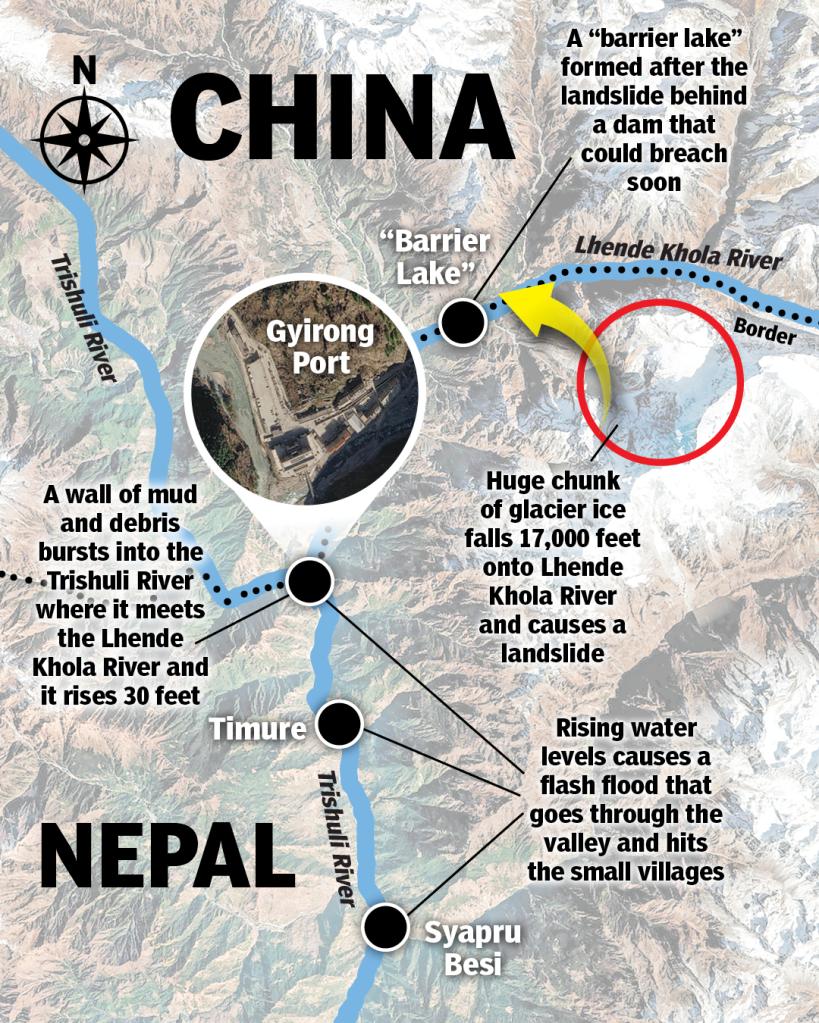
Scientists believe the collapse occurred on the lower section of a glacier near Nepal’s Langtang Lirung peak, about 15km from the flood site. An analysis by the International Centre for Integrated Mountain Development found that an ice-rock avalanche may have entered the Lende Khola, a tributary of the Bhote Koshi river. The resulting surge carried water, sediment and large boulders downstream, raising river levels by seven to nine metres in only 30 minutes and damaging or destroying monitoring stations.
Experts say the disaster may have involved several stages, including a landslide, the temporary damming of a river and the eventual release of a massive flood. The steep Himalayan terrain likely accelerated and concentrated the flow. The exact cause of the glacier’s sudden collapse remains unclear, but scientists point to the interaction of tectonic uplift and climate change. As the Himalayas rise, glaciers become steeper and less stable, while rising temperatures cause ice and permafrost to melt and weaken mountain slopes.
The article places the event within a broader pattern of increasingly frequent cryosphere hazards. Hindu Kush Himalaya glaciers are reportedly losing ice at twice the rate observed since 2000. Similar glacier-related disasters have occurred in India, Switzerland and Italy, including the deadly 2021 Chamoli collapse in northern India. Scientists caution that they cannot attribute any single event entirely to climate change, but warming is expected to increase the risks of landslides, debris flows, glacial lake outbursts and glacier collapses. The floods have killed at least 469 people, according to the article, while many others remain missing.
Entities: Nepal-Tibet border, Langtang Lirung peak, Lende Khola, Bhote Koshi river, Himalayan glaciers • Tone: analytical • Sentiment: negative • Intent: inform
28-08-2026
Survivors of devastating flash floods along the Nepal-Tibet border have described watching relatives, homes and livelihoods disappear in torrents of mud and water. At least 469 people have died and several hundred remain missing after the floods destroyed entire villages on Wednesday. The force of the flooding was so intense that seismologists initially mistook it for an earthquake.
In Nepal’s Nuwakot district, Kalpana Malla said her father, mother, sister and her sister’s children were swept away in front of her. She and her son, Sugam, survived by climbing onto the roof of a house. Sugam said he had pulled his mother to safety but was worried that his sister, whose phone was no longer reachable, had also been carried away. Another survivor, Goma Pandit, said the disaster destroyed her farmland, livestock and stored crops, leaving her with nothing.
At Kathmandu’s TU Teaching Hospital, relatives anxiously waited for news of missing family members. Ram Khumari Shrestha said her husband, who had travelled to Rasuwa for driving work, stopped answering his phone. Mani Shrestha Bishwa was searching for his younger brother, cousin, uncle and a friend.
Trekking guide Sonam Dorjee narrowly avoided the flood after leaving his village about an hour before it was struck. He said the sound of the water resembled an earthquake and that his home had collapsed. His sister and several other relatives remained missing. Dorjee described the disaster as sudden and devastating and said survivors urgently needed rescue, evacuation, food, temporary shelter and medical care. Meanwhile, rescuers worked through mud and debris as authorities rushed aid and relief supplies to affected areas.
Entities: Nepal-Tibet border floods, Nepal, Tibet, Nuwakot district, Kathmandu • Tone: emotional • Sentiment: negative • Intent: inform
28-08-2026
Massive landslides and flash floods along the Nepal-Tibet border have caused widespread destruction, killing at least 469 people in Nepal and leaving hundreds more missing. Chinese authorities have reported three deaths and 558 missing in Tibet’s Gyirong county, although it is unclear whether some people appear in both countries’ figures. Rescue and evacuation operations are continuing, while officials warn that additional flooding could occur if debris blocks rivers and creates temporary landslide dams.
The disaster was initially attributed to an earthquake, but the US Geological Survey says it was caused by a glacial collapse. The collapse generated a seismic signal equivalent to a magnitude-5.2 event and sent debris downstream, producing catastrophic flooding. Scientists are investigating whether rainfall, melting ice, glacier thinning, thawing permafrost, or a blocked river contributed to the sequence of events. Although climate change is accelerating glacier melt and weakening mountain slopes in the Hindu Kush Himalaya, experts caution that it is too early to establish a definitive link to this particular disaster.
Floodwaters and debris swept through northern Nepal, including the Nuwakot region and areas popular with tourists, mountaineers, and pilgrims. Buildings, roads, vehicles, and a border checkpoint were destroyed, while severe flooding affected the Bhote Koshi, Trishuli, and Narayani rivers.
Nepal, China, India, the United States, the United Kingdom, and the United Nations have pledged assistance. Nepalese officials report hundreds of missing foreign nationals, including tourists from India, China, the United States, Ukraine, Malaysia, and the UK. Chinese Premier Li Qiang visited Gyirong to oversee relief efforts, while China’s President Xi Jinping called for an extensive search and improved early-warning systems.
Entities: Nepal-Tibet border, Kathmandu, Nuwakot, Gyirong county, Trishuli River • Tone: urgent • Sentiment: negative • Intent: inform
28-08-2026
A catastrophic flash flood along Nepal’s Himalayan border with Tibet has killed at least 579 people and left 1,924 missing, including 32 Canadian citizens and permanent residents, Foreign Affairs Minister Anita Anand said Friday. Of those still unaccounted for, 517 are foreign nationals; no Canadians have been confirmed dead. Canada announced $5 million in emergency relief for Nepal.
The disaster began Wednesday when a glacier collapse sent ice, rock and debris into the Bhote Koshi River basin in northern Rasuwa. The event was recorded as a magnitude-5.2 seismic event by the U.S. Geological Survey and destroyed villages, roads, hospitals and other infrastructure. Nepal’s disaster authority said 3,742 people had been rescued, while emergency teams continued searching through mud and debris, including at the Upper Trishuli-1 Hydropower Project, where people were reportedly trapped in a tunnel. Responders had rescued 350 people from one tunnel, but more than 100 remained trapped.
A newly formed lake created by glacial debris has begun overflowing, creating a serious risk of additional flooding downstream. Nepalese and Chinese authorities urged residents in vulnerable areas to move to safer ground. The International Federation of Red Cross and Red Crescent Societies said at least 93,000 people had been affected and that its relief operations were temporarily disrupted by further flooding.
The affected region is popular with tourists, hikers and pilgrims, and people from several countries remain missing. Families have searched hospitals and forensic units for relatives among the recovered bodies. Survivors described a sudden “black storm” and said that only seconds of warning allowed some people to escape. Humanitarian officials described the situation as chaotic and said entire communities had been swept away, leaving few people and damaged facilities available to support rescue efforts.
Entities: Nepal, Tibet, Anita Anand, Canada, Bhote Koshi River basin • Tone: urgent • Sentiment: negative • Intent: inform
28-08-2026
Anil Goel, a 67-year-old Northern Virginia resident and former World Bank employee, is missing after devastating floods and mudslides struck the Rasuwagadhi immigration checkpoint on Nepal’s border with Tibet. Goel was traveling toward Mount Kailash on a religious pilgrimage and trekking expedition with 10 other Americans and two Nepali nationals when a torrent of mud and floodwater destroyed the border facility.
Goel’s family received a photograph from the checkpoint on August 26, 2026. The image shows at least seven members of his trekking group outside the immigration office, although Goel himself is not visible. His son, Anurag Goel, said the family confirmed that his father’s visa had been approved at 8:35 a.m. local time. Approximately 35 minutes later, the area was overwhelmed by water and debris believed to have been released after the collapse of a distant rock ledge and the Himalayan glacier it supported.
The family does not know whether Goel crossed into Tibet before the disaster. His children believe he may still have been on the Nepali side when the flooding occurred. A seasoned trekker, Goel had visited Nepal about 10 times and considered the region his favorite place in the world. He had previously traveled to Mount Everest base camp and climbed Mount Kilimanjaro, and he documented his treks on YouTube.
Rescue operations were continuing amid fears that a swollen, debris-dammed glacial lake upstream could cause another inundation. Authorities said roughly 1,500 people were missing on both sides of the border, including as many as 540 foreign nationals from 31 countries. The U.S. State Department said up to 90 Americans may have been affected. Local media reported that the number of missing could be as high as 12,000, though authorities had not confirmed that figure. Nepal’s Foreign Ministry said it did not require foreign assistance despite offers from several countries. Goel’s family said it hoped for good news while urging greater international awareness and assistance.
Entities: Anil Goel, Anurag Goel, Manvi Goel, Rasuwagadhi immigration checkpoint, Gyirong Port border crossing • Tone: urgent • Sentiment: negative • Intent: inform
28-08-2026
Rescue teams are searching for more than 1,000 people missing after catastrophic flash floods and mudslides struck communities along the Nepal-China border following a reported glacial collapse. Nepal Police reported at least 360 deaths and more than 1,400 missing across Nepal and Tibet, while Chinese state broadcaster CCTV separately reported 558 missing in Tibet, including 260 foreigners, and at least three deaths there. Authorities identified missing people in Nepal as tourists, security personnel and local residents, with the worst damage reported in Nuwakot and Rasuwa districts.
The disaster has affected many foreign nationals, including Americans. Nepal Tourism Board chief Hikmat Singh Ayer said at least 65 U.S. nationals were missing, while the U.S. State Department said about 90 Americans may have been affected. Three U.S. citizens had been rescued, and no American deaths were known at the time of publication. The United States offered assistance, dispatched an adviser and provided a $500,000 grant to Catholic Relief Services. Officials urged Americans and their families to use State Department emergency numbers, although communications remained severely disrupted.
The Isha Foundation said about 80 participants in a pilgrimage involving roughly 1,000 people were missing, including 22 Americans from 19 countries. Families described desperate efforts to locate relatives who had been traveling to or from Mount Kailash, including Sridevi Vejella and Venus Rajnikant Patel. Patel’s family said he had been near the border shortly before the floods struck.
Floodwaters destroyed villages, homes, roads, bridges, dams and power plants, leaving buildings buried in cement-like mud and cutting off travel. Nepalese army and private helicopters rescued more than 100 people, including at least eight foreign nationals, while bodies were found downstream and injured survivors were taken to Kathmandu. The scale of the disaster remained uncertain as search-and-rescue operations continued.
Entities: Nepal, Tibet, China, Nuwakot district, Rasuwa district • Tone: urgent • Sentiment: negative • Intent: inform
28-08-2026
Nepal and China are facing a major flood disaster after a glacial collapse triggered a tsunami-like surge of ice, mud and water through villages and hydropower sites near the Nepal-Tibet border. By Friday, authorities reported that at least 586 people had died and more than 2,400 were missing. Nepal added 933 hydropower workers to its missing-persons list, alongside trekkers and pilgrims traveling toward Mount Kailash. Some victims were reportedly swept downstream into India.
Rescue teams are working in unstable conditions as new flooding threatens the search effort. A debris-created lake reportedly began overflowing toward emergency workers in Gyirong, Tibet, prompting China to suspend operations temporarily before officials said the danger had eased. Nepali police also warned rescuers to move to safety after receiving reports that another water dam had burst on the Tibetan side.
The Nepali military has rescued hundreds of people from hydropower sites along the Trishuli Valley, but more than 100 remained trapped in a tunnel at the Trishuli 3A project. Survivors described being caught by rapidly rising water and seeing colleagues swept away. Hospitals in Kathmandu have become gathering places for relatives searching for missing family members.
Humanitarian assistance is beginning to reach survivors sheltering in temporary army relief centers. UNICEF said at least 17,000 children urgently need aid, while 18 schools were destroyed and 20 others damaged. The International Red Cross estimated that at least 93,000 people were affected and in great need. The European Union pledged €2 million in emergency assistance, while Chinese President Xi Jinping offered Beijing’s support for Nepal’s response. The disaster is described as Nepal’s deadliest since the 2015 earthquake.
Entities: Nepal, Tibet and China, Nuwakot district, Gyirong, Mount Kailash • Tone: urgent • Sentiment: negative • Intent: inform
28-08-2026
Nuwakot district in central Nepal is experiencing widespread destruction after flash floods and landslides struck on 26 August. The disaster followed a glacial collapse near the Nepal–Tibet border one day earlier, sending torrents of mud and debris through communities along the Trishuli River basin. Bidur, Devighat and Trishuli Bazaar are among the affected areas, where buildings have been partially buried, vehicles submerged and critical infrastructure severely damaged.
Nuwakot and neighbouring Rasuwa are reportedly among the worst-hit districts. Hundreds of residents, tourists and security personnel remain unaccounted for as emergency crews continue search-and-rescue operations. The article does not provide a confirmed death toll, but describes the destruction as catastrophic and says many people are still missing.
The Nepal Army has deployed MI-17 helicopters to create an emergency airlift corridor to the District Hospital in Trishuli. The operation is intended to evacuate critically injured survivors and support rescue teams working in isolated locations. Authorities have also issued high alerts for communities along the Trishuli and Narayani rivers because unstable debris upstream could trigger additional flooding and landslides.
Several bridges and major roads connecting Nuwakot with neighbouring districts and Kathmandu have been swept away or badly damaged, complicating access and relief efforts. The report emphasizes the scale of the infrastructure damage, the continuing risk to downstream communities and the urgent efforts to locate missing people and evacuate the injured.
Entities: Nuwakot district, Nepal, Trishuli River, Bidur, Devighat • Tone: urgent • Sentiment: negative • Intent: inform
28-08-2026
Dramatic video released by Nepal’s Prime Minister’s Office shows rescue workers pulling people through mud from a hydropower tunnel after catastrophic flash floods and a mudslide struck northern Nepal. Authorities said 350 people had been rescued from the tunnel, while more than 100 remained trapped and rescue teams continued evacuation efforts. Another 533 residents were moved to safety from flooded areas.
The disaster centered on the Rasuwa district near Nepal’s border with China and also affected Tibet. Nepal’s National Disaster Risk Reduction and Management Authority and Nepal Police reported at least 538 confirmed deaths. The Associated Press reported that as many as 1,924 people remained unaccounted for on the Nepalese side. In Tibet, Chinese authorities reported five deaths and 558 missing people. Approximately 90 Americans were also among those missing, according to the U.S. State Department.
The U.S. Geological Survey said the disaster was likely triggered on August 26, 2026, by a glacial collapse in Langtang National Park near the Chinese border. The resulting debris flow and flooding traveled nearly 100 kilometers along the Trishuli and Bhote Koshi river systems, affecting populated areas and China’s Gyirong Port. Reports and imagery indicated that buildings, infrastructure and a vital highway connecting Nepal and China may have been buried or destroyed.
President Donald Trump described the destruction as unusually severe, saying that powerful buildings had been swept away by a mixture of mud and water. The article highlights the continuing danger facing rescue teams and the scale of the humanitarian emergency. Fox News said it had contacted Nepal’s Foreign Ministry and the U.S. State Department for further comment, while Reuters and The Associated Press contributed to the report.
Entities: Nepal, Rasuwa district, Tibet, China, Langtang National Park, Trishuli River • Tone: urgent • Sentiment: negative • Intent: inform
28-08-2026
A France 24 report dated August 28, 2026, describes the continuing search for people missing after severe flooding in Nepal. The confirmed death toll has reached at least 538, while nearly 1,000 people remain unaccounted for. Families are searching hospitals and disaster zones, holding on to the possibility that their relatives may still be found alive. The report presents the human consequences of the disaster alongside the ongoing rescue operation.
More than 3,700 people have been rescued so far, indicating that emergency teams continue to make progress despite extremely difficult conditions. Destroyed roads and bridges have disrupted access to affected areas, while thick mud is further slowing search and rescue efforts. These obstacles make it harder for responders to reach isolated communities and for families to obtain information about missing relatives.
The article’s central focus is the uncertainty facing families and the logistical challenges confronting rescue workers. While the rising death toll underscores the scale of the flooding, the number of people rescued and the continued searches provide some grounds for hope. The report does not provide details about the cause of the floods, the specific affected locations, or the identities of victims, but it emphasizes the immediate priorities: locating missing people, reaching disaster zones, and supporting those affected by the destruction.
Overall, the article is a concise update on Nepal’s flood emergency, combining casualty figures with the emotional reality of families waiting for news and the practical difficulties hampering the response.
Entities: Nepal, Nepal floods, Families of missing people, At least 538 confirmed deaths, Nearly 1,000 missing people • Tone: urgent • Sentiment: negative • Intent: inform
28-08-2026
This France 24 video report examines the aftermath and longer-term risks of a major disaster in Nepal, where entire communities remain difficult to reach and tens of thousands of people have been affected. David Fisher, head of the Nepal delegation of the International Federation of Red Cross and Red Crescent Societies, tells presenter William Hilderbrandt that the full scale of the disaster has not yet been determined because official assessments are only beginning.
The report argues that the crisis should not be treated only as an immediate humanitarian emergency. While urgent relief is necessary, the response must also include early planning and funding for long-term recovery. This includes rebuilding homes, restoring livelihoods and supporting communities after international media attention and donor interest decline. Fisher warns that postponing recovery efforts could leave many survivors unable to rebuild their lives fully.
The report also highlights a broader environmental and disaster-risk concern: the region contains hundreds of high-altitude lakes that could potentially release enormous volumes of water. The destructive speed and force of the current extreme natural event may become more common, increasing the need for preparedness and sustained investment in resilience. The video therefore combines an account of the immediate humanitarian situation with a warning about future hazards in Nepal and the wider Asia-Pacific region. Its overall message is that emergency assistance, long-term reconstruction and disaster-risk planning must begin together rather than being handled as separate stages.
Entities: Nepal, William Hilderbrandt, David Fisher, International Federation of Red Cross and Red Crescent Societies, France 24 • Tone: urgent • Sentiment: negative • Intent: warn
28-08-2026
France 24 reports from a monastery-turned-relief camp in northern Kathmandu, where about 500 people are sheltering after catastrophic floods in Nepal. The camp has become a temporary refuge for families who have lost their homes and, in some cases, loved ones. The article emphasizes the shock and grief of survivors, while a cover image shows family members at a Kathmandu hospital checking lists of injured people after the flooding. The scene underscores that the disaster’s consequences extend beyond flooded areas to hospitals and emergency shelters, where relatives are still trying to locate or identify those affected. Rescue teams continue searching for nearly 1,000 people reported missing, and their operations are expected to continue through the night. The ongoing search gives the report an urgent focus, with the situation still developing and the possibility of further losses unresolved. Reporter Shahzaib Wahlah provides the on-the-ground account from the camp. The brief item does not provide a final death toll, detailed accounts of damage, or an explanation of the flood’s cause; instead, it concentrates on immediate humanitarian conditions: shelter for displaced people, grief among families, and rescue efforts for the missing. It also identifies Nepal and Tibet as keywords, reflecting the wider regional context of the disaster.
Entities: Nepal, Kathmandu, Northern Kathmandu relief camp, Tibet, Nepal floods • Tone: urgent • Sentiment: negative • Intent: inform
28-08-2026
A France 24 live report describes an escalating disaster on the Nepal–Tibet border after a glacial collapse triggered landslides and a torrent of mud and water across parts of Nepal and China’s autonomous region of Tibet. Chinese authorities warned that a lake created by a mudslide could breach its banks, sending floodwaters downstream and causing additional destruction. Water levels were expected to rise over the following three days, increasing the risk to communities and people in the affected region. A total of 499 residents and 555 tourists had already been evacuated from the disaster zone.
The report says that rescue and search efforts were continuing for approximately 1,300 people after the landslides. Nepal and China had both issued warnings about further flooding, with two newly formed lakes—one on each side of the border—posing a potential risk of bursting. The disaster had killed at least 359 people, according to an update from Nepali police. The article includes a photograph showing rescuers using heavy machinery to clear a road leading to areas affected by the mudslide in Tibet.
Presented as a liveblog, the report provides a brief overview of the latest developments rather than a detailed account of the causes or long-term consequences. It identifies the Himalayas as the broader region affected and lists landslides, floods and climate change among its keywords. The report was published on August 28, 2026, and attributed material to France 24, Reuters, the Associated Press and Agence France-Presse.
Entities: Nepal, Tibet, China-Nepal border, Himalayas, Chinese authorities • Tone: urgent • Sentiment: negative • Intent: inform
28-08-2026
The article examines the severe operational challenges facing rescue teams after a devastating flash flood struck the Nepal-Tibet border region. Nepalese police reported that at least 552 people had died, while Chinese authorities said five people were killed in Tibet. More than 1,400 people remained missing, although authorities from both countries promised to mobilize all available resources. Rescue operations were temporarily halted when floodwater threatened to overrun a newly formed lake created by mud and debris upstream. Experts warned that the unstable debris dam could fail or be overtopped, releasing millions of cubic metres of water and causing another catastrophic flood. Two such lakes were reportedly posing continuing risks, particularly as heavy monsoon rainfall was expected. The geography of the disaster zone is another major obstacle. The remote Himalayan terrain was already difficult to reach, while the flood destroyed bridges, buried roads in mud and increased the danger of landslides. Excavators could worsen the situation by destabilizing debris, leaving helicopters as the most practical means of access. However, aerial operations were also hazardous because of poor weather, muddy landing zones and the risk of helicopter crashes. More than 3,000 people had already been airlifted from the disaster area. Experts also highlighted difficulties in communications and coordination among government agencies, emergency services and civil society organizations. With further rain forecast, the rescue effort has become a race against time: worsening weather could expand the barrier lakes, trigger additional flooding and make it even harder to locate survivors or evacuate those at risk.
Entities: Nepal, Tibet, Trishuli River and Nuwakot district, Nepal Disaster Management Authority, Chinese authorities • Tone: analytical • Sentiment: negative • Intent: analyze
28-08-2026
Rescuers are searching remote and heavily damaged areas along the Nepal-Tibet border after devastating flash floods and mudslides killed more than 580 people and left over 2,400 missing. Nepal’s disaster management authority reported 579 deaths and 1,924 missing people in Nepal, while the combined missing-person figure for Nepal and China approached 2,500. The tally includes local residents, foreign nationals, trekkers, pilgrims visiting Tibet’s Mount Kailash and 933 hydropower workers who were newly added to Nepal’s missing list. Some bodies were reportedly swept downstream into India.
Emergency operations are being hampered by rugged mountain terrain, extensive mud and the possibility of additional flooding from high-altitude lakes formed by debris upstream. Chinese state media said rescuers in Tibet had reached the main area destroyed by a mudslide. Authorities are also working to locate four missing French nationals, while Canada announced CAN$5 million in humanitarian assistance and the European Union pledged €2 million for relief efforts.
UNICEF warned that at least 17,000 children urgently need assistance. Eighteen schools were destroyed and another 20 damaged, with surviving schools being used as emergency shelters. The Red Cross estimated that approximately 93,000 people were affected.
The live blog also documents survivors’ experiences. Indian travelers described buses and vehicles being engulfed by a sudden torrent, while an eight-year-old Nepali boy, Zoyal Ghale, survived by climbing trees and was later reunited with his mother after being airlifted to Kathmandu with injuries. The article emphasizes both the scale of the disaster and the continuing risks faced by rescuers and displaced communities as authorities search for survivors and missing people.
Entities: Nepal, Tibet, China, Kathmandu, Rasuwa district • Tone: urgent • Sentiment: negative • Intent: inform
28-08-2026
The article reports that at least 32 Canadians are missing following severe flooding and landslides in an area spanning parts of Nepal and Tibet, an autonomous region of China. The disaster has reportedly killed more than 500 people and left nearly 2,000 unaccounted for across the affected region.
Foreign Affairs Minister Anita Anand and Secretary of State Randeep Sarai provided the update at a Friday news conference. Canada’s ambassador to Nepal confirmed to Global Affairs Canada that 579 bodies had been recovered and that 1,924 people remained missing overall, including the reported Canadian nationals.
Anand said none of the deaths identified so far by the Nepalese government had been confirmed to involve Canadians. However, she also said Canadian officials had not been able to reconcile the number of Canadians reported missing with the smaller number of missing Canadians identified by Nepalese authorities. This discrepancy leaves uncertainty about the exact number and status of Canadian nationals affected.
Global Affairs Canada had reported on Thursday that 30 Canadians were missing in the region, meaning the figure had risen by two by Friday. The article’s supplied text ends mid-sentence after noting the earlier report, so it does not provide further details about search-and-rescue operations, consular assistance, the identities of those missing, or the causes of the discrepancy. The overall report focuses on the growing number of missing Canadians and the broader human toll of the Nepal-Tibet floods and landslides. No Canadian deaths had been confirmed at the time of the report.
Entities: Anita Anand, Randeep Sarai, Global Affairs Canada, Government of Canada, Nepal • Tone: urgent • Sentiment: negative • Intent: inform
28-08-2026
A deadly flash flood in Nepal and Tibet was likely worsened by a large piece of glacier ice breaking loose and falling thousands of feet into a valley, according to initial assessments. The resulting surge of rock, ice and mud traveled for miles along a river, destroying bridges, riverside settlements and homes. More than 1,000 people were reported missing and at least 400 were dead after the disaster.
Scientists say human-caused climate change is making glaciers across the Hindu Kush Himalayan region increasingly unstable. Rising temperatures are accelerating glacier melt and weakening the frozen ground, or permafrost, that helps stabilize mountain slopes. As this terrain loses structural strength, experts warn that similar glacier-related hazards are likely to become more frequent. Climate scientist Twila Moon said there is “no question” climate change made the Nepal event more likely, while other researchers predicted the world will see more disasters of this kind.
The flooding was intensified by Nepal’s monsoon season. Heavy rains had already saturated the ground and swollen rivers, leaving communities more vulnerable when the glacier-related surge arrived. Experts described the Nepal disaster as part of a broader increase in the frequency and variety of hazards throughout the Himalayan region.
The article also examines shortcomings in Nepal’s flood-warning infrastructure. Although the government has invested significantly in warning systems over the past decade and installed alarms in many flood-prone valleys, maintaining those systems has been difficult. Preliminary reports indicate that the system was not prepared for flooding on this scale.
The article links the long-term trend to emissions from burning coal, oil and gas, while noting that renewable energy and battery technologies are becoming increasingly competitive. It concludes that reducing climate pollution, improving warning systems and preparing mountain communities will be increasingly important as warming continues.
Entities: Nepal, Tibet, Hindu Kush Himalayan region, Trishuli River, Nepal monsoon season • Tone: analytical • Sentiment: negative • Intent: analyze
28-08-2026
The article follows Shreya Ahuja, a 30-year-old physician in North Carolina, as she searches for her parents after catastrophic flash floods struck the Nepal-China border region. Ahuja had spoken with Deepak and Madhu Ahuja only hours before the flooding. They had completed a pilgrimage trek to Mount Kailash and were traveling toward the border, celebrating her father’s 60th birthday. Their last known location was the Gyirong border crossing, where security-camera footage reportedly showed floodwaters destroying a building where their group was expected to be.
The disaster produced waves nearly 30 feet high. As of Friday, Nepalese police reported that more than 500 people had died on the Nepal side of the border, while more than 1,500 people overall remained missing. Ahuja’s parents, who were born in India and became U.S. citizens after moving to the United States in the 1990s, own a small business in Dallas.
Ahuja is in Washington, D.C., with relatives, including her grandparents, trying to locate her parents and establish contact with people on the ground. She described the search as an exhausting, seemingly continuous day and said the family fears they may not reach her parents in time.
In addition to asking the public to contact lawmakers, Ahuja is urging India, Nepal, China and the United States to cooperate more closely during the crisis. She also wants Nepal to authorize Starlink satellite internet service, saying SpaceX had reportedly attempted to deploy equipment but had not received approval. She argues that improved communications could help families locate missing people and support rescue efforts.
Entities: Shreya Ahuja, Deepak Ahuja, Madhu Ahuja, Steve Inskeep, NPR • Tone: emotional • Sentiment: negative • Intent: inform
28-08-2026
A devastating flash flood struck the Nepal-Tibet border after nearly 30-foot-high waves surged down a river, sweeping away roads, bridges, homes and entire villages. Nepalese authorities report that more than 500 people have died on the Nepal side, while more than 1,000—and according to one update, over 1,500—remain missing. More than 1,500 people have reportedly been rescued, although officials do not yet know whether all of them were included on missing-person lists.
Search-and-rescue operations continue, but severe damage and difficult terrain are hampering access. Rasuwa, one of the worst-affected areas, can currently be reached only by helicopter, which is being used to deliver aid and hygiene supplies. Authorities also warn of a possible secondary flood because an overflowing lake remains near the site where experts believe a glacier collapsed, blocking a river valley and causing the initial surge. Rescue workers and residents face uncertainty over how powerful another flood could be.
The U.S. State Department says 90 Americans were impacted, many of them Hindu pilgrims traveling to Mount Kailash in Tibet. Ariadna Riley told NPR that her in-laws, who had saved for the pilgrimage, remain unaccounted for. The State Department has committed $500,000 to rescue efforts, while President Trump offered U.S. assistance.
Red Cross officials are calling for sustained support to help communities recover, not only immediate food and supplies. They also linked the disaster’s severity to human-caused climate change, arguing that Nepal, despite contributing little to global emissions, faces increasing risks. The Red Cross urged greater investment in disaster-risk reduction and early-warning systems so residents can evacuate before floodwaters arrive.
Entities: Nepal-Tibet border, Nepal, Tibet, Rasuwa, Mount Kailash • Tone: urgent • Sentiment: negative • Intent: inform
28-08-2026
A Bay Area technology worker, Prabhath Sajeepa, 48, is among dozens of Americans missing after catastrophic flash floods in Nepal killed more than 300 people and left thousands unaccounted for. Nepali authorities released an initial list of 65 missing U.S. citizens that included Sajeepa, an engineering leader at Santa Clara-based data-storage company Pure Storage. He has worked there since 2016 and previously held a position at Cisco.
Sajeepa was also involved for several years with the Isha Foundation, a spiritual nonprofit that offers yoga programs. His niece, Kavya Koulagi Jayatheertha, told the BBC that a group associated with the foundation was traveling in the affected area. Eighty members of that group, including 22 Americans, remain missing. Foundation leader Jaggi Vasudev said the group was inside an immigration building at Gyirong shortly before the structure was swept away. He said the last message from the group leader arrived nine minutes before the flood struck.
The disaster is believed to have begun when part of a glacier broke off from about 17,000 feet and crashed into a valley, triggering an ice avalanche. The cause of the glacier’s collapse remains unclear, but the resulting torrent of water and debris destroyed homes, roads and businesses. Officials said at least 19 bridges and nearly 25 miles of road were washed away, while villages and hydropower projects were also severely damaged.
The U.S. Embassy in Nepal said it was coordinating with local authorities and tour operators to locate affected Americans. U.S. officials said approximately 90 citizens remained unaccounted for on Thursday, while three had been rescued.
Entities: Prabhath Sajeepa, Nepal, Pure Storage, Cisco, Isha Foundation • Tone: urgent • Sentiment: negative • Intent: inform
28-08-2026
The article reports that catastrophic flash floods along the Nepal-China border have killed more than 500 people and left at least 1,500 missing, while rescue teams confront a possible second disaster from a rapidly filling barrier lake. Nepal’s disaster management authority raised the country’s death toll to 538, while Nepali police later reported 547 deaths. More than 3,700 people have been rescued in Nepal, including 3,253 airlifted by helicopter. China reported five deaths, while hundreds of people remained missing on both sides of the border, including foreign workers, trekkers and pilgrims.
Nepali authorities issued a new warning after receiving information that a dam on the Tibetan side had burst. It was unclear whether that incident was connected to the barrier lake formed after the initial floods, but officials said the lake was overflowing and urged people in vulnerable areas to move to higher ground. Rescue workers temporarily stopped traveling toward Gyirong Port because of fears that the lake could overflow, although about 680 rescuers later reached the hardest-hit area by foot, raft and drone-assisted transport.
Rescuers are also searching for people trapped in a hydropower tunnel in Nepal’s Rasuwa district. Survivors have described feeling the ground shake before a wall of mud and water swept through communities. Scientists believe a bedrock collapse beneath a Himalayan glacier triggered a major rockfall, measured at magnitude 5.2, sending melted water and debris into rivers across Tibet and Nepal.
The disaster has devastated families and disrupted pilgrimage and tourism routes. Nepal’s tourism board said more than 500 foreigners were among the missing, including about 90 Americans and pilgrims traveling toward Mount Kailash. The article includes accounts from survivors and relatives searching for missing family members, underscoring the continuing uncertainty and human cost of the disaster.
Entities: Nepal, China and the Tibet Autonomous Region, Gyirong Port, Kathmandu, Mount Kailash • Tone: urgent • Sentiment: negative • Intent: inform
28-08-2026
Nepal has rejected offers from foreign governments to send search-and-rescue teams after a devastating flash flood and mudslide struck several towns, including areas in Rasuwa district near the Chinese border. Nepal’s Foreign Ministry said its own security agencies were managing the rescue operation and that foreign assistance was not currently required. Ministry spokesperson Lok Bahadur Chhetri provided no further operational details and rejected speculation that the decision was driven by the strategic sensitivity of Rasuwa, which borders China’s Tibet region.
The disaster destroyed entire settlements, damaged hydropower projects and killed nearly 500 people, according to the article. Hundreds of foreign nationals remain missing. South Korea reported that nine of its citizens working at a hydropower plant were missing and 10 others were stranded. Seoul said it had already sent a response team to Nepal and planned to dispatch a disaster relief team, but Nepal indicated it was not yet prepared to accept foreign rescue teams. South Korea’s Foreign Ministry said it would continue negotiating with Nepal and separately pledged $1 million in humanitarian assistance through international organizations.
The Kathmandu Post reported that India, China, the United States, Britain, Japan, South Korea, Sri Lanka and Bangladesh had asked Nepal to permit their search-and-rescue teams to participate. Former Nepali ambassador to the United Nations Dinesh Bhattarai suggested that Nepal’s reluctance could reflect concerns about the location’s sensitivity. Chhetri denied that explanation, saying Nepal’s own rescue teams were handling the emergency. The article highlights both the scale of the catastrophe and the diplomatic tensions surrounding international assistance during the rescue effort.
Entities: Nepal, Rasuwa district, South Korea, Lok Bahadur Chhetri, Dinesh Bhattarai • Tone: neutral • Sentiment: negative • Intent: inform
28-08-2026
The International Federation of Red Cross and Red Crescent Societies (IFRC) estimates that at least 93,000 people are in urgent need of assistance after catastrophic flash floods struck the Nepal-Tibet border on Wednesday. By Friday afternoon, authorities reported 584 deaths—579 in Nepal and five in Tibet, China—and 1,942 people missing. The IFRC warned that the death toll is likely to rise because rescuers have yet to reach some of the worst-affected areas, where roads and bridges were destroyed.
The floods followed the collapse of a huge section of a Himalayan glacier in Nepal’s Langtang National Park. A torrent of water, mud, rock and ice swept through river valleys, destroying villages, power stations, roads and bridges. More than 40 bridges were reportedly destroyed or badly damaged, while over 40km of road was wiped out. Rescue teams have recovered bodies hundreds of miles downstream and transported injured survivors to Kathmandu. More than 100 people have been rescued by army helicopters.
Rescue operations were repeatedly disrupted by the threat of further flooding. A debris dam created a temporary lake near the border, and its overflow caused the Trishuli River to rise again. Residents and rescuers in Rasuwa and Bidur were forced to evacuate, while many affected areas remained accessible only by helicopter. Bidur suffered extensive destruction, with homes, public buildings and businesses buried or washed away.
Nepal said it did not currently require foreign rescue assistance, despite offers from India, China, the US, Britain, Japan, South Korea, Sri Lanka and Bangladesh. A former Nepali ambassador suggested that the decision could reflect sensitivities surrounding the border region, although the foreign ministry denied this. Information about the disaster in Tibet remains limited because of China’s tight control over reporting, with authorities confirming only five deaths there. The article also links the increasing frequency of intense monsoons, glacier melt and other extreme weather events to human-caused climate change.
Entities: International Federation of Red Cross and Red Crescent Societies (IFRC), David Fisher, Lila Pieters Yahia, Lok Bahadur Chhetri, Dinesh Bhattarai • Tone: urgent • Sentiment: negative • Intent: inform
28-08-2026
Families of 33 British nationals are travelling to Nepal as efforts continue to locate people missing after catastrophic flash floods struck Nepal and Tibet on Wednesday. At least 538 people have died and more than 1,500 remain missing, including foreign tourists and pilgrims visiting the mountainous region. The worst-affected areas include Nepal’s Rasuwa district, where villages were swept away and power and communications remain disrupted.
Authorities in Nepal and China have warned of further flooding. A mudslide at the Nepal-Tibet border has created an artificial or barrier lake, while debris blocking a river in Nepal has caused another lake to rise, raising fears that either could burst. Search operations were suspended temporarily, and residents returning to Rasuwa were ordered to evacuate to higher ground.
Many of the missing Britons were travelling on religious pilgrimages to Mount Kailash or Kailash Mansarovar. The Isha Foundation said 80 members of a group returning from the pilgrimage were missing, including nine British nationals. Among them is 51-year-old Neetu Goyal Tiwari, whose family has struggled to determine whether she remains in China or has reached Nepal. Other missing people include NHS psychiatrist Pravin Atmakur, Leena Bector, nurse Sarada Simkhada, several members of the Sahu family, and Coventry couple Bipin and Mala Patel.
Relatives have described anguish, confusion and frustration at the lack of information. Some are booking flights to Kathmandu, while others have been unable to obtain visas or confirm whether loved ones appear on official missing-persons lists. Tour operators have reported additional missing British nationals, including groups travelling with Alpine Eco Trek, the Trekkers’ Society, Himalayan Glacier US, Kailash Journeys and Leaf Holidays. The article emphasizes the scale of the disaster, the continuing danger from unstable flood barriers, and the desperate attempts by families and authorities to establish the whereabouts of those still unaccounted for.
Entities: Nepal, Tibet, Rasuwa district, Nepal-Tibet border, 33 missing British nationals • Tone: urgent • Sentiment: negative • Intent: inform
28-08-2026
A catastrophic flash flood along the Nepal-Tibet border has killed at least 469 people, according to Nepalese police, while more than 1,300 remain missing. Hundreds of those missing are foreign tourists and pilgrims from India, the United States, Britain, Australia and Canada. The disaster struck on Wednesday after a glacier-related collapse and flood sent torrents of water, mud and debris through mountainous communities on both sides of the border.
Rescue operations are being hampered by the destruction of dozens of bridges and nearly 40km of roads. Nepalese army helicopters and ground teams are searching for survivors, including about 100 people trapped inside a tunnel at the Trishuli 3A hydropower project. Authorities say 350 people have been rescued from the project area, while more than 100 people have been evacuated by helicopter elsewhere. Injured survivors have been taken to Kathmandu, and bodies have been recovered as far downstream as Nepal’s Chitwan district.
The disaster is also creating a risk of further flooding. Chinese authorities warned that an artificial lake formed near the China-Nepal border could receive about 3 million cubic metres of water over the next three days and may breach, threatening Gyirong Port and downstream areas. Nepalese authorities separately warned that a debris-blocked lake could burst its banks.
China has evacuated hundreds of residents and tourists from Tibet, while its premier, Li Qiang, visited Gyirong to oversee rescue efforts. The Nepal Red Cross has shifted from immediate rescue to large-scale relief operations and estimates that about 93,000 people may have been affected. The International Federation of Red Cross and Red Crescent Societies launched a $31m emergency appeal. Families, including relatives of a missing Australian family, continue to wait anxiously for news as search teams race to locate survivors.
Entities: Nepal-Tibet flash flood disaster, Nepal, Tibet and China, Glacial lake outburst and glacier collapse, Flash flooding and downstream flood risk • Tone: urgent • Sentiment: negative • Intent: inform
28-08-2026
Rescue operations on the Nepal-Tibet border resumed after being temporarily halted when a debris dam and the lake formed behind it began overflowing, sending water toward areas where teams were searching for survivors. Residents in Nepal’s Rasuwa district fled uphill amid fears of another river surge. Authorities in Nepal and China reported that at least 543 people had died, while hundreds remained missing on both sides of the border. Nepalese officials said 826 people were missing, including more than 500 foreign nationals, while Chinese state media reported 558 missing in Tibet, including at least 260 foreigners.
The flash floods, which struck on Wednesday, destroyed power stations, roads and bridges along a key route linking Kathmandu with Lhasa. Bidur, in Nepal’s Nuwakot district, suffered extensive destruction as mud, rocks and debris swept through the Trishuli River valley. Survivors described clinging to buildings and trees, while rescue workers found bodies trapped inside damaged structures that remained too dangerous to enter. Many flood-hit areas could be reached only by army helicopter, and hundreds of traumatised survivors were evacuated.
Nepal said it was conducting its own search-and-rescue operation and did not yet require foreign assistance, despite offers from India, China, the US, Britain, Japan, South Korea, Sri Lanka and Bangladesh. A former Nepali ambassador suggested that sensitivities surrounding the border with China might have influenced the decision, but the foreign ministry rejected that explanation. Information from Tibet remained limited because of China’s strict controls on reporting.
Nepali army teams also worked to rescue roughly 100 people trapped inside a flooded hydropower tunnel. Hundreds of workers and local residents were evacuated, injured people were flown to Kathmandu, and bodies were recovered far downstream in Chitwan. The disaster has prompted renewed concern about the vulnerability of mountainous areas to climate-related flooding and landslides.
Entities: Nepal-Tibet border flash floods, Nepal, Tibet, China, Rasuwa district • Tone: urgent • Sentiment: negative • Intent: inform
28-08-2026
Rekha Shashidharan, 54, and her 14-year-old daughter, Rashi, both from New York, are among 90 Americans reported missing after severe flooding and a landslide in Nepal. The mother and daughter had traveled with a tour group for a Hindu pilgrimage. Rashi, an eighth-grade student, had initially planned to undertake the pilgrimage alone, but her mother decided to accompany her so she would not have to travel by herself.
According to Shekhar Agarwal, Rekha’s brother and Rashi’s uncle, the pair spent several days in Kathmandu acclimating to the high altitude before traveling north toward the Chinese border. Agarwal last spoke with them at approximately 7:30 a.m. local time on Wednesday. They reportedly planned to reach an immigration checkpoint around noon before crossing into Tibet.
Within an hour of that conversation, a glacier broke, triggering devastating flooding that affected towns and villages along the riverbank. The family has been unable to contact the mother and daughter since then. Relatives have called helpline numbers and tried to reach authorities and other contacts, but many of the numbers circulating online and on television were either not working or provided no information.
Agarwal said the family is uncertain whether Rekha and Rashi were still at their hotel when the disaster occurred. He described the situation as helpless but said the family remains hopeful that they are safe. He cited previous cases in which people survived or managed to travel to safety several days after similar disasters. The article does not report any confirmed information about the pair’s location or condition.
Entities: Rashi Shashidharan, Rekha Shashidharan, Shekhar Agarwal, New York, Nepal • Tone: urgent • Sentiment: negative • Intent: inform
28-08-2026
The provided material reports a catastrophic flooding event along the Himalayan border between Nepal and China. According to the headline, at least 540 people have been killed, while hundreds of others remain missing. The disaster was caused by devastating flash floods, and the continuing threat of additional flooding has made recovery and search operations more difficult.
Authorities were still searching Friday for people who had not been accounted for. The risk of further floods appears to be affecting rescuers’ ability to reach damaged areas, locate survivors, and recover victims. The situation is therefore both a humanitarian emergency and an ongoing disaster-response challenge, with conditions remaining dangerous even after the initial floods.
The article’s focus is on the rising death toll, the large number of missing people, and the obstacles confronting rescue teams. Its framing emphasizes the urgency of the search and the uncertainty caused by unstable flood conditions in a mountainous border region. The headline and opening indicate that the disaster has affected communities on or near the boundary between Nepal and China, though the supplied excerpt does not specify which towns, rivers, or border facilities were damaged.
The content provided consists only of the headline, byline, and opening paragraph, rather than the complete article. As a result, it does not include further details about the victims, the precise cause of the flooding, the agencies involved, weather conditions, infrastructure damage, or statements from officials and survivors. Those details cannot be reliably inferred from the excerpt.
Entities: Aoife Walsh, Joshua Yang, N. Kirkpatrick, The Washington Post, Nepal • Tone: urgent • Sentiment: negative • Intent: inform
28-08-2026
Two men, identified as 25-year-old Madan Gurung and 38-year-old Umesh Chaudhary, were arrested in Nepal after allegedly stealing earrings from the body of a woman killed in severe flash floods. The incident was captured on video and circulated widely on social media, prompting authorities to detain the suspects at a bus station in Bharatpur on Thursday. According to footage released by Nepal police, the men used wooden logs to move the woman’s body from the Narayani River to the shoreline before Gurung allegedly removed her earrings. One of the men was reportedly seen wearing a purple shirt while holding the jewelry.
The woman had been swept away in flooding that followed a glacier collapse on Wednesday. The disaster overwhelmed villages in the Himalayas and caused extensive loss of life. Nepalese authorities reported at least 547 deaths, more than 460 injuries, and 977 people still missing. In China-controlled Tibet, officials confirmed three deaths and reported 558 missing. Rescue teams continued searching for people carried away by the floodwaters.
Chitwan police chief Rameshwar Paudel warned that theft from deceased flood victims would not be tolerated. The article said it was unclear whether the two arrested men had been formally charged. Authorities had also been concerned about a possible second wave of flooding caused by a barrier lake formed from rock, mud, and debris. However, China’s CCTV broadcaster later reported that the risk was considered manageable, according to CNN. The report presents the alleged theft as a particularly callous act amid an ongoing humanitarian catastrophe.
Entities: Madan Gurung, Umesh Chaudhary, Rameshwar Paudel, Nepal Police, Chitwan police • Tone: negative • Sentiment: negative • Intent: inform
28-08-2026
NPR’s Up First briefing leads with the worsening disaster along the Nepal-Tibet border, where flash floods triggered by a glacial collapse have killed more than 460 people and left over 1,500 missing. About 90 Americans are among those unaccounted for, according to the U.S. State Department, which has pledged $500,000 for rescue operations. Search efforts continue as floodwaters recede, but difficult terrain and the risk of a second flood from an overflowing lake are complicating the response. Nepali authorities have rescued more than 1,500 people, though authorities are still reconciling rescue and missing-person lists.
The briefing also previews Federal Reserve Chairman Kevin Warsh’s first major speech as chair. Investors and consumers are seeking clarity about how he plans to combat inflation, which reached 3.7% in the year ending in July. NPR says Warsh’s less predictable communication style has left observers uncertain about whether he will discuss near-term policy decisions or offer a broader economic outlook.
A federal judge is considering a legal challenge to the Kennedy Center board’s plan to add President Donald Trump’s name to the arts complex’s entrance as part of a proposed renovation. A previous ruling found that renaming the center would require congressional approval. The current dispute concerns whether the board’s proposed signage would effectively amount to an unlawful renaming.
The newsletter’s deeper report examines Trump’s proposal to reduce tariffs on a limited quantity of imported ground beef. Although the plan is intended to reduce prices, experts say the volume involved is too small to significantly affect the market. The briefing also recommends weekend films, television, books, music, and quizzes, and briefly highlights Rwanda’s milk bars, the renaming of Lake Ontario to Lake America, and an incomplete item about CVS and Walgreens.
Entities: Nepal-Tibet border, Nepal flash floods, Glacial collapse and secondary flood risk, Rasuwa, Nepal, U.S. Geological Survey • Tone: analytical • Sentiment: neutral • Intent: inform