29-08-2026
The article reports growing anger in Nepal’s flood-hit Nuwakot district following a devastating flash flood near the Nepal-Tibet border. Survivors say the government has been slow to provide emergency aid and has not responded quickly enough to efforts to locate people who remain missing. The disaster occurred on Wednesday and has left affected communities waiting for assistance and information about their loved ones.
According to the report by Al Jazeera correspondent Barnaby Lo, frustration is increasing among residents as they assess the government’s response. The central concerns described are delays in delivering relief to survivors and delays in searching for or finding those who disappeared during the flood. These complaints suggest that affected communities feel neglected during the immediate aftermath of the disaster.
The report focuses on the human and administrative consequences of the flash flood rather than providing a detailed account of the event’s causes, casualty figures, or the government’s explanation. It highlights the gap between the needs of survivors in Nuwakot and the assistance they say they have received. The article also indicates that the situation remains urgent, with families still seeking information about missing relatives and survivors demanding more effective emergency support.
The primary purpose of the report is to inform audiences about the worsening public anger and the challenges facing communities affected by the flood. Its emphasis on survivors’ accusations gives the story a critical and somber tone, while the continuing search for missing people underscores the seriousness of the disaster and the urgency of the response.
Entities: Nepal, Nuwakot district, Nepal-Tibet border, Government of Nepal, Al Jazeera • Tone: urgent • Sentiment: negative • Intent: inform
29-08-2026
Rescue operations have resumed in the flood-ravaged Nepal-Tibet border region after being temporarily suspended because of fears that a newly formed glacial lake could trigger another flood. The disaster’s death toll has risen to 633, including 626 people in Nepal and at least seven in Tibet. Nearly 3,000 people remain missing: Nepalese authorities have reported 2,426 missing on their side of the border, including 517 foreign nationals, while Chinese authorities have reported 554 missing in Tibet.
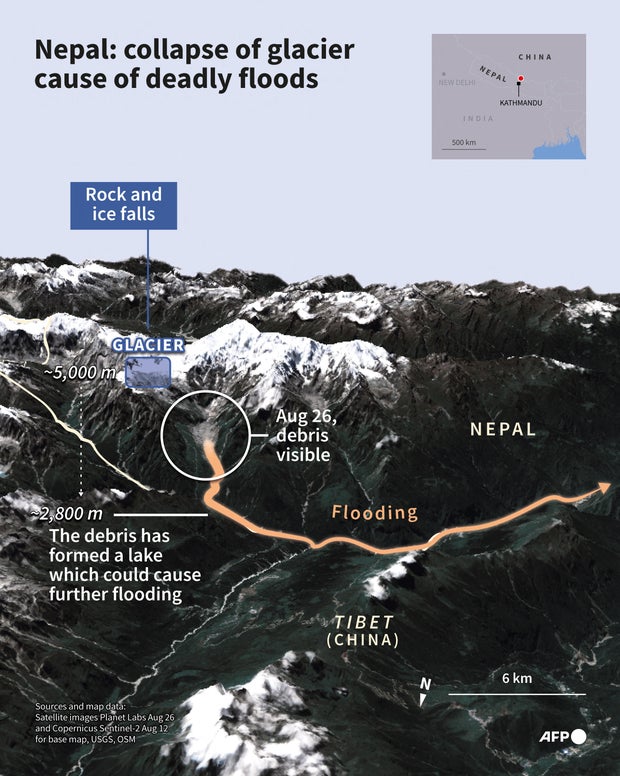
Nepal has requested specialist assistance from India and China, including tunnel-rescue teams, because officials say lives are at stake and existing operations have gaps. The catastrophe began when part of a glacier collapsed at an elevation of about 5,200 metres in the Himalayas. The ice and debris plunged approximately 1,200 metres before striking the Lende River, sending a powerful surge through Nepal’s Rasuwa, Nuwakot and Dhading districts. The flood briefly raised the Trishuli River by nine metres in 30 minutes.
The US Geological Survey revised its initial assessment that an earthquake had triggered the event, concluding instead that the recorded seismic signal came from the landslide itself. A lake formed at the collapse site and began to rise, prompting the temporary suspension of rescue work. Scientists now consider the immediate risk manageable, although glacial-hazards expert Alton Byers warned that the lake’s loose-debris barrier is highly unstable. A gradual natural drainage would be safest, but Chinese crews may attempt to lower the lake manually.
Chinese leaders have ordered stronger monitoring and scientifically planned rescue operations. Aid has arrived from India, the United Nations, the Red Cross Federation, Australia, South Korea and the United States. Officials caution that the death toll is likely to increase as rescuers reach communities isolated by mud and damaged roads.
Entities: Nepal-Tibet border region, Nepal, Tibet, Kathmandu, DeviGhat village • Tone: urgent • Sentiment: negative • Intent: inform
29-08-2026
Deadly flash floods struck the Nepal-Tibet border near Gyirong Port, a major crossing between Nepal and Tibet, sweeping away people and infrastructure as hundreds fled. Dramatic CCTV footage of the flooding circulated internationally, but China’s heavily censored internet has shown little of it. Chinese state media has broadcast only a still image and limited rescue footage, while user-generated videos, survivor accounts and information about missing people have been difficult to find.
Chinese authorities have launched a major rescue operation involving hundreds of emergency workers. President Xi Jinping chaired an emergency meeting, and Premier Li Qiang travelled to the region to inspect the aftermath. State media has emphasized the scale and bravery of the rescue effort, including teams crossing rivers and searching through mud and debris, but has provided few details about casualties, survivors or those rescued.
The BBC argues that the limited public information reflects Beijing’s longstanding sensitivity over Tibet, where China has faced resistance, international criticism and accusations of serious human-rights abuses. The government is concerned that the disaster could generate public anger over its response or alleged failures to prevent it, potentially creating discontent in a region where religious identity remains important.
A local Communist Party notice urged officials to provide psychological support, maintain social order and preserve public confidence, warning that officials would be held accountable for poor performance. Rights activists say Tibetans risk detention for speaking with journalists or sharing material that challenges the official narrative. The International Campaign for Tibet has accused authorities of deleting online evidence and called for complete, verifiable casualty information.
The article places the flood within the broader context of strict controls on travel, communications and reporting in Tibet, concluding that people inside China are unlikely to learn the full extent of the disaster.
Entities: Tibet, Nepal, Gyirong Port, China, Xi Jinping • Tone: analytical • Sentiment: negative • Intent: analyze
29-08-2026
Anjana Raja and Pattabiraman Venkatesan, a couple from California’s San Francisco Bay Area, described to CBS News how they escaped a catastrophic flash flood while traveling through Nepal on a pilgrimage to Tibet. The couple was aboard a tour bus in Timure, in Nepal’s Rasuwa District near the Nepal-China border, when a massive wall of dark water and debris surged down from the Himalayas. The flood followed the collapse of a glacier, sending torrents through valleys and destroying homes and communities.
Venkatesan said the approaching flood appeared to be 60 or 70 feet high and initially looked like fire or a forest fire. Raja said she pulled him from the bus and yelled for them to run. They joined thousands of people fleeing toward higher ground as floodwaters swept away homes and people. Raja said she heard the screams of victims and saw death directly in front of her.
A guide led the couple up a steep, slippery path to a flat area on a nearby mountain. They spent the night in a goat shed with other survivors, including local residents and tourists, before being airlifted to safety the next day. Everyone on their tour bus survived.
The disaster killed nearly 600 people, according to the report, while approximately 2,500 others were believed to be missing. The U.S. State Department estimated that about 90 Americans were among those missing. Search-and-rescue teams continued combing the affected region for survivors.
The couple described their survival as a miracle. Venkatesan said the experience gave him a renewed appreciation for life and reinforced his belief that people should “be good, do good, think good,” while leaving the rest to a higher power.
Entities: Anjana Raja, Pattabiraman Venkatesan, CBS News, U.S. State Department, Nepal • Tone: emotional • Sentiment: negative • Intent: inform
29-08-2026
The death toll from devastating flash floods in Nepal and along the Nepal-China border has risen above 600, while approximately 3,000 people remain missing. Rescue operations have entered their fourth day, but poor weather has forced authorities to suspend helicopter missions. More than 3,700 people have been rescued in Nepal, while Chinese state media reports that 558 people are missing on the Chinese side. Many of those unaccounted for are foreign workers, trekkers and pilgrims.
Nepali Army spokesperson Brig. Gen. Raja Ram Basnet said more than 100 people may be trapped beneath thick mud in a hydropower construction tunnel in Rasuwa district. Rescuers have extracted at least one mud-covered survivor, but operations are being slowed by mud several feet deep and limited places for helicopters to land. A newly formed lake upstream is also threatening to overflow, prompting Nepali and Chinese authorities to warn residents to move to safer areas and forcing rescue teams to relocate temporarily.
The flooding is believed to have been caused by the collapse of bedrock beneath a Himalayan glacier, which dragged part of the glacier downhill. The resulting rockfall registered as a magnitude 5.2 seismic event and sent rocks and meltwater into rivers, sweeping away buildings, bridges and soil in Nepal and Tibet. Scientists are still confirming the precise sequence of events, but climate experts warn that rapid warming in the Hindu Kush Himalayas is destabilizing glaciers, permafrost and mountain slopes.
The United States said five Americans had reached safety, while about 90 remained unaccounted for. Twenty-two missing Americans were part of an Isha Foundation pilgrimage to Mount Kailash. The U.S. Embassy in Nepal is providing supplies, including food, blankets, mosquito nets and temporary shelter materials, while President Trump offered additional assistance. The Red Cross estimates that about 90,000 people have been affected.
Entities: Nepal, China and Tibet, Rasuwa district, Brig. Gen. Raja Ram Basnet, Nepali Army • Tone: urgent • Sentiment: negative • Intent: inform
29-08-2026
Catastrophic flash floods and landslides in Nepal and China have killed at least 579 people and left roughly 2,500 missing, according to official figures cited by CBS News. Nepal reported 1,924 people still unaccounted for, while Chinese state media previously reported 558 missing on the Chinese side of the border. More than 3,700 people have been rescued in Nepal, including over 3,000 evacuated by helicopter, but hundreds of missing people are foreigners who were working, trekking, or traveling on pilgrimage near Mount Kailash and the Tibet-Nepal border.
Rescue operations continued Friday despite severe damage and warnings of additional flooding. Authorities alerted residents and emergency personnel about a new lake that formed upstream after the initial disaster. The lake, created by debris and water high in the Himalayas, posed a potential threat to areas near Gyirong Port, a border crossing largely destroyed by the floods. Nepal Police ordered personnel to remain on high alert, while Chinese officials later said the risk from the overflowing lake was manageable.
The Red Cross estimated that approximately 90,000 people had been affected. Scientists believe the disaster began when a rocky ledge beneath a glacier collapsed, causing part of the glacier to fall and sending huge quantities of rock and meltwater into rivers below. The event registered as a magnitude 5.2 seismic disturbance. Climate scientists warned that rapid warming in the Hindu Kush Himalayan region is increasing instability in glaciers, permafrost, snow cover, and mountain slopes.
The United States said 90 Americans remained missing and five had been rescued. The U.S. Embassy pledged supplies, while Catholic Relief Services prepared food, blankets, mosquito nets, and shelter materials. The Isha Foundation also reported missing pilgrims, including 22 Americans. Rescue teams continued searching damaged roads, villages, and a hydropower tunnel in Nepal’s Rasuwa district, where workers were trapped beneath mud.
Entities: Nepal, China and Tibet, Nepal’s National Disaster Risk Reduction and Management Authority, Nepal Police, Nepali Army • Tone: urgent • Sentiment: negative • Intent: inform
29-08-2026
The death toll from a devastating flash flood along the Nepal-Tibet border has risen above 600, with 682 bodies recovered and nearly 3,000 people still missing. Nepal’s disaster agency reported 675 deaths and 2,426 missing people, including foreigners, while China confirmed seven deaths and 554 missing in Tibet. Some bodies have reportedly been carried dozens of kilometers downstream into southern Nepal and India.
The disaster began Wednesday when a glacial collapse sent rock, ice, mud and debris through Himalayan river systems, destroying towns, damaging hydropower facilities and blocking transport routes. In Nepal, heavy rain has prevented helicopter operations, while thick mud and difficult terrain are obstructing rescue work. More than 100 people are believed to remain trapped inside a mud-filled tunnel at the Trishuli 3A hydropower project in Rasuwa District. Rescuers have used ropes and baskets to reach some survivors, and a specialized tunnel-rescue team from India has arrived to assist.
Nepal’s foreign minister said the country needs technical assistance and equipment for tunnel rescues, repairing destroyed bridges and communications links, identifying bodies, conducting DNA testing and storing remains. The government estimates that rebuilding could cost between $4 billion and $5 billion, nearly one-tenth of Nepal’s economy.
In Tibet, rescue efforts near Gyirong were temporarily suspended because of the risk of renewed flooding. Chinese authorities later said the threat had declined and reported rescuing two villagers. The glacial collapse also created debris dams and a barrier lake upstream. Although satellite images showed that one lake had begun to shrink, officials identified another large body of water whose depth remains unknown. Nepalese authorities warned that flood risks will continue until both lakes have completely drained.
Entities: Nepal, Tibet, Nepal Army, China’s Xinhua news agency, India • Tone: urgent • Sentiment: negative • Intent: inform
29-08-2026
Devastating flash floods in the Himalayan border region between Nepal and Tibet have killed at least 682 people and left nearly 3,000 missing, according to figures reported after the disaster earlier in the week. A large number of those unaccounted for are foreign nationals and tourists caught in areas cut off by floodwaters and debris.
Chinese officials said 260 foreigners remained missing, while Nepal’s disaster agency reported 517 missing foreign nationals. Separately, the Nepal Tourism Board said 622 tourists were still “out of communication,” including 471 foreign tourists. The tourism board’s list included nationals from India, Ukraine, Malaysia, the United Kingdom, Latvia, Canada, South Korea, Singapore, Russia, Germany, South Africa, Japan, New Zealand and France, as well as several other countries. The United States said 90 of its citizens remained unaccounted for, and Australia reported that the number of missing Australians had risen to 41.
The figures differ among agencies, and China has not released a national breakdown of the foreign nationals it considers missing. Nepal also reported that two of three missing Spanish citizens had been located, although Spain’s Foreign Ministry had not publicly commented.
Rescue operations are continuing in remote and isolated areas. Nepalese army personnel have been delivering relief supplies by helicopter to survivors stranded in districts cut off by the flooding. The disaster has prompted international support, with the European Union activating its Copernicus Earth observation satellite system to help assess the aftermath. European Commission President Ursula von der Leyen announced €2 million in humanitarian aid for Nepal, intended to provide life-saving assistance to the families and communities most severely affected.
Entities: Nepal floods, Nepal, Tibet, Himalayan region, Nuwakot district • Tone: urgent • Sentiment: negative • Intent: inform
29-08-2026
The death toll from severe floods and mudslides along the Nepal-China border has risen to at least 676, while nearly 3,000 people remain missing, according to figures reported by Nepali and Chinese authorities. Nepal’s disaster agency reported 669 deaths and 2,426 missing people, while Chinese authorities reported seven deaths and more than 550 missing in Tibet.
The disaster struck Wednesday after flash floods and mudslides swept through parts of Nepal and China’s Tibet region. Experts believe the flooding may have been triggered when a large piece of ice broke away from a glacier and fell into the Lhende Khola River. The resulting destruction damaged roads, disrupted communications and left rescue teams struggling to reach the main disaster zone.
Search-and-rescue operations were temporarily suspended because of rain and fog. Officials expect intermittent rain through the weekend, raising concerns that conditions will worsen. A lake created by the glacial collapse had also threatened to overflow into the river, although Chinese officials said that risk had substantially declined by Saturday.
Nepal has said it does not need foreign personnel for general search-and-rescue work, but it requested specialized tunnel experts from China because as many as 100 people may still be trapped inside a mud-filled hydropower plant tunnel. China sent five workers from Tibet by helicopter to assist Nepali authorities, and dramatic video showed the rescue of at least one person from the mud.
Nepal Finance Minister Swarnim Wagle estimated that the country could require more than $4 billion to rebuild, while emphasizing that the full extent of the loss and damage was still being assessed. The report was based on Reuters and Associated Press information.
Entities: Nepal floods and mudslides, Nepal-China border, Tibet Autonomous Region, China, Lhende Khola River, Rasuwa district, Nepal • Tone: urgent • Sentiment: negative • Intent: inform
29-08-2026
This France 24 video report covers an ongoing disaster response along the Nepal-Tibet border after flash floods and landslides caused extensive loss of life and widespread disruption. At the time of publication, nearly 3,000 people were still missing and 682 deaths had been confirmed. The scale of the disaster has left rescue teams working under dangerous and rapidly changing conditions.
A major threat is a lake that formed upstream as a result of the flooding. The lake could burst its banks, potentially sending another surge of water downstream and placing rescuers and nearby communities at further risk. Because of this danger, rescue operations are described as “extremely risky,” with teams required to work while monitoring the possibility of additional flooding.
The report is presented by FRANCE 24 journalist Shahzaib Wahlah and focuses on the immediate emergency response rather than providing a detailed account of the causes of the disaster or long-term recovery plans. The accompanying material gives no further information about the identities of those missing, the precise locations of rescue efforts, or the number of people evacuated. It does, however, place the events within a broader regional humanitarian crisis, with separate related reports describing continuing rescue efforts, survivors trapped in infrastructure, military helicopter operations, relief camps, and large numbers of people affected in Nepal and Tibet.
Overall, the report emphasizes the mounting death toll, the uncertainty surrounding thousands of missing people, and the additional danger posed by the unstable upstream lake. Its central message is that rescue work is continuing, but responders face a potentially catastrophic secondary flood while attempting to reach survivors.
Entities: Nepal, Tibet, Nepal-Tibet border, FRANCE 24, Shahzaib Wahlah • Tone: urgent • Sentiment: negative • Intent: inform
29-08-2026
Rescuers in Nepal and China are searching for nearly 3,000 people missing after catastrophic flooding struck the Nepal-Tibet border region on Wednesday. The disaster sent a tsunami-like wall of water, ice, mud and debris through villages and infrastructure sites. Authorities have recovered 682 bodies: 675 in Nepal and seven in Tibet. India has also recovered seven bodies from rivers flowing from Nepal, believed to be flood victims.
Nepal’s army made a potential breakthrough at the Trishuli 3A hydroelectric project, inserting a pipe into a tunnel where more than 100 workers may be trapped. Air was being sent through the opening while excavation work was prepared. Rescue efforts are also focused on the Trishuli 3B site. Nepal has reported 2,426 people out of contact, including 933 hydropower workers and 517 foreigners, among them trekkers and pilgrims traveling toward Mount Kailash. An Indian group affiliated with the Isha Foundation was in the heavily damaged Chinese border town of Gyirong, which the group said had been completely washed away.
The US Geological Survey attributed the torrent to a glacial collapse. UN climate chief Simon Steill said melting glaciers and climate change are making such disasters more likely and severe, particularly for vulnerable communities. Survivors face widespread destruction, with entire settlements along rivers swept away and families waiting for information about missing relatives.
Nepal’s government warned that reconstruction could cost billions of dollars and requested specialized equipment, including heavy-lift drones, forensic testing kits and freezer units. Further flooding remains a threat because the deluge created large lakes. China and Nepal discussed sharing satellite and hydrological data, while rescue operations around Gyirong were temporarily paused before Chinese authorities reported that the newly formed lake had largely drained. Hope was fading for families still unable to locate loved ones.
Entities: Nepal, Tibet and the Nepal-China border, China, Trishuli River and Trishuli Bazar, Trishuli 3A and 3B hydroelectric projects • Tone: urgent • Sentiment: negative • Intent: inform
29-08-2026
France 24 reports that Nepali army rescue teams are working to save more than 100 people trapped inside a hydropower tunnel after devastating floods struck the site. The rescue operation was underway on Saturday, three days after the flooding, with teams using drilling equipment to reach those inside the tunnel. The report presents the incident as an urgent emergency response amid severe flooding in Nepal.
The available article extract provides few further details. It does not identify the hydropower project, specify the exact location, explain how the people became trapped, or give information about their condition. It also does not state whether rescuers had reached or communicated with the trapped workers, or provide a confirmed death toll connected to the tunnel incident. The report is accompanied by a France 24 video and is categorized under Asia/Pacific, with keywords focused on Nepal, rescue efforts, and floods.
The wording emphasizes the scale and urgency of the operation: more than 100 people remain trapped, the floods are described as devastating, and military teams are racing against time while using heavy drilling equipment. The incident forms part of a wider series of France 24 reports about flooding in Nepal, including missing people, relief camps, survivors, and the broader humanitarian impact in Nepal and Tibet. However, those related headlines are separate links rather than substantive content in the article extract provided here. Overall, the article informs readers about an ongoing rescue operation and highlights the danger posed by the floods, while leaving the eventual outcome of the mission unresolved.
Entities: Nepal, Nepali Army, France 24, Hydropower tunnel, Floods • Tone: urgent • Sentiment: negative • Intent: inform
29-08-2026
A devastating series of flash floods and mudslides along the Nepal–Tibet border has killed at least 633 people and left nearly 3,000 missing, according to the latest figures in France 24’s live report. The disaster followed an apparent glacial collapse on Wednesday that sent rock, ice, mud and debris through Himalayan river systems, engulfing villages and damaging major infrastructure.
Nepal’s disaster authority reported 626 deaths in the country and 2,426 missing people, including 933 hydropower workers, trekkers and pilgrims travelling to Tibet’s Mount Kailash. China reported seven additional deaths in its Tibet region. Some victims may have been swept downstream into India. Survivors have been rescued by helicopter and taken to safer areas, while families have gathered at hospitals and army camps seeking information about missing relatives.
Chinese authorities said the risk of a lake formed by the glacial collapse bursting near the disaster site had declined. Satellite imagery showed that the lake was gradually draining and had shrunk to approximately 99,000 square metres. India has also increased monitoring of Himalayan areas bordering Nepal and China because of the risk of similar glacier-related events.
Nepal estimates that reconstruction could cost between $4 billion and $5 billion, although officials stressed that assessments are preliminary. Foreign Minister Shisir Khanal said Nepal needs international assistance with specialized tasks, including tunnel rescues, restoring transport and communications, identifying bodies, DNA testing and preserving remains. China has sent five tunnel experts from Tibet to assist with rescue work at a hydropower station.
The report emphasizes the scale of the humanitarian emergency, the continuing search for missing people and the longer-term consequences of a disaster potentially linked to glacier instability and climate change.
Entities: Nepal, Tibet, China, Nepal-Tibet border flash floods and mudslides, Trishuli, Nuwakot district • Tone: urgent • Sentiment: negative • Intent: inform
29-08-2026
A France 24 video report describes the Nepali army’s continuing response to deadly floods in Nepal. Because flooding has damaged roads, ground-based rescue operations are difficult, prompting the army to use helicopters to reach affected areas, evacuate survivors, and transport them to safety. The report presents the helicopter effort as a crucial part of the emergency response while access by road remains disrupted.
The situation remains dangerous and unstable. Skies are still overcast, and additional rain is expected in the hours following the report. That forecast is raising concerns that water levels could rise further and cause more flooding, potentially complicating rescue efforts and placing additional communities at risk. The article does not provide a detailed casualty figure or identify the specific locations shown in the footage, but it situates the report within a broader series of reports about the disaster, including people trapped in a hydropower tunnel, families waiting for missing relatives, relief camps, and widespread effects in Nepal and Tibet.
Reported by France 24 journalist Shahzaib Wahlah, the short video focuses on the immediate operational challenge facing rescuers: reaching flood survivors when roads have been damaged and weather conditions may deteriorate. Its primary purpose is to inform viewers about the army’s emergency helicopter deployments and the continuing threat posed by further rainfall. The overall picture is one of an active rescue operation unfolding under hazardous conditions, with survivors being moved to safety but the risk of additional flooding still present.
Entities: Nepal, Nepali army, France 24, Shahzaib Wahlah, Asia/Pacific • Tone: urgent • Sentiment: negative • Intent: inform
29-08-2026
France 24 reports that rescue operations were still underway on the fourth day after catastrophic flash floods struck communities along the border between Nepal and China. Authorities continued searching for people buried or trapped by the flooding, finding survivors and transporting them to safety. The report emphasizes the scale of the disaster through scenes of displaced people arriving at relief centers with little more than the clothes they were wearing.
At these centers, families waited anxiously for information about relatives whose whereabouts remained unknown. The article says both the death toll and the number of people unaccounted for continued to rise, underscoring the worsening humanitarian situation. It does not provide specific figures for deaths or missing people in the available text, but describes a rapidly developing emergency involving widespread displacement, rescue efforts, and family separation.
The report is presented as a short video segment from France 24’s Asia/Pacific coverage. Its focus is on the continuing emergency response rather than on explaining the causes of the floods or assessing long-term recovery needs. The accompanying related coverage refers to helicopter rescues, people trapped in a hydropower tunnel, relief camps, and the large number of people affected in Nepal and Tibet, but those items are separate from the main report. Overall, the article portrays an ongoing natural disaster in which authorities are racing to save survivors while families await news and casualties continue to mount.
Entities: Nepal, China, Nepal-China border, France 24, catastrophic flash floods • Tone: urgent • Sentiment: negative • Intent: inform
29-08-2026
Rescue operations continued for a fourth day after catastrophic flash floods struck communities along the Nepal–China border. Authorities were still finding survivors and evacuating them to safer areas, while the number of dead and missing continued to rise. According to figures cited in the article, the combined death toll in Nepal and Tibet reached 676, with nearly 3,000 people unaccounted for. Chinese authorities reported seven deaths and more than 550 missing, while Nepal’s disaster agency reported 669 deaths and 2,426 missing people. More than 3,700 people had been rescued in Nepal.
In Nuwakot, one of the hardest-hit Nepali districts, helicopters delivered relief supplies such as clothing, rice, crackers and instant noodles while also transporting survivors. Many evacuees arrived with little more than the clothes they were wearing, and soldiers carried injured or vulnerable people—including babies—to medical tents. As evacuations continued, some villagers returned to their devastated homes to search for belongings or check on animals left behind.
The disaster has created an agonizing information crisis for families. In Kathmandu, relatives gathered outside the main government hospital, searching help desks, notice boards and lists of injured and missing people. Families posted photographs and contact details on hospital walls, hoping for news. In Nuwakot, military personnel displayed lists of missing people at a relief center, where families crowded together, photographed names and searched for loved ones.
The article highlights the fear and grief of relatives who have gone days without information. Dil Maya Lama searched for her missing brother, a driver in Rasuwa, while Nelza Moktan sought news of her missing cousin. Rajesh Kumar Ram held on to hope that his son might still be alive. The account ends with Priti Kharel seeking information about her brother, Milan Kharel, an engineering geologist whose family had not heard from him.
Entities: Nepal–China border flash floods, Nepal, Tibet, Nuwakot, Trishuli • Tone: urgent • Sentiment: negative • Intent: inform
29-08-2026
An NPR report examines the severe difficulties facing relief efforts after catastrophic flooding in Nepal. Blocked roads, damaged infrastructure, debris and ongoing monsoon weather are preventing aid organizations from reaching many survivors with food, shelter and emergency hygiene supplies. Joel Rose speaks with Dhruba Gurmachhan, the programme readiness manager for World Vision International in Kathmandu, who recently visited affected communities.
Gurmachhan describes scenes of widespread destruction, with floodwater, sand, mud and debris covering the ground. He says the smell of decomposition was overwhelming and that the number of people who may remain buried is unknown. Residents were seen standing beside rivers where their homes had been swept away, visibly grieving their losses. He recounts meeting a young girl, approximately seven or eight years old, who had lost her entire family and was the only survivor. The child was deeply traumatized and unable to speak.
Gurmachhan also explains the personal psychological impact of witnessing the devastation. He says the girl’s face stayed with him throughout the night, even after he tried to cope through prayer and meditation.
Relief access remains the most immediate operational challenge. World Vision had sent two trucks carrying food to one side of a river, but the opposite bank was completely unreachable by road. The organization was considering hiring a helicopter, pending government approval, to deliver food and other supplies. Gurmachhan emphasizes that successful delivery depends on coordination among relief agencies and authorities. The report highlights both the human trauma caused by the floods and the logistical barriers complicating emergency response.
Entities: Nepal, Kathmandu, Dhruba Gurmachhan, Joel Rose, World Vision International • Tone: urgent • Sentiment: negative • Intent: inform
29-08-2026
NPR’s photo report documents the aftermath of deadly flash floods that struck Nepal and Tibet, an area administered by China, on Wednesday. Nepalese officials say the death toll is continuing to rise after floodwaters and mud swept away homes, roads and entire communities. Approximately 2,500 people are reported missing across the two affected areas, including about 90 Americans, according to the U.S. State Department. The U.S. Geological Survey said the flooding was triggered by a glacial collapse, highlighting the hazards posed by rapidly changing conditions in the Himalayan region.
The photographs show the scale of the disaster in Nepal’s Nuwakot district and surrounding communities. Aerial images reveal extensive mud and debris along the Bhotekoshi and Trishuli rivers, while ground-level photographs show submerged or destroyed houses, damaged roads and vehicles buried in sludge. Rescue workers and Nepalese soldiers are shown evacuating survivors by helicopter and searching through debris with heavy machinery.
The gallery also captures the human consequences of the disaster. Police collect information from relatives of missing people, families react at a Kathmandu hospital, and photographs of victims are displayed outside a government hospital to help identify those killed. Residents salvage usable materials from destroyed homes, while people gather to mourn the victims, including students holding candlelight tributes in Chennai.
The United States announced $500,000 in aid to support rescue operations. The report primarily conveys the destruction, grief and urgency of the ongoing search-and-rescue effort through a combination of factual updates and documentary images.
Entities: Nepal, Tibet Autonomous Region, China, Nuwakot district, Bhotekoshi River, Trishuli River • Tone: urgent • Sentiment: negative • Intent: inform
29-08-2026
Rescue teams in Nepal and China are racing to locate survivors after deadly floods struck the Himalayan border region on Wednesday. Authorities in both countries report that at least 600 people have died and nearly 3,000 remain missing, including dozens of Americans. The disaster occurred after a massive section of ice apparently broke away from a glacier, sending torrents of mud, water and ice through mountain communities.
Rescue operations have been severely hindered by destroyed roads and bridges, steep canyons and unstable terrain. The Gyirong-Rasuwa border checkpoint, one of the hardest-hit areas, is largely inaccessible by road. A Chinese rescue team reached the area on foot after trekking overnight, but rescuers faced near-vertical cliffs, large boulders and the effects of high altitude. Another team arriving at the checkpoint found extensive mud and debris, including a partially buried car and tree branches. Officials warned that additional floods, landslides and avalanches could threaten rescue workers.
The terrain presents different challenges on either side of the border. According to geohazard specialist Dai Zili, Nepal’s broader valleys make it somewhat easier to establish rescue routes, while Tibet’s narrow, high-altitude canyons make it more difficult to bring in personnel and supplies. Access to Tibet is also complicated by China’s restrictions on foreign journalists, leaving international coverage dependent in part on Chinese state media.
At a teaching hospital in Kathmandu, people were checking lists of those still missing. For families and survivors, the uncertainty and waiting have become one of the most painful aspects of the disaster.
Entities: Nepal, Tibet, China, Himalayan floods, Gyirong-Rasuwa border checkpoint • Tone: urgent • Sentiment: negative • Intent: inform
29-08-2026
Families in the United States and Canada are pleading for expanded international rescue efforts after catastrophic flash floods struck near the Nepal-China border, leaving more than 2,000 people missing and hundreds dead. About 90 Americans are among those unaccounted for, according to the U.S. State Department. Many of the missing were members of a two-week Himalayan Glacier Adventure and Travel Company tour that included 40 guests and seven guides. The group had stopped in Timure, Nepal, while preparing to travel to Mount Kailash in Tibet.
Mukti Patel of Richmond, Virginia, is waiting for news about her father, Umesh Kumar; her sister, Akanksha Patel; her brother-in-law, Ishan Patel; and Ishan’s mother, Shilpa. The family last spoke with Ishan on his 32nd birthday, Wednesday, when the floods struck. Patel said the hotel where they were staying was swept away, but she remains reluctant to describe her relatives as dead without confirmation.
Other families are facing similar uncertainty. Jiwan Jyoti, a U.S. citizen from Massachusetts, was last known to be at a destroyed hotel after speaking with family shortly before the flooding. Vaasavi Unnava learned that messages to her parents, Hanumantha Rao and Vasundhara Unnava, had not been delivered. The California couple had planned to visit family in India after their pilgrimage.
Relatives have asked whether survivors could be trapped in air pockets or whether they can reach the disaster area themselves. Sanket Pandey, managing director of the tour company, said families have received very little information. The article highlights their fading hope, grief, and frustration while rescuers continue searching through mud and debris. Several families are calling for more countries to assist with rescue and recovery operations.
Entities: Mukti Patel, Umesh Kumar, Akanksha Patel, Ishan Patel, Shilpa Patel • Tone: emotional • Sentiment: negative • Intent: inform
29-08-2026
A young boy who survived catastrophic flooding in Nepal has been reunited with his mother after she believed both of her children had died. Matti Maya Tamang, 28, spent days searching for her children after floods and mudslides devastated the Rasuwa, Nuwakot and Dhading districts in central Nepal. The disaster began Wednesday morning when a massive chunk of ice broke away from a Himalayan glacier and sent water into the Lendhe River, overwhelming surrounding areas.
Tamang’s 8-year-old son, Zoyal Ghale, had been at school when the flooding began. As conditions suddenly became dark and dangerous, he fled into a forest with a friend and climbed trees to escape the rising water. He survived with a broken leg and cuts to his face and was airlifted to Kathmandu for treatment.
Ghale’s whereabouts were initially unknown. Journalist Sahana Bajracharya found him at a hospital in Nuwakot and managed to contact Tamang, informing her that her son was alive. Tamang said she had already lost hope and could barely believe the news. She reached the hospital in Kathmandu on Friday, where she was reunited with Ghale. The boy’s father, who works as a construction worker in Japan, was also traveling to see him. Tamang later learned that her other child had survived as well.
The flooding has caused widespread devastation. As of Friday, 1,924 people remained missing, including many foreign nationals, while 579 deaths had been confirmed and 4,451 people had been rescued, according to Nepal’s National Disaster Risk Reduction and Management Authority. Rescuers remain on alert because a newly formed lake near the Tibetan border, created by a glacier collapse, is reportedly overflowing and could trigger additional flooding. Authorities have instructed government personnel and members of the public involved in rescue efforts to remain prepared to act immediately.
Entities: Matti Maya Tamang, Zoyal Ghale, Sahana Bajracharya, Nepal, Rasuwa district • Tone: emotional • Sentiment: negative • Intent: inform
29-08-2026
Families in the United States are desperately awaiting news about relatives who disappeared in catastrophic flash floods along Nepal’s border with China. Mukti Patel, of Richmond, Virginia, has been staying with family and friends at her parents’ home since her father, sister and two other relatives went missing. The hotel where they were staying was reportedly swept away, but Patel is resisting speaking about them in the past tense because their fate remains unknown.
The disaster has left more than 2,000 people unaccounted for, according to the report, including approximately 90 Americans, based on information from the US State Department. As rescuers continue searching through mud and pulling survivors from the flood zone, relatives are maintaining hope that missing people may still be alive, even if the chances appear increasingly slim.
Families have also been trying to determine whether they can reach the affected area and whether missing relatives could have survived inside an air pocket or another sheltered space. Sanket Pandey, managing director of Himalayan Glacier Adventure and Travel Company, said relatives raised these questions during a Zoom call. The report also describes anxious family members waiting for information at Tribhuvan University Teaching Hospital in Kathmandu.
The article focuses on the uncertainty facing families rather than providing a definitive casualty count or explaining the full scope of the rescue operation. Its central human story is the tension between grief and hope as relatives wait for confirmation about loved ones caught in the floods.
Entities: Mukti Patel, Sanket Pandey, Richmond, Virginia, Nepal-China border, Nepal • Tone: emotional • Sentiment: negative • Intent: inform
29-08-2026
A catastrophic flash flood struck the China-Nepal border on Wednesday, causing extensive deaths, destruction and widespread displacement in Nepal and Tibet. The latest figures in the live report state that Nepal’s death toll has risen to 626, while Chinese authorities report seven deaths in Tibet. At least 2,478 people are missing: 1,924 on Nepal’s side and 554 in Tibet. More than 3,700 people have been rescued in Nepal, but the Red Cross estimates that at least 93,000 people have been affected.
The disaster has particularly affected the Gyirong border area, a major route for travelers and pilgrims heading toward Tibet’s Mount Kailash. A Chinese rescue team reaching the Gyirong border crossing found the complex almost completely destroyed, describing it as “nothing but ruins.” More than 550 people remain unaccounted for in Gyirong County, including 260 foreigners. Overall, at least 777 foreigners are reported missing, including tourists and foreign workers. Australians and British citizens are among those affected, while seven bodies believed to be flood victims have been recovered from rivers in India.
Rescue operations have been complicated by dangerous conditions, including overflowing lakes, a broken lake dam in Nepal’s Rasuwa district and the risk of further flooding. Nepalese authorities are attempting to rescue people trapped inside a hydropower tunnel and have asked other countries for specialized technical assistance with the tunnel operation, as well as with identifying and storing bodies. Nepal has also requested Bailey bridges from China and India to restore access.
The report includes testimony from survivors, including Sivaranjani Muthunathan, who described a torrent suddenly engulfing a bus convoy. It also highlights grief among families searching for missing relatives and the difficulties of assessing damage in Tibet because of Chinese restrictions on information. The live coverage presents an evolving humanitarian emergency involving rescue efforts, missing people, foreign nationals, infrastructure destruction and urgent international assistance.
Entities: Nepal, Tibet, Gyirong County, Gyirong border crossing complex, Rasuwa district • Tone: urgent • Sentiment: negative • Intent: inform
29-08-2026
The live blog reports the aftermath of a catastrophic flash flood that struck the China-Nepal border on Wednesday, causing extensive deaths, destruction and mass displacement. In its closing update, Reuters reported that Nepal’s death toll had risen to 626, while China’s Xinhua news agency confirmed seven deaths in Tibet. Earlier, Nepal’s official tally stood at 579, reflecting continuing revisions as bodies were recovered and identified.
The total number of people reported missing reached 2,478: 1,924 in Nepal and 554 in Tibet. At least 777 foreigners were unaccounted for, including tourists, foreign workers and Hindu pilgrims travelling to Tibet’s Mount Kailash. More than 3,700 people had been rescued in Nepal, but the Red Cross estimated that at least 93,000 people were in serious need of assistance. Chinese authorities said they had evacuated 555 stranded tourists and 499 Chinese residents, while Indian officials recovered seven bodies from rivers flowing from Nepal.
The flood virtually destroyed the Gyirong border-crossing complex in Tibet. A Chinese rescue team that reached the area described finding “nothing but ruins,” while more than 550 people remained missing in Gyirong County, including 260 foreigners. Nepal reversed an earlier position and requested specialised international assistance for rescuing people trapped in a hydropower tunnel, identifying victims and storing bodies. It also asked China and India to provide Bailey bridges to restore damaged crossings.
The report includes survivor Sivaranjani Muthunathan’s account of a sudden torrent engulfing her bus during a pilgrimage journey, sweeping away vehicles and burying others in mud. The number of missing Australians rose to 41, although one family was reunited with a woman who made contact after being listed as missing.
Entities: Nepal-Tibet flash flood disaster, Nepal, Tibet Autonomous Region, China, Gyirong County, Gyirong Port border crossing • Tone: urgent • Sentiment: negative • Intent: inform
29-08-2026
More than 600 people have died and many others remain missing after devastating floods swept through parts of Nepal and Tibet following a landslide and glacier collapse near Langtang Lirung peak in the Himalayas. The disaster destroyed homes, roads and other infrastructure, while rescue operations continued amid fears that additional lakes formed by debris could overflow and trigger further flooding.
Scientists say climate change is increasing the likelihood of similar disasters by accelerating glacier retreat and thawing the permafrost that helps stabilize steep mountain slopes. Warmer conditions may also allow meltwater to enter glaciers through crevasses, lubricating their bases and making them more likely to slide. Tectonic activity is another factor, as the still-rising Himalayan mountains create steeper and potentially less stable terrain.
Experts believe the initial glacier collapse may have blocked a river, forming a temporary lake that filled over approximately two days before its debris dam breached. The resulting floodwave intensified as it moved through narrow valleys, producing what one expert described as an “apocalyptic event.”
The catastrophe has renewed calls for detailed hazard mapping, active monitoring and improved early-warning systems in vulnerable mountain communities. Experts pointed to the Swiss village of Blatten, where residents were evacuated more than a week before a glacial collapse destroyed the settlement last year, as evidence that effective monitoring and preparation can save lives. The article presents the Nepal-Tibet disaster as both a humanitarian emergency and a warning that climate change is making high-mountain hazards more frequent and potentially more destructive.
Entities: Nepal–Tibet floods, Nepal, Tibet, China, Langtang Lirung peak, Himalayas • Tone: analytical • Sentiment: negative • Intent: analyze
29-08-2026
Nepal has suspended search-and-rescue operations in the Rasuwa district because of heavy rain and fog, while families continue waiting for news of relatives missing after catastrophic floods near the border with China’s Tibet. At least 626 people have been confirmed dead in Nepal and 2,426 remain unaccounted for. China reported seven deaths and 554 missing in Tibet. Many of those missing are tourists, pilgrims, trekking workers and hydropower employees from Nepal and other countries, including India, Malaysia, the United States and Britain.
Nepal has deployed more than 15,000 military and police personnel, but officials say the country lacks the specialist expertise needed to rescue people trapped in tunnels, restore destroyed bridges and communications networks, and identify recovered bodies through DNA testing. Foreign Minister Shisir Khanal said Nepal had requested technical assistance, while Rasuwa’s chief district officer said efforts were temporarily halted because poor visibility and rain made operations unsafe. Authorities were also prioritising the evacuation of rescued people to Kathmandu.
At hospitals in the capital, families have registered missing-person reports with police and searched lists of unidentified victims. Resham Tamang said he had been looking for five friends and relatives for four days. Tour operator Gopal Thapa said 55 people associated with his company, including his brother, remained missing. The family of Jiwan Jyoti, an Indian-American engineer from Boston who travelled to Nepal for a pilgrimage, also continued to hope she would be found alive.
India has sent three flights carrying about 60 tonnes of relief supplies and offered tunnel-rescue and medical teams, disaster-response personnel and prefabricated bridges. Nepal’s Finance Minister Swarnim Wagle estimated that reconstruction could cost $4 billion to $5 billion. The disaster followed the collapse of a glacier, which sent rock, ice, mud and debris through mountain river systems, destroying buildings, bridges and power stations.
Entities: Nepal, Tibet, China, Rasuwa district, Kathmandu, India • Tone: urgent • Sentiment: negative • Intent: inform
29-08-2026
The article follows the family of Jiwan Jyoti, an Indian-American engineer from Boston who disappeared during a pilgrimage to Nepal for her 50th birthday. Jyoti was last known to be at Hotel Kailash in Rasuwagadhi, near Nepal’s border with China, after travelling there from Kathmandu with a pilgrimage group. Her husband spoke with her by telephone for about nine minutes beginning at 8:35 a.m. Nepal time on Wednesday, after which all contact was lost.
The disappearance occurred amid catastrophic floods and mudslides across Nepal and Tibet. Nepal Police reported that 626 people had been killed, 1,473 injured and more than 2,000 left missing. More than 4,000 police personnel were participating in rescue operations, while survivors were being airlifted from devastated areas. Roads, hotels and other infrastructure around Rasuwagadhi were reportedly destroyed, preventing Jyoti’s relatives from travelling to the area themselves.
Jyoti’s family described her as a working mother who devoted herself to her career and family. Her trip was intended as a personal milestone, and during four days in Kathmandu she visited Pashupatinath, local markets and other attractions while regularly sending photographs to relatives. She then travelled toward Rasuwagadhi, a route used by pilgrims heading overland to Mount Kailash in Tibet.
Although the family understands that the likelihood of finding her alive becomes less certain with time, they are refusing to abandon hope. They believe she and others may have escaped to higher ground before the floodwaters arrived, and that survivors in remote mountain areas could be unable to contact authorities because of limited mobile coverage. The family remains in Kathmandu, relying on updates from local authorities, the embassy and tour operators while search-and-rescue efforts continue.
Entities: Jiwan Jyoti, Jiwan Jyoti’s family and husband, Nepal Police, The National, Kathmandu, Nepal • Tone: emotional • Sentiment: negative • Intent: inform
29-08-2026
Tulshi Patel, a pharmacist from Milton Keynes, England, is trying to locate her mother, Hemangini Jitendra Patel, and her aunt, Hema Sunil Amin, who disappeared during severe flooding in Nepal while travelling on a pilgrimage to Tibet. Patel last spoke with the two women on Monday and received a photograph from them on Tuesday. Their last known location was identified through a GPS signal from their tour group at Friendship Bridge on the Nepal-China border.
After searching independently, Patel found a TikTok video apparently recorded by a local tour guide. The footage showed her mother, aunt and three other members of the tour group waiting at the border to cross into China. Patel told LBC News that the video was likely filmed shortly before 6 a.m. Nepal time on Wednesday. The women had expected to cross the border on Tuesday, but bad weather reportedly delayed them until Wednesday morning.
The flood is believed to have occurred after a magnitude 5.2 seismic event near the Nepal-China border at 8:37 a.m. local time, according to the US Geological Survey. Since the incident, Patel and her family have repeatedly contacted the women and the tour guide through WhatsApp, hoping that the messages will eventually show as delivered or read when phone service returns.
Patel said the family had not given up and was calling every day, but needed people on the ground to help locate and evacuate the missing travellers. The family considered travelling to Nepal to assist with the search but decided against it because they were uncertain how close they could get to the affected area or whether they could provide practical help.
Entities: Tulshi Patel, Hemangini Jitendra Patel, Hema Sunil Amin, Milton Keynes, England, Nepal • Tone: urgent • Sentiment: negative • Intent: inform
29-08-2026
Vikram Ravi, the son of California-based Indian-American couple Anjana Raja and Pattabiram Venkatesan, described his parents’ survival of a deadly flood in Nepal as a miracle. The couple had traveled on a pilgrimage to Tibet and were aboard a tour bus when they saw a massive wall of water and debris rushing down the mountain. Ravi said he was relaxing in bed when his mother called, crying, and told him, “Shiva saved us.”
Raja later described the oncoming surge as resembling a dark tsunami approximately 60 to 70 feet high. Venkatesan said he initially could not determine whether the approaching mass was water, fire, or a forest fire. As homes and other structures were swept away, Raja grabbed her husband by the collar and urged him to run. The couple jumped from the bus and followed a guide toward a flat area near the top of a mountain.
The escape was difficult. The route was narrow and slippery, covered with mud, stones, and rocks. Raja said she did not know how they managed to climb so high. That night, the couple sheltered in a goat shed with other survivors, including local residents and tourists. They were airlifted to safety the following day, and all passengers on their tour bus survived.
Ravi told CNN that he felt immense relief when his parents called to say they were safe, sparing him the anguish of searching for them. Raja said the experience had changed her perspective and that she would tell her children to take life seriously and prepare for unexpected danger. She also said that the first thing she planned to do after returning home was hug her children.
Entities: Vikram Ravi, Anjana Raja, Pattabiram Venkatesan, California-based Indian-American couple, Nepal • Tone: emotional • Sentiment: positive • Intent: inform
29-08-2026
A devastating flash flood that swept through southwest Tibet and central Nepal has raised concerns about the growing risk of glacier-related disasters in Europe’s Alps. Nepalese authorities suspect the flood, which killed hundreds of people, may have been triggered by a glacial lake outburst or the collapse of a glacier. Although experts say an Alpine event would probably be much smaller, similar processes are becoming more likely as climate change destabilises high mountain environments.
Glaciologist Olaf Eisen of the Alfred Wegener Institute and the University of Bremen explains that Europe is warming rapidly, causing glaciers to retreat and permafrost to thaw. These changes weaken the ground and the connections between glaciers and mountain slopes. Areas between roughly 2,500 and 3,000 metres in France, Italy, Austria and Switzerland are considered particularly vulnerable, especially when heatwaves or heavy rainfall add further pressure.
The article highlights the May 2025 rock and glacier collapse near Blatten in Switzerland, which killed one person despite the village being evacuated, and recent movements at Switzerland’s Weisshorn East glacier. Several hundred thousand cubic metres of ice could potentially break away there, although authorities currently say residents are not in danger. Hiking and cycling routes have been closed as a precaution.
Eisen says glacier collapses can occur naturally, but climate change is increasingly contributing to them. Thawing permafrost and melting at a glacier’s base can create pockets of water that weaken the ice. During extreme heat or rainfall, pressure may cause the glacier front to fail suddenly. The 2022 Marmolada glacier collapse in Italy, which killed 11 mountaineers, illustrates the danger. Eisen concludes that reducing global warming is the most effective form of glacier protection, while mechanical measures are limited, costly and temporary.
Entities: Olaf Eisen, Frederic Imboden, Nepal-Tibet flash flood, Himalayas, Alps • Tone: analytical • Sentiment: negative • Intent: analyze
29-08-2026
Nepali families are gathering at hospitals in Kathmandu, searching for information about relatives missing after catastrophic flash floods near the Nepal-Tibet border. The disaster followed a glacial collapse that sent water, mud and debris through valleys, destroying communities, roads and bridges. Nearly 2,500 people are missing in Nepal, 517 bodies have been recovered on the Nepali side, and almost 3,000 people remain unaccounted for across Nepal and Tibet.
At the Maharajgunj Medical Campus and Tribhuvan University Teaching Hospital, walls are covered with A4 photographs of unidentified dead people, as well as lists of survivors and injured patients. Rain frequently damages the photographs, forcing families and authorities to reprint them. Relatives have also posted their own pictures and contact details, while police and volunteers collect information about missing people. Some families visit hospitals and morgues several times a day, hoping for news.
Tilmaya Gurung is searching for her sister’s husband, Meg Bahadur, who was working at a hydropower plant in Rasuwa when the flooding struck. His phone is disconnected and his name has not appeared on hospital lists. Other families are similarly dividing into groups to search different locations.
More than 400 injured people have been airlifted to Kathmandu. Doctors say many were buried in mud and suffered crushed chests, fractures, head injuries, aspiration and suffocation. Medical staff have had to develop new treatment methods, including decontamination showers. A five-year-old girl who lost her entire family remains in critical care.
The destruction of transport infrastructure is obstructing both rescue operations and aid delivery. Supplies are being trucked part of the way and then flown by helicopter. The UN World Food Programme says access is highly restricted and the needs in remote areas remain unclear. About 93,000 people are believed to have been affected by the disaster.
Entities: Kathmandu, Nepal, Nepal-Tibet border, Maharajgunj Medical Campus, Tribhuvan University Teaching Hospital, Rasuwa • Tone: emotional • Sentiment: negative • Intent: inform
29-08-2026
The Straits Times’ Aug 29, 2026, “While You Were Sleeping” roundup highlights five international developments in disaster response, Ukrainian politics, US food processing, entertainment and football. The most serious story concerns catastrophic flooding in Nepal and China, where more than 2,400 people were reported missing after a tsunami-like surge of water and debris swept through villages. Rescuers had recovered 586 bodies, while Nepal added 933 hydropower workers to its missing list. Some bodies were reportedly carried downstream into India, and relatives gathered at hospitals in Kathmandu seeking information about missing family members.
The roundup also reports that Ukraine’s former defence minister Mykhailo Fedorov accepted an advisory role with Italy’s defence minister after being dismissed in July. His removal by President Volodymyr Zelensky triggered rare wartime protests, with demonstrators demanding that he be reinstated.
In the United States, President Donald Trump said he was preparing a legal order enabling farmers and ranchers to process their own food, part of an effort to challenge what he called a “nasty monopoly” among major food processors. Agriculture Secretary Brooke Rollins said forthcoming announcements would focus on beef processing, interstate sales and assistance for smaller processors.
The article further describes uncertainty surrounding Kanye West’s planned concerts in Russia. The shows have drawn attention because officials are divided over whether they should proceed, while some see the performances as a way to counter perceptions that Russia is isolated following its invasion of Ukraine.
The final item is sports-related: Manchester City defeated Crystal Palace 4-1, with Rayan Cherki and Erling Haaland scoring twice each as City secured a second consecutive Premier League victory.
Entities: Nepal and China floods, Nepal disaster authority, Nuwakot district, Trishuli camp, Mount Kailash • Tone: neutral • Sentiment: neutral • Intent: inform