31-08-2026
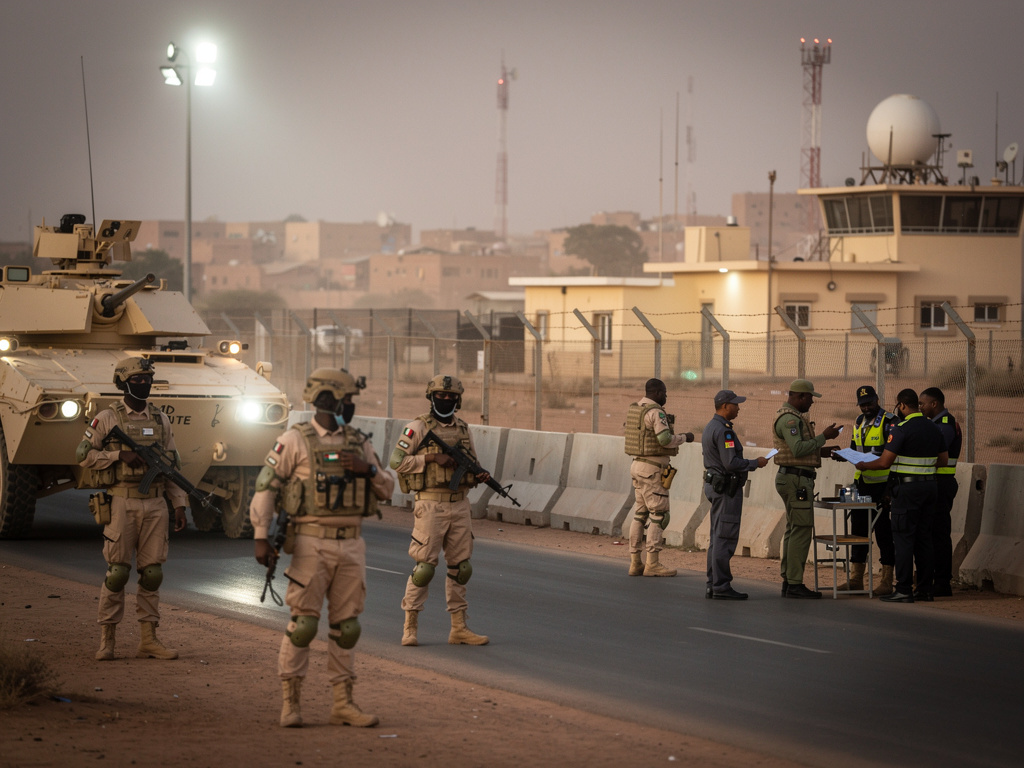
Life in Niamey returned to normal on Sunday after Niger’s military regime suppressed a mutiny by soldiers the previous day. Fighting broke out in the early hours of Saturday, when dozens of soldiers were detained and several others were killed while reportedly attempting to storm the presidential palace. The mutineers were said to be frustrated by the government’s failure to contain militant violence in the country.
The incident marked the third outbreak of fighting in Niger’s capital this year. The two earlier incidents involved jihadist attacks on a strategically important military base located at the airport, whereas Saturday’s violence involved members of the armed forces themselves. Resident Hassane Assoumane said that a mutiny indicated that conditions within the military and government were not satisfactory, adding that the authorities would need to decide whether to negotiate with the soldiers or take another approach.
Niger has been led for three years by General Abdourahmane Tiani, who seized power in a coup while promising to improve national security. However, his administration has struggled to stop attacks by militant groups affiliated with the Islamic State and Al-Qaeda. The security difficulties have continued despite a major realignment of Niger’s international partnerships. Tiani’s regime has severed ties with former colonial power France and sought assistance from Iran, Turkey and Russia.
The Russian paramilitary Africa Corps reportedly helped government forces repel Saturday’s mutiny. The episode highlights continuing tensions within Niger’s military and the difficulty the ruling authorities face in delivering the improved security that helped justify the coup.
Entities: Niamey, Niger, Niger’s military regime, General Abdourahmane Tiani, failed army mutiny • Tone: neutral • Sentiment: negative • Intent: inform
31-08-2026
Niger’s military government has suppressed an attempted mutiny that began at Base 101 near Diori Hamani International Airport in Niamey and spread toward other sensitive sites, including the presidential palace and state broadcaster. The episode reportedly involved a hostage situation, gunfire and explosions, and the temporary shutdown of state media. Niger’s army said it regained control, but the number of soldiers killed, arrested or involved remains unverified.
The uprising appears to be the most serious internal challenge to General Abdourahamane Tiani since he took power in the July 2023 coup. Although the mutineers’ precise motives are unknown, analysts and security sources have linked the unrest to frustration over worsening insecurity and heavy military losses. Nigerien forces continue to fight armed groups affiliated with al-Qaeda and ISIL, particularly in the west, while attacks have also targeted the airport complex.
The crisis has highlighted Niger’s increasingly close security relationship with Russia. Russia’s Africa Corps, which includes former Wagner personnel and operates under Moscow’s Defence Ministry, reportedly provided ground and aerial support after Nigerien forces struggled to retake the base. Russia’s ambassador said Niger had requested the assistance. The intervention does not prove that Moscow controls Niger’s armed forces, but it demonstrates that the military government can call on Russian forces already stationed in the country during an internal military crisis.
Algeria also reportedly provided military assistance, while the Alliance of Sahel States supported Niger politically. The mutiny further illustrates the decline of Western influence after France and the United States withdrew their forces following the coup. However, the article stresses that it remains unclear whether Russia’s operational role will translate into greater political influence or solve Niger’s broader security problems. The supplied text ends as it reaches a section titled “Can Russia solve Niger’s security problem?”
Entities: Niger, Niamey, General Abdourahamane Tiani, Viktor Voropaev, Russia’s Africa Corps • Tone: analytical • Sentiment: negative • Intent: analyze
31-08-2026
The failed coup attempt in Niger’s capital, Niamey, has exposed deep dissatisfaction within the country’s armed forces and raised questions about the stability of the junta led by General Abdourahamane Tchiani. Soldiers face Islamist insurgencies under dangerous conditions, while earning low salaries and dealing with inadequate equipment, supplies, transportation and logistics. Many reportedly earn less than €150 per month while supporting large families, contributing to growing resentment within the military.
The uprising involved army units temporarily taking control of Air Base 101 at Niamey’s international airport and attempting to advance toward the presidential palace and state broadcaster. Although the government described the incident as a mutiny, analysts interviewed by DW characterized it as an attempted coup. The episode reflects frustration over the army’s inability to contain jihadist violence and allegations that the presidential guard receives preferential treatment over frontline troops.
Russia’s Africa Corps played an important role in suppressing the uprising, reportedly helping retake the air base at the junta’s request. This assistance highlights Niger’s increasing dependence on Russia for regime security, although loyal Nigerien forces and Algeria, which deployed fighter jets, also contributed to the response. The article argues that Russian support may help sustain the junta in the short term but cannot resolve the Nigerien army’s structural weaknesses or defeat the insurgency.
Niger’s crisis is presented as a test for the Alliance of Sahel States, comprising Niger, Mali and Burkina Faso. The three military-led governments have turned increasingly toward Russia while distancing themselves from Western partners. The failed coup was a short-term victory for Tchiani, but it also demonstrated that the loyalty of Niger’s armed forces can no longer be assumed.
Entities: Niger, Niamey, General Abdourahamane Tchiani, Mohamed Bazoum, Nigerien armed forces • Tone: analytical • Sentiment: negative • Intent: analyze