06-11-2026
Iranian security chief Mohsen Rezaei met Russian President Vladimir Putin in Moscow on Thursday, delivering a message from Iran’s Supreme Leader Mojtaba Khamenei, according to Iranian state media. The meeting focused on regional security, the post-war period and Russia’s support for ending the US-Israel war on Iran. Rezaei did not disclose the contents of Khamenei’s letter, but said it had been important to deliver it quickly. He also discussed energy cooperation, including a proposed gas pipeline linking Russia and Iran.
The meeting took place as diplomatic efforts to end the war intensify, with Qatar involved and regional governments pursuing discussions. Rezaei said Iran would not negotiate with the United States or reopen the Strait of Hormuz until Washington met seven Iranian demands, which he did not detail in the article. Issues central to diplomacy include the strait’s status, a US blockade of Iranian ports, sanctions and Iran’s nuclear programme. Khamenei had recently urged resistance to US pressure and called for Iran to achieve stronger deterrence.
Rezaei said Putin reiterated Russia’s readiness to help end the conflict. He also briefed Putin on a late-October meeting in Tehran involving Iran, Saudi Arabia, Turkiye and Pakistan, which Putin reportedly welcomed. Iran’s Foreign Minister Abbas Araghchi separately held calls with officials from several regional countries about developments and peace efforts.
The article places the meeting in the context of closer Russian-Iranian ties, including a strategic partnership treaty signed in January 2025 and effective that October. It notes that the pact does not contain a mutual-defence clause. Iranian officials also said the country had purchased Russian Su-35 fighter jets, which it expects to receive after the war.
Entities: Mohsen Rezaei, Vladimir Putin, Mojtaba Khamenei, Iran, Russia • Tone: analytical • Sentiment: neutral • Intent: inform
06-11-2026
Iran has intensified diplomatic outreach as US President Donald Trump threatens a possible return to major strikes against the country. The article reports that US Central Command is reportedly preparing for renewed operations, while Trump has warned that the United States may have to “destroy” the rest of Iran. The tensions follow Iran’s downing of two US reconnaissance drones near Qeshm island and earlier US strikes; Tehran says it will retaliate if larger attacks resume.
Iran has presented Washington with a new nuclear and peace proposal through Qatari mediators. Tehran says talks and reopening the Strait of Hormuz depend on the United States meeting seven demands, including lifting sanctions, unfreezing Iranian assets and ending the naval blockade of Iranian ports. Washington, meanwhile, insists that limits on Iran’s nuclear capacity must be part of any ceasefire agreement.
Iran is also deepening relations with Russia. Security official Mohsen Rezaei met President Vladimir Putin in Moscow and delivered a message from Supreme Leader Mojtaba Khamenei. The reported agenda included energy cooperation and proposed gas pipelines. The Financial Times has reported that Russia agreed to supply Iran with helicopter-mounted missile launchers. The countries’ wider cooperation includes Iranian Shahed drones used by Russia in Ukraine and reported Russian assistance to Iran’s missile and air-defence capabilities. Russia has also said it could help mediate, though its foreign ministry warned citizens against travelling to Iran amid risks of escalation.
Iranian Foreign Minister Abbas Araghchi held calls with officials from the UAE, Saudi Arabia, Kuwait, Turkiye, Qatar and Oman on regional stability, de-escalation and maritime navigation. These contacts take place amid Iranian restrictions on shipping through the Strait of Hormuz, where ships have recently been damaged, although some countries have received exemptions. Trump has not ruled out further attacks despite political backlash and higher energy prices linked to the war. A former Iranian diplomat argues that a settlement depends on US flexibility, but observers say Trump’s next move remains uncertain.
Entities: Iran, United States, Donald Trump, Russia, Vladimir Putin • Tone: analytical • Sentiment: neutral • Intent: inform
06-11-2026
The live updates describe a combination of escalating military risks and diplomatic efforts surrounding the U.S.-Iran war. President Donald Trump said the world would soon learn whether he would pursue a deal to end the conflict or order new strikes aimed at destroying what remains of Iran. He also spoke with Qatar’s emir, Sheikh Tamim bin Hamad Al Thani, about de-escalation. Qatar has played a key mediating role, while Iran’s foreign minister held calls with counterparts around the Persian Gulf to discuss regional stability.
Maritime incidents added to concerns about the conflict’s effects on shipping and energy markets. A Greek-managed, Marshall Islands-flagged tanker was reportedly hit by an explosion in the Persian Gulf, killing one crew member. Separately, a U.K. maritime agency reported that a tanker’s master had described an explosion near the waterline in the Strait of Hormuz; the crew were safe and the vessel continued under its own power. Iranian state media and the Islamic Revolutionary Guard Corps reported additional fires involving tankers and attributed some incidents to sea mines, while Trump accused Iran of lying about such events to raise energy prices.
The updates also report regional security developments involving Yemen’s Houthis. A Saudi-led coalition said it intercepted a drone in the Mecca region and, in a separate update, intercepted two ballistic missiles. The Houthis have previously attacked targets in Saudi Arabia and denied targeting the holy cities. An adviser to Iran’s supreme leader, Aliakbar Velayati, asserted that Iran had become a central architect of Middle Eastern security and argued that regional security was interconnected.
Meanwhile, U.S. fuel prices had fallen, with analysts expecting the national average for gasoline to dip below $4 per gallon for the first time since July. One analyst linked the decline partly to market expectations that midterm election results could increase pressure on the Trump administration to reach a deal. The supplied article ends mid-sentence in an update about the coalition’s interception of missiles.
Entities: Donald Trump, Iran, Qatar, Sheikh Tamim bin Hamad Al Thani, Persian Gulf • Tone: neutral • Sentiment: negative • Intent: inform
06-11-2026
The article reports continuing attacks and disruption around the Strait of Hormuz amid the Iran war, despite a sharp post-midterm decline in oil prices that appeared to reflect market hopes for a deal to end the conflict and reopen the waterway. Iran’s Revolutionary Guards said two oil tankers struck mines and caught fire, following Iranian media reports the previous day of five tankers and a tugboat burning. Maritime officials had not confirmed those incidents. Iran said the vessels were using unauthorized routes and blamed the United States, while the U.S. Central Command had recently said mines were cleared from the strait. The conflict has disrupted a passage that normally carries about one-fifth of global oil consumption; the United States has imposed a blockade on Iranian ports and escorted tankers through the area.
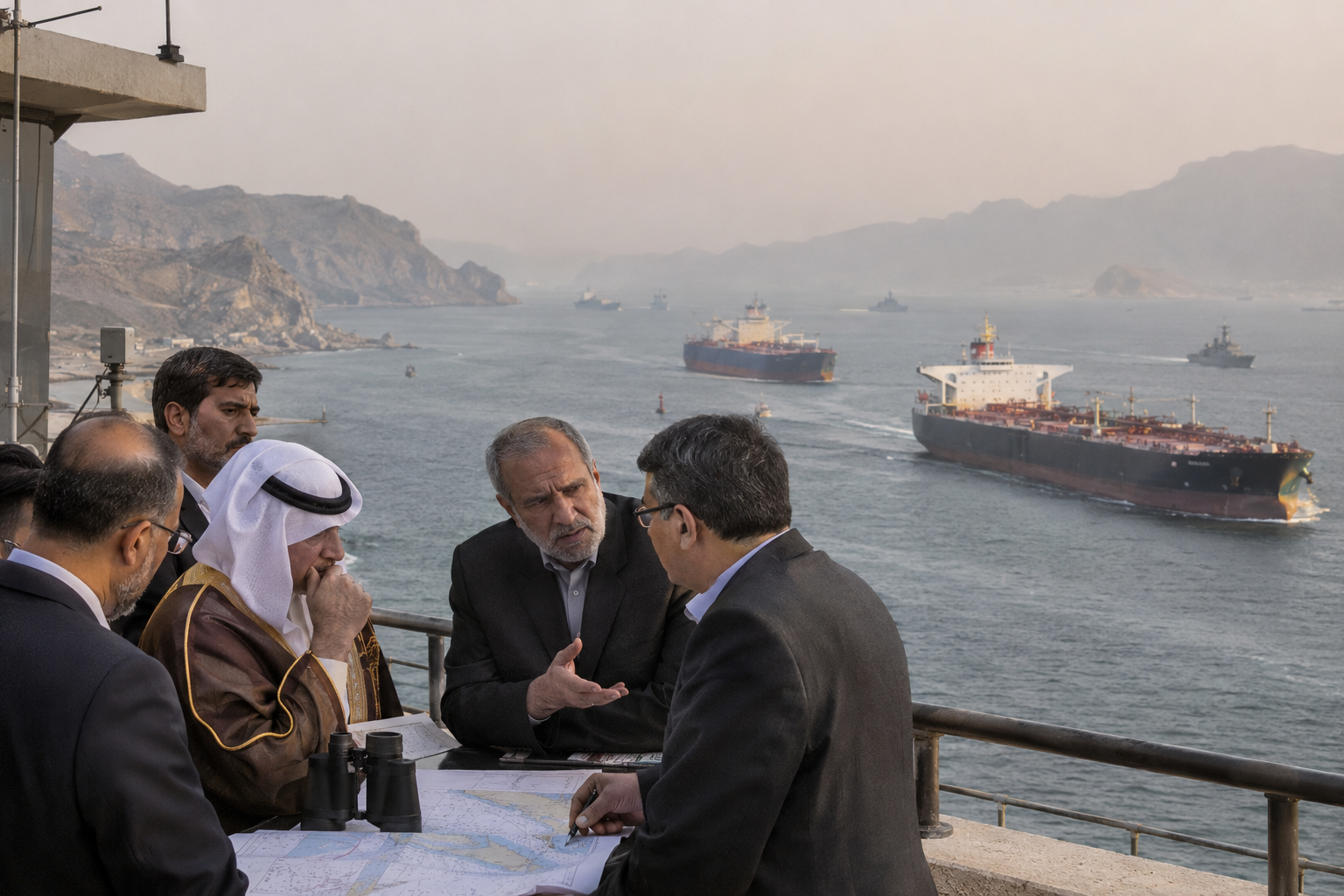
The updates also describe regional diplomacy and security developments. Oman said it remained in talks with Iran on a system for joint control of strait traffic, which it said could help end the state of war and prevent renewed clashes. Iranian security chief Mohsen Rezaei met Russian President Vladimir Putin in Moscow, with discussions including a proposed gas pipeline from Russia to Iran. Iran’s foreign minister Abbas Araghchi spoke with counterparts from nine Middle Eastern countries, including Pakistan, which has helped mediate U.S.-Iran peace talks.
Separately, the Associated Press reported that the Trump administration held discussions with Iran about deporting Iranian nationals during the war. Court documents showed the government was considering removal through a third country. A judge raised concerns about the danger deportees could face, while a Justice Department lawyer said the government was carrying out lawful removal orders. The article also reports Saudi coalition claims that it intercepted two Houthi-launched ballistic missiles aimed at Najran, and the Houthis’ claim that a drone disrupted traffic at an airport in Dammam.
Entities: Strait of Hormuz, Iran war, Iranian Revolutionary Guard Corps, Mohsen Rezaei, Vladimir Putin • Tone: analytical • Sentiment: negative • Intent: inform
06-11-2026
Oil prices fell on Friday after reversing earlier gains, as traders weighed the possibility of renewed U.S.-Iran military conflict against signs that diplomacy might avert further escalation. By 4:38 a.m. ET, Brent crude futures were down 1.38% at $96.93 a barrel, after reaching nearly $100 earlier in the session. U.S. West Texas Intermediate futures fell 1.49% to $89.17. Both benchmarks had declined sharply from their levels earlier in the week: Brent had been above $110 on Monday, and WTI above $100.
Investors are considering whether the conclusion of the U.S. midterm elections could lead to renewed action against Iran and threaten Middle Eastern oil supplies. Bob McNally, founder and president of Rapidan Energy Group, told CNBC that he puts the probability of military fighting resuming at 80% and expects both benchmarks could rise above $100 if tensions escalate. He argued that the U.S. and Iran remain far apart over Iran’s nuclear capabilities, keeping the risk of escalation in place.
At the same time, there are indications of a possible diplomatic path. Reuters reported that Iran had sent a nuclear proposal to Washington through Qatar. Meanwhile, Iran reported three more attacks on oil tankers in the Strait of Hormuz on Thursday, and UK Maritime Trade Operations data showed vessel attacks continuing at a near-record rate. The article notes that other analysts, including Lombard Odier’s Samy Chaar and Luca Bindelli, share McNally’s concerns. Overall, the market decline reflects competing expectations: hopes for a diplomatic breakthrough have eased prices, while the possibility of renewed conflict and disruption to oil supplies remains a significant risk.
Entities: Brent crude, West Texas Intermediate (WTI), Bob McNally, Rapidan Energy Group, United States • Tone: analytical • Sentiment: neutral • Intent: inform
06-11-2026
Rapidan Energy Group CEO Bob McNally estimates there is an 80% chance the United States will resume military action against Iran in the coming days, now that the midterm elections have passed. He expects Brent and West Texas Intermediate crude futures to rise above $100 a barrel; they are trading at roughly $100 and $91, respectively. Oil had already climbed above $100 before the elections amid uncertainty about the conflict and the possibility of further U.S. strikes. President Donald Trump had said he would hold off on new attacks until after the vote, although The Wall Street Journal reported that Washington had conducted limited strikes, citing U.S. officials.
McNally says Trump is determined to prevent Iran from obtaining a nuclear weapon, while Iran is unwilling to surrender its nuclear capabilities. He sees that disagreement as sustaining the risk of escalation. Analysts at Lombard Odier similarly suggested that the period before the new Congress is sworn in could give Trump an opportunity to strike, though limits on U.S. munitions could restrict a renewed campaign. By contrast, Julius Baer's Norbert Rücker said markets had become more hopeful that the midterms could open a diplomatic path rather than trigger escalation.
That prospect was reinforced by reports that Iran sent the United States a nuclear proposal through Qatar. Tehran says discussions should follow U.S. acceptance of seven demands, including ending alleged acts of aggression, the naval blockade of Iranian ports and economic pressure, and releasing Iranian assets. Iran would, in return, permit ships to pass freely through the Strait of Hormuz. Washington is reviewing the proposal, according to an Iranian official cited by Reuters.
The article also describes political fallout from the war. Iranian parliament speaker Mohammad Bagher Ghalibaf mocked Vice President JD Vance's explanation that the conflict contributed to Republican midterm losses, calling his response “losing gambler energy” and accusing the Trump administration of preparing another phase of conflict. Vance said the war was the reason Republicans lost and cited polling that found ending it was a leading concern among former Trump voters who switched to Democrats. Living costs and inflation were also concerns. The conflict has contributed to higher global energy costs, adding to inflation and cost-of-living pressures.
Entities: Bob McNally, Rapidan Energy Group, Donald Trump, JD Vance, Mohammad Bagher Ghalibaf • Tone: analytical • Sentiment: neutral • Intent: inform
06-11-2026
The article describes growing anxiety in Iran amid fears that the United States could resume large-scale attacks, while reliable information about the military and diplomatic situation remains scarce. A Tehran mother says she and her children live with constant fear, although schools have reopened. Iran’s Education Ministry has urged people to ignore rumors and says it will decide whether schools remain open in coordination with security authorities. At the same time, Iranian state television has broadcast advice on what to do in the event of a nuclear strike, intensifying public concern. Some Iranians fear a US nuclear attack on the underground “Pickaxe Mountain” bunker near the Natanz nuclear facility, though President Donald Trump has not explicitly threatened to use nuclear weapons there, and Iran denies nuclear-related work is being conducted at the site.
The article links the risk of renewed conflict to US domestic politics. Fighting had largely subsided while the Trump administration focused on the midterm elections, but Axios reported that the US military was making final preparations for possible large-scale strikes shortly after the vote. International Crisis Group analyst Hamidreza Azizi says the election’s implications remain uncertain. Iran’s leadership views the result as a victory and may take a harder line, while Trump could have a two-month window before the new Congress takes office to pursue military action.
Diplomatic efforts are also underway: Qatari mediators are trying to secure agreement on a draft peace deal and restart direct talks. Yet negotiations are closed to the public, leaving even Iranian journalists poorly informed. One journalist says domestic media rely on foreign outlets for reports, making independent reporting feel pointless. The article ends with accounts of exhaustion and news avoidance, including a retired woman who says she can barely think about the situation and is relieved that her children have emigrated.
Entities: Donald Trump, Hamidreza Azizi, Hadi Mohammadi, Ali Farhadi, Iran • Tone: analytical • Sentiment: negative • Intent: inform
06-11-2026
Sheikh Abdullah bin Zayed, the UAE’s Deputy Prime Minister and Minister of Foreign Affairs, urged de-escalation and continued diplomacy during a phone call with Iranian Foreign Minister Abbas Araghchi. Their discussion covered the regional situation, as concern grows that fighting between the United States and Iran could resume. Sheikh Abdullah stressed that diplomatic efforts should advance security and stability. Araghchi also spoke with the foreign ministers of Turkey and Kuwait about recent developments.
The call came amid reports of maritime incidents in the Strait of Hormuz. Iran said at least three tankers caught fire after hitting mines in areas it describes as prohibited. Iran’s Revolutionary Guard naval forces said two tankers had caught fire the previous night, but the claims had not been independently confirmed. The UK Maritime Trade Operations agency reported that a tanker was struck by two objects north of Qatar; reports identified the vessel as the Velos Sapphire.
The article also describes the UAE’s position. Dr Anwar Gargash, diplomatic adviser to President Sheikh Mohamed, said the UAE did not want another military confrontation but was prepared for the worst while seeking a peaceful solution. Speaking at the IISS Manama Dialogue in Bahrain, he said the UAE and other Gulf states hoped mediation would produce a breakthrough, and argued that escalation would serve neither regional interests nor Iran’s.
According to the article, the UAE has faced more than 550 ballistic missiles and 2,265 drones since the war began in February, most of which were intercepted or destroyed. A US-Iran ceasefire agreement signed in June was intended to lead towards a final peace settlement. It collapsed the following month after renewed Iranian attacks on ships and retaliatory US strikes. The article says both sides have recently signalled preparations for renewed hostilities.
Entities: Sheikh Abdullah bin Zayed, Abbas Araghchi, Dr Anwar Gargash, Sheikh Mohamed, United Arab Emirates • Tone: analytical • Sentiment: negative • Intent: inform
06-11-2026
President Donald Trump is weighing whether to resume military operations against Iran, continue economic pressure or pursue a diplomatic agreement, after meeting with national security advisers. Speaking Thursday, he said a decision would come soon and expressed reluctance to destroy more of Iran, while leaving open the possibility of further attacks. No order to restart operations had been issued, although reports said US officials were considering next steps as US Central Command prepared for a potential operation.
The decision follows Republican losses in Tuesday’s midterm elections. The article says the political setback, and acknowledgement that the conflict contributed to Democrats’ gains, may create an opening for de-escalation. Iran has portrayed the results as evidence that Trump’s war policy is unpopular, while Vice President JD Vance said voters were motivated by frustration over the conflict, living costs and US support for Israel. Iran has nevertheless warned that it is preparing for further attacks rather than assuming diplomacy will succeed.
Regional diplomatic activity has intensified. Iranian Foreign Minister Abbas Araghchi spoke separately with counterparts from the UAE, Qatar, Saudi Arabia, Turkey and Pakistan. Qatari mediators have also been in contact with Washington and Tehran. A senior Iranian official said Iran had sent a nuclear proposal to the US through Qatar, but that it would be discussed only after Washington met seven Iranian demands. These include lifting US sanctions, releasing frozen Iranian assets and paying war reparations. Iran has also linked negotiations to the Strait of Hormuz, while Washington says nuclear issues must be included in initial talks.
Iranian security official Mohsen Rezaei discussed diplomacy in Moscow and met Russian President Vladimir Putin. Rezaei said he had delivered a message from Supreme Leader Ayatollah Mojtaba Khamenei and that Putin was prepared to help bring the conflict to an end.
Entities: Donald Trump, Iran, United States, Qatar, US midterm elections • Tone: analytical • Sentiment: neutral • Intent: inform
06-11-2026
The article reports that US President Donald Trump met with senior national security advisers to consider whether to resume military operations against Iran. The meetings, held at the White House on Wednesday and Thursday, were the first such discussions on Iran since the November 3 midterm elections, according to officials cited by news outlets. Trump said the administration would soon decide whether to conduct further strikes, maintain pressure through other means, or seek an agreement. He said the goal of any further strikes would be to ensure Iran’s nuclear programme could not be revived, while warning that more of the country might be destroyed.
US Central Command is reportedly preparing for the possible return of major combat operations, though it has not received a new order from Washington. Officials reportedly considered the low moonlight expected around November 9 favourable for military operations. A possible deployment of a third US aircraft carrier group was also discussed, although the USS Theodore Roosevelt was scheduled to make a port call in Singapore and was not expected in the region before mid-November. In a call with Trump, Iraqi Prime Minister Ali Faleh Al-Zaidi said Iraq’s territory should not be used to launch attacks against neighbouring countries.
At the same time, Iranian Foreign Minister Abbas Araghchi contacted regional counterparts and mediators. A Qatari-mediated proposal would sequence confidence-building steps: the US would lift its naval blockade and release some frozen Iranian funds, while Iran would invite International Atomic Energy Agency inspectors to sites that had been bombed. The Strait of Hormuz would then reopen and nuclear negotiations resume. However, Iranian official Mohsen Rezaei said talks and reopening the strait would not happen until the United States met Iran’s seven conditions. After meeting Russian President Vladimir Putin in Moscow, Rezaei said Putin condemned US and Israeli strikes and offered Russian help to end the war. The leaders also discussed energy cooperation, including possible gas pipelines.
Entities: Donald Trump, Iran, White House, US Central Command (CENTCOM), Ali Faleh Al-Zaidi • Tone: analytical • Sentiment: neutral • Intent: inform
06-11-2026
The Times of India reports that US President Donald Trump issued a new warning to Iran, saying the United States might take further action and that he would prefer not to destroy more of the country, but might do so. Speaking to reporters at the Oval Office, Trump also said Iran could not advance its nuclear programme without US approval.
The article places the remarks amid an eight-month Iran war and political pressure on Trump after Republicans lost seats in the US midterm elections. Voter dissatisfaction with the conflict and rising fuel prices are described as factors behind Democratic gains. Before the elections, Trump had repeatedly threatened large-scale strikes if Iran did not accept a settlement on terms Washington considered acceptable.
The conflict has extended beyond Iran, with tensions in the Red Sea involving attacks by Yemen’s Houthi rebels and retaliatory action by regional forces. Meanwhile, diplomacy remains uncertain. Iran reportedly sent the United States a new proposal concerning its nuclear programme through Qatar. Tehran has said talks depend on Washington meeting its demands, including lifting sanctions, releasing frozen Iranian assets and paying reparations. The United States is reviewing the proposal, but Trump has not ruled out renewed military action.
The article also notes continued tensions around the Strait of Hormuz. Overall, it presents a situation in which military threats, regional conflict and competing conditions for negotiations are unfolding at the same time, while domestic political consequences add pressure on the US administration.
Entities: Donald Trump, United States, Iran, Tehran, Iran war • Tone: analytical • Sentiment: negative • Intent: inform
06-11-2026
The supplied page is a live-update news page about the Iran war, but the provided extract contains no detailed article body or reporting beyond the headline and a list of linked updates. Its headline says the United Nations maritime agency has condemned Houthi attacks on international shipping. Other update headlines point to a widening regional crisis: Qatar’s Emir and the US President discussed the conflict; the UK Maritime Trade Operations agency reported an explosion east of Oman; and the Iranian Revolutionary Guard Corps said two oil tankers caught fire after hitting mines in the Strait of Hormuz. The list also mentions Israel responding to a US halt in military assistance, the interception of drones and missiles near Makkah and Najran, and Iraqi official Al Zaidi telling Donald Trump that Baghdad would not be a “launchpad” for regional attacks.
Several video headlines and interview excerpts add political and economic context. They describe US Defence Secretary Pete Hegseth defending the war, Trump characterizing US pressure on Iran as an “occupation,” and former US official Amos Hochstein warning about possible regional consequences. Other items concern the war’s political cost for Trump, energy security, negotiations with Iran, and US support for allies. These are presented as headlines or video titles, not as substantiated detail in the supplied text.
The extract is dated November 6, 2026, and shows a live-page update time of 2:57 PM. Because the page’s actual article paragraphs are absent, the available material supports only a high-level account of the topics being tracked; it does not establish the circumstances, evidence, or outcomes behind the individual reports.
Entities: Iran war, United Nations maritime agency, Houthi attacks, International shipping, Qatar's Emir • Tone: analytical • Sentiment: negative • Intent: inform