01-11-2026
Residents of the Russian-occupied Ukrainian town of Oleshky have crossed into Ukrainian-controlled territory during a six-day humanitarian ceasefire, in what the article describes as a major civilian evacuation and the first truce of its kind in more than four years of Russia’s war. The pause in fighting was reached through mediation involving US First Lady Melania Trump and Pope Leo XIV. Ukrainian President Volodymyr Zelenskyy said evacuees would receive assistance and called for further steps toward de-escalation and peace.
The people arriving at the Ukrainian-Belarusian border were exhausted and, according to accounts from residents, had faced severe food shortages. Fighting and drone activity disrupted supply routes, and some residents said food deliveries stopped in May. One elderly evacuee said he had lost 20 kilograms and needed hospital treatment; another, Svitlana Yermakova, said she and others ate grass and squash to survive. She described risking a bicycle journey through minefields to find food for herself and her dog.
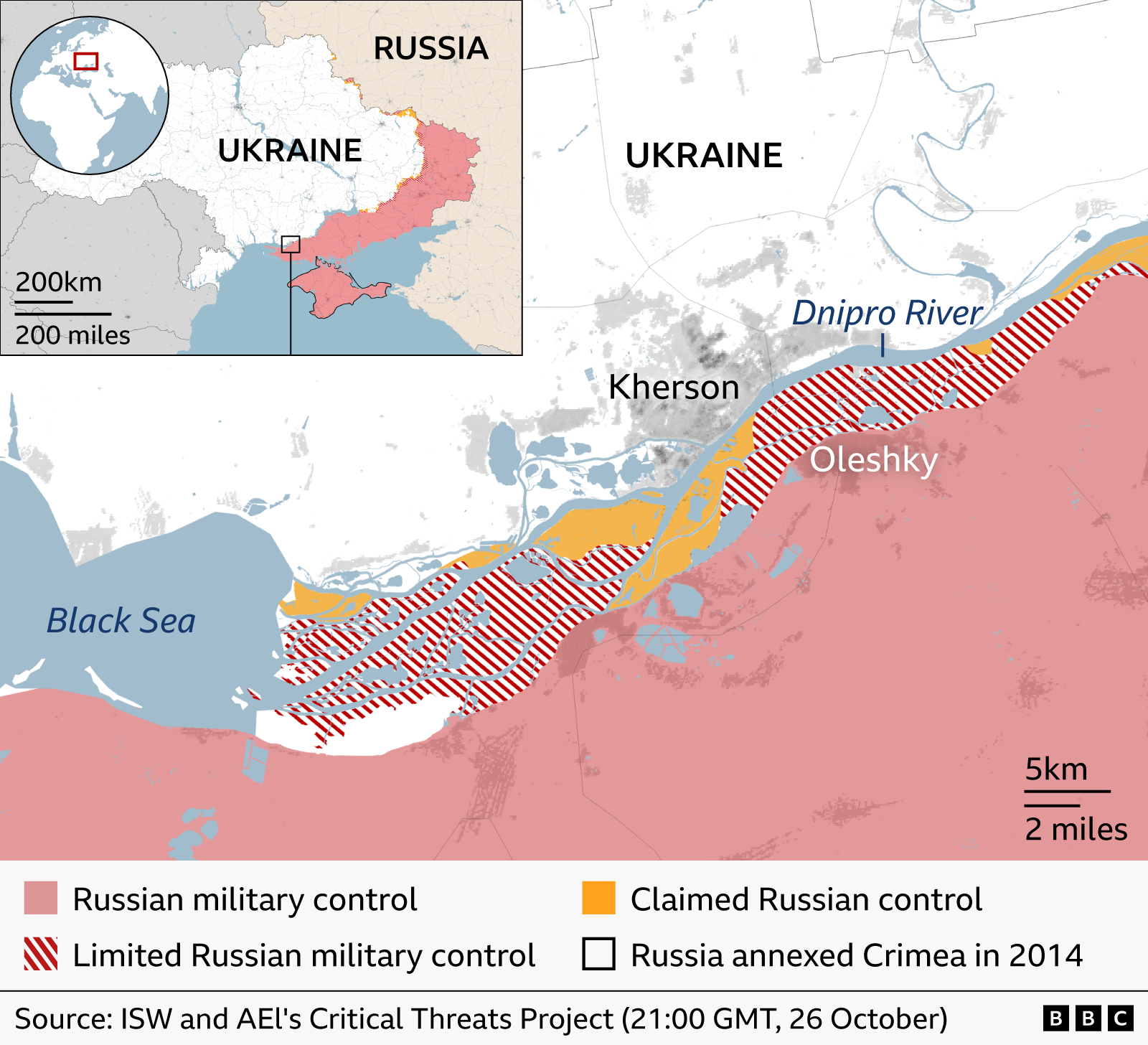
Leaving Oleshky required a complicated journey: residents travelled by bus through Crimea to Anapa in Russia, flew to Belarus, and then crossed into Ukraine. At their arrival point, officials and local residents welcomed them, while ambulances, tents, meals, tea and medical assistance were available. The ceasefire also enabled de-mining and the delivery of food, medicine and other supplies to the town, and was due to end Sunday evening.
Some residents chose to stay in Oleshky, where gas, electricity and running water remain unavailable. Russian Human Rights Commissioner Yana Lantratova said conditions were difficult and that regular humanitarian missions would be pursued with Ukrainian counterpart Dmytro Lubinets. Oleshky’s pre-war population of about 24,000 had fallen to an estimated 1,700 before the evacuation; officials did not disclose how many people left or stayed. Fighting and drone attacks continued elsewhere along the front.
Entities: Oleshky, Ukraine, Russia, Chernihiv region, Belarus • Tone: analytical • Sentiment: negative • Intent: inform
01-11-2026
A rare, locally negotiated ceasefire in Ukraine’s Kherson region, which enabled civilians to leave the Russian-occupied city of Oleshky, ended on Sunday night. The pause began the previous Tuesday and was expanded beyond Oleshky, but fighting continued elsewhere in Ukraine. Oleshky residents had endured severe shortages of food, water and electricity while trapped between the Dnipro River and Russian forces, with routes out exposed to mines and drone attacks. Evacuees travelled through Russian-occupied territory to southern Russia, then via Belarus before returning to Ukraine. The oldest evacuee was 94 and the youngest one year old; families were reunited after years apart.
Meanwhile, Russian attacks on Ukrainian energy infrastructure in four regions overnight on Saturday left hundreds of thousands of homes without power. Repairs restored some service, including to most customers in Dnipropetrovsk, though more than 60,000 there remained without electricity. Emergency power cuts were being used nationwide, and Kyiv faced prolonged electricity outages and disrupted water supplies. A separate strike in Vinnytsia killed two people, including a 13-year-old girl.
Ukraine’s air force said its air-alert application had apparently been interfered with after it issued a false warning about radiation over Kyiv, and urged people to remain calm. President Volodymyr Zelensky described the intensity of Russian strikes as extremely high and said Ukraine urgently needed more Patriot missiles to counter Russian ballistic missiles. He said Ukraine was making daily requests to the United States, European countries and other partners.
Zelensky also said Ukraine had struck a major missile-fuel producer in Russia’s Rostov region, causing a fire and damaging four production facilities. The article reports on the humanitarian evacuation and ongoing effects of attacks on infrastructure, while noting that the ceasefire was limited in scope and duration.
Entities: Volodymyr Zelensky, Melania Trump, Pope Leo, Dmytro Lubinets, Oleshky • Tone: analytical • Sentiment: negative • Intent: inform
01-11-2026
Residents evacuated from the Russian-occupied Ukrainian city of Oleshky crossed into Ukrainian-held territory on Saturday, traveling by bus and plane through Russia and Belarus under a temporary ceasefire brokered by U.S. first lady Melania Trump. The ceasefire began Tuesday and was expected to last until Sunday evening. Oleshky, in the southeastern Kherson region, has faced a severe humanitarian crisis since Russian forces occupied it early in the war. An estimated 2,000 residents remained in the city; people were offered the option of going to Ukrainian-held or Russian-held territory, or staying with replenished food and medical supplies. Authorities withheld the number of evacuees and the border crossing location to protect those remaining in the city and future humanitarian efforts. Relatives and volunteers, including representatives of the Red Cross, Doctors Without Borders and World Central Kitchen, waited at the Ukrainian-Belarusian border. The article recounts the hopes and fears of families awaiting reunions after years of separation. Liza Paliy had not seen her father in more than two and a half years. Daria Pavlyn was waiting for her father, Mykhailo, who had remained behind after plans to leave with his family fell through and who feared the difficult journey, particularly without Russian documents. The number of people who left was not confirmed. Melania Trump said the convoy could safely evacuate more than 750 people; Pope Leo XIV also urged the leaders of Russia and Ukraine to permit aid deliveries and civilian evacuations. Fighting continued elsewhere during the localized truce. Russian officials reported Ukrainian drone attacks in Bryansk and Bashkortostan, including a deadly strike in Bryansk and a fire in Ufa. Russia’s Defense Ministry said its forces had shot down 433 Ukrainian drones overnight. Ukrainian President Volodymyr Zelenskyy said Russian drone attacks damaged energy and railway infrastructure across Ukraine, leaving 280,000 households in the Dnipro and Kyiv regions without power. Repair crews were working to restore electricity.
Entities: Oleshky, Kherson region, Melania Trump, Russia-Ukraine war, Temporary humanitarian ceasefire • Tone: analytical • Sentiment: negative • Intent: inform
01-11-2026
France 24 reports that residents of Oleshky who had requested evacuation were reunited with loved ones in Ukraine on Saturday, October 31. The evacuation took place during a localized ceasefire that had been in effect since Tuesday, described in the headline as the first humanitarian truce of the war. Oleshky is a front-line city under Russian occupation, where civilians are facing a humanitarian crisis and lack even basic necessities. The report presents the evacuation as successful for those residents who were able to leave, while emphasizing the severe conditions facing people still in the city. France 24 correspondent Emmanuelle Chaze provides the latest information in a video report. The supplied article text does not give the number of people evacuated, explain the ceasefire’s terms, or describe how the evacuation was organized. It also does not provide further details about the broader humanitarian situation beyond the shortage of basic necessities. The central focus is therefore the reunion of evacuees with family or loved ones in Ukraine and the temporary truce that enabled the operation, set against the danger and deprivation associated with life in an occupied front-line city.
Entities: Oleshky, Ukraine, Russia, France 24, Emmanuelle Chaze • Tone: neutral • Sentiment: negative • Intent: inform
01-11-2026
France 24 reports that residents evacuated from Oleshky have reached territory held by Ukraine after a rare local truce. The city is under Russian occupation and, according to the report, remains isolated by the Dnipro River on one side and Russian troops on the other. It was seized by Russian forces during the early days of Russia’s 2022 invasion. Residents described living for years in isolation amid food shortages and regular shelling. Some said conditions became so desperate that they were forced to eat grass and dogs to survive. Their return to Ukrainian-held territory followed a rare pause in fighting locally, although the report does not provide further details about the truce, the number of people evacuated, or what will happen to those who remain in Oleshky. The item is presented as a short France 24 video report, issued on 1 November 2026. Its focus is the residents’ return and their accounts of hardship under occupation, rather than a broader account of the military situation or the negotiations behind the truce.
Entities: Oleshky, Ukraine, Russia, Dnipro River, Russian forces • Tone: neutral • Sentiment: negative • Intent: inform
01-11-2026
France 24’s “Testimonies from Oleshky” is a short Spotlight segment about people evacuated from Oleshky, a Russian-occupied hometown in Ukraine. The article page identifies American filmmaker Zarina Zabrisky as a journalist who has lived and reported for the past three years in Ukrainian-controlled Kherson, across the Dnipro River from the occupied area. Zabrisky speaks with France 24’s Gavin Lee about events over the preceding 24 hours.
The page’s cover caption describes residents of Oleshky crossing the Belarus-Ukraine border in Ukraine’s Chernihiv region after being evacuated from their hometown. The photograph is credited to Efrem Lukatsky for the Associated Press. The segment is listed as 18 minutes and 39 seconds long and was issued on November 1, 2026, though the caption dates the pictured border crossing to Saturday, October 31, 2026.
The supplied page text does not include the interview’s detailed testimony or explain the circumstances of the evacuation. It instead provides a brief introduction and metadata; the video itself is not available in the supplied content. Consequently, the article establishes the setting, the people involved in the broadcast, and the evacuation context, but does not support more specific conclusions about what residents experienced or what Zabrisky discussed.
Entities: Oleshky, Zarina Zabrisky, Gavin Lee, France 24, Kherson • Tone: neutral • Sentiment: neutral • Intent: inform
01-11-2026
Pope Leo XIV said on Nov. 1 that he hoped cooperation between Russia and Ukraine during a ceasefire in the Russian-occupied Ukrainian town of Oleshky could encourage wider peace efforts. The six-day truce, agreed to by the two countries on Oct. 23, enabled humanitarian aid deliveries and evacuations from a town facing severe shortages of food and medicine. The arrangement was brokered by US First Lady Melania Trump, with Pope Leo also involved, according to the article.
In his Sunday prayer, the Pope described a humanitarian operation to assist Oleshky’s civilians and said the cooperation that made it possible might strengthen the parties’ willingness to engage in dialogue and lead to new, concrete peace initiatives. Ukrainian President Volodymyr Zelensky has said negotiators would hold fresh talks in early November.
The article also recounts the Pope’s Oct. 16 conversations with Russian President Vladimir Putin and Zelensky. The Kremlin said Putin supported a Vatican initiative to deliver supplies to Oleshky’s civilians and was ready to cooperate. However, the Vatican’s foreign minister, Archbishop Paul Gallagher, said on Oct. 27 that, despite the Pope’s recent conversations with both leaders, he did not believe the Vatican had played a direct role in arranging the ceasefire. The report therefore presents the truce as a limited humanitarian step that the Pope hopes can contribute to dialogue, while noting uncertainty about the Vatican’s role in securing it.
Entities: Pope Leo XIV, Oleshky, Ukraine, Russia, Vatican City • Tone: neutral • Sentiment: positive • Intent: inform