31-10-2026
The article reports on large demonstrations in France and other European countries, amid public anger over the rising cost of living and poor public services. In France, hundreds of thousands of people took part in protests as the country prepared for a general strike expected in the coming days. Paris saw clashes between police and protesters during the third weekend of nationwide demonstrations, with police firing tear gas. France’s interior ministry said more than 320,000 people demonstrated across the country and at least 290 protesters were arrested. Police estimated that about 70,000 people demonstrated in Paris. Authorities had made extensive preparations to prevent a repeat of violence, rioting and looting that occurred two weeks earlier. The protests were not limited to France: demonstrations also took place in Albania, Germany and Italy, as young people joined protests around Europe. BBC correspondent James Waterhouse reported on the wider European unrest. The article presents the demonstrations as part of a broader wave of public protest, while distinguishing official figures and statements from the reported events. It does not provide further detail about the specific demands of protesters in each country, the planned general strike, or the extent of any clashes outside Paris. Overall, it focuses on the scale and geographic spread of the demonstrations, the immediate police response in the French capital, and the authorities’ efforts to prevent a recurrence of earlier disorder.
Entities: Paris, France, Albania, Germany, Italy • Tone: neutral • Sentiment: neutral • Intent: inform
31-10-2026
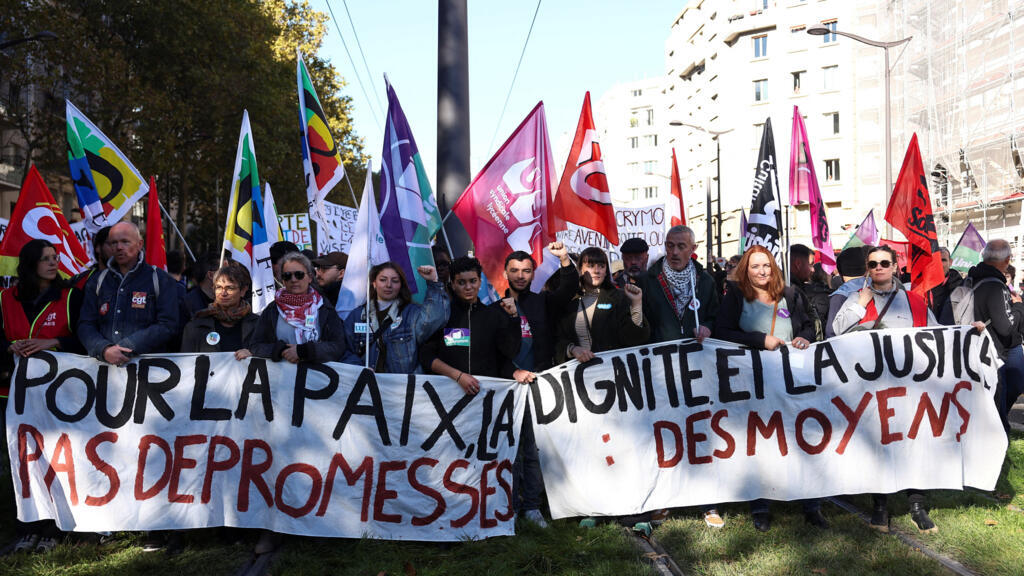
Hundreds of thousands of people, mostly young protesters, demonstrated across France for a third consecutive weekend over living costs, education and other social concerns. The French government estimated Saturday’s turnout at 320,000, down from 410,000 the previous weekend and more than 500,000 on Oct. 17. Authorities deployed about 70,000 police and gendarmes nationwide, and reported more than 560 arrests by Saturday night following earlier demonstrations marked by rioting and looting. Although most protesters have been peaceful, some groups have attacked police with fireworks and projectiles; police have responded with tear gas, grenades and water cannons, causing severe injuries. The movement began with high school students objecting to deteriorating school buildings, teacher shortages and an admissions system they regard as unfair to disadvantaged students. Unions, climate activists and people concerned about the cost of living have joined, bringing a range of demands. At a Paris march, students led the procession while union security agents and police maintained a presence. Protesters described poor conditions in student housing and schools, and some hoped Halloween-themed demonstrations could counter the association with violence. President Emmanuel Macron said marches would remain outside city centres to protect shops. Authorities also imposed restricted-access zones and curfews, although a court had suspended an earlier curfew on minors as an infringement of freedom of movement. Youth-led demonstrations or heightened security measures were also reported in Germany, Italy, the Netherlands and Spain, with calls for gatherings circulating elsewhere in Europe. German demonstrators called for investment in education, health, climate protection and affordable living, and opposed a return to military conscription. Turnout there was far below organizers’ online sign-up figures. In the Netherlands, Spain and Italy, authorities prepared for possible unrest after online appeals or previous clashes, though major disturbances had not occurred everywhere.
Entities: France, Paris, Germany, Italy, Spain • Tone: analytical • Sentiment: neutral • Intent: inform
31-10-2026
An estimated 320,000 people took part in demonstrations across France on Saturday, including about 70,000 in Paris, protesting the rising cost of living and conditions in schools. The demonstrations were the third consecutive weekend of mass action. France’s Interior Ministry said the marches generally proceeded peacefully within authorized routes, but reported that groups it described as “radical elements” tried to enter city centers in Bordeaux, Toulouse and Marseille, allegedly intending to vandalize property and loot. Fires were reported in Marseille, and clashes with police occurred in several cities, including Rennes and Toulouse. In Paris and Lyon, police fired tear gas later in the day. Footage from the capital showed fireworks and incendiary devices being thrown at riot police as tensions rose near the end of the march.
Police said more than 290 people were arrested nationwide. Ahead of the protests, Paris police conducted more than 1,200 checks at railway stations and nearby areas, seeking to prevent people from bringing prohibited items such as fireworks and knives. Authorities also used camera-equipped drones to monitor the capital. Around 70,000 police officers and other security personnel were deployed nationally. Officials cited concerns about calls for looting and rioting, the possibility that Halloween celebrations could help people conceal their identities, and potential attacks on public buildings. Protest routes were moved away from city centers, businesses boarded up windows, and some cities imposed curfews and other restrictions.
The protests followed earlier demonstrations in which violence and destruction had occurred on October 17. Young people had initially mobilized over inadequate staffing and equipment in schools; since mid-October, other groups joined, focusing largely on the cost of living. Trade unions, school and student organizations, and the Yellow Vest movement—which rose to prominence in 2018—called for Saturday’s demonstrations.
Entities: France, French Interior Ministry, Laurent Nunez, Paris, Bordeaux • Tone: neutral • Sentiment: negative • Intent: inform
31-10-2026
France is preparing for another day of protests on Saturday, with around 70,000 police officers deployed nationwide and authorities warning of a high risk of public disorder. The demonstrations, involving trade unions, students and yellow vest protesters, are planned for a third consecutive weekend. They oppose the cost-of-living crisis and school conditions, despite the government having recently announced policies to address student concerns that unions consider insufficient.
The security operation follows violence and looting that accompanied demonstrations on 17 October, although the protests that day were otherwise peaceful. Authorities say calls for unauthorised gatherings and marches toward government institutions have increased. Interior Minister Laurent Nuñez has banned protests in city centres, permitting demonstrations only on city outskirts, and asked organisers to guarantee they will take place safely. Unions and yellow vest activists have condemned the restrictions as a disproportionate infringement on the right to demonstrate and say they will consider legal appeals.
Officials are particularly concerned that Halloween could extend gatherings into the night or provide a pretext for unauthorised protests. Nuñez has said gatherings disguised as Halloween celebrations will be banned, and criticised social media calls for revolution and insurrection. Officers have been recalled from leave or had rest days cancelled. Paris police have also imposed a weekend night curfew in districts affected by unrest on 17 October.
In Paris, the permitted march route runs along the eastern outskirts, from Porte de Bagnolet to Porte de Charenton. The route changed after the Council of State overturned a lower administrative court’s decision to allow a march between Bastille and Nation. France Unbowed leader Jean-Luc Mélenchon said he would join the demonstration and accused the government of moving toward authoritarianism.
The student movement began in mid-September with protests over school conditions in Parisian suburbs, then spread nationwide and drew support from unions and political groups. It has grown into a broader movement against rising living costs and fuel prices, roughly six months before France’s presidential election. Human rights groups have also accused French law enforcement of excessive force against protesters.
Entities: France, Estelle Nilsson-Julien, Laurent Nuñez, Jean-Luc Mélenchon, France Unbowed • Tone: urgent • Sentiment: negative • Intent: inform
31-10-2026
France’s third consecutive weekend of social protests drew about 320,000 people, including 70,000 in Paris, according to the Interior Ministry. The turnout was below the ministry’s estimates for the previous two Saturdays—410,000 on 24 October and 550,000 on 17 October—though organisers had put attendance on both earlier dates at 800,000. Disruptions to public transport, including reduced service in Lyon and the closure of more than 40 Paris Metro stations, may have contributed to the decline. Authorities initially described the situation as generally calm, with 27 arrests by 2 p.m., compared with 217 at the same time the previous Saturday. However, tensions increased as marches dispersed. Police used tear gas in Lyon, and officials warned they would act firmly against violence and property damage. The protests began with high school students campaigning over neglected school buildings, teacher shortages and perceived unfairness in university admissions. Labour unions and other opponents of President Emmanuel Macron have since joined, bringing a wider range of demands. While most participants have been peaceful, some gatherings have involved attacks on police, rioting and looting, alongside forceful police responses that have caused serious injuries. The article also describes protest activity and security concerns elsewhere in Europe. In Germany, youth demonstrations focused on education, health, climate protection, affordability and opposition to renewed conscription, although participation was much lower than online sign-ups suggested. Dutch police prepared for possible unrest in The Hague, while Italy remained alert after clashes in several cities. In Barcelona, authorities planned their highest alert after calls for gatherings circulated on TikTok; riots the previous weekend led to about 130 arrests, mostly of minors. Calls to protest also spread online in several other European countries.
Entities: France protests, French Interior Ministry, Emmanuel Macron, Paris, Lyon • Tone: analytical • Sentiment: neutral • Intent: inform
31-10-2026
France has deployed 70,000 police officers nationwide as authorities prepare for a third week of anti-government protests, with demonstrations expected to resume on Saturday and coincide with Halloween. The protests began among young people calling for better schooling conditions and educational reform, then expanded to include broader grievances over rising living costs, fuel prices, borrowing costs and public services. Protesters have looted shops and damaged property, prompting Interior Minister Laurent Nuñez to promise an “extremely firm response” to disorder.
Authorities have tracked at least 150 planned gatherings. Social-media videos appeared to show new confrontations despite the large police deployment, including an object thrown toward riot police in Paris that a journalist identified as a Molotov cocktail, and a crowd apparently breaking into a residential building in Marseille. Some demonstrators may wear Halloween masks to conceal their identities. A planned march between Paris’s Place de la République and Place de la Bastille was banned by the country’s top administrative court and rerouted to eastern boulevards.
The economic damage has been substantial: France’s Chamber of Commerce estimates losses from looting and property damage at more than $1 billion, while estimates including lost revenue put the total at potentially twice that amount. Luxury retailers including Hermès and Louis Vuitton have been targeted, and stores have boarded up their premises. The government is developing legislation that could require people who damage property during riots to pay up to €10,000 ($11,000).
Although the government has pledged education reforms and reductions in fuel costs, protesters remain dissatisfied. Fifteen-year-old student Aaron Berthier de Grandry said young people lacking resources could mean France ultimately collapses. The U.S. Embassy has advised travelers to avoid areas where large gatherings are taking place.
Entities: France, Emmanuel Macron, Laurent Nuñez, Aaron Berthier de Grandry, French Interior Ministry • Tone: urgent • Sentiment: negative • Intent: inform
31-10-2026
The France 24 item reports that France was preparing for a third consecutive weekend of protests that would coincide with Halloween. Its accompanying description says that some shops had boarded up their storefronts and that authorities were working to prevent a recurrence of street violence that had swept the country two weeks earlier. The report was issued on October 31, 2026, and is presented as a short video segment by France 24. The page lists French student protests and France’s Yellow Vest protests as keywords, placing the Halloween demonstrations within a wider context of protest activity in the country, but the supplied text does not explain whether those movements are directly connected to the weekend’s events. It also does not identify the protest organizers, the locations where demonstrations were expected, the number of participants, or the specific measures being taken by authorities. The linked video’s full transcript is not included in the provided content, so further details about the protests or official responses cannot be confirmed from this text. The central point is that the prospect of renewed demonstrations and recent violence prompted visible precautions by businesses and preventive efforts from authorities. The headline and description convey anticipation and concern, rather than reporting that violence had already occurred during this particular weekend. Related headlines and videos elsewhere on the webpage concern other French news stories and are not part of this report.
Entities: France, France 24, Halloween, third weekend of protests, French student protests • Tone: urgent • Sentiment: negative • Intent: inform
31-10-2026
France is preparing for a third consecutive weekend of protests, with about 70,000 security personnel being deployed to reduce the risk of a repeat of the violence reported on October 17. The authorities are concerned that the demonstrations could lead to further clashes, and Halloween celebrations add a particular security challenge because masked demonstrators may be harder to distinguish or manage. In anticipation of unrest, some shops have boarded up their premises.
The protests bring together Yellow Vest activists, trade unions and students. They began around concerns including the rising cost of living, inequality and poor conditions in schools, but have broadened to include demands for greater civil liberties and the right to protest. This expanding agenda is unfolding in a politically tense period, six months before presidential elections, as support for the far right is growing.
Authorities have restricted marches in several cities. In Paris, police have authorised a demonstration only on the outskirts of the capital, and curfews have been imposed in some areas. These measures reflect officials’ efforts to contain the demonstrations and prevent another outbreak of disorder. The article presents the situation as a significant public-security concern, while also describing the protests’ social and political context and the range of issues motivating participants.
Entities: France, Paris, Nunez, Yellow Vest activists, Trade unions • Tone: urgent • Sentiment: negative • Intent: warn
31-10-2026
The available France 24 page text describes preparations for a third consecutive weekend of protests in France. Demonstrations over the rising cost of living are planned across the country, and nearly half a million people are expected to participate. In response, the government plans to deploy 70,000 police officers to maintain public order. In Paris, a court ruling issued shortly before the march has limited the demonstration to the eastern outskirts of the capital. The report says Jack Pownall is covering the situation.
There is a notable mismatch between the headline and the supplied article text: the headline refers to two rallies against racism near Paris, while the visible report text focuses on cost-of-living protests and a restriction on a Paris march. The supplied page content does not provide details about the two anti-racism rallies, their organizers, participants, or the court’s reasoning. It also does not establish whether the cost-of-living demonstration mentioned in the text is the same event as the rallies named in the headline. Accordingly, the available material supports only a brief account of protest preparations, expected attendance, the planned police deployment, and the geographic limit imposed on the Paris march; further specifics cannot be confirmed from the text provided.
Entities: France, Paris, Jack Pownall, France 24, cost-of-living protests • Tone: neutral • Sentiment: neutral • Intent: inform
31-10-2026
The France 24 report describes preparations for another day of nationwide demonstrations in France on Saturday, amid anger over the cost of living and conditions in schools. The protests, called “Act Three,” are expected to bring together Yellow Vest activists and student demonstrators. In Paris, protesters will not be able to follow their planned march route: France’s highest administrative court upheld a ban on that route, requiring the march to remain on the eastern outskirts of the capital. Authorities are deploying 70,000 security personnel and imposing curfews in some areas, repeating measures used the previous weekend. The report also highlights Interior Minister’s Halloween-themed warning that concealing one’s face while participating in a demonstration remains illegal. Ophelie Jacobson reports. The supplied article page contains a short video-report description rather than a full transcript, so it does not provide further details about the minister’s remarks, the precise curfew locations, or the court’s reasoning.
Entities: France, Paris, French Interior Minister, Ophelie Jacobson, France 24 • Tone: neutral • Sentiment: neutral • Intent: inform
31-10-2026
Tens of thousands of young people joined demonstrations across Germany on Saturday, October 31, 2026, responding to a call from the youth collective “GenZ regelt!” (“Gen Z has got this!”). They demanded increased education funding and protested the high cost of living, government spending cuts, poorly maintained schools, and political decisions they believe disregard younger generations. Protesters also objected to sharply increased military spending and a new voluntary service model, which some fear could lead to the return of conscription.
The marches were inspired by youth-led movements in France and Italy and were largely peaceful during the day. Some participants wore Halloween costumes and carried signs including “Time for resistance” and “Merz must go,” referring to Chancellor Friedrich Merz. Demonstrators interviewed in Berlin described the protests as a show of solidarity with young people elsewhere in Europe and said they wanted politicians to take their concerns seriously.
Tensions rose in the evening when some groups refused to disperse and threw fireworks, stones, bottles, or eggs at police and emergency workers. Authorities used water cannon and pepper spray in Frankfurt, Hamburg, Cologne, Leipzig, and other locations. Several officers were injured, including one with minor injuries in Bonn, and police reportedly made several arrests. Despite the clashes, police described the main demonstrations as very peaceful, and a police union official said major property damage had been avoided. Some luxury shops had boarded up their windows in anticipation of the protests.
The movement said about 120,000 people took part and explicitly rejected violence, racism, hate speech, extremist groups, and anti-constitutional symbols. The article presents the demonstrations as part of broader European youth dissatisfaction with economic conditions and political priorities.
Entities: GenZ regelt!, Germany, Berlin, Frankfurt, Hamburg • Tone: neutral • Sentiment: neutral • Intent: inform
31-10-2026
The article reports comments by French Interior Minister Laurent Nuñez following nationwide demonstrations on October 31, 2026. The protests were organised by the Yellow Vest movement, labour unions, and high school and university students, with rising living costs and inequality among the issues cited. Nuñez said demonstrations across France were largely peaceful, while also describing the violence committed by some groups of rioters as “extraordinary.” The article gives two estimates of participation: the interior ministry counted around 320,000 protesters, while youth unions put the number at nearly half a million. It does not provide further details about the clashes, arrests, injuries, or specific locations affected. The page was presented as a live coverage report, but the liveblog had ended and the page would no longer be updated. It credits FRANCE 24, with AFP, AP, and Reuters, and includes a photograph caption identifying Nuñez at the French Interior Ministry in Paris. Overall, the report offers a brief account of the minister’s assessment and the differing crowd estimates, rather than a detailed narrative of the day’s events.
Entities: Laurent Nuñez, France, Paris, French Interior Ministry, FRANCE 24 • Tone: neutral • Sentiment: neutral • Intent: inform
31-10-2026
Around 320,000 people joined a third consecutive weekend of protests across France on October 31, according to the Interior Ministry; organizers estimated nearly half a million. Turnout was down from the previous two Saturdays, when authorities counted 410,000 and 550,000 demonstrators. The protests brought together students, trade unions and some Yellow Vest activists, united by concerns including the cost of living, fuel prices, inflation, strained public services and education. Students began mobilising in September over deteriorating schools, crowded classrooms and university admissions they consider unfair.
Most marches were peaceful during the day, but clashes and tensions emerged in several cities in the evening. Police dispersed groups in Paris and used tear gas in Lyon and Toulouse. Interior Minister Laurent Nuñez said security forces had faced significant violence and warned they were prepared to respond to further unrest, including on Halloween night. Authorities also said they had thwarted attempts by radical groups to break away from marches and cause damage, and warned that masks could be used to conceal rioters’ identities. The protests followed riots and looting on October 17 that damaged shops, public buildings and businesses.
The demonstrations have inspired youth-led protests elsewhere in Europe, including in Germany and Italy. They also carry political consequences: far-right leader Marine Le Pen has gained support in polling ahead of next April’s presidential election, while Macron’s potential centrist successors remain divided. France’s government faces additional financial pressure after Fitch revised the country’s debt outlook to negative. Public debt is nearing 120 percent of economic output, and the economy contracted in the third quarter. Retail losses from weeks of unrest are estimated at more than €1 billion, with some estimates reaching twice that when uninsured damage and lost revenue are included.
Entities: France, Paris, Lyon, Toulouse, Marseille • Tone: analytical • Sentiment: negative • Intent: inform
31-10-2026
France is preparing for a third consecutive weekend of protests, with authorities deploying 70,000 security personnel to limit the risk of renewed violence. The large-scale deployment follows violence reported during protests on October 17. Businesses have boarded up their premises, while officials warn that further clashes may occur. Halloween has added to security concerns because masked demonstrators could make it harder to monitor gatherings or identify people involved in disorder.
The protests began amid anger over the cost of living and poor conditions in schools, but their aims have broadened. Demonstrators are also calling for greater civil liberties and the right to protest. The article says authorities have tightened security and restricted demonstrations in several cities as the country approaches presidential elections, which are six months away. It presents the situation as a balance between preventing violence and responding to demands for political and civil rights. The report is a short France 24 video item, issued on October 31, 2026; it does not provide further detail about the planned rallies, the specific cities affected by restrictions, or the government’s response to protesters’ demands.
Entities: France, Paris, Emerald Maxwell, France 24, French police and security personnel • Tone: analytical • Sentiment: neutral • Intent: inform
31-10-2026
Hundreds of thousands of people, mostly young protesters, demonstrated across France for a third consecutive weekend, voicing concerns about living costs, education, housing and other issues. The French government estimated that 320,000 people took part, down from 410,000 the previous weekend and more than 500,000 on Oct. 17, when protests escalated into some of the country’s worst rioting in years. Authorities reported about 300 arrests by Saturday, compared with 800 at the same stage of the prior week, and deployed roughly 70,000 police and gendarmes nationwide.
In Paris, officials rerouted the main march to the city’s edge, where students and other demonstrators initially gathered in a largely festive atmosphere. Participants included high school students, climate activists and people protesting the cost of living. Students described deteriorating school and housing conditions. Later, clashes broke out near the march’s endpoint: protesters threw bottles and fireworks, and police used stun grenades and tear gas, prompting many peaceful marchers to leave. The government and police also imposed restrictions and curfews, some of which faced legal challenges.
Protests and rallies took place elsewhere in Europe. In Germany, a youth initiative organized demonstrations in more than 30 cities calling for investment in education, health, climate protection and affordable living, while opposing a return to military conscription. Some German marches saw confrontations with police. In Lisbon, thousands peacefully protested Portugal’s housing crisis. In the Netherlands, authorities prepared for possible unrest in The Hague, but no major disturbance had occurred by midafternoon. The article presents the demonstrations as a broad, youth-led expression of concerns about public services, affordability and the future, alongside a recurring risk of clashes and disorder.
Entities: Laurent Nuñez, Emmanuel Macron, Corentin Cabreux, Lara Breitenbach, Janelle Schulz • Tone: analytical • Sentiment: neutral • Intent: inform
31-10-2026
France is preparing for a third consecutive weekend of protests focused on the cost of living and education, while youth-led demonstrations and calls for rallies are spreading across Europe. The French government has deployed 70,000 police and gendarmes. In Paris, authorities restricted marches to an outer-boulevard route, barred access to several locations previously affected by rioting and looting, and imposed a nighttime curfew on unaccompanied minors near the Champs-Elysees. Interior Minister Laurent Nuñez warned of a “very high risk” of disorder, particularly after dark on Halloween. Unions and student groups challenged the route restrictions in court; a court had already suspended an earlier minors’ curfew as an unlawful infringement of freedom of movement. President Emmanuel Macron said marches would be kept out of city centers to protect businesses.
The movement began with high school students protesting school conditions and expanded into wider anger over living costs. Authorities recorded roughly 550,000 marchers on October 17, when rioters looted hundreds of shops, and 410,000 the following weekend. Although the latter demonstrations were largely peaceful, police made more than 1,300 arrests.
Protests are also being organized elsewhere. In Germany, the youth initiative “Gen Z regelt” called for demonstrations in around 30 cities supporting education, health, climate protection and affordable living, and opposing a return to military conscription. More than 140,000 people reportedly signed up online; Berlin police anticipate about 10,000 at the Brandenburg Gate. Some businesses boarded up windows, though authorities said they knew of no specific threats of violence.
In Barcelona, Catalan police planned their highest alert after an anonymous TikTok network called Blocus urged new gatherings. Rioting the previous weekend led to about 130 arrests, mostly involving minors. Italian police were also on alert following clashes in several cities, while online calls to protest circulated in Belgium, the Netherlands, Austria, Switzerland and Portugal.
Entities: France, Paris, Laurent Nuñez, Emmanuel Macron, Gen Z regelt • Tone: urgent • Sentiment: neutral • Intent: inform
31-10-2026
Nationwide Halloween demonstrations in France brought an estimated 320,000 people into the streets, including 70,000 in Paris, according to the Interior Ministry. The turnout was substantially below the 410,000 recorded the previous week and the 550,000 who protested on October 17. The marches, led initially by students and later joined by trade unions and Yellow Vest protesters, reflected anger about the cost of living, high fuel prices, inflation, strained public services and the condition of schools and universities.
Most demonstrations were peaceful through the afternoon, but isolated clashes occurred in Paris, Lyon, Toulouse and Marseille. Riot police dispersed groups in Paris, used tear gas in Lyon and Toulouse, and faced tensions at unauthorised demonstrations in Marseille. Authorities said people they described as radical elements tried to break away from marches to cause damage or loot, and that security checks found objects that could be used as weapons. Officials had deployed heavily after the October 17 riots and warned that Halloween masks might be used to conceal identities. A court also upheld a ban on a proposed march route through central Paris; authorities approved a route farther east instead.
The protests are adding pressure to President Emmanuel Macron’s government as it discusses its 2027 budget. Fitch revised its outlook on French debt to negative, while public debt is nearing 120 per cent of economic output and borrowing costs are rising. Retail losses from the unrest are estimated at more than €1 billion, with some estimates doubling that figure when uninsured damage and lost revenue are included. The article says the unrest has benefited far-right leader Marine Le Pen in opinion polls ahead of the presidential election, while potential centrist successors to Macron remain divided. The demonstrations have also inspired youth-led protests in Germany and Italy.
Entities: France, Paris, Lyon, Toulouse, Marseille • Tone: neutral • Sentiment: negative • Intent: inform
31-10-2026
The Straits Times’ Nov 1, 2026, “While You Were Sleeping” roundup covers five international stories. In Germany, police clashed with demonstrators after tens of thousands joined youth-led protests organised by GenZ regelt!, a movement inspired by similar demonstrations in France and Italy. Most protests were peaceful during the day, but evening confrontations included fireworks, stones and bottles thrown by masked protesters, and police used water cannon and pepper spray; several officers were injured. France also saw a third weekend of demonstrations over soaring living costs, with hundreds of thousands marching in Paris and other cities. Although the marches were described by Interior Minister Laurent Nunez as largely orderly, riots and clashes led to hundreds of arrests, and a Paris officer was hit by a Molotov cocktail. In Ukraine, evacuees from Russian-occupied Oleshky described desperate conditions, saying residents had resorted to eating grass and dogs. A humanitarian truce announced by US First Lady Melania Trump enabled Ukrainian and Russian officials to visit together, deliver aid and evacuate residents who wanted to leave. The United Nations condemned the death of Mohammad al-Shami, a UN Human Rights Office employee in Yemen who had been held by the Houthis since June 2024. The organisation said his family learned of his death only recently and called for an urgent inquiry. Finally, Manchester United lost 2-0 to Chelsea in the English Premier League, a result that may hasten manager Michael Carrick’s departure. Chelsea scored through Morgan Rogers, and a red-card dismissal for Lisandro Martinez followed two yellow cards, with Cole Palmer converting the resulting penalty.
Entities: The Straits Times, GenZ regelt!, Germany youth-led protests, France cost-of-living protests, Laurent Nunez • Tone: neutral • Sentiment: negative • Intent: inform
31-10-2026
The France 24 program “The World This Week” examines three political stories: renewed protests in France, an inconclusive Israeli election, and the final stretch of the US midterm campaign. In France, Yellow Vest protesters are preparing to return to the streets under the slogan “Act III – Halloween.” The government has deployed 70,000 police and security personnel after weeks of riots and looting. It faces growing public grievances and a continuing protest movement while contending with severe debt and limited options ahead of elections.
In Israel, neither Benjamin Netanyahu nor his rival Gadi Eisenkot secured the 61 parliamentary seats required for a majority, although both claim victory. Arab parties made historic gains and could hold the balance of power. Netanyahu is challenging the legitimacy of their result, while Eisenkot says he wants a Zionist government.
The US segment focuses on the theatrical tone of the closing days of the midterm campaign. Donald Trump and Barack Obama have traded public barbs, with the exchange involving arguments about gold-plated White House décor and accusations of elitism, as well as an unexpected reference to the Cheesecake Factory. Taken together, the program presents a week marked by political uncertainty, public unrest, and sharp campaign exchanges across three countries.
Entities: France, Yellow Vests, Act III – Halloween protests, Paris, Benjamin Netanyahu • Tone: analytical • Sentiment: negative • Intent: inform