02-10-2026
Brazil’s final televised presidential debate before Sunday’s first-round election was cancelled after the two leading candidates, President Luiz Inácio Lula da Silva and Senator Flávio Bolsonaro, declined to participate. The debate, organized by the popular broadcaster TV Globo, was intended to give voters one last opportunity to see candidates confront one another. Two other candidates were due to take part, but the broadcaster cancelled the event after last-minute court rulings changed previously agreed rules, including restrictions on mentioning candidates who were absent.
Flávio Bolsonaro, the son of former President Jair Bolsonaro, withdrew hours after Lula announced that he would not attend. Their absence marks the first time in 20 years that Brazil’s leading presidential candidates have rejected a public confrontation of this kind. Analysts say both front-runners have pursued a strategy of avoiding direct, on-stage exchanges before the first round. Both instead held online broadcasts at the time the debate was scheduled.
The article says recent polls identify Lula and Bolsonaro as the only candidates with a realistic chance of reaching the runoff or winning outright. Brazil has 158 million voters, and the first round includes 10 candidates in addition to the two front-runners. The candidates could still face each other in debates during the three weeks before a runoff scheduled for 25 October, if no candidate wins outright in the first round. The report focuses on the cancelled debate and the candidates’ campaign choices, without endorsing either contender.
Entities: Brazil, Luiz Inácio Lula da Silva, Flávio Bolsonaro, Jair Bolsonaro, TV Globo • Tone: analytical • Sentiment: neutral • Intent: inform
02-10-2026
The article introduces Brazil’s closely contested presidential election, which is scheduled for the Sunday following its publication on October 2, 2026. Voters are choosing between incumbent President Luiz Inácio Lula da Silva and the son of former President Jair Bolsonaro. The report characterizes the contest as too close to call, but gives no polling figures, vote shares, party details, or further information about the candidates’ campaigns.
The central electoral contingency is whether either candidate can secure an outright majority. If neither does, Brazil will hold a runoff vote on October 25. The article presents the possibility of a second round as a key part of the election’s immediate outlook, rather than predicting which candidate is likely to prevail.
Al Jazeera correspondent Monica Yanakiew explains what is at stake. However, the supplied article text does not spell out those stakes or provide details about policy differences, the candidates’ platforms, or the broader political context. It is a brief introduction to a news video, directing attention to the tight race, the two choices identified, and the possible runoff. The article’s framing is informational and restrained: it highlights the uncertainty of the result without endorsing either candidate or expressing a clear positive or negative view.
Entities: Brazil, Luiz Inácio Lula da Silva, Jair Bolsonaro, Son of Jair Bolsonaro, Monica Yanakiew • Tone: neutral • Sentiment: neutral • Intent: inform
02-10-2026
Brazil’s Oct. 4 presidential election is a close contest between incumbent Luiz Inácio Lula da Silva and Sen. Flávio Bolsonaro, with a runoff scheduled for Oct. 25 if no candidate wins more than half the first-round vote. The result could shape Brazil’s domestic economic policies and its relations with the United States and China. Lula is campaigning on Brazilian sovereignty, social programs, tax relief for lower-income people, a shorter work week and policing reforms. Bolsonaro, son of former president Jair Bolsonaro, favors privatization, spending cuts and close alignment with Washington. His father is under house arrest after receiving a 27-year prison sentence for plotting a coup following his 2022 election loss.
The article frames the vote as consequential for regional geopolitics. Analysts say a Bolsonaro victory could strengthen the Trump administration’s influence in Latin America and complicate Brazil’s relationship with China, its largest trading partner. Brazil’s reserves of critical minerals and rare earths add to its strategic importance amid U.S.-China rivalry. Lula’s return to office, by contrast, would broadly maintain recent foreign-policy relationships and could frustrate Washington’s effort to limit Chinese influence. Tensions with the Trump administration have included 50% U.S. tariffs announced in 2025 over what Trump called a politically motivated prosecution of Jair Bolsonaro.
Fiscal conditions are another major concern for voters and investors. Brazil’s government debt reached 82.9% of GDP in August, while its budget deficit was 9.48% of GDP. Inflation remains above 4%, growth forecasts have been trimmed, and high interest rates reflect concerns about fiscal fragility. Higher oil prices have benefited Brazil as a net exporter, though they have also made inflation harder to control. One analyst said whichever candidate wins will need to present a credible plan to rein in public finances, warning that debt could become unsustainable over time and bring higher borrowing costs. Brazil’s 10-year government bond yield was reported at about 14.16%.
Entities: Brazil, Luiz Inácio Lula da Silva, Flávio Bolsonaro, Jair Bolsonaro, Donald Trump • Tone: analytical • Sentiment: neutral • Intent: analyze
02-10-2026
Brazil’s presidential race between incumbent Luiz Inácio Lula da Silva and challenger Flávio Bolsonaro is entering its final stretch, with the election expected to be close and polls suggesting a runoff on 25 October. The United States suspended consular services in Brasília and Australia closed its embassy on Friday, both citing security concerns without providing further details. The closures came as US President Donald Trump’s influence and the country’s deep political polarization remained prominent features of the campaign. Lula’s Workers’ Party president, Edinho Silva, criticized the US decision as an attempt by Trump to influence Brazilian public opinion.
Voters interviewed by the article expressed dissatisfaction with both candidates, though they differed over whom they considered the lesser option. Crime, the cost of living and dissatisfaction with the candidates are central concerns. Campaign exchanges have focused on inflammatory remarks and claims, including a false rumor about Bolsonaro and Brazil’s patron saint, Our Lady of Aparecida, and clips of Lula’s comments about medical examinations that circulated online as though they referred to abuse. The electoral court ordered the removal of posts containing the false claim about the saint.
Lula is seeking a fourth, non-consecutive term and has emphasized national sovereignty, economic indicators and reduced deforestation, while also announcing measures such as increased welfare payments and a ban on sports betting. Bolsonaro, a senator and son of former president Jair Bolsonaro, has campaigned on being tough on crime and predicted a first-round victory. His campaign has faced scrutiny over an investigation into financing for a biopic about his father, including his admission that he asked jailed banker Daniel Vorcaro to fund it. The article portrays a bitter, spectacle-filled contest in a polarized country, with both candidates making confident claims despite uncertainty about the result.
Entities: Luiz Inácio Lula da Silva, Flávio Bolsonaro, Jair Bolsonaro, Donald Trump, Brazil • Tone: analytical • Sentiment: neutral • Intent: inform
02-10-2026
France 24’s Friday press review surveys French newspaper reactions to violent high-school protests and previews Brazil’s presidential election, before briefly highlighting finalists in the Comedy Wildlife Awards. In France, the papers reported that demonstrations escalated on Thursday, with more than 2,000 arrests. Le Parisien described pupils’ anger and the worsening situation. Several newspapers blamed the left-wing France Unbowed party for supporting the students; Le Figaro portrayed the party as operating behind the protests. La Croix stressed that violence remained marginal, while Libération focused on students’ demands for better-funded schools, improved facilities and sufficient teachers and staff. It cited examples of shortages, including a maths teacher absent for three months and a school with only one toilet for 1,200 pupils. L’Humanité condemned the police response with a headline playing on the French word “bac,” which can refer both to police and to the high-school diploma.
The review then turns to Brazil, where voters are due to choose between incumbent Luiz Inacio Lula da Silva and Flavio Bolsonaro, son of former president Jair Bolsonaro. Polls cited by Jornal do Brasil predict Lula will lead in the first round, while the October 25 run-off could be close. International observers have arrived to monitor the electoral process. The campaign’s final debate, planned by O Globo, was cancelled after both leading candidates withdrew. O Globo said electoral authorities had rejected its proposed empty-chair format for absent candidates and objected to the participation of a candidate who allegedly did not meet debate requirements. The newspaper said political interference and violations of constitutional and press freedoms left it no choice but to cancel. A Folha da Sao Paolo columnist criticized the Supreme Electoral Court’s involvement, comparing it to conduct once associated with “banana republics.”
Finally, the review introduces finalists for the Nikon Comedy Wildlife Awards, to be announced in December, including photographs of an orangutan, elephant seals and a macaque. France 24’s press review airs on weekday mornings.
Entities: France 24, Dheepthika Laurent, France, Brazilian presidential election, High-school protests in France • Tone: analytical • Sentiment: neutral • Intent: inform
02-10-2026
The article examines Luiz Inácio Lula da Silva’s bid for a fourth Brazilian presidential term, despite his earlier promise that his 2022 victory would be his last. At 80, Lula is campaigning against far-right candidate Flavio Bolsonaro, son of former president Jair Bolsonaro, in a close race. The article describes Lula’s appeal among working-class voters, rooted in his upbringing in poverty in northeastern Brazil, his work in São Paulo, and his rise through the metalworkers’ union movement during the military dictatorship. His campaign has again emphasized those roots, while he has sought to reassure voters about his age and health and promised this would be his final term.
Lula’s political career has included repeated presidential defeats before he softened his public image, won in 2002 and 2006, and oversaw economic growth and social programmes, including Bolsa Familia, credited with lifting millions out of poverty. His legacy is complicated by corruption allegations: he was convicted in 2017 and imprisoned, but Brazil’s Supreme Court overturned the ruling in 2021, citing jurisdictional problems and bias concerns. He returned to office in 2022.
The article presents a mixed assessment of his current record. Unemployment is at a historic low, inflation has slowed, poverty is declining, and labor protections have expanded. However, growth has slowed, public and household debt remain concerns, and many people do not feel economic gains. A September poll found more Brazilians rated his performance negatively than positively. Cost-of-living concerns, public finances, security, and campaign controversies also challenge him. The supplied article ends mid-sentence while describing a dispute over Flavio Bolsonaro and the status of Brazil’s patron saint.
Entities: Luiz Inácio Lula da Silva, Flavio Bolsonaro, Jair Bolsonaro, Brazil, Workers’ Party • Tone: analytical • Sentiment: neutral • Intent: analyze
02-10-2026
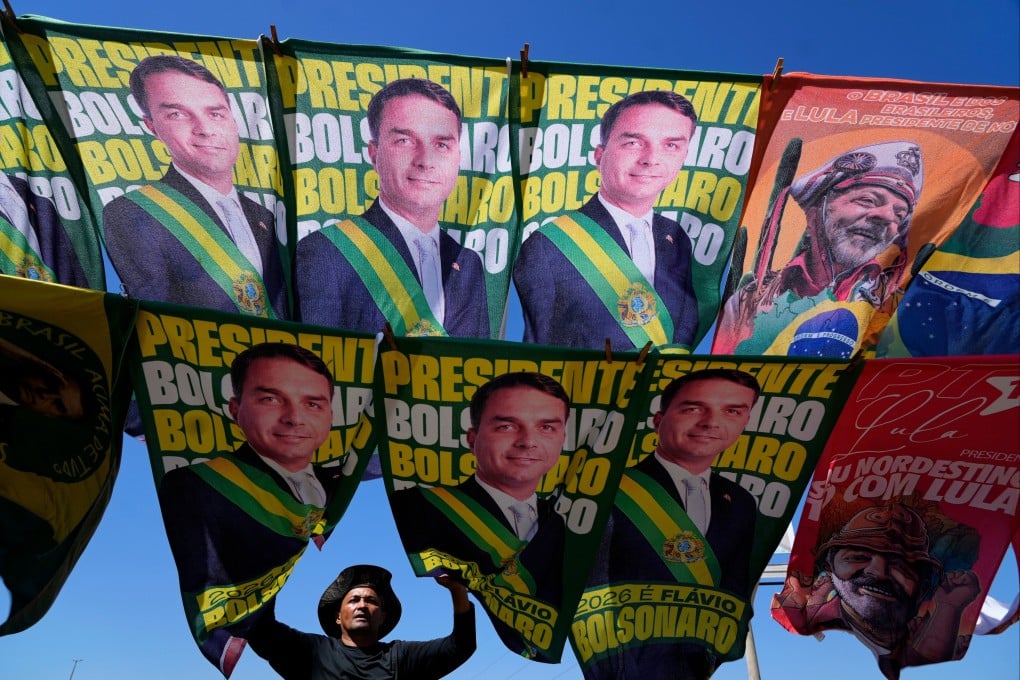
France 24 reports on the popularity of campaign merchandise in Brazil ahead of a general election. Nearly 159 million Brazilians are expected to vote on Sunday. Voters will choose members of the lower house, fill two-thirds of the Senate’s seats, and elect a president. Although ballots are secret, political preferences are visible in public: supporters display candidates’ and parties’ names on flags in the streets of Rio de Janeiro. The report describes a boom in business for vendors selling merchandise associated with President Luiz Inácio Lula da Silva and his rival, Flávio Bolsonaro. France 24 correspondent Jan Onoszko presents the report from Brazil. The supplied article text offers a brief introduction rather than the full video transcript, so it does not provide further details about the vendors, the merchandise, or the candidates’ campaigns. Its focus is the contrast between private voting and public expressions of support, as well as the commercial activity generated by election enthusiasm.
Entities: Brazil, Rio de Janeiro, Luiz Inácio Lula da Silva, Flávio Bolsonaro, Jan Onoszko • Tone: neutral • Sentiment: neutral • Intent: inform
02-10-2026
France 24’s short video introduces Flavio Bolsonaro, a 45-year-old Brazilian senator who, according to the article, had been relatively unknown nationally only a few months earlier but is now polling neck and neck with incumbent President Luiz Inacio Lula da Silva ahead of Brazil’s upcoming presidential election. The report presents Bolsonaro’s rapid emergence as a notable development in the race and places it within a broader regional trend: a victory for him would add Brazil to the list of Latin American countries that have recently shifted toward the right or far right.
The item is a brief election-focused overview rather than an in-depth profile. It does not provide polling figures, name the polls, explain Bolsonaro’s political platform, or detail the causes of his rise. Nor does it describe Lula’s campaign or discuss how voters view either candidate. The video’s framing instead emphasizes Bolsonaro’s recent increase in prominence, the closeness of the contest, and the possible significance of the result for the region’s political direction. The article identifies Flavio Bolsonaro as a senator and Jair Bolsonaro’s son through its associated keywords, but offers no further biographical details in the supplied text. The video was produced by Ava Luquet and issued by France 24 on October 2, 2026. Overall, it informs viewers of the reported state of the race and the potential regional implications, while leaving the underlying political context largely unexplored.
Entities: Flavio Bolsonaro, Luiz Inacio Lula da Silva, Jair Bolsonaro, Brazil, Latin America • Tone: analytical • Sentiment: neutral • Intent: inform
02-10-2026
The France 24 Focus report examines the role of artificial intelligence and disinformation in Brazil’s presidential election, which was two days away from its first round when the report was issued on October 2, 2026. It highlights two examples of AI-generated political content: a deepfake avatar of former president Jair Bolsonaro appearing in support of his son’s candidacy, and an AI-generated working-class woman voter criticizing President Luiz Inacio Lula da Silva. The article does not provide further details about who created or distributed these materials, how widely they circulated, or how voters responded. It does, however, point to the Brazilian intelligence agency’s warning that disinformation would be one of the election’s main challenges. France 24’s correspondents report on how such synthetic media is bringing questions of authenticity to the forefront of the campaign. The framing is informational and cautionary: AI is presented not merely as a technology in the background, but as a tool appearing in political messaging at a consequential moment. The available article text is a brief introduction to a video report, rather than a full transcript, so it does not set out specific measures to counter disinformation or assess the effects of the featured content. Its central concern is the difficulty of distinguishing real political expression from AI-generated material during Brazil’s election race.
Entities: Brazil, Brazilian presidential election, artificial intelligence, Jair Bolsonaro, Flavio Bolsonaro • Tone: analytical • Sentiment: neutral • Intent: inform
02-10-2026
The France 24 report examines how access to firearms has become an issue in Brazil’s election, with particular significance in the rural south. It describes the gun lobby’s support for Jair Bolsonaro in the context of his record in office: during his presidency, Brazil became more heavily armed, and the number of registered hunters, shooters and collectors—known as CACs—grew sevenfold over four years. The report contrasts this expansion with Luiz Inácio Lula da Silva’s promise to reverse the trend. That proposal has angered the powerful gun lobby, whose interests are therefore aligned with Bolsonaro as voters head to the polls.
The article presents firearm access as a potentially influential electoral issue, rather than offering polling figures or predicting how many voters it will sway. Its brief description frames the political contest through the opposing positions of Bolsonaro and Lula and highlights the scale of the increase in CAC registrations under Bolsonaro. It also identifies the rural south as an area where the issue could matter particularly. The report was produced by France 24’s team in Brazil. The supplied article text does not include the video’s full transcript, individual interviews, or further detail about the lobby’s members and arguments, so those aspects cannot be assessed from the available material.
Entities: Brazil, Jair Bolsonaro, Luiz Inácio Lula da Silva, France 24, rural south of Brazil • Tone: analytical • Sentiment: neutral • Intent: inform
02-10-2026
Crime and public security have become the leading concern for Brazilian voters ahead of the national election, helping reshape a close presidential contest between incumbent leftist Luiz Inácio Lula da Silva and conservative candidate Flávio Bolsonaro, son of former far-right President Jair Bolsonaro. The article reports that many voters want tougher, more immediate action against crime, reflecting a wider rightward shift in Latin America.
Robson Florencio, a working-class resident of São Paulo, describes street homelessness, open drug activity, and fear of going out at night. He also recounts a phone theft from a car in a wealthier neighborhood, arguing that violence affects rich and poor alike. Although public security statistics show declines in homicide and violent robbery, street crime—particularly phone theft in São Paulo and Rio de Janeiro—remains a prominent concern.
Flávio Bolsonaro has made crime a centerpiece of his campaign appearances, including waving a plastic machete and promising chemical castration for rapists and abusers. Risk analyst Roberto Simone says crime is mobilizing voters and traditionally benefits conservative candidates. Lula, by contrast, emphasizes reducing poverty, expanding opportunity, and improving coordination to dismantle criminal organizations. The article notes that gradual reforms may be less compelling to voters than “Mano Dura,” or iron-fist, policies. Ben Gedan of the Stimson Center says voters often want to see more police and more criminals jailed or killed in the short term, while recent presidential contests across Latin America have favored conservative and far-right candidates.
The campaign’s appeal is illustrated by Marli Alves, who says she voted for Lula previously but is switching to Bolsonaro because she believes crime is out of control. She says Bolsonaro defends people while the left protects criminals. Polls put the presidential race in a statistical tie, making a runoff later in the month likely.
Entities: Brazil, São Paulo, Rio de Janeiro, Luiz Inácio Lula da Silva, Flávio Bolsonaro • Tone: analytical • Sentiment: neutral • Intent: inform
02-10-2026
The article reports on the final days of Brazil’s presidential campaign, in which incumbent Luiz Inacio Lula da Silva faces Flavio Bolsonaro, the son of former far-right president Jair Bolsonaro. The contest is described as extremely close, with the candidates making last-minute efforts to discredit one another and attract voters before Sunday’s election. The campaign’s closing stretch has been marked by controversy, personal attacks and a dispute involving religion, according to the headline and introductory description.
The article places the election in the context of Brazil’s deep political polarisation and its significance across Latin America. Brazil is described as the region’s largest economy and one of its remaining major leftist bastions. The race also has connections to wider regional and international politics: Jair Bolsonaro is characterized as a close ally of US President Donald Trump and as a supporter of a wave of successful right-wing candidates in Latin America. Trump said he was watching Brazil’s election “very closely.”
The report focuses on the campaign’s tense atmosphere and the high stakes of a closely contested vote, rather than detailing policy differences or predicting an outcome. It identifies Lula, aged 80, and Flavio Bolsonaro as the principal contenders, while describing the election as a nail-biter. The supplied article text ends after Trump’s comment, so it provides no further details about the religious row, specific scandals, or the candidates’ plans.
Entities: Luiz Inacio Lula da Silva, Flavio Bolsonaro, Jair Bolsonaro, Donald Trump, Brazil • Tone: analytical • Sentiment: neutral • Intent: inform
02-10-2026
Brazilian President Luiz Inácio Lula da Silva led a large rally in Rio de Janeiro two days before the 4 October 2026 election, presenting the vote as a defining choice between democracy and far-right authoritarianism. Seeking a historic fourth term at age 80, Lula said he believed he was the only candidate capable of preventing the Bolsonaro family from returning to power. He staged the march between Candelária and Cinelândia, sites associated with major pro-democracy protests during Brazil’s struggle against military rule, and urged supporters to defend democratic institutions. Lula also alluded to alleged efforts by the Trump administration to influence the election through economic and diplomatic pressure.
Lula’s opponent, 45-year-old Flávio Bolsonaro, is the son of former president Jair Bolsonaro, who is serving a 27-year sentence for plotting a failed coup after losing to Lula in 2022. Critics and rally-goers fear Flávio would pardon his father and other coup plotters, weaken institutions such as the supreme court, and consolidate power. Flávio has promised to pardon his father and announced plans to appoint conservative judges; his brother Eduardo Bolsonaro is described as having ties to Donald Trump’s MAGA movement.
Politicians, demonstrators, and public figures at the rally echoed Lula’s warnings, invoking Brazil’s past dictatorship and expressing concern that a Bolsonaro victory could erode democracy for years. Anthropologist Luiz Eduardo Soares compared the potential pace of democratic backsliding to Hungary under Viktor Orbán. Polls cited in the article show Lula with a narrow lead, around 45% to Flávio Bolsonaro’s 40%, making a second-round runoff on 25 October likely. Lula nevertheless said he might win outright in the first round. Bolsonaro, meanwhile, urged undecided voters to support him, describing the election as a decision that would shape Brazil for decades.
Entities: Luiz Inácio Lula da Silva, Flávio Bolsonaro, Jair Bolsonaro, Eduardo Bolsonaro, Brazil • Tone: analytical • Sentiment: negative • Intent: inform
02-10-2026
The article introduces a Guardian podcast episode about Brazil’s upcoming presidential election and the unexpected political resurgence of the Bolsonaro family. It recalls that Jair Bolsonaro was convicted in September 2025 of attempting a coup, an event that might have appeared to end his political career and permanently damage his legacy. However, the article says that in the first round of Brazil’s presidential election, taking place on Sunday, his son Flávio Bolsonaro has genuine hopes of winning the presidency. Flávio is also campaigning to have his father released from jail.
The episode’s host, Annie Kelly, speaks with the Guardian’s Latin America correspondent, Tom Phillips, who explains how Brazil has returned to this political situation. Phillips also considers what a Flávio Bolsonaro victory could mean for the wider region. The article frames the election as historic and emphasizes the contrast between Jair Bolsonaro’s conviction and his son’s continued political prospects. It names Luiz Inácio Lula da Silva among the topics associated with the piece, but the supplied text does not describe Lula’s role in the election or provide polling figures, policy comparisons, or further detail about the candidates’ campaigns. Overall, the article is a brief introduction to a political podcast rather than a full report: it highlights the Bolsonaro family’s renewed relevance, the election’s significance, and the potential regional implications, while directing readers to the podcast for further explanation.
Entities: Brazil, Jair Bolsonaro, Flávio Bolsonaro, Luiz Inácio Lula da Silva, Tom Phillips • Tone: analytical • Sentiment: neutral • Intent: inform
02-10-2026
The United States suspended consular services at its embassy and consulates in Brazil on Friday, October 2, ahead of Brazil’s presidential election, citing unspecified security concerns. In a statement issued Thursday, the US State Department said the suspension would take effect on Friday and advised US citizens seeking emergency assistance not to go to the embassy, consulates, or other US diplomatic facilities during the closure. The department did not explain the nature of the security concerns, connect them to Sunday’s election, or provide a date for resuming consular services. It also had not immediately responded to a request for further information.
Brazilian voters are due to choose a president on Sunday. The election will determine whether Latin America’s largest country continues the conservative political shift seen elsewhere in the region or takes a different direction. Leftist President Luiz Inacio Lula da Silva has warned of possible foreign interference, including the imposition of new tariffs by Washington. Meanwhile, concerns about violent crime have featured prominently in election polling, and candidates have promised tougher security measures. The article reports these political and public-safety issues as background to the election, but does not establish that they prompted the US decision to suspend consular services.
Entities: United States, Brazil, US State Department, US Embassy and consulates in Brazil, Brazilian presidential election • Tone: neutral • Sentiment: neutral • Intent: inform