03-11-2026
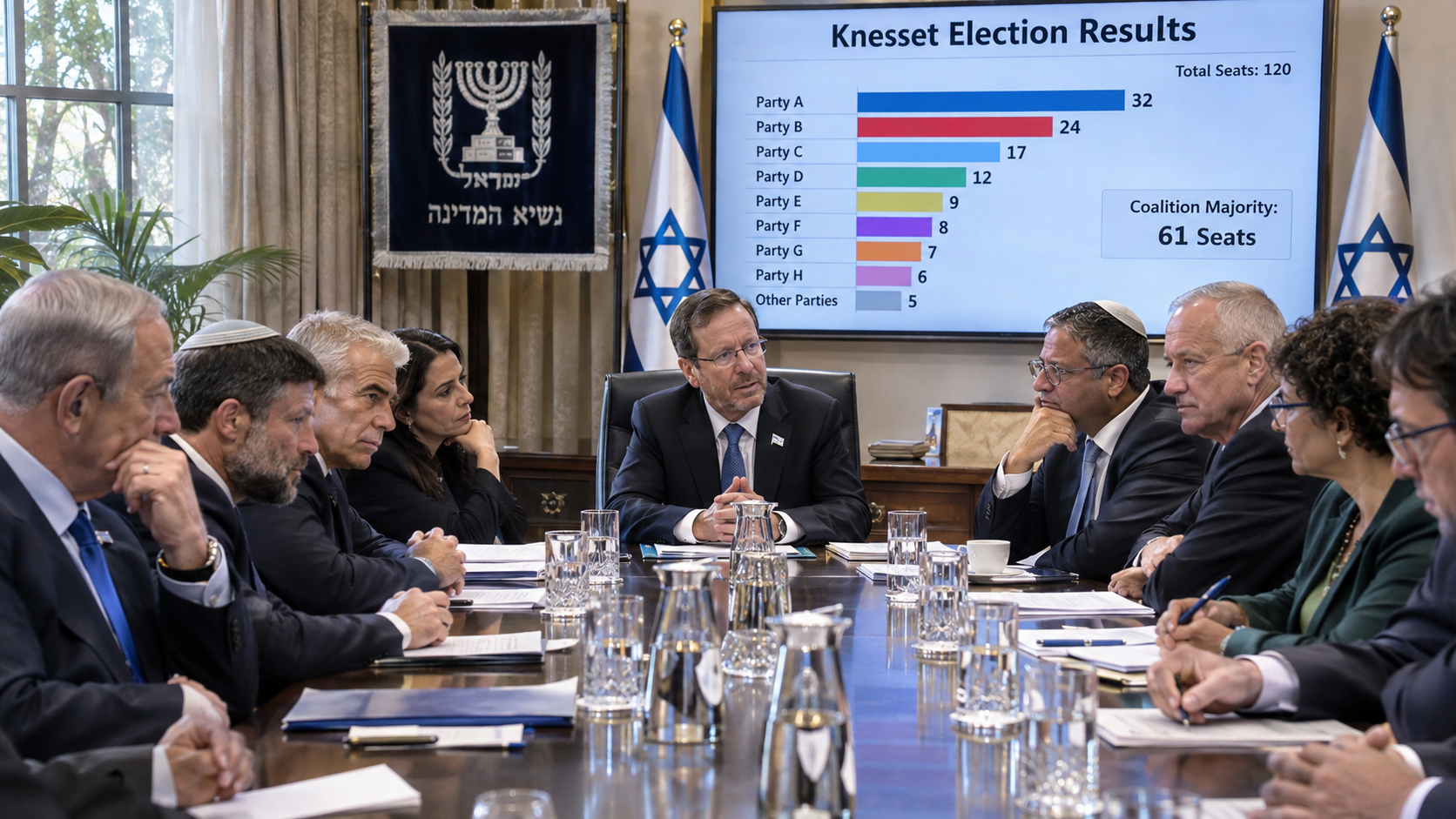
France 24 reports that an Israeli opposition bloc led by Gadi Eisenkot has pledged to form a government quickly and remove Prime Minister Benjamin Netanyahu. The report says the bloc has not made clear how it intends to assemble the necessary support, particularly amid disagreement over whether it should cooperate with Arab lawmakers. Arab-majority parties won 19 seats in the 120-member parliament in the previous week’s election. Eisenkot’s diverse opposition bloc holds 48 seats, while Netanyahu’s camp has 53, including 27 held by his Likud party. These figures show that neither side is described as having a majority on its own, and the opposition’s stated goal depends on resolving its differences and finding additional parliamentary backing. The article presents the promise to replace Netanyahu alongside the unresolved practical question of how a governing coalition could be formed. It does not provide further details about negotiations, the positions of individual parties, or a timetable beyond the pledge to act quickly. The report is a brief account of the post-election political balance and coalition challenge, rather than an analysis of likely outcomes. Its emphasis is on the gap between the opposition’s ambition and the uncertainty surrounding its route to power.
Entities: Gadi Eisenkot, Benjamin Netanyahu, Likud, Israeli opposition bloc, Arab-majority parties • Tone: analytical • Sentiment: neutral • Intent: inform
03-11-2026
Israel’s far-right parties, Jewish Power led by Itamar Ben-Gvir and Religious Zionism led by Bezalel Smotrich, retained 13 seats combined in the Oct. 27 election, matching their previous total. Although they did not achieve the gains they had hoped for, the result keeps them represented in the political landscape. Their prospects of remaining in government are uncertain: Prime Minister Benjamin Netanyahu’s bloc won 53 seats, short of the 61 required for a majority, while the opposition led by former army chief Gadi Eisenkot won 48. An alliance with Arab-Israeli parties, which secured 19 seats, could allow the opposition to form a government and would likely exclude the far right.
Entities: Itamar Ben-Gvir, Bezalel Smotrich, Benjamin Netanyahu, Gadi Eisenkot, Yael Shomer • Tone: analytical • Sentiment: neutral • Intent: inform
03-11-2026
Yousef Jabareen, leader of Israel’s Arab-led Joint List, is urging opposition parties to work with the Joint List and the Arab-led Ra’am party to form a parliamentary majority and replace Benjamin Netanyahu’s government. The appeal follows an inconclusive election: Netanyahu’s bloc won 53 seats and the opposition camp 48, while the Joint List and Ra’am secured 11 and eight seats. Together, the Arab-led parties could provide the support needed to reach the 61-seat threshold for a majority in the Knesset.
Jabareen said opposition politicians who have resisted partnering with Arab parties, including Yisrael Beiteinu leader Avigdor Liberman, must acknowledge the election results and parliamentary arithmetic. He argued that Netanyahu’s government cannot be replaced without coordinating with the Joint List. Opposition leader Gadi Eisenkot has expressed reservations about including Arab parties in a coalition, though he has not ruled it out. Yair Golan of The Democrats is the only opposition-bloc member identified as publicly advocating such a partnership.
Jabareen said the Joint List is prepared to support legislation and decisions that advance its agenda. While it differs from many Jewish-majority opposition parties on issues including Palestinian statehood, he emphasized concerns affecting Arab Israelis: crime and violence, house demolitions, discriminatory policies and budget allocations. He said these are areas where dialogue is possible.
Any prospective partners, however, would need to take seriously the Joint List’s opposition to Netanyahu’s wars, destruction in Gaza and settler violence in the West Bank. Jabareen framed his party’s positions as grounded in human rights and international law, rejecting the characterization of them as extremist. The article also notes that President Isaac Herzog was due to consult parties elected on Oct. 27 before deciding which leader would first be tasked with forming a government.
Entities: Yousef Jabareen, Benjamin Netanyahu, Joint List, Ra’am, Knesset • Tone: analytical • Sentiment: neutral • Intent: inform
03-11-2026
Israel’s opposition parties are trying to unite behind a government that could replace Prime Minister Benjamin Netanyahu after an election left no bloc with the 61 seats needed for a Knesset majority. Former army general Gadi Eisenkot and other leaders of the “change bloc” met in Herzliya and issued a statement saying they were united and would act quickly to form a “national emergency government.” They want Eisenkot to receive the first opportunity to form a government, as President Isaac Herzog begins consultations with parliamentary factions. The candidate chosen by Herzog has 28 days to form a government, with a possible 14-day extension; if that attempt fails, a second candidate may be asked to try.
The opposition won 48 seats, while Netanyahu’s bloc won 53, down from 64 in 2022. Likud remains the largest individual party, with 27 seats. A coalition would need support from Arab-majority parties to reach a majority, but some opposition politicians reject that partnership. Arab parties won a record 19 seats after strong turnout among Israel’s Arab minority. Yair Golan of the Democrats advocated coordination with the Arab Joint List, while Avigdor Lieberman of Yisrael Beiteinu argued that a stable government could be formed without the Joint List or Ra’am. Naftali Bennett urged allies to move urgently to establish a government and address the country’s problems.
The talks are complicated by Netanyahu and Likud’s claims that the election was “stolen” through alleged foul play by Arab parties, although no evidence has been made public. The Central Elections Committee said the vote was conducted properly and its results reflected voters’ will. Likud also tried to delay the official results announcement. If negotiations fail, Israel could face an early second election, which the president and many politicians hope to avoid. The article also notes that renewed fighting with Iran could delay government formation and potentially allow Netanyahu to remain in power longer.
Entities: Benjamin Netanyahu, Gadi Eisenkot, Isaac Herzog, Naftali Bennett, Yair Golan • Tone: analytical • Sentiment: neutral • Intent: inform
03-11-2026
After his Likud party’s setback in Israel’s October 27 election, Prime Minister Benjamin Netanyahu said he was open to forming a “broad national government” under his leadership. This differs from his earlier commitment to building a right-wing coalition. However, he did not indicate that he would abandon the far-right and ultra-Orthodox parties in his outgoing coalition, and he ruled out relying on Arab-led parties Ra'am and the Joint List, accusing them of supporting terrorism and rejecting Israel’s identity as a Jewish state.
Likud won 27 seats, making it the largest party, but the pro-Netanyahu bloc secured only 53 of the Knesset’s 120 seats—short of a majority. Arab-led parties won 19 seats, and other Jewish-led parties won 48. Four Zionist opposition parties—Yashar, B'Yachad, The Democrats and Yisrael Beytenu—have said they will not join a Netanyahu-led government, leaving the path to a majority uncertain.
Likud also asked to delay official certification of the results, scheduled for Wednesday, citing an investigation into suspected foreign interference. Supreme Court Justice Noam Sohlberg, who chairs the Central Elections Committee, rejected the request, saying the committee lacked authority to withhold certification or intervene in the investigation. The allegations involve claims that Qatar or other foreign powers secretly funded efforts to increase Arab voter turnout. They remain unsubstantiated, and the election committee has said that even if proven, they would not be significant enough to alter the result.
Entities: Benjamin Netanyahu, Likud, Israel, Knesset, October 27 election • Tone: analytical • Sentiment: neutral • Intent: inform