03-11-2026
ABC News’ live coverage follows the final hours before the 2026 US midterm elections, with polling suggesting close contests and uncertainty over control of Congress. President Donald Trump used his last major campaign appearance in Washington to urge voters to keep Republicans in control, while acknowledging the historical difficulty faced by a president’s party in midterms. He called the election exceptionally important and criticized Democratic candidates. At the same time, several Republican candidates in tight races are seeking to establish distance from Trump. Georgetown political scientist Hans Noel says Trump’s unpopularity has weakened the value of his endorsement, and Maine Senator Susan Collins is presented as one example of a Republican emphasizing independence.
The coverage outlines the Senate battleground: Democrats need to gain at least four seats to take control and are targeting Republican-held seats in states including Alaska, Kansas, Maine, Nebraska, Ohio and Texas. Republicans are seeking to flip seats in Georgia, Michigan and New Hampshire. Texas is highlighted as unexpectedly competitive, with Democrat James Talarico holding a slight polling lead over Republican Ken Paxton since September; interviews with San Antonio voters reflect divided preferences.
The live blog also explains that results should begin arriving in Australia on Wednesday morning, November 4, though state-specific counting rules and close margins could delay official calls. The political landscape is complicated by the unpopular Iran conflict and its effects on fuel prices and the economy. Trump had previously said the US would not strike Iran before the election, while Vice President JD Vance expressed optimism about a negotiated settlement. Separately, the Associated Press reports that Israeli Prime Minister Benjamin Netanyahu is pressing Trump for another wave of strikes after the midterms. Mediators are reportedly working on a framework involving Iran stopping attacks in the Strait of Hormuz in exchange for the US lifting its blockade on Iranian ports. Trump has not committed to military action, and neither the Israeli government nor the White House immediately commented directly on the reported discussion.
Entities: Donald Trump, Benjamin Netanyahu, JD Vance, Hans Noel, Susan Collins • Tone: analytical • Sentiment: neutral • Intent: inform
03-11-2026
The article examines whether polling that points to major Republican losses in the 2026 US midterm elections should be trusted. Democrats appear well positioned to gain the four House seats needed for control, and may have a chance to take the Senate as well—an especially notable prospect given that they began the cycle facing a difficult path. Analysts attribute Republicans’ worsening position partly to President Donald Trump’s declining popularity and his decision to launch a war on Iran, which has contributed to higher fuel prices. Democrats are competitive in several traditionally Republican states, while North Carolina appears likely to elect Democrat Roy Cooper to a Republican-held Senate seat and Michigan remains close.
However, the article stresses that polls are snapshots, many races remain within the margin of error, and polling errors could again underestimate Republican support. Republican officials argue that national polls tend to undercount their voters. Polling expert Charles Franklin also notes the persistent risk that Republicans may be less likely to participate in surveys. Republican strategist Patrick Ruffini describes the political environment as genuinely poor for his party, but cautions that historical polling has often overstated Democrats—especially in Iowa, Ohio and Michigan. He sees a possible Democratic win in Texas as more credible than one in Iowa, reflecting differing polling records across regions.
The article frames the current mood less as a decisive “blue wave” than as a “red undertow,” with voters expressing dissatisfaction with incumbents generally. Democrats remain cautious despite recent wins in off-cycle gubernatorial elections. Campaign spending offers another clue: Republicans are spending heavily in many battleground Senate races, supported by the Trump-aligned MAGA Inc PAC and wealthy donors, while Republican spending has stopped in North Carolina. Trump has promised further financial support and continues to campaign mainly in deeply Republican areas. He has also dismissed polls as fake or rigged, even while conceding they mean something. Overall, the article presents a troubling outlook for Republicans but emphasizes substantial uncertainty about how accurately polls reflect the eventual results.
Entities: Donald Trump, Emilie Gramenz, Jessica Taylor, Patrick Ruffini, Charles Franklin • Tone: analytical • Sentiment: negative • Intent: analyze
03-11-2026
Americans are voting in midterm elections that could shift control of Congress and constrain President Donald Trump during his second term. Democrats need three net gains to take the House and four to win the Senate. If they succeed, they could block parts of Trump's legislative agenda and investigate his administration; a Senate loss would also complicate confirmations of senior officials and Supreme Court justices. Governorships in 36 states are also being contested.
The article presents the vote as a nationwide judgment on Trump, whose approval rating is near the low 30s. It describes voter frustration over living costs, inflation, tariffs, and fuel prices affected by conflict in the Middle East. Democrats portray the election as a chance to redirect the country toward democracy, while Republicans argue that Trump's tax cuts and immigration policies will benefit Americans and characterize Democratic candidates as radicals. Trump's final campaign appearance focused largely on renovations to Washington's Reflecting Pool rather than the economy, drawing criticism from Senate Democratic leader Chuck Schumer.
Although Republicans hold a 53–47 Senate majority, Democrats are competing in several traditionally conservative states while defending vulnerable seats, including in Michigan. A final forecast cited by the article projected a Democratic House majority and a narrow Democratic Senate majority, though Republicans hope for strong turnout and polls can be inaccurate. More than 57 million people had voted early, and the campaign drew over $11 billion in political advertising, with Elon Musk spending heavily to support Republicans.
The article also highlights concerns about whether Republicans will accept the results. It notes Trump's past attempt to overturn his 2020 defeat and his unsupported fraud claims, as well as legal disputes over election certification in Alaska and mail-in ballots in California. Trump said he might veto everything if Democrats took control, while leaving open the possibility of later deals.
Entities: Donald Trump, United States midterm elections, U.S. Congress, Democratic Party, Republican Party • Tone: analytical • Sentiment: negative • Intent: inform
03-11-2026
The United States attacked Iran’s Qeshm Island on Monday, according to a Wall Street Journal report cited in the article, while President Donald Trump was publicly suggesting that negotiations with Tehran might make progress. The reported strike came on the eve of US midterm elections and during an eight-month-old conflict. Qeshm is Iran’s largest island in the Strait of Hormuz, a strategically important energy corridor.
The Journal, citing unnamed US officials, described the attack as one of several limited US strikes against Iran carried out secretly in recent weeks. Separately, an anonymous US official told the Associated Press that the targets were Iranians using surface-to-air missiles against US assets. The article does not report a public US announcement of the strikes. According to the Journal, Washington had kept them undisclosed to avoid signaling that it intended to resume major combat operations.
The reported attacks appeared limited rather than a return to full-scale hostilities, but they followed Trump’s earlier statement that the United States would not launch new strikes before Tuesday’s midterms. On Monday, he said a deal with Tehran “could happen,” offering a sign of possible diplomatic progress even as military action was reported.
The conflict’s economic consequences were also evident. Iran’s blockade of the Strait of Hormuz had sent oil prices sharply higher; on Monday, prices fell by more than 7% amid optimism that the conflict could end. The article thus presents a contrast between reports of continuing, covert military strikes and public hopes for a negotiated settlement, with the election timing and energy-market reaction adding to the significance of the developments.
Entities: United States, Iran, Qeshm Island, Strait of Hormuz, Donald Trump • Tone: analytical • Sentiment: negative • Intent: inform
03-11-2026
Several explosions were reported late Monday on Iran’s Qeshm Island, near the Strait of Hormuz, amid US media reports that the US military had carried out strikes against Iranian targets in the waterway. Iran’s state news agency IRNA said the blasts occurred in rapid succession, and witnesses reported seeing two aircraft over the island. The semi-official Fars news agency also reported explosions near Bandar Lengeh, apparently coming from the sea.
The Wall Street Journal and Associated Press, citing US officials, reported that US forces conducted what officials described as defensive strikes. The stated aim was to restrict Iran’s ability to attack commercial shipping; one US official said Iranian forces using surface-to-air missiles against US assets were targeted. Reports by Fox News and Axios linked the strikes to an alleged IRGC attack on a US aircraft. A Fox News reporter said the incident did not signal the beginning of expanded US strikes. Neither Iranian nor US authorities had immediately commented.
The reports emerged as US-Iran negotiations and other diplomatic efforts were under way to avert renewed US and Israeli attacks. Earlier Monday, Iran’s Islamic Revolutionary Guard Corps claimed it had captured two US reconnaissance drones near Qeshm and destroyed an MQ-9 drone east of the strait. President Donald Trump said a deal with Iran could happen soon and denied considering an attack after the US midterm elections. Vice President JD Vance also expressed optimism about the prospects for a negotiated settlement.
Iranian Foreign Ministry spokesperson Esmaeil Baghaei said Tehran’s peace demands had been conveyed to Washington and that Iran’s proposal to reopen the Strait of Hormuz could be implemented within two days if the US lifted its naval blockade of Iranian ports and secured an end to hostilities. Separately, the Associated Press reported that Israeli Prime Minister Benjamin Netanyahu was pressing for another wave of strikes after the elections. The reported explosions and strikes thus coincided with both heightened military tensions and continued diplomatic activity.
Entities: Qeshm Island, Strait of Hormuz, Bandar Lengeh, Iran, United States • Tone: analytical • Sentiment: neutral • Intent: inform
03-11-2026
The article reports that voting has begun across the United States in the 2026 midterm elections, presenting the contest as a consequential test of President Donald Trump’s presidency. The elections could alter the balance of power in Congress: every seat in the House of Representatives and 35 seats in the Senate are being contested. If Republicans lose control of either chamber, the president’s party could face a changed political landscape for the remainder of his term.
The campaign is described as being shaped by rising living costs and the war on Iran, which the article identifies as dominant issues for voters and candidates. It does not provide details about polling, particular races, candidates beyond Trump, voting procedures, or projected outcomes. Instead, the report focuses on the broad stakes and the start of voting nationwide. The short item is presented as a news video/newsfeed report, published on November 3, 2026. Overall, it gives readers a concise overview of what is being decided and the major issues defining the campaign, while emphasizing that the results could determine whether Trump’s Republicans retain control of Congress.
Entities: United States, Donald Trump, Republican Party, US Congress, US House of Representatives • Tone: analytical • Sentiment: neutral • Intent: inform
03-11-2026
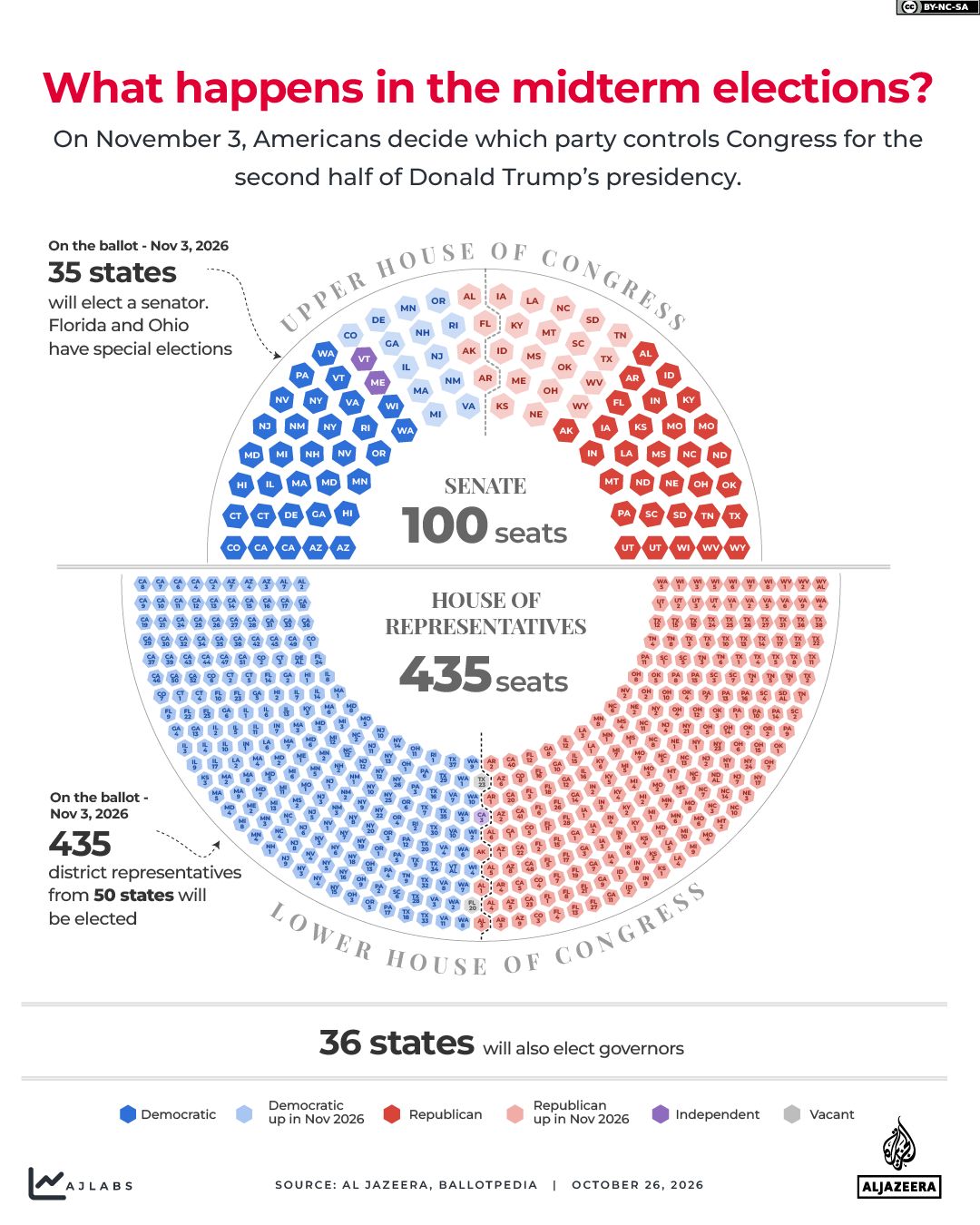
The article outlines voting hours, vote-counting expectations and closely watched races in the 2026 US midterm elections. More than 230 million eligible voters can vote on Tuesday, November 3. All 435 seats in the House of Representatives and 35 of the Senate’s 100 seats are contested, and voters in 36 states will elect governors. Republicans currently control both chambers of Congress.
Poll opening and closing times vary by state. Vermont is expected to open first, at 5am Eastern Time (10:00 GMT). Several states begin voting between 6am and 7am, with Michigan opening at 7am. The earliest polls close at 6pm in Indiana and Kentucky. Closures continue in waves, with Alaska last, at around 1am Eastern Time on Wednesday (06:00 GMT).
Initial results may arrive as polls close on Tuesday, but early counts do not necessarily identify winners. Election officials report vote counts as ballots are processed, while news organisations such as the Associated Press assess when races can be called. Close contests may take hours or days to resolve, and control of Congress may not be clear immediately. Mail, provisional and other ballots can be counted after election night, meaning final tallies may take days or weeks.
The article says Senate Democrats need a net gain of four seats to reach a majority, while House Democrats need three. It highlights contests including Abdul El-Sayed versus Mike Rogers in Michigan; Angie Nixon challenging Ashley Moody in Florida; Jon Ossoff versus Mike Collins in Georgia; Susan Collins versus Troy Jackson in Maine; Chris Pappas versus John Sununu in New Hampshire; and Roy Cooper versus Michael Whatley in North Carolina.
Entities: 2026 US midterm elections, United States Congress, US House of Representatives, US Senate, Republican Party • Tone: neutral • Sentiment: neutral • Intent: inform
03-11-2026
The United States has carried out what US officials described as limited, defensive strikes on Iran’s Qeshm Island in the Strait of Hormuz. The officials said the action followed fire by Iran’s Islamic Revolutionary Guard Corps (IRGC) at a US aircraft. Iranian state media reported explosions on the island, while the IRGC said it had shot down US drones. The US military has not publicly commented on the strikes.
The strikes came amid uncertainty about whether the war, which began with US and Israeli attacks on Iran in February, could escalate after the US midterm elections. President Donald Trump has faced declining poll numbers and pressure from Republicans to end the conflict. He said he was in no rush to intensify attacks, though he also suggested the US might strike an underground Iranian site associated with the nuclear programme. Trump denied that significant strikes were necessarily planned after the elections. The Associated Press reported that Israeli Prime Minister Benjamin Netanyahu had urged Trump to launch another wave of attacks.
Diplomatic efforts are continuing through Qatari and Pakistani mediators. Iran’s chief negotiator, parliament speaker Mohammad Bagher Ghalibaf, said the United States had the responsibility to prevent war, while Foreign Minister Abbas Araghchi said intensive talks were under way. Qatar said both sides were reviewing proposals and expressed hope for an agreement.
Negotiations include the Strait of Hormuz, a vital route for about one-fifth of global oil and gas shipments. Iran has reportedly proposed reopening it after the US meets conditions that include lifting its naval blockade of Iranian ports and releasing frozen Iranian assets. A preliminary agreement reached in June collapsed within weeks as attacks on shipping resumed and the US reinstated its blockade. Iran has sought to retain some control over the waterway, while the US has been protecting tankers carrying Gulf states’ oil exports.
Entities: Donald Trump, Mohammad Bagher Ghalibaf, Abbas Araghchi, Benjamin Netanyahu, Majed al-Ansari • Tone: analytical • Sentiment: neutral • Intent: inform
03-11-2026
U.S. President Donald Trump said he and Israeli Prime Minister Benjamin Netanyahu had agreed to end roughly $4 billion in annual U.S. funding to Israel after 2026, while continuing weapons sales and potentially helping Israel if needed. Trump made the announcement in a Fox News interview on U.S. midterm Election Day, presenting the change partly as a way to deprive Democrats of a political argument against Republicans’ support for Israel. He said Israel no longer needed the money and singled out Michigan Senate candidate Abdul El-Sayed, who opposes unconditional military aid.
Trump gave no details about how the funding could stop so soon. The current U.S.-Israel memorandum of understanding provides $3.8 billion annually and runs through September 2028, while Congress must pass annual appropriations to release the funds. Neither the White House nor Netanyahu’s office immediately commented. Gadi Eisenkot, a rival Israeli leader, criticized Netanyahu for allowing the public and security establishment to learn about a major change in the relationship through the media. Netanyahu himself had previously warned that U.S. aid would likely decline over time.
The announcement comes amid weakening U.S. public support for Israel, especially among Democrats, following Israel’s military response in Gaza after the Hamas-led October 2023 attack. A Quinnipiac poll found that 48 per cent of voters and 66 per cent of Democrats thought the United States was too supportive of Israel, up substantially from 2017. Israel’s recent election also left Netanyahu without a governing majority, prompting negotiations over a new government.
The article notes that criticism of Israel is growing among progressive Democrats and some members of Trump’s own political movement. At the same time, Trump’s announcement’s timing drew scrutiny: the United States and Israel remained in conflict with Iran, and analysts wondered whether a major joint strike might be imminent. Some supporters of Israel urged a gradual phase-out, while progressive Democrat Ro Khanna endorsed ending aid. Republican Don Bacon objected that Israel had not been informed. The article’s final sentence is cut off after beginning to describe a House defence-bill provision anticipating reduced U.S. support.
Entities: Donald Trump, Benjamin Netanyahu, Gadi Eisenkot, Abdul El-Sayed, Ro Khanna • Tone: analytical • Sentiment: negative • Intent: inform
03-11-2026
The article reports on a fragile diplomatic effort to end the eight-month U.S.-Iran war amid continued military activity around the Strait of Hormuz. U.S. forces carried out what officials described as limited defensive strikes on Iranian targets near the strait after Iran’s Islamic Revolutionary Guard Corps fired at an American aircraft. Iran’s Deputy Foreign Minister Kazem Gharibabadi said the country retained the right to self-defense. President Trump said a peace deal remained possible and claimed Tehran wanted a settlement quickly, while also threatening larger strikes after the U.S. midterm elections. Qatar is mediating and says both sides are reviewing new proposals; a source told Reuters that negotiators were expected to respond to a fresh suggestion within 36 hours. Iranian officials say their core demands remain unchanged and that the next move is up to Washington.
The article also describes a deadly attack on an Indian-crewed vessel near the strait. India said one mariner, Gandhar Nahim Ajij, died after an unidentified aerial object struck the vessel; 13 other crew members were rescued by Oman’s coast guard. The U.K. Maritime Trade Operations center characterized the vessel as a small dhow, rather than a large cargo ship, and confirmed it was sailing outbound through the strait. Responsibility for the attack had not been claimed. The report notes that Iran has attacked vessels it alleges used unauthorized southern shipping routes, which the U.S. says are safe and open.
Separately, Trump told Fox News that the United States would end its reported $4 billion in annual aid to Israel by year’s end, saying he and Prime Minister Benjamin Netanyahu had agreed to the change. The announcement comes amid debate over U.S. military support for Israel and growing political and economic pressure ahead of the elections, including high energy prices linked to the conflict.
Entities: Donald Trump, Kazem Gharibabadi, Benjamin Netanyahu, Sarbananda Sonowal, Gandhar Nahim Ajij • Tone: analytical • Sentiment: negative • Intent: inform
03-11-2026
The U.S. military carried out limited defensive strikes against Iranian targets near the Strait of Hormuz on Monday, according to multiple U.S. officials. A senior official said the strikes targeted Qeshm Island, a strategically important location in the northern strait that Iran uses to monitor and influence commercial shipping. The strikes followed two incidents: Iran’s Revolutionary Guards fired at an American fighter jet, which returned fire, and Iran later launched a missile from Qeshm Island that U.S. officials said threatened shipping.
The strikes occurred as the war between Iran and the U.S.-Israeli alliance entered its ninth month and on the eve of U.S. midterm elections. President Donald Trump has alternated between saying a deal with Iran could be reached and warning that further attacks may occur. In a social media post, he said Iran wanted a settlement soon; later, in a television interview, he said the U.S. still needed to address several sites, including a suspected nuclear facility at Pickaxe Mountain. Israeli Prime Minister Benjamin Netanyahu has reportedly urged Trump to continue sustained strikes.
Iran’s Deputy Foreign Minister Kazem Gharibabadi said Tehran retained the right to self-defense until what he called military aggression ended permanently. Iran has retaliated during the war by targeting commercial shipping in the strait and U.S. allies and interests in the Persian Gulf region.
The conflict is affecting elections and economic conditions. Threats to shipping have contributed to rising costs and declining support for Trump and Republicans in the U.S., while Netanyahu’s right-wing bloc lost its parliamentary majority in Israel’s first elections since October 7, 2023. A U.S. Central Command estimate put military spending on the war at at least $47.1 billion by mid-October, including costs for munitions, lost equipment, and support for service members. The estimate did not include damage to U.S. bases in the Middle East.
Entities: Strait of Hormuz, Qeshm Island, Iran, United States military, Iranian Revolutionary Guards • Tone: analytical • Sentiment: negative • Intent: inform
03-11-2026
The article examines the 2026 midterm elections, which will determine control of Congress and could reshape President Donald Trump’s final two years in office. Republicans are defending their House and Senate majorities amid public frustration over consumer prices, the war with Iran, perceived government corruption, and immigration enforcement. Democrats are favored to retake the House, while the Senate contest remains uncertain after late gains made several races more competitive. The article identifies several key questions: whether Republican-backed congressional maps will deliver expected gains; whether Democrats can compete in traditionally Republican states such as Kansas, Mississippi, and South Carolina; whether Democrats can win statewide in Texas; and whether progressive candidates can succeed without creating difficulties for the party’s moderates. Redistricting in Texas and Florida, alongside a Supreme Court decision weakening a section of the Voting Rights Act, had appeared to give Republicans a structural advantage, but polling and competitive races have complicated that outlook. In the Senate, Democratic candidates are challenging Republican incumbents in unexpected states, while Democrats also face close races in Minnesota and New Hampshire that could offset gains elsewhere. Texas is especially consequential: James Talarico is challenging Republican Ken Paxton, who received Donald Trump’s endorsement and substantial financial support from Elon Musk. The article also focuses on Michigan’s Senate race, where progressive Abdul El-Sayed’s contest against Mike Rogers is framed as a test of the Democratic Party’s left wing and its relationship with the Democratic Socialists of America. Overall, the election could affect both the balance of power in Washington and the future direction of the Republican and Democratic parties. The supplied article text ends during its discussion of Michigan, so its remaining sections are not available.
Entities: Donald Trump, Hakeem Jeffries, United States Congress, 2026 midterm elections, Republican Party • Tone: analytical • Sentiment: neutral • Intent: inform
03-11-2026
The article explains that the 2026 midterm elections will determine which party controls Congress for the remainder of President Donald Trump’s term, with major consequences for his legislative agenda and the operation of government. Republicans retaining both chambers would allow Trump to pursue policy packages with relatively little congressional resistance. A Democratic victory in either chamber would make legislation harder to pass and could create significant gridlock. Polls and election odds favor Democrats in the House, while the Senate contest is described as especially close; final results may take days or weeks, potentially depending on vote counting in Alaska.
A divided Congress would make party-line budget reconciliation unavailable, forcing lawmakers to seek bipartisan support for legislation. Government funding, defense spending, and an approaching debt-ceiling increase could become contentious bargaining points. The article cites Stifel analysts, who anticipate a Democratic House and an uncertain Senate, and suggest that markets may initially react to results before investors conclude that gridlock is likely under several outcomes.
If Democrats win both chambers, they could pursue investigations of the White House and businesses connected to the administration, using committee subpoena powers. They might also advance reconciliation proposals as a political message ahead of the 2028 presidential election, although Trump could veto legislation. Even with unified Democratic control, major bills would face the Senate’s 60-vote filibuster threshold and the need to negotiate with the White House on must-pass measures.
Analysts expect Trump to rely more heavily on executive orders if Congress is divided or controlled by Democrats. Conversely, if Republicans retain both chambers, his legislative agenda could continue largely along its current course. The article emphasizes that each possible result would shape the degree of congressional oversight and legislative gridlock, while the eventual balance of power remains uncertain until votes are counted.
Entities: Donald Trump, U.S. Congress, 2026 midterm elections, Republican Party, Democratic Party • Tone: analytical • Sentiment: neutral • Intent: inform
03-11-2026
Former White House communications director Anthony Scaramucci told CNBC that President Donald Trump is likely to suffer a major defeat in the U.S. midterm elections, predicting that Trump will be “trounced.” Scaramucci said voters are dissatisfied with the economy and argued that Trump had failed to meet promises on affordability, avoiding prolonged wars, and transparency regarding the Epstein files. A CNBC survey found that 65% of respondents disapproved of Trump’s handling of the economy and 80% rated the economy fair or poor. Scaramucci said dissatisfaction was also emerging among some supporters of the MAGA movement. The White House did not immediately respond to CNBC’s request for comment; it had previously dismissed Scaramucci’s relevance. Prediction markets indicated roughly a three-in-four chance that Democrats would take control of the Senate, though the article cautions that such markets are not substitutes for traditional political polls. Scaramucci also expressed pessimism about a diplomatic resolution to the Iran war, saying he saw no alignment among Iran, Israel, and the United States. He questioned whether escalating U.S. military strikes alongside Israel would help the region and noted that wars hurt business and markets. Finally, he predicted that a Republican defeat could lead to congressional investigations and an internal party struggle over its future direction. He said MAGA ideas would likely remain influential in the next Republican presidential candidate’s platform, partly because Trump would retain influence through his political action committee funding, but expected the party to debate how closely it should remain tied to Trump.
Entities: Donald Trump, Anthony Scaramucci, CNBC, SkyBridge Capital, U.S. midterm elections • Tone: analytical • Sentiment: neutral • Intent: inform
03-11-2026
The article explains what Americans will decide in the November 3, 2026, midterm elections and why the results matter for President Donald Trump’s ability to govern. Midterms take place halfway through a presidential term and determine representation in Congress, rather than who occupies the White House. Voters will choose all 435 members of the House of Representatives, 35 senators, and governors in 36 states. House members serve two-year terms and represent districts apportioned by population; senators serve six-year terms, with two representing each state. Governors, usually elected for four-year terms, influence major state-level policy areas including abortion, education, and election procedures.
Republicans currently control both chambers, but narrowly. The House has 218 Republicans, 214 Democrats, one independent who usually votes with Republicans, and two vacant seats. The Senate has 53 Republicans, 45 Democrats, and two independents who usually vote with Democrats. Vice President JD Vance would break a 50–50 Senate tie. The article reports that analysts consider a Democratic House victory likely, with the party needing four additional seats; closely contested districts include ones in Iowa, Virginia, and Montana. Democrats also need four Senate seats for a majority. Texas is highlighted as a surprising potential opportunity: polls put Democrat James Talarico level with Republican Ken Paxton, and Talarico has received support from members of the Bush family. No Democrat has won a statewide Texas race since 1994.
The article says midterms often serve as a referendum on the president and the party in power. It notes Trump’s low approval ratings and explains that a Democratic majority in either chamber would make it harder for him to advance domestic and foreign policy. It also discusses gubernatorial contests in Minnesota and Georgia, where Black women candidates could make history. Democrat Amy Klobuchar is favored over Republican Lisa DeMuth in Minnesota, while Georgia’s Keisha Lance Bottoms is in a close race against Republican Rick Jackson.
Entities: 2026 US midterm elections, United States Congress, House of Representatives, US Senate, Donald Trump • Tone: analytical • Sentiment: neutral • Intent: inform
03-11-2026
The article examines whether the US midterm elections could meaningfully alter President Donald Trump’s policy toward Iran. Iran’s war and Washington’s relationship with Israel have become prominent campaign issues. Some Democratic candidates strongly criticize the conflict, while Trump has played down its remaining military objectives even as reports suggest the US and Israel may be preparing further strikes. Republican hawks, including Senator Ted Cruz, are urging a tougher approach.
Analysts interviewed by DW caution that a Democratic victory may not give Congress enough power to stop the administration. Former National Security Advisor John Bolton says Congress can control or restrict funding, but a presidential veto would be difficult to override. Iran expert Alan Eyre also describes substantial bipartisan agreement: both parties oppose the Islamic Republic’s political system and support pressure on Tehran to change its behavior.
The article says Tehran has kept indirect diplomacy open through Qatar and Oman while threatening retaliation against further strikes. Analyst Shahin Modarres argues that Iran may be misjudging how much a Democratic Congress could restrain Trump. Iran’s efforts to prolong negotiations and use pressure on the Strait of Hormuz and fuel prices to affect voters could backfire after the election, when political constraints on Trump may ease. The broad US opposition to Iran acquiring nuclear weapons also limits the extent of partisan differences.
Bolton expects Trump to decide his next steps after the election, when campaign pressure is less acute. One possible scenario, he says, is an attack on a reported new Iranian nuclear site near Natanz, followed by Trump declaring victory and withdrawing. Bolton considers regime change the only durable way to prevent Iran from pursuing nuclear weapons, whereas Eyre stresses that lasting political change would have to come from Iranian society itself. Eyre also criticizes US diplomacy for failing to communicate a clear, credible message to ordinary Iranians, and says the gap between US rhetoric and actions extends across administrations and election cycles.
Entities: Donald Trump, Abdul El-Sayed, Ted Cruz, John Bolton, Alan Eyre • Tone: analytical • Sentiment: neutral • Intent: analyze
03-11-2026
The article explains how the US midterm elections could influence President Donald Trump’s foreign policy, particularly toward Ukraine, Iran and international development aid. Although the president has substantial authority, Congress can shape legislation and government spending, oversee the executive branch and intelligence agencies, conduct impeachment proceedings, and approve Cabinet members, ambassadors and federal judges. Congress can also override a presidential veto with a two-thirds majority in both chambers. With Republicans currently holding both chambers, Trump has generally had an easier time governing; polling, however, suggests Democrats may win the House and could possibly take the Senate.
A Democratic congressional majority could press for renewed or increased US support for Ukraine, which has received less military and financial assistance under Trump than it did under Joe Biden. Democrats could introduce aid legislation, though Trump could veto it unless lawmakers had enough votes to override him. The article quotes analyst Brandon Conradis, who says Democrats could use their legislative influence to push for aid.
Congress’s ability to change the course of the war with Iran may be more limited. Trump began the conflict alongside Israel without consulting Congress. Democrats and some Republicans have opposed the war, but the administration has ignored a resolution calling for hostilities to end. Brookings Institution analyst Michael O’Hanlon suggests Congress might nevertheless constrain escalation by refusing to fund it.
The article also considers international development assistance. Trump sharply cut support for aid programs and shut down USAID. A Democratic Congress might not be able to restore the agency against the president’s wishes, but it could seek more funding and investigate the closure through oversight and hearings. The article concludes that a change in congressional control would alter the balance of power, but would not produce a complete reversal of US policy.
Entities: Donald Trump, Joe Biden, Volodymyr Zelenskyy, Vladimir Putin, Brandon Conradis • Tone: analytical • Sentiment: neutral • Intent: analyze
03-11-2026
The article reports on Donald Trump’s final campaign remarks before the US midterm elections, which are scheduled for November 3 and will determine control of Congress for the remainder of his presidential term. Trump called the elections the most important “in our lifetime” and described Democratic candidates as the most “extreme and dangerous” in US history. At the same time, he acknowledged the historical difficulty faced by the party of a sitting president in midterms, saying Republicans had given the contest a strong effort. Senate Minority Leader Chuck Schumer dismissed Trump’s closing message as “pathetic,” criticizing the administration over the war with Iran, corruption, and inflation.
The article also notes that the US Supreme Court rejected Trump’s last-minute effort to block 20,000 California ballots. Trump made his remarks near the Lincoln Memorial Reflecting Pool, where he also spoke at length about rusty pipes and algae.
A report by The Wall Street Journal, citing US sources, said the United States had carried out a strike on Iran’s Qeshm Island ahead of the election. US Central Command did not officially confirm the reported attack. The news came as the Trump administration expressed hope that negotiations with Iran could help end the war. Vice President JD Vance said the US aim remained preventing Iran from obtaining nuclear weapons, and said an agreement would require a firm, verifiable commitment not to rebuild its nuclear program.
The midterms are widely viewed as a referendum on Trump’s policies. Cost-of-living and energy-price increases, which the article links to the Iran war, are major campaign issues. Trump argued voters should consider the danger of a nuclear-armed Iran. Oil prices fell as the two countries resumed talks. Democrats are expected to regain the House, while control of the Senate is considered uncertain. The result could shape both parties’ strategies ahead of the 2028 presidential election.
Entities: Donald Trump, Chuck Schumer, JD Vance, United States, Democratic Party • Tone: analytical • Sentiment: neutral • Intent: inform
03-11-2026
US President Donald Trump said the United States would end its roughly $4 billion in annual military aid to Israel beginning in 2027, while continuing to sell arms to the country. He made the announcement by phone to Fox News on the day Americans were voting in midterm elections. Trump said Israel no longer needed the assistance and claimed Israeli Prime Minister Benjamin Netanyahu had proposed ending it, with the two leaders discussing the idea for several years. Trump also connected the decision to domestic political criticism, saying aid to Israel had become an easy target for critics including Abdul El-Sayed, a Democrat running for the Senate in Michigan.
The announcement concerns the existing 10-year, $38 billion military-aid agreement, signed in 2016 under President Barack Obama and scheduled to run through 2028. Netanyahu’s office did not immediately respond. Gadi Eisenkot, described as Netanyahu’s main rival, criticized the way Israel’s defence establishment learned of the change through media reports and called for Netanyahu to be replaced.
The report also describes rising tensions in the Gulf. A US official said American forces had conducted defensive strikes against Iranian targets in the Strait of Hormuz after those targets used surface-to-air missiles. Iranian state television reported explosions on Qeshm Island. Iran’s parliament speaker and chief negotiator, Mohammad Bagher Qalibaf, said Tehran had given Washington a “firm and rational response” and that preventing renewed war was now the United States’ responsibility. He said Iran remained ready to respond but did not specify what Tehran had done. The article places Trump’s aid announcement amid both US election politics and renewed US-Iran tensions.
Entities: Donald Trump, Benjamin Netanyahu, Gadi Eisenkot, Abdul El-Sayed, Mohammad Bagher Qalibaf • Tone: analytical • Sentiment: negative • Intent: inform
03-11-2026
The United States carried out strikes against Iranian targets in the Strait of Hormuz on Monday, according to an unnamed US official. The official described the operation as defensive, saying it targeted Iranians who were using surface-to-air missiles against a US asset. Iranian media separately reported five explosions on Qeshm Island, though the article does not provide further details about damage or casualties.
The strikes occurred just hours after President Donald Trump said negotiations with Tehran might be progressing. In a post on Truth Social, Trump wrote that Iran wanted a settlement “as soon as possible” and said one could happen. Vice President JD Vance also expressed optimism about the prospects for a negotiated settlement. Iran’s Foreign Minister Abbas Araghchi confirmed that indirect talks were taking place through mediators, with Qatar and Pakistan playing active roles.
The timing is politically significant: the strikes came on the eve of US midterm elections, in which Republicans are seeking to retain control of Congress. The article notes that the war in Iran has become a growing point of political contention and has contributed to declining approval ratings for Trump, amid increasing public disapproval of the conflict and concern about its economic consequences.
The conflict has also disrupted shipping through the Strait of Hormuz, a narrow passage between Iran and Oman that normally carries about one-fifth of the world’s oil. The article presents the military action, diplomatic contacts, election context and shipping disruption as developments unfolding simultaneously, without resolving whether negotiations will produce a settlement.
Entities: United States, Iran, Qeshm Island, Strait of Hormuz, Donald Trump • Tone: analytical • Sentiment: negative • Intent: inform
03-11-2026
The France 24 video report covers the November 3, 2026, midterm elections in the United States, describing them as pivotal for the balance of power in Congress and for President Donald Trump’s second term. Democrats hoped to gain control of Congress, which would give them a significant means of checking the president’s agenda. The report says that if Republicans lost the House of Representatives, Democrats could stall Trump’s legislative plans and begin broad investigations into his administration. It frames the election as a consequential test of Trump’s presidency, while the headline suggests that the outcome could substantially alter its trajectory. The report is presented from Washington, DC, by France 24 correspondent Fraser Jackson. The supplied article text provides no results, voter interviews, polling figures, or detailed campaign coverage; it focuses on the potential consequences of a Democratic victory in the House. Related links listed on the page refer to other election coverage, including whether the midterms amount to a referendum on Trump, what could happen if he loses, and the possible effect of a Democratic wave on divisions within the party. Those linked items are not part of the report itself.
Entities: Donald Trump, Fraser Jackson, France 24, Washington, DC, United States midterm elections • Tone: analytical • Sentiment: neutral • Intent: inform
03-11-2026
Americans are voting in the 2026 US midterm elections, a contest that could significantly constrain President Donald Trump’s ability to advance legislation during the remainder of his second term. Democrats are widely projected to retake the House of Representatives, while control of the Senate remains uncertain. The article says Democrats would need to gain three House seats and four Senate seats to overtake Republicans. Losing control of either chamber could impede Trump’s legislative agenda, and the results are framed as a referendum on his second term. France 24’s live coverage directs readers to follow updates as voting proceeds.
The article also recaps three developments from the previous day. In Michigan’s Senate race, Representative Haley Stevens made a high-profile break with her party by endorsing Republican Mike Rogers instead of Abdul Al-Sayed, the Democrat who defeated her in the primary. Trump sought to rally Republicans at Washington’s Reflecting Pool, a setting the article links to a botched renovation that had come to symbolize what it describes as the disorder of his second term. Separately, the Supreme Court rejected an effort to require California to set aside 20,000 mail ballots cast by people whom the Trump administration claims are noncitizens. The report attributes its coverage to FRANCE 24, Reuters, AP and AFP. The supplied page also includes a notice that requested content may no longer be available, but that is a website message rather than part of the reported election developments.
Entities: Donald Trump, Haley Stevens, Mike Rogers, Abdul Al-Sayed, United States midterm elections • Tone: analytical • Sentiment: neutral • Intent: inform
03-11-2026
France 24’s video report, issued on November 3, 2026, presents the US midterm elections as a potential referendum on President Donald Trump. Its brief description says voters are delivering their verdict on Trump’s “tumultuous first term,” framing the results as a test of his political standing and influence in Washington. The elections could significantly weaken his grip on power: Democrats are described as poised to win the House of Representatives and close to taking the Senate as well.
The report’s framing emphasizes the possible consequences of those outcomes for control of Congress and the president’s ability to govern. However, the available page text does not provide the video transcript, detailed election results, voter interviews, or further analysis, so it does not establish what ultimately happened or explain the candidates’ campaigns. The linked headlines and related-video listings are separate stories, not additional reporting within this video’s description.
Overall, the item is a concise election preview that casts the midterms as a judgment on Trump’s first term and highlights the possibility of a major Democratic congressional breakthrough. Its language signals high political stakes, but the supplied content offers only a short summary rather than a detailed account of the election or its causes.
Entities: Donald Trump, United States, France 24, US midterm elections, House of Representatives • Tone: analytical • Sentiment: neutral • Intent: inform
03-11-2026
The France 24 video report examines the approaching US midterm elections as a test of President Donald Trump’s political standing, the strength of American democratic institutions, and the Democratic Party’s ability to present a united alternative. It suggests that widespread dissatisfaction with Trump may create opportunities for Democrats, but that any electoral gains could also sharpen disagreements between the party’s centrist and progressive wings ahead of the 2028 presidential race. Katy Hull, an assistant professor of American Studies at the University of Amsterdam, argues that Trump’s highly populist and personalized style of politics is becoming an electoral liability. Journalist Philip Turle adds an important qualification: some Republican voters appear to be turning toward the opposition as a protest against Trump, not because they have embraced Democratic policies or the party itself. The report therefore frames a potential “blue wave” as politically complicated. A Democratic victory could reflect rejection of the president without necessarily representing broad support for a coherent Democratic program. The supplied article text does not include a full transcript or further details about the centrist-progressive divide, so the analysis is limited to the description and excerpts provided.
Entities: Donald Trump, Katy Hull, Philip Turle, Annette Young, George Shantzek • Tone: analytical • Sentiment: neutral • Intent: analyze
03-11-2026
The article reports that the United States carried out what a US official described as defensive strikes against Iranian targets in the Strait of Hormuz on Monday, November 2, 2026, the day before crucial US midterm elections. The headline identifies Iran’s Qeshm Island as the target area, while the short written report says only that the strikes hit “some Iranian targets in the Strait of Hormuz”; it provides no further details about the targets, damage, casualties, or the military operation. The report attributes the information to an unnamed US official and includes commentary from France 24 International Affairs Editor Oliver Farry in a video segment.
The article connects the strikes and the broader, unpopular Iran war to domestic US politics. It says the war and its effects on gasoline prices and other parts of the economy have become a vulnerability for Republicans as they seek to retain control of Congress. It does not provide polling figures, responses from the Iranian government, or statements from candidates, and it does not establish whether the strikes are directly related to the election beyond their timing and political context.
Overall, the piece is a brief news update framed around the overlap of US military action and election-season pressures. Its central points are the reported US strikes, their location in the Strait of Hormuz, and the potential political consequences of the war’s economic impact for Republicans. Because the available article text is limited and the video’s contents are not transcribed, the report leaves important operational and political details unspecified.
Entities: United States, Iran, Qeshm Island, Strait of Hormuz, US midterm elections • Tone: analytical • Sentiment: negative • Intent: inform
03-11-2026
The United States reportedly struck Iran’s Qeshm Island on Monday, according to the Wall Street Journal, even as President Donald Trump indicated that negotiations with Tehran might be advancing toward a deal to end the eight-month-old conflict. The newspaper, citing unnamed US officials, described the attack as the latest in a series of limited strikes that Washington has reportedly conducted secretly in recent weeks. Qeshm is the largest island in the Strait of Hormuz, a strategically important route for oil shipments.
Iran’s state news agency IRNA reported hearing five explosions in rapid succession on the island, while some residents said they saw two aircraft in the sky. The Pentagon referred questions to US Central Command, which had not responded to an AFP request for comment by late Monday. The article notes that the US government had not publicly announced the reported strikes. The Journal said officials characterized some of the operations as defensive measures intended to prevent Iran from attacking commercial shipping in the Strait, which has been largely blocked since the conflict began in late February. Keeping the strikes unannounced, the paper reported, was intended to avoid signaling a return to major combat operations.
On the eve of US midterm elections, Trump said a deal with Tehran “could happen.” Expectations of a possible end to the conflict helped push oil prices down by more than seven percent on Monday. Prices had risen sharply because of Iran’s blockade of the Strait of Hormuz energy corridor. The article presents the reported attack and the diplomatic signals as developments unfolding in parallel, while noting that the strike account relied on media reporting and unnamed officials.
Entities: Donald Trump, Iran, United States, Qeshm Island, Strait of Hormuz • Tone: analytical • Sentiment: neutral • Intent: inform
03-11-2026
France 24’s video report, published on November 3, 2026, examines the possible consequences if Republicans lose control of Congress in the US midterm elections. The accompanying article text says Americans are voting in what it describes as pivotal elections. Democrats hope to take control of Congress, which could give them the ability to impose the first significant checks on Donald Trump’s second presidential term.
The report’s central question is what might happen if Republicans lose that control. France 24 identifies its International Affairs Editor, Philip Turle, as the reporter explaining the potential implications. However, the supplied page text does not include a transcript or spell out specific consequences, so it does not establish which outcomes Turle discusses. Any detailed claims about legislation, investigations, appointments, or other political effects would go beyond the information provided.
The page labels the video as 2 minutes and 51 seconds long and lists the United States and US midterm elections as keywords. Its framing presents the election as a consequential test of congressional power and the balance of power between the White House and Congress. The article is informational and forward-looking: it invites viewers to consider how a Republican loss of congressional control could affect Trump’s presidency, without the available text endorsing a particular party or predicting an election result.
Entities: Donald Trump, Philip Turle, France 24, United States, Congress • Tone: analytical • Sentiment: neutral • Intent: inform
03-11-2026
A limited U.S. strike on Iranian targets in and near the Strait of Hormuz, reported hours before the November 3 midterm elections, has renewed uncertainty about whether the United States will resume broader military operations against Iran. President Donald Trump had said for weeks that he was considering another wave of strikes after the elections, while Israeli Prime Minister Benjamin Netanyahu reportedly urged him to act. The conflict has been paused from major U.S. attacks for nearly two months, but the war has continued for more than eight months and has affected the global economy and U.S. gasoline prices.
Iranian state media reported explosions on Qeshm and Hengam islands and near Bandar Abbas. A U.S. official said the strikes targeted Iranians who had been using surface-to-air missiles against U.S. forces in the strait. Iran’s Supreme National Security Council chief, Mohsen Rezaei, said the strait would not reopen until Washington addressed Tehran’s conditions. Iran has offered to reopen it and resume nuclear talks if the U.S. lifts its naval blockade of Iranian ports, eases restrictions on Iranian oil sales, and accepts a ceasefire that includes Lebanon.
Diplomatic efforts are continuing alongside military pressure. Vice President JD Vance said he and Trump felt hopeful about a possible negotiated settlement. Mediators are reportedly working on a framework in which Iran would stop attacks in the strait in return for the U.S. lifting its blockade. Thousands of U.S. troops remain in the region, another aircraft carrier and additional troops are headed there, and regional allies are urging restraint. Egypt’s president has called for dialogue and warned against further escalation. The article ends mid-sentence while describing hopes among some people in Tehran that the U.S. midterm elections might bring a change.
Entities: Donald Trump, JD Vance, Benjamin Netanyahu, Mohsen Rezaei, Abdel-Fattah el-Sissi • Tone: analytical • Sentiment: neutral • Intent: analyze
03-11-2026
The article reports, citing the Wall Street Journal and unnamed U.S. officials, that U.S. forces carried out a strike on Iran’s Qeshm Island on Monday. It describes the attack as part of a series of small-scale, undisclosed strikes in recent weeks, which U.S. officials reportedly characterized as defensive and aimed at securing the Strait of Hormuz. The strikes were kept secret, according to an official quoted by the Journal, to avoid suggesting that the United States intended to resume major combat operations.
Qeshm Island lies at the entrance to the Strait of Hormuz. The article says Iran has used it to store ballistic missiles and that it is home to a naval base and a desalination plant. It also reports that U.S. forces have repeatedly targeted the island since the war with Iran began.
The report places the strike amid conflicting signals from President Donald Trump. At a campaign rally in Iowa, Trump said the United States might eventually have to use force against Iran, while also saying the conflict would end soon. Earlier Monday, when asked whether he would resume attacks after the midterm elections, he answered, “No.” In remarks in Washington, he said the United States had won and controlled the Strait of Hormuz, while also claiming fighting had not taken place for months.
Meanwhile, U.S. and Iranian negotiators are pursuing a potential peace deal. Iranian Foreign Minister Abbas Araqchi said consultations through mediators were intensive and that Iran had presented its conditions and proposals, leaving the outcome dependent on Washington’s political judgment. U.S. Central Command had not immediately responded to the New York Post’s request for comment. The article identifies itself as a developing story.
Entities: United States, Iran, Qeshm Island, Strait of Hormuz, Donald Trump • Tone: neutral • Sentiment: neutral • Intent: inform
03-11-2026
Americans voted in pivotal 2026 midterm elections that could shift control of Congress from Republicans to Democrats, creating the first major institutional checks on President Donald Trump’s second term. All 435 House seats, 35 Senate seats and governorships in 36 states were being contested. Democrats needed three gains in the House and a net four in the Senate to take both chambers. A loss in either chamber could constrain Trump’s legislative agenda, prompt investigations, and—in the Senate—complicate appointments to the Supreme Court and senior government posts.
The article describes the election as a nationwide judgment on Trump. Republican prospects were challenged by voter anger over rising living costs and the war with Iran, as well as Trump’s approval rating, which had hovered near the low 30s. Although Republicans argued that tax cuts and immigration enforcement would benefit Americans and portrayed Democrats as radicals, Trump’s final campaign appearance focused largely on renovations to Washington’s Reflecting Pool rather than the economy. Democratic leader Chuck Schumer criticized the speech, while some Republican voters remained confident their party would win.
The race was competitive even in traditionally conservative states, while Democrats also faced difficult contests and internal disputes, including in Michigan. A final Decision Desk HQ forecast projected a Democratic House majority and a narrower Democratic Senate majority. More than 57 million people had voted early, and campaign advertising exceeded US$11 billion, with Elon Musk contributing heavily to Republican efforts.
The article also highlights concerns about whether Republicans would accept unfavorable results. Trump has repeatedly made unsupported fraud claims, and legal efforts involving Alaska’s Senate race and California mail ballots had raised further questions about certification and voting access. Trump said he might veto everything if Democrats took control, though he left open the possibility of later making deals.
Entities: Donald Trump, 2026 United States midterm elections, United States Congress, Democratic Party, Republican Party • Tone: analytical • Sentiment: negative • Intent: inform
03-11-2026
The United States carried out strikes on Iran’s Qeshm Island, in the Strait of Hormuz, on Nov. 2, according to a US official. The strikes were first reported by The Wall Street Journal and were described by officials as limited, rather than a resumption of major combat operations. One official said they were defensive measures against Iranians using surface-to-air missiles against US assets. Fox News, citing officials, reported that the action followed Iran firing at a US aircraft. The Pentagon directed questions to US Central Command (CENTCOM), which oversees American forces in the Middle East; CENTCOM did not respond to requests for comment. Iranian state news agency IRNA had reported several explosions on Qeshm Island earlier that day. The article places the strikes amid a series of limited US attacks in recent weeks and uncertainty over whether Washington might renew attacks on Iran. President Donald Trump had hinted at renewed attacks after the US midterm elections scheduled for Nov. 3. However, following a speech at the Lincoln Memorial Reflecting Pool on Nov. 2, he appeared to signal that he might be reconsidering. The report does not provide further details about the targets, damage, casualties, or the precise circumstances of the strikes. It presents the accounts as statements attributed to officials and media reports, while noting that CENTCOM did not comment.
Entities: Qeshm Island, Strait of Hormuz, United States, Iran, Donald Trump • Tone: neutral • Sentiment: neutral • Intent: inform
03-11-2026
US President Donald Trump said he and Israeli Prime Minister Benjamin Netanyahu had agreed to end the roughly $4 billion in annual US military aid to Israel after the end of 2026. In an interview with Fox News, Trump said the deal had been reached months earlier and that Israel was “fine with it.” He also said the United States would help Israel if it needed assistance, and suggested that Netanyahu had proposed ending the aid.
Trump made the announcement on the morning of the US midterm elections, when he was urging voters to back Republicans. The results would determine control of Congress for the final two years of his term; a Democratic majority in either chamber could limit his agenda and investigate his administration. Trump had called the election the most important midterm of his lifetime.
The decision comes as US support for Israel faces growing opposition among Democrats and some Republicans, alongside a broader shift in public opinion. The war in Gaza, in which the article reports that more than 75,000 people have been killed, has brought military assistance under heightened public scrutiny. Trump connected the aid decision to political criticism of US support for Israel, naming Michigan Senate candidate Abdul El-Sayed, who has described Israel’s actions in Gaza as genocide and called for an end to US military aid. The article says El-Sayed’s message has resonated particularly with younger voters. Trump has repeatedly attacked El-Sayed during the campaign, calling him a “jihadist lunatic.” The report presents the announcement against the intertwined backdrop of the Gaza war, changing public attitudes, and a consequential midterm election.
Entities: Donald Trump, Benjamin Netanyahu, Jihan Abdalla, Abdul El-Sayed, United States • Tone: analytical • Sentiment: neutral • Intent: inform
03-11-2026
Americans are voting in the 2026 midterm elections to determine the make-up of the next Congress and fill important state-level positions. Most polling stations are scheduled to open at 7am and close at 8pm local time, following early voting that began in some states in mid-September. The elections are taking place amid sharply increased living costs, with petrol, food and other necessities remaining expensive during the Iran war.
Although President Donald Trump is not on the ballot, the results are expected to reflect voters’ views of his first two years back in office. Trump urged Americans to vote as though his presidency itself were at stake. At a Monday rally near the Lincoln Memorial Reflecting Pool, he called the elections the most important midterms in his lifetime and described the country as being in a “Golden Age.” Historically, the party holding the presidency tends to lose seats in midterms; the scale of Republican losses in Congress and governorships may indicate how voters assess Trump’s performance.
The article also describes disputes over election administration. The Trump administration has pursued efforts to address what it calls voter fraud. In Alaska, the Justice Department sued to prevent officials from declaring a winner in the Senate race unless Republican incumbent Dan S Sullivan prevailed. The department argued that voters could be confused by another candidate, Dan J Sullivan, whose name is nearly identical. The article notes that the issue has been widely reported and that the incumbent’s name is clearly marked on the ballot, while the White House has alleged attempted fraud.
In California, the White House sought to have as many as 20,000 mail-in ballots rejected, alleging they were cast by non-citizens. The article places these efforts in the context of Trump’s past challenges to election results: after losing the 2020 presidential election to Joe Biden, he claimed widespread fraud, but election officials and members of his own administration said no widespread fraud had occurred.
Entities: Donald Trump, Joe Biden, Sara Ruthven, United States midterm elections, Iran war • Tone: analytical • Sentiment: neutral • Intent: inform
03-11-2026
The National’s live coverage reports that US polling stations have opened for the 2026 midterm elections. Voters are choosing all 435 members of the House of Representatives and 35 senators. Republicans hold narrow majorities in both chambers, while recent polls place President Donald Trump’s national approval rating in the low 30s. The article’s headline says Trump has stated that the United States will stop providing $4 billion in military aid to Israel at the end of 2026.
The captured page offers a brief set of election-day updates rather than a full, detailed account of the aid announcement. It notes that ballots are being processed in Los Angeles and highlights the possibility that Republicans could lose the midterms. Other linked video items address why the elections matter beyond the United States, whether Trump has become a liability for Republicans, and Michigan’s significance in a contest involving Abdul El-Sayed and Mike Rogers.
The page also points readers to coverage of US policy toward Iran, including Trump’s comments about Iran at the UN General Assembly, his prediction that the Iran war will end after the midterms, and the US leaving open the possibility of negotiations. No further details about the Israel aid decision, the candidates’ platforms, vote totals, or election results are present in the supplied article text. The material is therefore best understood as a short snapshot of a live election coverage page, combining a headline about US-Israel military assistance with polling-place updates, background election context, and links to related video coverage.
Entities: Donald Trump, United States, Israel, 2026 US midterm elections, US military aid to Israel • Tone: neutral • Sentiment: neutral • Intent: inform
03-11-2026
The article examines whether Donald Trump and Republicans can defy the historical tendency for a president’s party to lose seats in midterm elections. With all 435 House seats and 35 Senate seats being contested, the results will determine how much of Congress remains available to advance Trump’s agenda during the final two years of his presidency. Republicans currently control both chambers, but Trump’s approval rating—reported at around 38%—and concerns about living costs and the Iran war have strengthened Democratic hopes. Historically, the president’s party has lost an average of 27 House seats in midterms since 1934, though the article notes that Trump’s party has previously exceeded expectations despite unfavorable polling.
The House is especially vulnerable for Republicans because their 218 seats amount to a narrow majority. Eighteen races are classified as toss-ups, most held by Republicans. Democrats face a more difficult Senate map: Republicans hold 53 seats, and Democrats would need to win several competitive races and other favorable contests to reach a majority. The article highlights Michigan and contests in Alaska, Iowa, Ohio, and Texas, where a Democratic victory would be historically significant.
Voters’ concerns include inflation, petrol prices, healthcare, immigration, and the Iran conflict. The war has disrupted energy supplies and coincided with rising petrol prices; a poll cited in the article found substantial disapproval of Trump’s handling of it. Republicans, however, have a fundraising and advertising advantage, including substantial party and allied-group cash reserves and greater spending in many close races. Control of either chamber could affect legislation, oversight, and challenges to Trump’s policies. The results may also influence the political landscape ahead of the 2028 presidential election, when Trump will be constitutionally barred from seeking another term.
Entities: Donald Trump, United States midterm elections, House of Representatives, United States Senate, Republican Party • Tone: analytical • Sentiment: neutral • Intent: analyze
03-11-2026
During a Fox News interview on Election Day, President Donald Trump joked that he would move to Israel and become prime minister if Americans grew tired of him. He claimed his approval rating in Israel was 99 per cent and described himself as having the highest approval rating of anyone in history, but the article says he offered no polling evidence for the latter claim. It also reports a figure of 32 per cent for his US approval rating, citing TMZ without identifying the poll behind that number.
Trump made the comments while discussing US-Israel relations. He praised Israel as an important American ally and said the United States would end roughly $4 billion in annual assistance to Israel by the end of 2026. According to Fox News, Trump said Israeli Prime Minister Benjamin Netanyahu had raised the possibility of ending the assistance and that they had discussed it over several years. Trump argued Israel’s economic strength meant it no longer needed the support. The article notes, however, that the existing US-Israel military assistance agreement provides about $3.8 billion annually through 2028, raising questions about how the announcement relates to that arrangement.
The article says Trump had made a similar joke in May, also claiming 99 per cent support among Israelis. His latest comments came as Americans voted in the 2026 midterm elections, which would decide control of Congress and affect the remainder of his presidency. Republicans were defending narrow majorities: 219–214 in the House and 53 seats in the Senate. Democrats would need four net gains in each chamber to take control. A change in either chamber could make it harder for Trump to pass legislation and give Democrats greater investigative and oversight power.
Entities: Donald Trump, Benjamin Netanyahu, Israel, United States, Fox News • Tone: analytical • Sentiment: neutral • Intent: inform
03-11-2026
The article reports that spending on the 2026 U.S. midterm elections is projected to reach nearly $12 billion, potentially making them the most expensive campaign cycle in U.S. history. OpenSecrets estimates a final total of $11.9 billion, about 30% more than the 2022 midterms. Federal Election Commission filings show that more than $9.5 billion had been spent by mid-October, with political action committees and Super PACs accounting for roughly $5.5 billion. Super PACs can accept unlimited donations and spend independently to support or oppose candidates, though they cannot contribute directly to them.
Billionaire Elon Musk is identified as the largest individual donor, with nearly $500 million contributed, much of it through America PAC and Republican-aligned groups. Spending has been concentrated in Texas, including the Senate contest between Republican Ken Paxton and Democrat James Talarico; America PAC has spent more than $45 million in that race. It has also directed about $10 million each to Senate contests in Michigan and Ohio. Other major donors include George Soros-linked organizations, Michael Bloomberg, Jeff Yass, and Richard and Elizabeth Uihlein. The cryptocurrency industry is another significant source of funding, with Ripple and Coinbase together contributing $63 million to Super PACs supporting the sector’s interests.
The article also describes campaign spending on voter outreach, events, polling, and advertising. Advertising is the largest category: AdImpact estimated that political advertising spending had reached $11.15 billion by the end of October. Broadcast television still receives the largest share, while digital spending is growing. The heaviest advertising investments were in Senate races in Michigan, Texas, and Ohio, followed by Iowa and Maine. Final expenditure totals will be available after the election.
Entities: 2026 U.S. midterm elections, Elon Musk, George Soros, Michael Bloomberg, Ken Paxton • Tone: analytical • Sentiment: neutral • Intent: inform
03-11-2026
The article examines whether Latino voters will help determine the outcome of Texas’s 2026 midterm races and whether Donald Trump’s gains among Hispanic voters in 2024 will endure. In Texas, nearly 6.3 million eligible Latino voters make up about 31.7% of the electorate, giving their preferences potential influence over Senate, gubernatorial and House contests. The implications could extend to competitive districts in California, Arizona, Florida and Pennsylvania, and to control of the House of Representatives.
Polling cited in the article points to a possible shift toward Democrats. A CBS News poll found that 51% of Latino voters planned to support a Democratic House candidate, compared with 24% for a Republican. Other surveys showed Democratic candidates James Talarico and Gina Hinojosa leading among Latino voters in statewide races. However, support varies by geography: rural Latino voters were more favorable to Republicans in one survey, while urban Latino voters leaned toward Democrats. Republicans also question whether polling will translate into votes and argue that economic priorities, social conservatism, religion and immigration policy may sustain support for their party among some Latino voters.
The article describes competing explanations for voter dissatisfaction with Trump: Democratic strategist Chuck Rocha emphasizes prices, fuel costs and affordability, while Representative Joaquin Castro points to immigration enforcement and the effects of ICE operations on Latino communities. It also stresses that Latino voters are not politically uniform and that turnout, not just candidate preference, will matter. Early voting increased sharply in Hidalgo and Cameron counties, but those figures do not reveal party preference. Past ticket-splitting and the limits of primary-turnout data further complicate predictions. Both parties are competing for Latino voters, with Democrats expanding Spanish-language and community-based outreach. The supplied article text ends mid-sentence while beginning to describe Republican efforts.
Entities: Latino voters, Donald Trump, Texas, 2026 US midterm elections, UCLA Latino Policy and Politics Institute • Tone: analytical • Sentiment: neutral • Intent: analyze
03-11-2026
Michigan’s closely watched 2026 Senate race is unfolding amid widespread concern over the cost of everyday necessities, including fuel, food and medical care. Detroit resident Crystal Hill, who works long hours delivering packages and driving for Uber, says she cannot afford essential kidney medication. Her experience reflects polling that found more than four in ten Americans had struggled to pay for basic needs in the past year. Economic frustration could help Democrats regain control of Congress, but the Senate outcome remains uncertain, and Michigan is one of several battleground states that could decide it.
Democrat Abdul El-Sayed, a physician advocating more affordable healthcare, is challenging Republican Mike Rogers. The campaign has become bitter, with Rogers portraying El-Sayed’s proposals as socialist and warning of communism. El-Sayed also faces attacks directed at his Muslim identity, including insults from President Donald Trump. El-Sayed argues that his name and faith are unrelated to voters’ financial difficulties. A final New York Times/Siena University poll gave him an 11-point lead, but a late endorsement of Rogers by Haley Stevens, who had lost to El-Sayed in the primary, disrupted the Democratic campaign and prompted staff resignations and criticism from party leaders.
Voters interviewed in Detroit described sharply rising costs and financial strain. Arab American voter Sindus Segmen, who supports El-Sayed, said she relies on her children and cannot afford a car. Terrance Lemmons blamed Trump for high petrol prices. However, economic discontent does not automatically benefit El-Sayed: some voters resist his progressive platform, while others express fears about religious radicalism. Political consultant Lynn Wiggins cautioned that Michigan is not a progressive stronghold. The article presents the race as a collision between pocketbook concerns and divisive political and religious attacks, with implications for congressional control and Trump’s power.
Entities: Abdul El-Sayed, Mike Rogers, Donald Trump, Haley Stevens, Crystal Hill • Tone: analytical • Sentiment: neutral • Intent: analyze
03-11-2026
On the eve of the 2026 US midterm elections, Michigan Senate candidates Abdul El-Sayed, a Democrat, and Mike Rogers, a Republican, held competing rallies as their bitter campaign reached its final hours. The race could help determine control of Congress, though polling indicated that El-Sayed had widened his lead despite late developments that appeared to offer Rogers an opening.
At a rally in Rochester Hills, Rogers framed the election as a fight for the country’s “heart and soul” and urged supporters to defeat what he called the “Democrat Socialists of America.” In Detroit, El-Sayed spoke to members of the United Auto Workers and emphasized the cost of living, arguing that voters were more concerned about expensive gas and groceries than the attacks on his name and faith. The article describes a wave of anti-Muslim rhetoric during the campaign. President Donald Trump had claimed El-Sayed would “invite hordes of jihadis” and repeatedly misnamed him. El-Sayed responded that he expected to be called senator after the election.
A major late development was Democratic Representative Haley Stevens’s endorsement of Rogers. Stevens had lost to El-Sayed in the Democratic Senate primary. She said her decision followed concerns about an advertisement linking US support for Israel to grocery costs and her claim that she had been shut out of El-Sayed’s campaign. Stevens acknowledged her disagreements with Rogers but said she believed El-Sayed was not fit to serve. Rogers praised the endorsement, and his rally crowd chanted her name. Stevens also suggested she intended to help shape the Democratic Party after leaving office in January.
A New York Times-Siena poll released Sunday put El-Sayed ahead by 11 percentage points among likely voters, 53 percent to 42 percent, with a margin of error of plus or minus 3.6 points.
Entities: Abdul El-Sayed, Mike Rogers, Haley Stevens, Donald Trump, Michigan • Tone: analytical • Sentiment: neutral • Intent: inform
03-11-2026
Al Jazeera’s brief video report covers the final campaign appeals by the two candidates seeking a Texas seat in the US Senate: Republican Ken Paxton and Democrat James Talarico. Both made their last appearances before the election scheduled for Tuesday, November 3, 2026, as their campaigns reached their final push. The report identifies Talarico’s particular historical goal: he is trying to become the first Democrat to win a Texas Senate seat since 1988. It does not describe what either candidate said at their final appearances, provide details about their campaign proposals, or report election results. Instead, it presents the candidates’ closing activity and situates Talarico’s bid against the long interval since a Democrat last won a Texas Senate seat. The item is dated November 3, 2026, the day of the election, and is labeled as coverage of the 2026 US midterm elections. Overall, the article is a concise election-news update focused on the candidates’ final campaign appearances and the historical significance of Talarico’s effort. It offers no further analysis of the race or prediction about its outcome.
Entities: Ken Paxton, James Talarico, Texas, Al Jazeera, US Midterm Elections 2026 • Tone: neutral • Sentiment: neutral • Intent: inform
03-11-2026
NPR’s Up First briefing covers three major stories on Election Day, November 3, 2026, along with a photo feature and a report on special education staffing. The midterms could change control of Congress. The campaign has been exceptionally expensive, many lawmakers are leaving office, and Democrats see an opportunity to regain control. Voters have raised concerns about the economy, gas prices, corruption and the war in Iran, while both parties have made major investments in competitive House races. NPR also describes how turnout and results in key Senate races could shape perceptions of the night, and notes that the Supreme Court rejected the Justice Department’s request to intervene in its dispute with California over voter rolls.
The Iran segment reports that the Associated Press says the U.S. carried out defensive strikes on Iranian targets near the Strait of Hormuz, though NPR could not independently confirm the details. Iran reportedly offered to reopen the strait if the U.S. returns to negotiations. The country is also facing severe inflation, economic hardship and concerns about unstable natural-gas infrastructure damaged during the war. Iranian officials may be waiting to see whether the U.S. midterms alter the political balance.
In Massachusetts, a judge is considering whether to dismiss the murder case against Lindsay Clancy or order a new trial. Clancy is charged with first-degree murder in the 2023 deaths of her three children. Her first trial ended in a mistrial after jurors could not reach a unanimous verdict; the judge is expected to announce a decision later in November.
The briefing also highlights George Steinmetz’s award-winning aerial photograph of shipbreaking in Bangladesh and a report on the persistent shortage of special education teachers. The shortage is worsening as the number of students with disabilities grows, while paperwork and other non-teaching duties make the roles difficult to fill.
Entities: NPR Up First, 2026 U.S. midterm elections, Donald Trump, U.S. Congress, Associated Press • Tone: analytical • Sentiment: neutral • Intent: inform