17-09-2026
Canadian Prime Minister Mark Carney has welcomed European Commission President Ursula von der Leyen’s proposal for Canada to become the European Union’s first associate member. Speaking at the European Parliament in Strasbourg, Carney described closer Canada-EU ties as a way to strengthen democratic countries and protect their sovereignty, rather than create a rival power bloc.
Carney said Canada and Europe share core values and should cooperate more closely in areas including critical minerals, defence manufacturing, artificial intelligence and computing capacity, energy security, space, and international payment systems. He also advocated seamless digital trade and expanded opportunities for young Canadians and Europeans to work and study on either side of the Atlantic.
The proposal comes as Canada and the EU face pressure from US President Donald Trump’s administration, particularly over trade, as well as growing competition from China. Trump warned that the United States could impose severe tariffs or restrict trade with Europe if it regarded the associate-membership plan as hostile. He called the proposal “laughable,” while leaving open the possibility of accepting it if it reflected good intentions.
The European Commission rejected the suggestion that the initiative was directed against the United States. Spokesperson Olof Gill said the proposed strengthening of the Canada-EU partnership was intended to increase shared resilience and common strength, not target another country. The proposal remains preliminary: it has not yet been fully defined and would require approval from EU member states before it could proceed.
Entities: Mark Carney, Ursula von der Leyen, Donald Trump, Canada, European Union • Tone: analytical • Sentiment: neutral • Intent: inform
17-09-2026
US President Donald Trump has warned the European Union that it could face substantial new tariffs if it proceeds with a proposal to give Canada “associate member” status. Speaking to reporters in Charlotte, North Carolina, Trump said the US response would depend on the EU’s intentions. If the proposal were made in good faith, he said, it would be acceptable, but if it were intended to harm the US, Washington would impose “very heavy tariffs.” He also suggested that the US could stop trading with Europe in several areas.
Trump dismissed the possibility of Canada joining the EU as “laughable” and described Canada as a “terrible trade partner.” His comments followed European Commission President Ursula von der Leyen’s proposal to explore associate membership for Canada, which would make it the EU’s first country with such a status. The initiative comes as Ottawa seeks closer economic and strategic ties with Europe while relations with Washington deteriorate.
The meaning of associate membership remains uncertain. The status is not currently provided for under EU treaties, and von der Leyen did not specify the rights or obligations it would entail. Any formal proposal would also require approval from the EU’s member states.
Canadian Prime Minister Mark Carney’s office welcomed the prospect of a stronger alliance with Europe but did not explicitly endorse associate membership. Carney has previously referred to Canada’s goal as a “unique alliance” rather than EU membership. Canada and the EU are already discussing expanded cooperation in trade, technology, defence, energy, critical minerals and the Arctic. More detailed discussions are expected at a Canada-EU summit in Montreal next month. The broader effort reflects Canada’s attempt to reduce its economic dependence on the US amid an escalating trade dispute between the two neighbours.
Entities: Donald Trump, Mark Carney, Ursula von der Leyen, United States, Canada • Tone: analytical • Sentiment: negative • Intent: inform
17-09-2026
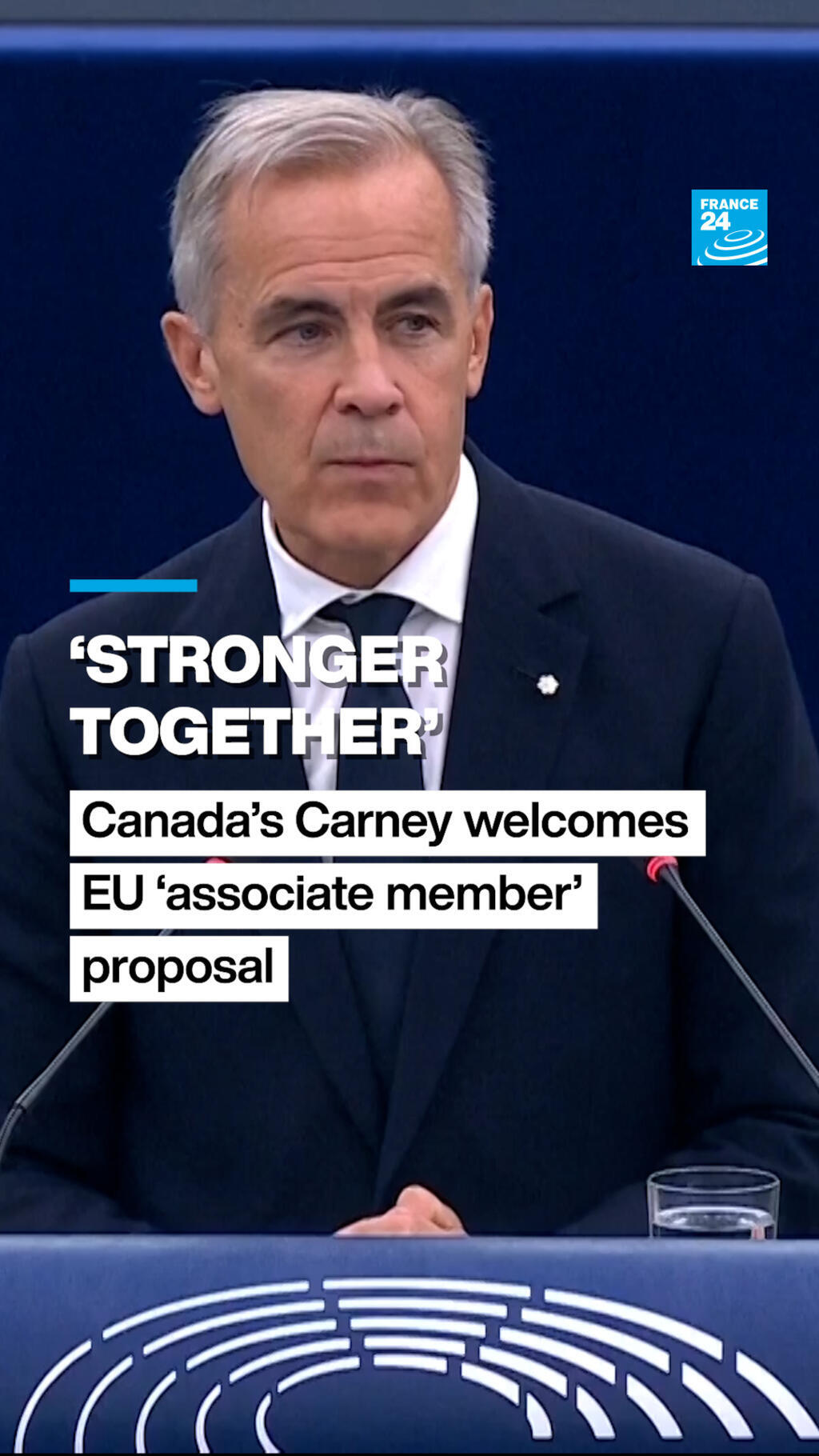
Canadian Prime Minister Mark Carney has welcomed the European Union’s proposal for Canada to become its first “associate member,” presenting the idea as a way to strengthen cooperation between Canada and Europe amid worsening geopolitical and economic tensions. Speaking to the European Parliament in Strasbourg, Carney said Canada and Europe were “stronger together” and called for closer collaboration on defence, critical minerals, energy security, technology, manufacturing and economic security.
The proposal was put forward by European Commission President Ursula von der Leyen, but the EU has no existing associate-member status. Creating one would require agreement from all 27 EU member states and could take years. Canada is not seeking full EU membership; instead, Carney described the proposal as a new framework that the two sides would define together.
The initiative comes as Canada and the United States face an escalating trade dispute involving retaliatory tariffs after negotiations broke down. US President Donald Trump criticized the idea, calling it potentially “hostile” and threatening severe tariffs or restrictions on trade with Europe if he concluded it was directed against the United States. Carney rejected the suggestion that the proposed alliance was intended to create a rival power bloc, saying it was instead about sovereignty and democratic cooperation.
Carney outlined possible practical benefits, including Canadian supplies of liquefied natural gas, hydrogen and critical minerals for Europe, alongside European expertise in clean-energy technologies. He also proposed greater technological cooperation and expanded educational and work opportunities through Canada’s possible participation in the Erasmus+ programme.
The plan will be debated and voted on by the Canadian Parliament. A Canada-EU summit scheduled for Montreal in late October is expected to examine the proposal in greater detail.
Entities: Mark Carney, Ursula von der Leyen, Donald Trump, Canada, European Union • Tone: analytical • Sentiment: neutral • Intent: inform
17-09-2026
The article reports that European Commission President Ursula von der Leyen has endorsed exploring a new form of “associate membership” for Canada, potentially making it the European Union’s first country to receive such a status. Speaking to the European Parliament, von der Leyen said the EU and Canada share similar positions on democracy, artificial intelligence, climate change, geopolitics, Ukraine, defence, raw materials and supply chains. She argued that closer partnerships are increasingly important as the international rules-based system comes under pressure.
The proposal comes as relations between Canada and the United States deteriorate. Trade negotiations between Ottawa and Washington collapsed the previous month, followed by new tariffs and renewed tension over President Donald Trump’s repeated suggestion that Canada could become the 51st US state. Trump called the EU-Canada proposal “laughable” and threatened severe tariffs or an end to trade with Europe if he considered it hostile.
The article notes that associate membership does not currently exist in the EU and that creating such a status could take years. Some EU countries may prefer to expand existing trade and defence agreements, while ten member states have still not ratified the EU’s free-trade agreement with Canada. Canadian Prime Minister Mark Carney, who attended the speech, has described the relationship as a potential “unique alliance.”
Von der Leyen also proposed a European Security Council involving countries including the UK, Ukraine, Norway and Canada. The body could provide emergency consultations during security crises, but some governments fear it might duplicate or compete with NATO. Other proposals addressed AI regulation, business bureaucracy, children’s social-media use, the cost of living and emergency responses to mass migration. Human-rights groups warned that tighter migration measures could undermine asylum protections, particularly for vulnerable people.
Entities: Ursula von der Leyen, Mark Carney, Donald Trump, European Union, Canada • Tone: analytical • Sentiment: neutral • Intent: inform
17-09-2026
The article examines a proposal by European Commission President Ursula von der Leyen for Canada to become an “associate member” of the European Union, a designation that does not formally exist under current EU law. Canadian Prime Minister Mark Carney welcomed the idea and called for an “alliance of the future” between Canada and the EU’s 27 member states, as Canada seeks closer ties with Europe while navigating a trade conflict with the United States.
René Repasi, a German member of the European Parliament and a former professor of EU law, describes the proposal as bold and potentially historic. He says it could represent the first concrete step toward Carney’s broader vision of an alliance among middle powers capable of resisting pressure from powerful states. Repasi believes the proposed relationship could involve exceptionally close political and economic ties, although its precise structure remains unclear.
The lawmaker stresses that creating such an arrangement would require a comprehensive new treaty between Canada and the EU. Existing models, such as the European Economic Area—which includes Iceland, Norway and Liechtenstein—provide close access to the EU’s internal market and participation in some EU rules and institutions, but Repasi says the Canada proposal would be more politically ambitious. The existing Canada-EU trade agreement, CETA, would not be sufficient on its own.
Repasi argues that closer cooperation would not necessarily undermine Canadian or European sovereignty. Instead, he says, sovereign countries could pool their strengths and expand their ability to act. He also acknowledges the geopolitical risks: U.S. President Donald Trump has mocked the prospect of an EU-Canada alliance and threatened heavy tariffs if he considers it hostile. Repasi presents the proposal as evidence that Europe may be willing to confront Trump more directly, rather than retreating to avoid conflict, though the supplied article ends mid-answer before his comments are completed.
Entities: Canada, European Union (EU), United States, Donald Trump, Mark Carney • Tone: analytical • Sentiment: neutral • Intent: analyze
17-09-2026
Canadian Prime Minister Mark Carney received a standing ovation at the European Parliament as Canada and the European Union explored a much closer economic, political and security relationship amid worsening tensions with the United States. Carney welcomed European Commission President Ursula von der Leyen’s proposal to consider Canada for a new “associate member” status, although that arrangement does not currently exist under EU treaties and its terms would need to be negotiated.
Carney said Canada was seeking deeper cooperation with Europe in trade, defense, critical minerals, artificial intelligence, energy, space, research and financial services. He emphasized that Canada was not pursuing full EU membership, which could require surrendering some sovereignty, but instead wanted resilience and independence so that no major power could control its markets, threaten its territorial integrity or undermine its democracy.
The proposal has drawn a sharp response from President Donald Trump. Trump threatened additional tariffs on the EU, and possibly restrictions on trade, if Europe’s intentions toward Canada were deemed hostile. He mocked the idea of associate membership and criticized Canada as a poor trading partner. His administration’s tariffs, demands for economic concessions and repeated suggestions that Canada become the 51st U.S. state have encouraged Ottawa to reduce its dependence on the United States.
The article places the development within a broader shift in the international system. Carney has argued that the old world order is gone and that middle powers should build stronger partnerships rather than negotiate individually with dominant countries. Canada sends approximately 70% of its exports to the United States, leaving it vulnerable to American trade measures, while Europe has accepted tariffs of up to 15% on many exports rather than retaliating.
Canada and the EU are expected to discuss the proposed relationship at a summit in Montreal on October 29 and 30. Canada has already joined the EU’s SAFE defense procurement program, and officials and analysts say the Trump administration’s policies are pushing both sides toward greater cooperation and reduced reliance on U.S. leadership.
Entities: Mark Carney, Donald Trump, Canada, European Union, Ursula von der Leyen • Tone: analytical • Sentiment: neutral • Intent: inform
17-09-2026
Canadian Prime Minister Mark Carney has welcomed European Commission President Ursula von der Leyen’s proposal for Canada to become the European Union’s first associate member, describing closer Canada-EU relations as a way to strengthen economic and political resilience. Speaking to EU lawmakers in Strasbourg, Carney said Canada and Europe would be stronger together and warned that tariffs, financial systems and supply chains are increasingly being used as instruments of coercion.
Although Carney did not name U.S. President Donald Trump directly, his remarks came shortly after Trump criticized the proposed arrangement as “laughable,” called Canada a poor trade partner and threatened to impose heavy tariffs on Europe if he considered the plan hostile. The United States and Canada are already engaged in a trade dispute, with Washington increasing tariffs on Canadian goods and Ottawa preparing reciprocal levies.
The proposed associate membership would represent a significant expansion of Canada-EU cooperation, but such a status does not currently exist under EU treaties. Any new arrangement would need to be negotiated, created legally and ratified by EU member states. Carney said Canadian lawmakers would have multiple opportunities to debate the relationship and would ultimately vote on its final structure.
Carney emphasized that the initiative was not intended to create a rival power bloc. Instead, he said Canada and Europe were seeking resilience, sovereignty, secure open markets and protection for democratic institutions. The EU and Canada already cooperate under the Comprehensive Economic and Trade Agreement, which eliminated 99% of tariff lines when it provisionally took effect in 2017. Von der Leyen said the relationship could evolve from CETA into a broader alliance covering trade, economic security, artificial intelligence, climate change, geopolitics, defense and Arctic security.
The article also reports that Carney met U.K. Prime Minister Andy Burnham in Liverpool, where they discussed closer cooperation with European partners, including trade and defense. Their talks included complementary defense initiatives involving the Multilateral Defence Mechanism and the Canada-led Defence Security Resilience Bank.
Entities: Mark Carney, Ursula von der Leyen, Donald Trump, Andy Burnham, Canada • Tone: analytical • Sentiment: neutral • Intent: inform
17-09-2026
U.S. President Donald Trump threatened to impose severe tariffs on the European Union or suspend trade with the bloc if it proceeds with a proposal to make Canada the EU’s first associate member. Trump called the idea “laughable” and criticized Canada as a poor trading partner, while saying his response would depend on whether he viewed the move as hostile.
The proposal was announced by European Commission President Ursula von der Leyen during her annual State of the European Union address. She said Brussels wanted to elevate its relationship with Canada through cooperation in manufacturing, defense industries, technology, energy, artificial intelligence and Arctic affairs. Associate membership is not currently a formal status under EU treaties, meaning any arrangement would need to be created and approved by the bloc’s member states.
The initiative represents a notable change in the EU’s position. Germany had proposed associate membership for Ukraine in May, but the bloc had responded cautiously. Canada, meanwhile, has expressed interest in a distinctive security and economic relationship with Europe without seeking full EU membership. Ottawa has increasingly pursued alternatives to dependence on the United States after months of escalating trade tensions and the collapse of bilateral negotiations.
Trump has already imposed a 50% tariff on Canadian goods and plans to prohibit Canadian dairy, alcohol and automotive imports later in September, prompting retaliatory measures from Ottawa. Canada already has a free-trade agreement with the EU that eliminates tariffs on about 99% of goods, although the agreement still requires ratification by 10 EU countries. It is also the only non-European participant in the EU’s SAFE defense-procurement initiative.
The article notes that new U.S. tariffs on European goods would test a trade framework reached by Washington and Brussels last year, which established a 15% tariff ceiling on most EU exports to the United States. The EU has not said whether it will advance the associate-membership plan despite Trump’s threat, and several member states were reportedly surprised by von der Leyen’s announcement.
Entities: Donald Trump, Ursula von der Leyen, Mark Carney, European Union, Canada • Tone: analytical • Sentiment: negative • Intent: inform
17-09-2026
Canadian Prime Minister Mark Carney has welcomed the European Union’s proposal to create an “associate member” status for Canada, describing the idea as ambitious while acknowledging that the arrangement still needs to be defined. Speaking to the European Parliament in English, French and German, Carney emphasized the shared democratic values, economic interests and security priorities of Canada and Europe.
Carney portrayed Canada and the EU as natural partners committed to the rule of law, human rights, individual freedom and democracy. He argued that closer cooperation would strengthen both sides’ resilience, while rejecting the idea that Canada and Europe were seeking to form a rival power bloc. His comments included an indirect criticism of the United States, as he said the goal was not to dominate others or achieve complete self-sufficiency, but to build collective resilience.
The speech comes amid a serious deterioration in Canada-US relations. Canada and the United States have been engaged in an escalating trade dispute after Carney and US President Donald Trump failed to reach an agreement. The EU’s proposal was announced by European Commission President Ursula von der Leyen, who said the bloc needed to adapt to a hostile international environment and strained relationships.
Trump sharply criticized the possibility of Canada becoming an EU associate member, calling the prospect “laughable” and warning that he could impose major tariffs or restrict trade with Europe if he viewed the move as hostile. The article also outlines the broader deterioration in bilateral ties, including Trump’s tariff measures, his suggestions that Canada could become the 51st US state, and his references to Canadian leaders as governors. Against this backdrop, Canada is exploring a closer and potentially unprecedented relationship with the EU.
Entities: Mark Carney, Canada, European Union, European Parliament, Ursula von der Leyen • Tone: analytical • Sentiment: neutral • Intent: inform
17-09-2026
US President Donald Trump has threatened the European Union with severe economic retaliation if it proceeds with a proposal to make Canada an associate member of the bloc. European Commission President Ursula von der Leyen announced the initiative during her annual address to the European Parliament in Strasbourg, describing it as a way to open the EU to Canada. Because the EU currently has no such associate-membership arrangement, the relationship would have to be developed from scratch.
Trump said the proposal could constitute a “hostile act.” He warned that the United States could impose “very serious tariffs” or halt trade with Europe in response, while also dismissing the idea of Canada joining the EU as “laughable.” His remarks add a new point of tension to already strained US-EU and US-Canada relations.
Canada’s interest in closer ties with Europe comes amid a major deterioration in its relationship with Washington during Trump’s second term. Canada was among the early targets of Trump’s tariff policy. Trade negotiations between Ottawa and Washington broke down the previous month, after which Trump imposed additional measures and Canadian Prime Minister Mark Carney vowed to retaliate.
The article also places the dispute in the wider context of deteriorating transatlantic relations. Trump’s push for US control of Greenland, an autonomous territory within the Kingdom of Denmark, has further alarmed European governments. The EU itself was affected by Trump’s broad tariff campaign, although Washington and Brussels later reached an agreement intended to reduce those tariffs. The proposed Canadian associate membership therefore reflects both Canada’s search for economic and political alternatives and the broader uncertainty surrounding relations between North America and Europe.
Entities: Donald Trump, Ursula von der Leyen, Mark Carney, European Union, Canada • Tone: analytical • Sentiment: negative • Intent: inform
17-09-2026
US President Donald Trump has threatened to impose “very serious tariffs” or cut trade with the European Union after European Commission President Ursula von der Leyen proposed making Canada the bloc’s first associate member. Trump called the idea of Canada joining the EU “laughable” and described Canada as a “terrible trade partner,” while warning that Washington would respond harshly if the proposal had hostile intentions.
Von der Leyen presented the proposal during her annual State of the European Union address, with Canadian Prime Minister Mark Carney attending. She said the EU and Canada would expand their existing free trade agreement, the Comprehensive Economic and Trade Agreement (CETA), through an “Alliance for the Future.” The partnership would cover trade and economic security as well as advanced manufacturing, technology, defense production, the Arctic, energy, critical minerals, batteries, artificial intelligence, quantum computing and cybersecurity.
The initiative reflects efforts by both Canada and the EU to reduce their dependence on the United States amid worsening trade and political tensions under Trump. Canada sends roughly 70% of its exports to the US, but Carney has sought a “unique alliance” with Europe and argued that middle powers should cooperate rather than negotiate separately with dominant countries. Ottawa has retaliated against US tariffs and rejected terms it believes would undermine Canadian sovereignty.
Canada is not seeking full EU membership, which officials say would require surrendering too much sovereignty. Instead, it wants the closest possible relationship with the bloc while preserving its independence. Canada has already joined the EU’s defense procurement program and has discussed associate membership with European officials. The EU, meanwhile, has reached a separate trade arrangement with Washington that caps tariffs on most EU exports at 15%, while Europe has removed tariffs on US industrial goods. The dispute risks further straining transatlantic trade and accelerating Canada’s strategic shift toward Europe.
Entities: Donald Trump, Ursula von der Leyen, Mark Carney, Jonathan Wilkinson, Canada • Tone: analytical • Sentiment: negative • Intent: inform
17-09-2026
France 24 reports on the reception given to Canadian Prime Minister Mark Carney during a speech at the European Parliament on 17 September 2026. The report presents the event as a sharp contrast between the response of most lawmakers and that of far-right members of the European Parliament.
According to France 24 correspondent Dave Keating, Carney received “thunderous applause” and a standing ovation. Centrist members of the European Parliament reportedly welcomed the speech, while left-wing members also responded positively. The report does not provide details about the substance of Carney’s address, instead concentrating on the political reaction inside the chamber.
The far-right was described as openly hostile to Carney’s presence. Far-right members reportedly grumbled during the event, and one far-right member began chanting “U-S-A! U-S-A!” when Carney started speaking. The chant appears to signal opposition to Carney’s appearance or to Canada’s closer relationship with European institutions, although the supplied article text does not explicitly explain the demonstrator’s motivation.
The headline uses a rhetorical and somewhat provocative question—“Guess who didn’t like Mark Carney’s speech today?”—before identifying the far-right as the answer. The report’s metadata links Carney to Canada, trade, and Donald Trump, while related coverage refers to Canada’s shifting alliances and efforts to strengthen ties with Europe amid tensions with the United States. However, those broader subjects are not developed in the article excerpt itself.
Overall, the piece is a brief political video report focused on the divided parliamentary reaction to Carney’s speech rather than on the speech’s policy content.
Entities: Mark Carney, Dave Keating, France 24, European Parliament, Canada • Tone: analytical • Sentiment: neutral • Intent: inform
17-09-2026
France 24 presents a replay of Canadian Prime Minister Mark Carney’s address to the European Parliament, dated Thursday, September 17, 2026. The brief item identifies the speech as taking place against a backdrop of comments by U.S. President Donald Trump, who suggested that allowing Canada to become an associate member of the European Union could be interpreted as a “hostile act.” The page does not provide a transcript, detailed account, or analysis of Carney’s remarks; it primarily directs readers to the replay video. The article is categorized under Europe and lists Canada, Europe, and Mark Carney as keywords. The available text therefore establishes the event, the participants, and the diplomatic context, but does not explain Carney’s policy positions, the EU’s response, or the substance of the discussion in Parliament. The page metadata states that it was issued on September 17, 2026, at 13:04 and modified at 13:20. Other material in the supplied content consists of video-player notices, cookie and advertising-tracking prompts, related-story links, navigation elements, and a “Page not found” message. These elements do not add substantive information about the address and have been excluded from the cleaned version. Overall, this is a concise video-replay listing rather than a full news report. Its main purpose is to inform readers that the address occurred and to frame it within a reported disagreement or tension involving Canada, the European Union, and the United States.
Entities: Mark Carney, Donald Trump, European Parliament, European Union (EU), Canada • Tone: neutral • Sentiment: neutral • Intent: inform
17-09-2026
The France 24 video report, issued on 17 September 2026, covers Canadian Prime Minister Mark Carney’s response to a European Union proposal for Canada to become the bloc’s first “associate member.” Speaking to EU lawmakers in Strasbourg, Carney welcomed the proposal and emphasized the perceived benefits of closer cooperation between Canada and Europe. He described both sides as individually strong but argued that their partnership would make them “stronger together.”
The report presents the proposal as a significant development in Canada–EU relations, although the available article text does not explain the precise institutional meaning, rights, obligations, or timeline associated with associate membership. It also does not provide details about how the proposal was made, whether it has received formal approval, or how Canada’s government plans to respond beyond Carney’s stated welcome. The item is formatted primarily as a short video report rather than a detailed analysis, with the accompanying text limited to Carney’s remarks and the basic circumstances of his address.
The overall framing is favorable toward closer ties between Canada and Europe. Carney’s statement presents cooperation as mutually beneficial and reflects a diplomatic, partnership-oriented message. The report does not include criticism, opposition, or reactions from other EU officials, Canadian political figures, or external commentators. Its primary purpose is to inform viewers about Carney’s endorsement of the EU proposal and his remarks to lawmakers in Strasbourg.
Entities: Mark Carney, Canada, European Union (EU), EU lawmakers, Strasbourg • Tone: positive • Sentiment: positive • Intent: inform
17-09-2026
A France 24 report describes a growing diplomatic and trade dispute between US President Donald Trump, the European Union and Canada. Trump threatened to impose severe tariffs on the European Union or halt trade in numerous areas if the bloc proceeds with a proposal to make Canada its first associate member. The proposal appears to be part of Canada’s effort to strengthen its relationship with Europe, but Trump characterized the initiative as potentially hostile toward the United States.
Speaking to reporters on Wednesday, Trump dismissed the plan as “laughable.” However, he also issued a conditional warning, saying that he would respond with “very serious tariffs” or stop trading with Europe on “many things” if he judged the EU’s action to be hostile. His comments raise the possibility of a new transatlantic trade confrontation involving not only the United States and the EU, but also Canada.
The report does not provide details about the terms of the proposed Canadian associate membership or explain how the arrangement would affect existing trade and political agreements. It does, however, place the announcement within a broader pattern of shifting alliances and closer Canada-Europe ties. France 24 correspondent Christopher Guly reports from Ottawa, highlighting Canada as the central location for the developing diplomatic story.
The article presents Trump’s remarks as a direct warning rather than an announced policy action. Any tariffs or trade restrictions remain conditional on his assessment of whether the EU’s proposal constitutes a hostile act. Nevertheless, the threat signals heightened tensions over Canada’s international alignment and the future of US-EU economic relations.
Entities: Donald Trump, European Union (EU), Canada, Christopher Guly, Ottawa • Tone: urgent • Sentiment: negative • Intent: inform
17-09-2026
The supplied page extract does not contain the actual article body, so a fully reliable summary of the reported reactions from EU leaders is not possible. The headline indicates that the article concerns a proposal for Canada to obtain some form of associate membership or closer institutional relationship with the European Union, and examines how European leaders are responding to it.
The available material consists largely of Global News navigation, sharing and commenting tools, followed by reader comments dated September 17–18, 2026. Those comments suggest that the proposal has generated a sharply polarized debate. Several commenters criticize Prime Minister Mark Carney, portraying the EU initiative as a diversion from unresolved Canada–United States trade negotiations or as a failure to deliver domestic election promises. Others raise concerns about the potential costs of an associate relationship, Canadian sovereignty, EU regulations, carbon taxes, trade rules and whether Canadians should be consulted through a referendum. Some commenters argue that closer ties with Europe could reduce Canada’s dependence on the United States, while others contend that Canada would be better served by maintaining or improving its relationship with Washington.
The comments also contain broader arguments about Alberta separatism, immigration, Ukraine and comparisons between Canadian, American and European economic conditions. These are reader opinions rather than verified statements from the article and should not be treated as evidence of EU leaders’ positions. No specific European leaders, official statements, proposed terms, institutional arrangements or economic consequences are included in the supplied text. Consequently, the article’s substantive findings, the precise nature of the associate-membership proposal and the responses from European governments remain unavailable from this extract.
Entities: European Union (EU), Canada, EU associate membership proposal, EU leaders, Mark Carney • Tone: neutral • Sentiment: neutral • Intent: inform
17-09-2026
Global News publishes a transcript of Prime Minister Mark Carney’s address to the European Parliament on September 17, 2026. In the speech, Carney calls for deeper cooperation between Canada and the European Union, particularly in trade, artificial intelligence, critical minerals and defence. The article also includes a video segment in which Carney responds to an invitation for Canada to become an associate member of the EU.
Carney frames Canada–EU relations as being founded on more than commercial agreements or formal treaties. He argues that the relationship is rooted in shared history, culture and democratic values. To make this point, he invokes the example of an oak tree associated with Johann Wolfgang von Goethe on Ettersberg, near Weimar, Germany. The tree later stood behind the barbed wire of Buchenwald, becoming a symbol of the contrast between European cultural ideals and the moral failures of the 20th century.
The speech emphasizes that freedom and democratic principles cannot be taken for granted. Carney says they must be defended continuously, rather than regarded as achievements secured only by historical milestones such as the end of the Second World War, the formation of European institutions or the fall of the Berlin Wall. He credits European resistance movements, the European Coal and Steel Community, the European Community and the European Union’s enlargement with helping preserve and develop freedom.
The supplied article content ends partway through the transcript, during Carney’s discussion of European integration and the expansion of the European Union.
Entities: Mark Carney, European Parliament, Canada, European Union, Roberta Metsola • Tone: urgent • Sentiment: positive • Intent: inform
17-09-2026
The article examines a proposed closer relationship between Canada and the European Union amid deteriorating ties between Canada and the United States. European Commission President Ursula von der Leyen floated the idea of an EU “associate membership” for Canada, even though no such formal category currently exists. Canadian Prime Minister Mark Carney welcomed deeper cooperation but rejected the notion of creating a new bloc designed to challenge the United States.
Speaking with NPR’s Mary Louise Kelly, Eurasia Group founder Ian Bremmer argues that the proposal is primarily substantive rather than a coded message to President Donald Trump. He says Canada is seeking greater resilience and predictability because its traditionally dependable relationship with the United States has become more vulnerable to unilateral decisions and tariffs during Trump’s second administration. Potential areas for cooperation include critical minerals, raw materials, energy security, defense, technology, research, and capital markets.
Bremmer says the EU would also benefit from closer ties with Canada because Canada offers resources, human capital, political stability, and a commitment to long-term relations. He places the initiative within a broader breakdown in the global order, driven both by U.S. retrenchment and China’s growing economic power without a corresponding commitment to democracy, free markets, or the rule of law.
The discussion frames Canada’s outreach as one possible response to what Bremmer calls a “GZERO world,” in which no country provides consistent global leadership. Countries can build new institutions, reform existing ones, or resort to conflict; Bremmer views the Canada-EU initiative as an attempt to emphasize the first two options. He believes the United States could remain secure if it recommits to democratic norms and predictable policy, but says lasting damage has been done to Canadian trust. Although the relationship could be repaired after a future change in administration, he doubts it will ever return to its previous level. The interview closes with speculation about closer European ties with the United Kingdom and other partners.
Entities: Canada, European Union, United States, Mark Carney, Ursula von der Leyen • Tone: analytical • Sentiment: negative • Intent: analyze
17-09-2026
Canadian Prime Minister Mark Carney used a speech before the European Parliament in Strasbourg to endorse closer Canada-EU ties, shortly after U.S. President Donald Trump warned Europe against pursuing a proposed partnership with Ottawa. The European Commission has invited Canada to become the European Union’s first associate member, a role that would deepen cooperation without making Canada a full participant in the EU’s single market.
Carney emphasized shared Canadian and European commitments to democracy, individual freedom, human dignity, and the rule of law. He welcomed the EU’s ambition and proposed cooperation in critical minerals, defense-industrial capacity, artificial intelligence, and energy security. He rejected the idea that Canada and Europe were forming an anti-American bloc, arguing instead that greater Canadian resilience would make Canada a stronger partner for the United States.
The proposal comes amid increasingly tense relations between Washington and its traditional allies. Trump’s administration has imposed tariffs, questioned continued U.S. support for NATO, and threatened to take control of Greenland. Trump called the Canada-EU proposal “laughable” and said he could impose severe tariffs or restrict trade with Europe if he considered the arrangement hostile.
European leaders largely welcomed Carney’s message. French lawmaker Nathalie Loiseau said democracies facing geopolitical disruption should work together, while Spanish Prime Minister Pedro Sánchez expressed support on social media. Carney has promoted cooperation among “middle powers” as protection against the use of trade, financial systems, and supply chains as geopolitical weapons.
Canada does not seek full integration into the EU single market. It already has a free-trade agreement with the bloc, though 10 EU countries have yet to ratify it. Canada and the EU also signed a security-cooperation agreement in 2025, and Canada is the only non-European country permitted to participate in the EU’s 150-billion-euro joint defense-purchases fund.
Entities: Mark Carney, Canada, European Union, European Parliament, Ursula von der Leyen • Tone: analytical • Sentiment: neutral • Intent: inform
17-09-2026
The supplied NPR material reports that Canadian Prime Minister Mark Carney addressed the European Parliament after the European Union invited Canada to become an “associate member” of the bloc. The development is presented as a significant diplomatic and political relationship between Canada and the EU, although the excerpt does not explain the precise terms of the proposed status, the timeline for any decision, or whether Canada has formally accepted the invitation.
The headline and accompanying description identify Carney’s appearance before the European Parliament as the central event. The report is categorized under World news and was published on September 17, 2026, for NPR’s Morning Edition. It is credited to Eleanor Beardsley and Michel Martin and is available as a 3-minute, 39-second audio segment.
Beyond identifying the invitation and Carney’s speech, the provided text contains no detailed discussion of the motivations behind the EU’s proposal, Canada’s response, or the potential political, economic, security, or institutional consequences of associate membership. It also does not include quotations from Carney, European officials, or other participants. Consequently, the article excerpt supports a limited summary focused on the diplomatic invitation and the Canadian prime minister’s engagement with European lawmakers, rather than a full account of the negotiations or their broader implications.
The report’s framing is factual and restrained. It presents the EU invitation as the reason for Carney’s appearance and gives readers the basic context needed to understand the event without expressing approval or opposition. The available material is therefore best understood as a brief news introduction or audio-segment description rather than the complete article transcript.
Entities: Mark Carney, Canada, European Parliament, European Union (EU), associate membership • Tone: neutral • Sentiment: neutral • Intent: inform
17-09-2026
Canadian Prime Minister Mark Carney welcomed a proposal for Canada to become the European Union’s first associate member, presenting the idea as a way to deepen cooperation without creating a rival geopolitical bloc. The proposal, introduced by European Commission President Ursula von der Leyen, would establish a new status that does not currently exist under EU treaties. It could expand cooperation beyond the existing Canada-EU free trade agreement into defense, critical minerals, artificial intelligence, energy, space, research, digital trade and financial services.
Carney said the objective is to strengthen Canada’s resilience and reduce its vulnerability to economic and political pressure, rather than seek power or dominance. His comments followed President Donald Trump’s description of the proposed arrangement as a potentially “hostile act” and “laughable.” Trump also threatened heavy tariffs on Europe if he concluded that the bloc’s intentions were unfriendly.
The article links Canada’s interest in Europe to deteriorating relations with Washington. Canada sends approximately 70% of its exports to the United States and has faced tariffs, demands for economic concessions and repeated comments from Trump about making Canada the 51st state. Ottawa has retaliated against US measures while rejecting demands it considers threats to Canadian sovereignty. Canada is not seeking full EU membership because that would require surrendering some sovereignty, but officials say it wants to integrate as closely as possible while remaining independent.
Carney will host EU leaders at a summit in Montreal on October 29-30 to discuss the proposed relationship. Canada has already joined the EU’s $173 billion SAFE defense procurement program, becoming its first non-European participant. Analysts say Trump’s policies are encouraging Canada and Europe to prepare for a world with less dependable US leadership. They also argue that Carney’s resistance to Washington has increased European interest in him, while ensuring that the White House will closely monitor the developing relationship.
Entities: Mark Carney, Donald Trump, Ursula von der Leyen, Canada, European Union • Tone: analytical • Sentiment: neutral • Intent: inform
17-09-2026
Canadian Prime Minister Mark Carney has embraced a proposal for Canada to become the European Union’s first associate member, presenting it as an opportunity for significantly closer cooperation rather than the creation of an anti-American political bloc. Speaking to the European Parliament, Carney welcomed the initiative put forward by European Commission President Ursula von der Leyen and outlined areas in which Canada and Europe could integrate more closely, including trade, defence, critical minerals, artificial intelligence, energy, space, research and financial services.
The proposal has drawn criticism from US President Donald Trump, who described the idea as “laughable” and suggested that it could constitute a “hostile act.” Trump also threatened to impose heavy tariffs on Europe if he believed the arrangement reflected unfriendly intentions. His reaction adds geopolitical and economic pressure to a plan that would deepen ties between Canada and the EU.
Carney sought to counter that interpretation by stressing that closer Canada-Europe relations would not be intended to establish a new bloc capable of rivaling the world’s major powers. He said the goal was to reduce both sides’ vulnerability to economic and geopolitical pressure while maintaining a cooperative, rather than dominant, international posture. His statement that “we do not seek power to dominate others” framed the proposed partnership as a defensive and mutually beneficial arrangement.
The article portrays the associate-membership proposal as part of broader efforts by Canada and Europe to strengthen resilience across strategic sectors. It also highlights the tension between those efforts and the Trump administration’s apparent opposition to new forms of transatlantic cooperation outside the traditional US-led framework.
Entities: Mark Carney, Canada, European Union, Canada-EU associate membership, Donald Trump • Tone: analytical • Sentiment: neutral • Intent: inform
17-09-2026
Agence France-Presse reports that US President Donald Trump threatened the European Union with major trade retaliation after the bloc proposed making Canada its first-ever associate member. Trump said the United States could impose “very serious tariffs” on European goods or halt trade with Europe across a broad range of products if he considered the proposal a hostile act.
The proposal was raised by European Commission President Ursula von der Leyen one day before Canadian Prime Minister Mark Carney was scheduled to address the European Parliament. The initiative would represent an unprecedented formal relationship between Canada and the EU and comes as both sides look for closer cooperation beyond their traditional reliance on the United States.
The article characterizes the political context as increasingly strained under Trump’s leadership, describing Canada and the EU as seeking to pivot away from what it calls an aggressive US approach. Trump dismissed the proposal as “laughable” when questioned by reporters, but immediately followed that assessment with a warning of severe economic consequences.
The dispute highlights a growing clash over alliances, trade policy and Canada’s relationship with Europe. Canada’s possible associate membership could deepen its political and economic ties with the EU, while Trump appears to view the move as potentially hostile to US interests. The report does not provide detailed responses from von der Leyen, Carney or other European and Canadian officials, nor does it explain the precise terms of the proposed associate membership. Its focus is on Trump’s public reaction and the risk that the proposal could further intensify tensions in transatlantic trade and diplomacy.
Entities: Donald Trump, Ursula von der Leyen, Mark Carney, European Union (EU), Canada • Tone: urgent • Sentiment: negative • Intent: inform
17-09-2026
Canadian Prime Minister Mark Carney used a speech to the European Parliament in Strasbourg to call for a broad strategic alliance between Canada and the European Union. He proposed cooperation in critical minerals, artificial intelligence and computing, defence, energy security, space, payments and trade. His remarks followed European Commission President Ursula von der Leyen’s suggestion that Canada could become the EU’s first “associate member,” moving relations beyond the existing Comprehensive Economic and Trade Agreement (CETA).
Carney framed the proposal against a deteriorating geopolitical environment. He cited climate-related upheaval, the weakening of democratic norms, the weaponisation of trade, weakened multilateral institutions and the growing influence of technology platforms. He argued that technology is changing warfare, economies and governance, while large platforms increasingly seek control over regulation, data and public discourse.
In response, Carney said Canada and Europe should build an alliance based on shared commitments to the rule of law, human dignity, individual freedom and democracy. He described the proposed partnership as open to other countries, strong enough to protect members’ ability to make independent choices and grounded in international law rather than power alone. He also said public opinion in Canada strongly supports closer ties with Europe.
The prime minister linked sovereignty to resilience and strategic autonomy. Specific proposals included securing supplies of critical minerals, expanding defence-industrial capacity, strengthening AI and computing capabilities, improving energy security and developing cooperation in space and payment systems. He also called for more seamless digital trade in non-agricultural goods and services, as well as greater freedom for young people to live, work and study on either side of the Atlantic. Canada, he added, could support Europe’s energy needs by supplying liquefied natural gas and hydrogen, using port infrastructure in northern and eastern Canada.
Entities: Mark Carney, Canada, European Union, European Parliament, Strasbourg, France • Tone: analytical • Sentiment: neutral • Intent: inform
17-09-2026
Mark Carney received an enthusiastic welcome at the European Parliament in Strasbourg after Ursula von der Leyen proposed that Canada become the European Union’s first associate member. European politicians presented the initiative as a historic deepening of ties, particularly as Canada and the EU seek closer cooperation on artificial intelligence, energy security, critical minerals, quantum computing, Arctic affairs and trade. The proposal also comes amid pressure from Donald Trump, who mocked the idea and threatened the EU with heavy tariffs if it went ahead.
Despite the warm reception, the proposal is clouded by major uncertainty. Associate membership has no established legal definition in EU treaties, leaving governments unsure what rights, obligations or institutional arrangements it would involve. German officials welcomed a closer relationship but suggested that the label should be reconsidered, while EU diplomats described the term as premature or an empty phrase. Any new framework would require approval from all 27 member states.
The article also highlights practical obstacles. The EU-Canada Comprehensive Economic and Trade Agreement has still not been ratified by 10 EU countries, including France, Italy and Poland. Domestic political pressures and upcoming elections make further delays likely. Canada’s “buy Canadian” procurement policy and the EU’s proposed “buy European” rules could also undermine claims that both sides are committed to deeper free trade.
A further complication concerns access to the EU single market. Carney called for seamless digital trade in non-agricultural goods and services, but the EU generally treats the free movement of goods, services, labour and capital as an inseparable package requiring alignment with its rules. The article concludes that, beyond the symbolism and applause, substantial legal, political and economic questions remain unresolved.
Entities: Mark Carney, Canada, European Union, Ursula von der Leyen, European Parliament • Tone: analytical • Sentiment: neutral • Intent: analyze
17-09-2026
Based on the supplied excerpt, the article reports a growing diplomatic divide between Canada and the United States and describes Canada’s effort to strengthen ties with the European Union. Canadian Prime Minister Mark Carney is presented as responding to what the article characterizes as new threats from President Donald Trump. Rather than retreating in the face of pressure from Washington, Carney reportedly made a forceful argument in Brussels for Canada to move closer to the European Union.
The headline indicates that Trump views, or may view, Canadian membership in the European Union as a potentially “hostile act,” suggesting that closer Canadian-European integration could further strain relations between Ottawa and Washington. The excerpt frames Canada’s outreach to Europe as a strategic response to U.S. hostility rather than as a routine diplomatic initiative. It also portrays Carney as brushing aside Trump’s threats and advocating a more independent foreign-policy direction for Canada.
The passage does not provide details about the nature of Trump’s threats, the legal or political feasibility of Canada joining the European Union, or the reactions of European officials. It also does not explain whether Carney is proposing full membership or broader economic and political cooperation. Therefore, the available material supports a summary of the article’s central diplomatic theme but not a full account of its reported evidence, context, or consequences. The article’s overall focus appears to be the possible realignment of Canada toward Europe amid deteriorating relations with the United States.
Entities: Donald Trump, Mark Carney, Ellen Francis, Canada, European Union (E.U.) • Tone: analytical • Sentiment: negative • Intent: inform
17-09-2026
France 24 reports on Canadian Prime Minister Mark Carney’s address to the European Parliament on September 17, 2026. The report presents the speech as evidence of a significant change in Canada’s international relationships. Ottawa and Brussels are described as deepening their ties while Canada’s relationship with the United States has become strained. Against that backdrop, Carney’s decision to address European lawmakers is portrayed as symbolically important: a message focused on Canada’s strategic partnerships and international outlook that, until recently, would more likely have been delivered in Washington than in Brussels.
France 24 journalist Doug Herbert explains that the speech reflects a broader realignment of Canada’s alliances rather than being merely a parliamentary appearance. The report emphasizes the contrast between Canada’s strengthening engagement with the European Union and its more difficult relations with the United States. It does not provide extensive details about the contents of Carney’s remarks, specific agreements, or policy announcements. Instead, it focuses on the diplomatic significance of the venue and the changing balance of Canada’s external relationships.
The item is presented as a short video report under the Europe section. Its central message is that Canada is increasingly looking to Europe as an important partner at a time when its traditional relationship with Washington is under pressure. The article’s framing is analytical and largely neutral, describing the geopolitical implications of the speech without explicitly endorsing or condemning the shift. The accompanying keywords identify Canada, Mark Carney, and Europe as the main subjects.
Entities: Mark Carney, Canada, Canadian Prime Minister, European Parliament, European Union (EU) • Tone: analytical • Sentiment: neutral • Intent: analyze
17-09-2026
The France 24 program “A propos” presents a brief interview about the economic relationship between Canada and the European Union. In the segment, journalist Monte Francis speaks with Fabian Zuleeg, identified as the Chief Economist at the European Policy Center, about the potential benefits of closer Canada-EU cooperation. The segment was issued on September 17, 2026, and has a runtime of 9 minutes and 39 seconds.
Zuleeg describes the partnership as “a classic win-win situation.” His explanation is based on the complementary economic strengths of the two sides. According to him, Canada possesses substantial resources and economic capabilities that the European Union lacks. In turn, the EU offers access to a very large market and represents an important trading partner for Canada. The comments frame the relationship primarily through the lens of trade, market access, resources, and economic complementarity.
The item is a concise video interview rather than a detailed policy analysis. The available text does not identify specific resources, industries, trade agreements, investment figures, or political initiatives connected to the partnership. It also does not present opposing views or discuss possible challenges in Canada-EU relations. Instead, it communicates an economist’s broadly positive assessment of the relationship and emphasizes the mutual advantages that closer cooperation could provide. The central message is that Canada and the EU can each supply economic assets that benefit the other, making their partnership advantageous for both sides.
Entities: Canada, European Union, Canada-EU partnership, Fabian Zuleeg, European Policy Centre • Tone: analytical • Sentiment: positive • Intent: inform