21-09-2026
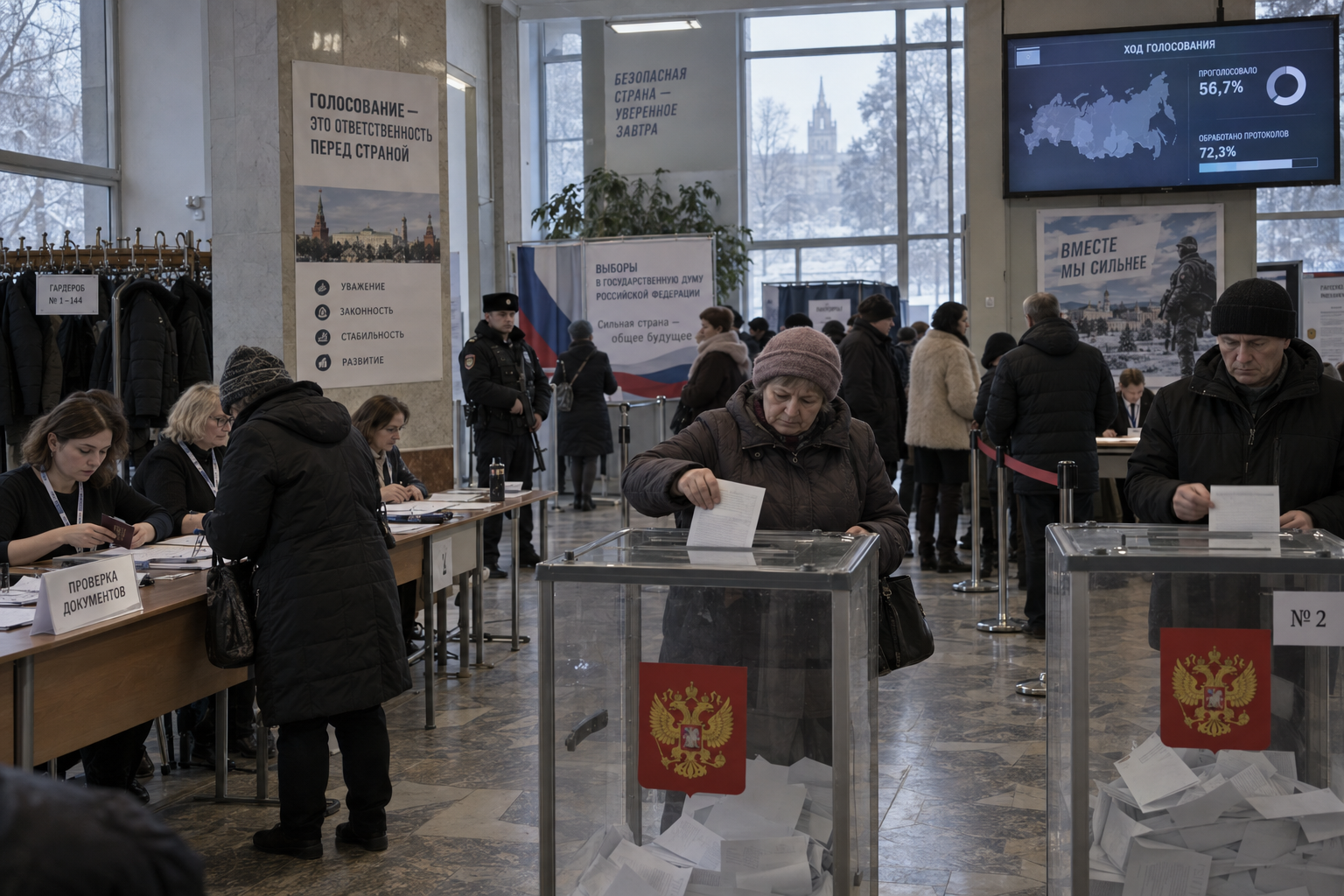
Russia’s ruling United Russia party is leading the country’s first parliamentary elections since the full-scale invasion of Ukraine began in 2022. Early results from the tightly controlled, three-day vote showed United Russia receiving nearly 58 percent of party-list ballots after about 58 percent of precincts had reported. The party was also expected to win most of the 225 single-seat constituencies, preserving its dominant position in the 450-member State Duma. Official turnout was reported at 56.66 percent.
The Kremlin has presented the election as a demonstration of public support for the war and as a means of legitimising its policies. The vote was held amid mounting economic pressure and increasingly frequent Ukrainian drone attacks inside Russia. Russian officials accused Ukraine of attempting to disrupt the election after Kyiv launched hundreds of drones against Moscow and other regions. Authorities said the attacks killed at least three people in the Moscow region and two others in the Russian-controlled part of Ukraine’s Kherson region, including an election official. Russian authorities also reported attacks on electronic voting systems and communications networks, although they said voting proceeded largely without disruption.
The election included residents of Crimea and four Ukrainian regions that Russia claims to have annexed but does not fully control. Ukraine condemned voting in those areas as illegal, while the European Union called it a blatant violation of international law.
The article says the election was conducted without genuine political competition. Smaller pro-Kremlin parties were expected to retain their parliamentary presence, while the liberal Yabloko party was removed from the ballot and anti-war politicians were imprisoned or forced into exile. Russia also did not invite election observers from the Organization for Security and Cooperation in Europe. Together, state media dominance, restrictions on opposition forces, and the exclusion of international observers are expected to ensure that the Kremlin maintains tight control over Russian politics.
Entities: United Russia, Russian parliamentary election, Kremlin, Russia’s Central Election Commission, State Duma • Tone: analytical • Sentiment: negative • Intent: inform
21-09-2026
A France 24 live report says Russian President Vladimir Putin’s ruling United Russia party won a large majority in Russia’s parliamentary elections, according to results published by Russian state media early Monday. The vote was reportedly conducted amid cyberattacks and a major wave of Ukrainian drone strikes, raising concerns about security and possible efforts to disrupt the electoral process.
The report focuses heavily on an overnight drone barrage targeting Russia, particularly Moscow. Russian officials said Ukrainian forces launched more than 1,000 drones at targets across the country. Moscow’s mayor described the assault as the largest ever directed at the Russian capital, while also alleging that more than 1,600 drones had been sent toward Russia with the intention of disrupting the parliamentary elections. The differing figures are presented as claims by Russian officials and are not independently verified in the excerpt.
In response, Moscow vowed to intensify its strikes on Kyiv. The escalation followed a Russian strike in Ukraine’s Kyiv region that Ukrainian authorities said killed at least four people, including three children. The report therefore portrays the election as taking place against the backdrop of a rapidly intensifying war involving long-range drone attacks, retaliatory threats and civilian casualties.
The supplied text is an introductory liveblog update rather than a complete account of the election or military events. It attributes information to Russian officials, Ukrainian authorities, state media, and the news agencies AFP, AP and Reuters. The article’s overall focus is on the reported election result, the scale and political significance of the drone attack, and the risk of further escalation between Moscow and Kyiv.
Entities: Vladimir Putin, United Russia, Russia, Ukraine, Moscow • Tone: urgent • Sentiment: negative • Intent: inform
21-09-2026
Russia’s ruling United Russia party has taken a commanding early lead in the State Duma election, receiving 57.5% of the vote in initial results, according to the country’s Central Election Commission. The three-day parliamentary election concluded on Sunday, with final results and the distribution of all 450 seats expected by September 25. United Russia, which supports President Vladimir Putin, previously won 324 seats in the 2021 election.
The vote is the first parliamentary election since Russia launched its full-scale invasion of Ukraine in February 2022. Putin presented the election as an opportunity for Russians to demonstrate unity and support for the country’s military campaign, linking voter participation to backing for Russian troops and the government’s domestic and military policies. Putin was not a candidate and is not due to face another presidential election until 2030.
The election took place in a highly restricted political environment. CNN reported that meaningful opposition to the Kremlin was largely absent, while Yabloko, described as Russia’s only registered anti-war party, was barred from participating in the federal party-list contest after a Supreme Court decision. National voter turnout was reported at 56.66%, with high participation also reported in Moscow. Because the result was widely anticipated, turnout and the final allocation of seats are key issues being monitored.
The election was also overshadowed by renewed military activity. Ukraine reportedly launched more than 1,000 drones toward Moscow and the surrounding region on Sunday. Russian officials said that at least two people were killed and an oil refinery was damaged. Moscow Mayor Sergei Sobyanin said the attacks aimed to disrupt the vote, although Ukraine had not independently confirmed that claim. The Kremlin is expected to use United Russia’s result as evidence of domestic support for Putin and his policies, including the war. Russian citizens abroad also voted, including at five polling stations in India.
Entities: United Russia, Vladimir Putin, State Duma, Russia’s Central Election Commission, Russian parliamentary election • Tone: analytical • Sentiment: neutral • Intent: inform