24-09-2026
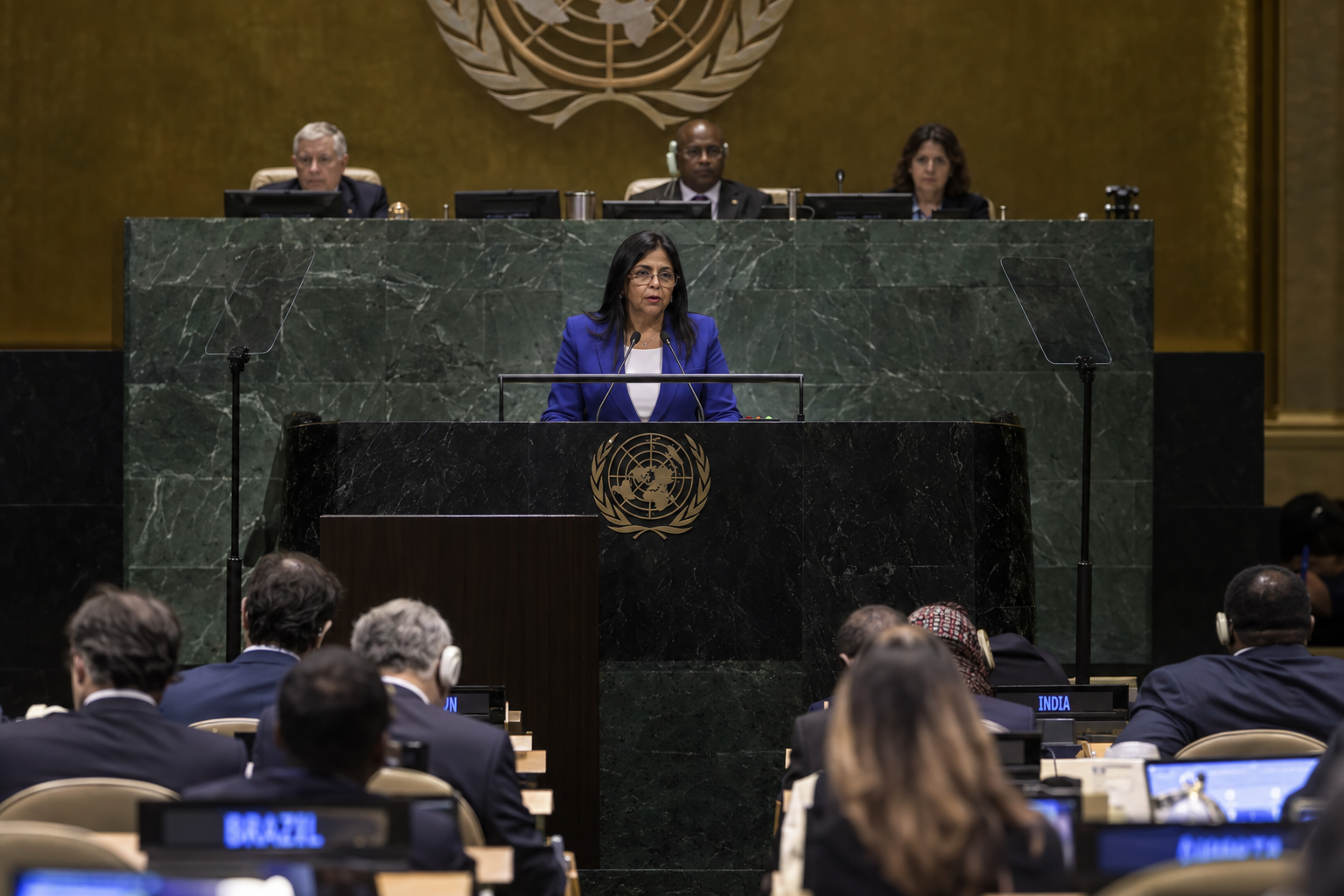
Venezuela’s acting President Delcy Rodriguez told the United Nations General Assembly that the country will hold elections as part of a transition to “full democracy,” but she did not announce a date. She said her government had begun political dialogue with opposition groups and that Venezuelans would determine when elections should proceed. Rodriguez promised that national institutions would be prepared to ensure an inclusive and transparent vote when the time comes.
Rodriguez became interim president after a US military raid in January abducted then-President Nicolas Maduro and took him to the United States to face drug-trafficking charges. Maduro is being held near UN headquarters while awaiting trial. Rodriguez’s appearance was the first visit to the United States by a Venezuelan head of state since Maduro attended the General Assembly in 2018, and it was described as a milestone in Venezuela’s return to international diplomacy.
Her speech had to address both Venezuelans and the US government, which holds her predecessor. Rodriguez said Venezuela was recovering from setbacks and thanked US President Donald Trump for being willing to resume relations. She met Trump briefly during the UN gathering; their discussions included restructuring Venezuela’s billions of dollars in sovereign debt.
The article notes that critics accuse Washington of sidelining Venezuela’s opposition and prioritizing oil and investment agreements with Rodriguez’s interim government over demands for free elections. Rodriguez described the country as being reborn, while warning that the path ahead would not be easy and saying that rebuilding the national soul would be a priority.
Entities: Delcy Rodriguez, Nicolas Maduro, Donald Trump, Venezuela, United Nations General Assembly • Tone: neutral • Sentiment: neutral • Intent: inform
24-09-2026
The brief report describes remarks by Venezuela’s Interim President Delcy Rodriguez during her first address to the United Nations General Assembly. Rodriguez said Venezuela must move away from what she called the “extremism” of the past in order to rebuild a new nation. She also pledged that the country would hold inclusive elections, presenting them as part of a path forward. However, she did not specify when those elections would take place, leaving their timing unclear. The item provides no further details about the proposed election process, what Rodriguez meant by “extremism,” or the political circumstances surrounding her remarks. It also does not describe reactions from other delegates or provide additional commitments. Its central focus is therefore the contrast between a broad pledge of political inclusion and the absence of a timetable. The article situates the statements at the UN General Assembly, where Rodriguez delivered her first address in that role, and reports her appeal to leave past extremism behind as the country seeks national renewal. Beyond those points, the report offers no elaboration on how Venezuela would achieve that rebuilding or implement the promised elections. Overall, it presents a concise account of Rodriguez’s stated intentions, while making clear that a key practical detail—the election date—was not announced.
Entities: Delcy Rodriguez, Venezuela, United Nations General Assembly (UNGA), Interim President, inclusive elections • Tone: neutral • Sentiment: neutral • Intent: inform
24-09-2026
Venezuela’s interim president, Delcy Rodriguez, told the United Nations General Assembly that the country would hold elections as part of a transition to what she called “full democracy.” She did not, however, announce when the vote would take place. Rodriguez emphasized that elections would be held, saying she wanted to make that commitment clear to the assembly. She took power after US forces captured then-President Nicolas Maduro in a January raid, according to the article.
Rodriguez said her government had begun talks with the opposition and would guarantee that all political forces could participate. She also said national institutions were being prepared for the electoral process. Her remarks therefore offered assurances about the intention to hold elections and the proposed inclusiveness of the process, but no timetable or specific date.
The article’s headline and subheading highlight an important qualification: a key rival remains in exile. This underscores that questions about opposition participation and the practical path to an election remain unresolved, despite Rodriguez’s stated commitment. The report does not identify the rival or provide further details about the talks, the preparations, or the conditions under which the elections would be held. Overall, it presents Rodriguez’s UN remarks as a promise of a democratic transition whose timing has yet to be specified.
Entities: Delcy Rodriguez, Nicolas Maduro, Venezuela, United Nations General Assembly, Reuters • Tone: neutral • Sentiment: neutral • Intent: inform
24-09-2026
On NPR’s Morning Edition, host A Martínez interviews veteran diplomat Richard Haass about diplomacy and political maneuvering at the United Nations General Assembly. Discussing Venezuela, Haass says political reform is needed for stability and legitimacy, and views interim president Delcy Rodríguez’s stated commitment to elections and a transition to democracy as a step in the right direction. He cautions, however, that there is no timetable and that reform should not be forced in a way that could provoke civil or armed resistance. Haass also notes that democracy in Venezuela could produce leaders less willing to cooperate with the Trump administration on oil, while uncertainty about future governments in both Venezuela and the United States makes long-term investment risky for oil companies.
Turning to Ukraine, Haass says concerns that Russia’s war could spread are real. He suggests Russia might pressure Baltic countries or Poland to weaken support for Ukraine, while also seeking to expose divisions within NATO, particularly between the United States and its European partners.
Asked about the most notable General Assembly speech, Haass points to President Trump’s address, which he says highlighted a major change in U.S. foreign policy. In his view, the United States has shifted from leading largely through consent toward attempting to impose its will more coercively and unilaterally. Haass also agrees that the United Nations has become less effective as an institution for collective action. He characterizes it chiefly as a gathering place for speeches and side meetings, arguing that rivalries among major powers—including the United States, Russia, and China—have gridlocked the Security Council. The institution, he concludes, reflects the world more than it leads it, and this situation is unlikely to change.
Entities: Richard Haass, A Martínez, Delcy Rodríguez, Donald Trump, Volodymyr Zelenskyy • Tone: analytical • Sentiment: neutral • Intent: analyze