28-10-2026
At least 64 people were killed when two high-speed trains collided in central Spain on Wednesday morning, according to local officials. The crash occurred near Toledo, in the Castilla-La Mancha region, on the line connecting Madrid with Andalusia. Rail operator Adif suspended traffic on the route after what it described as a rear-end collision.
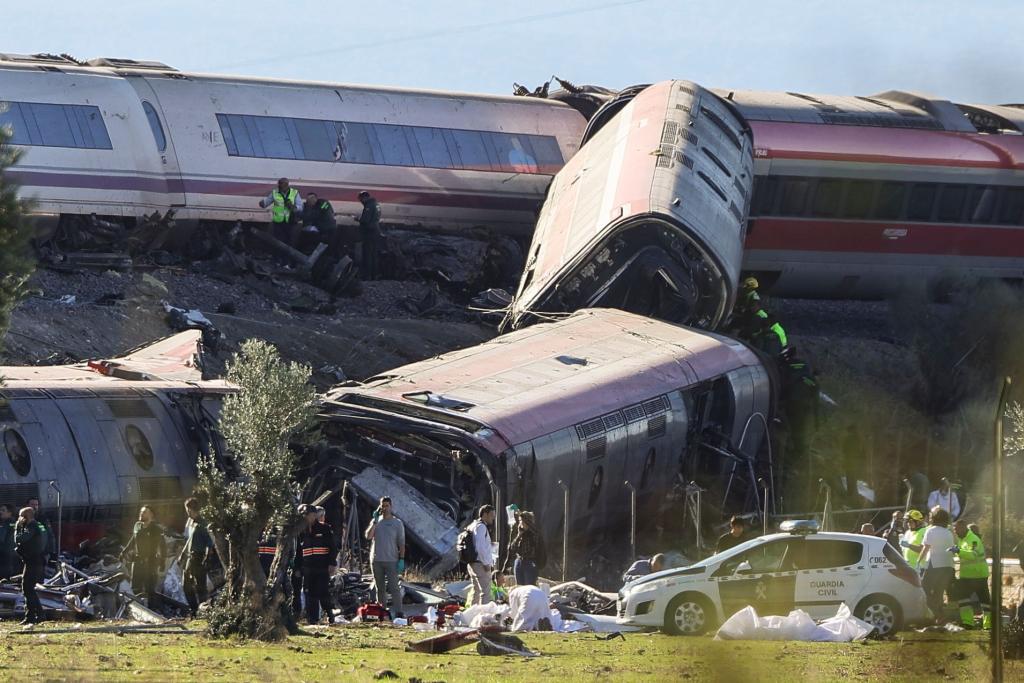
An official briefed on the accident said an Iryo express train had stopped at a signal when it was struck by a Renfe high-speed train. Regional spokesperson Esther Padilla said one train hit the stationary train’s rear, knocking carriages off the track; several carriages reportedly went down an embankment. The trains carried 147 Iryo passengers and 397 Renfe passengers. Padilla warned that the death toll was very likely to rise, while officials said the cause of the crash was not yet known. It occurred on a flat stretch between Urda and Los Yébenes.
Spanish Health Minister Mónica García said emergency crews were concentrating on rescuing survivors and recovering bodies from the two most badly damaged cars. Injured passengers were being taken to hospitals in the area. Urda’s mayor, Manuel Galán, said local civil protection authorities had asked the town to prepare a sports pavilion to receive injured passengers. A military emergency brigade joined firefighters, police and other responders at the scene. Prime Minister Pedro Sánchez cancelled his schedule and expressed dismay over the accident.
The article also notes a separate fatal train crash in southern Spain in January, in which 45 people died and 120 were injured after an Iryo train derailed into the path of an oncoming Renfe AVE train near Adamuz. That accident remains under investigation. A preliminary Civil Guard report identified possible defects in the track, rail or a weld as its main hypothesis, while leaving seven other theories open.
Entities: Toledo, Spain, Castilla-La Mancha, Madrid–Andalusia high-speed rail line, Iryo, Renfe • Tone: urgent • Sentiment: negative • Intent: inform
28-10-2026
A high-speed train collision in Toledo province, Spain, left at least 10 people dead, and officials warned that the death toll could increase. The crash happened between Urda and Los Yébenes when a train travelling from Madrid towards Seville struck the rear of another train that had stopped on the same track. The collision involved a RENFE train carrying 397 passengers and an IRYO service carrying 147. Two carriages were knocked off the rails; one was torn apart, leaving twisted metal and debris scattered down a gravel embankment. Aerial footage showed the wreckage in a flat, rural area, with firefighters, police and rescue teams at the scene.
Emergency workers focused on reaching victims trapped or otherwise affected in the two most badly damaged carriages. Injured passengers were transported to nearby hospitals. A military emergency unit was also deployed, and rail services between Madrid, Ciudad Real and Andalusia were suspended. Castilla-La Mancha government spokeswoman Esther Padilla confirmed the initial death toll. The cause of the collision had not been established.
Prime Minister Pedro Sánchez cancelled his engagements to focus on the disaster. The crash was Spain’s second major rail tragedy of 2026. In January, a collision in southern Spain killed 45 people, raising concerns about safety on the country’s extensive high-speed rail network. The article reports the latest crash and emergency response while noting that its cause and final human toll remained uncertain.
Entities: Urda, Los Yébenes, Toledo province, Madrid, Seville • Tone: neutral • Sentiment: negative • Intent: inform
28-10-2026
Rescue teams continued searching the wreckage of a serious train crash on Spain’s Madrid–Seville rail line, near Toledo. The collision happened shortly before 9 a.m. at kilometre 118, between Mora, Orgaz and Urda. According to the account, a Renfe AVE train carrying 397 passengers struck the rear of a privately operated Iryo train. The Iryo train had stopped after a reported signal fault and was carrying 147 people, including a baby. The impact knocked two carriages off the tracks.
Footage released by Spain’s Military Emergency Unit showed rescue personnel searching through debris. Civil Guard officers and firefighters also assisted at the scene. About 100 UME personnel were deployed, with sniffer dogs and specialist teams working among the twisted metal. Meanwhile, injured passengers were taken to hospitals in Toledo. Ambulances arrived throughout the morning, and police cordoned off hospital entrances.
Regional officials said 58 people required hospital treatment, approximately 50 of them seriously. King Felipe VI sent condolences to victims and their families, while Prime Minister Pedro Sánchez expressed solidarity and support. The article provides no further detail about the cause of the reported signal fault or the investigation into the collision.
The crash is described as Spain’s second major rail accident this year. In January, a separate crash in southern Spain killed 45 people. The account focuses on the rescue operation, the number of people treated, the trains and passenger counts involved, and expressions of official sympathy. It does not report the identities of the injured or provide additional information about the condition of the passengers.
Entities: Spain, Toledo, Madrid–Seville rail line, Mora, Orgaz • Tone: neutral • Sentiment: negative • Intent: inform
28-10-2026
A high-speed train struck the rear of another train that had stopped near Urda, in Spain’s Toledo province, derailing two carriages and killing at least 30 people, according to authorities. The collision occurred early on Wednesday, about 150 kilometres south of Madrid. At least 80 people were injured, and Emiliano Garcia-Page, president of the Castilla-La Mancha region, cautioned that the death toll could rise.
Spain’s Health Minister, Monica Garcia, said emergency crews were concentrating on rescuing survivors and recovering bodies from the two most badly damaged carriages. Injured passengers were being transported to several hospitals in the surrounding area. The article’s photographs show the crash site from the air, rescue teams working among the wreckage, and emergency workers searching the derailed cars.
The report places the collision in the context of two previous deadly Spanish rail disasters. In January, 45 people were killed in southern Spain when a train left the tracks and collided with an oncoming service. That crash was described as the country’s deadliest since a 2013 derailment that killed 80 people. The article provides no further details about the cause of the latest collision or the trains involved beyond the account that one struck another stopped train.
Entities: Spain, Urda, Toledo province, Madrid, Castilla-La Mancha • Tone: neutral • Sentiment: negative • Intent: inform
28-10-2026
At least 68 people were killed and dozens injured when two high-speed trains collided in central Spain on Wednesday morning. A train operated by Iryo, carrying 147 passengers, had stopped on the tracks after a computer failure. Spain’s Transport Minister Óscar Puente said a Madrid control centre then made an “inexplicable” decision to send trains moving again without speed restrictions. The stationary train was struck from behind by a Renfe train carrying 397 passengers. Several carriages fell down an embankment, one caught fire, and a section of track pierced a carriage.
Survivors described a violent impact, passengers being thrown through the air, and people trapped in wreckage. Emergency crews sent dozens of ambulances and a helicopter to the scene; authorities said DNA samples from relatives may be needed to identify some victims. Prime Minister Pedro Sánchez visited the site and said Spain was grieving, while pledging to investigate whether negligence contributed to the crash. The disaster is among Europe’s worst in recent history and Spain’s deadliest rail crash since 2013.
The collision follows another deadly high-speed rail disaster near Córdoba in January, which killed 46 people on the same line. Political parties largely cancelled campaign events, although Vox leader Santiago Abascal criticized what he called efforts to use mourning to silence criticism of rail infrastructure. Opposition leader Alberto Núñez Feijóo called for failures in the security system to be addressed, while the trade union CSIF demanded the transport minister resign, accusing him of scapegoating a traffic manager. The article reports that the cause and any responsibility remain under scrutiny.
Entities: Spain, Mora and Orgaz, Madrid–Seville rail route, Iryo, Renfe • Tone: emotional • Sentiment: negative • Intent: inform
28-10-2026
Two trains collided on Wednesday morning between Mora and Orgaz in Spain’s Castilla-La Mancha region, about 140km south of Madrid. The crash involved a Renfe train and an Iryo high-speed train on the Madrid-to-Seville route. At least 64 people have been confirmed dead, and authorities say the toll may rise. Around 80 people are being treated for injuries, including 50 in serious condition and 15 in critical condition. More than 500 passengers were reportedly on board: 147 on the Iryo train, including a baby, and 397 on the Renfe train. At least two carriages fell down an embankment after the collision. Reports cited by broadcaster RTVE said the Renfe train rear-ended the Iryo train, which was stationary on the tracks.
The cause remains under investigation. Iryo said its train was struck from behind for reasons not yet known. Transport Minister Oscar Puente said a computer failure initially stopped six moving trains, including the two involved. He said the control centre then allowed trains to move again without speed restrictions, describing the decision as inexplicable. The article reports that the Renfe train subsequently struck the stationary Iryo train.
Rail services on the line have been suspended, including services between Madrid, Ciudad Real and Andalusia. Emergency services, including firefighters and helicopters, are responding. Hospitals in the area have postponed planned surgeries to accommodate casualties, and a Madrid blood transfusion centre has urgently appealed for donations.
Prime Minister Pedro Sánchez expressed shock and said he was in contact with transport officials and the regional president. Spanish politicians cancelled public engagements, while the royal family sent condolences and the European Union said it was ready to assist. The article also notes that Spain experienced another fatal high-speed rail disaster in January, when a derailment killed 46 people.
Entities: Spain, Madrid, Mora and Orgaz, Castilla-La Mancha, Renfe • Tone: urgent • Sentiment: negative • Intent: inform
28-10-2026
Two high-speed trains collided in Spain after a reported failure in the automatic signalling system halted trains on the route from Madrid to Seville. According to the account, the Renfe train, carrying 397 passengers, was ordered to continue in error and struck the rear of an Iryo train carrying 147 passengers near Mora and Orgaz, about 140km south of Madrid. The crash killed at least 68 people and left many others injured; the article describes it as Spain’s worst rail disaster since 2013.
Survivors recounted sudden acceleration and braking, a devastating impact, wrecked carriages, smoke, and passengers thrown from their seats. Some suffered broken bones and head injuries, while others were trapped among detached seats and debris. One passenger described a length of track piercing a carriage roof, which he thought might have slowed the train. Those able to escape faced dangerous electrical wires and scenes of severe injury and death. Uninjured passengers, including Tangui Binier and his father, helped carry injured people to safety before local residents and emergency services arrived.
The collision has prompted anger and questions about how the trains were allowed to proceed and why warnings were not received. Passengers questioned the safety systems and the lack of information given to them. The crash also came as Spain was still reeling from the Adamuz rail disaster in January, in which 46 people died on the same high-speed line farther south, intensifying scrutiny of the authorities and rail operations.
Entities: Renfe, Iryo, Tangui Binier, Roberto Gómez, Óscar Puente • Tone: emotional • Sentiment: negative • Intent: inform
28-10-2026
At least 64 people were reported dead after a high-speed train collision in the province of Toledo, central Spain, on Wednesday morning, according to the regional government of Castilla-La Mancha. The crash involved two trains traveling in the same direction from Madrid toward Seville. Regional official Padilla told Spanish state broadcaster TVE that one train struck the rear of another while it was stopped, sending two cars off the track. The cause was not known at the time of reporting. Earlier reports said 80 people had been injured.
The trains belonged to Spain’s state-owned RENFE and private rail operator IRYO. Padilla said the RENFE train was carrying 397 passengers and the IRYO train 147. Spain’s rail system operator ADIF said the collision took place in the province of Toledo, and rail service was suspended between Madrid, Ciudad Real and Andalusia. Emergency responders attended the scene. The mayor of nearby Urda, Manuel Galán, said passengers had been injured and that civil protection authorities asked the town to prepare a sports pavilion to assist them. Castilla-La Mancha president Emiliano García-Page said he was traveling to the site.
The report places the crash in the context of another deadly rail disaster in Spain in January, when 45 people died after a train derailed and struck an oncoming train in the south of the country. That incident was the deadliest in Spain since a 2013 crash that killed 80 people and had shaken confidence in the country’s extensive high-speed rail network. The article notes that trains operated by RENFE and IRYO were also involved in the January crash.
Entities: Toledo, Spain, Urda, Castilla-La Mancha, Madrid, Seville • Tone: neutral • Sentiment: negative • Intent: inform
28-10-2026
At least 68 people were killed and 50 injured when two high-speed trains collided on the Madrid–Seville line in Spain’s Toledo province shortly before 9:15 a.m. local time on October 28, 2026. Emergency services responded to the crash near Urda, and officials warned that the death toll could rise. Transport Minister Óscar Puente said a control-system failure near Urda stopped six trains. One train was then permitted to resume moving and traveled about 25 kilometers before striking a stationary train at high speed. Puente described the sequence as “inexplicable.” Spain’s railway infrastructure manager, Adif, is investigating the accident. Regional leader Emiliano García-Page said 24 people died aboard a Renfe train, while the remaining fatalities were on an Iryo train. Iryo said its train had been struck from behind and that the cause was not yet known. More than 500 passengers were reportedly aboard the trains. The crash’s death toll exceeded that of a deadly high-speed rail collision in southern Spain in January, which killed 45 people, making this the country’s second deadly high-speed train collision of the year. Prime Minister Pedro Sanchez expressed shock and said any negligence or safety-system failures would be investigated and addressed firmly. The accident also entered Spain’s political debate ahead of a snap election scheduled for November 29. Vox leader Santiago Abascal blamed the government, while Sanchez’s political future is already under pressure amid unrest over the housing crisis.
Entities: Toledo province, Urda, Madrid–Seville high-speed rail line, Óscar Puente, Adif • Tone: neutral • Sentiment: negative • Intent: inform
28-10-2026
At least 68 people were killed and 58 required hospital treatment after two high-speed trains collided near Urda in Spain’s Toledo province, according to regional authorities. The Renfe AVE train, travelling from Madrid to Seville with 397 passengers, struck the rear of a stationary Iryo train carrying 147 people. The impact derailed carriages, some of which were shown overturned down an embankment. Rescue workers continued searching the wreckage for survivors and bodies.
Transport Minister Oscar Puente said a computer malfunction had disabled a safety system around 8:30 a.m., stopping trains along a 63-kilometer stretch. A central control center then instructed the Renfe train to resume its journey without speed restrictions, even though a stop signal remained active. The collision occurred at 8:53 a.m. Investigators were still determining the trains’ speed at impact; the line permits speeds of up to 200 kilometers per hour. Puente said the drivers were not to blame.
Prime Minister Pedro Sanchez expressed shock and offered support to victims and their families, while noting that emergency services were assisting those affected. The crash has renewed scrutiny of Spain’s rail safety following another high-speed train disaster near Adamuz in Andalusia in January, which killed 46 people and injured more than 150. That collision had already shaken public confidence in the country’s extensive high-speed rail network. The article describes the Urda crash as Spain’s deadliest since a 2013 collision that killed 80 people.
Entities: Spain, Urda, Toledo province, Castilla-La Mancha, Madrid • Tone: analytical • Sentiment: negative • Intent: inform
28-10-2026
The article documents the aftermath of a deadly collision between two high-speed trains near Urda, in Spain’s central province of Toledo. At least 64 people were killed and dozens more injured, according to the article. More than 500 passengers were travelling on the trains, which were operated by Spain’s national rail company Renfe and private operator Iryo.
Emergency crews mounted a major rescue operation at the crash site. Responders worked to free passengers trapped in derailed carriages and provide care to the injured. The article presents photographs showing both the wreckage and the work of emergency services, including an aerial view of the scene released by Spain’s Civil Guard, responders attending victims, and rescued passengers reaching a safe area.
The images and captions establish the scale and human consequences of the accident while emphasizing that rescue operations were continuing. Photographs are credited to the Associated Press and Europa Press, including images by Manu Fernández and Juanma Jiménez. Rather than providing a detailed account of how the collision occurred or its cause, the piece focuses on visual documentation of the crash site and the immediate rescue response.
Entities: Urda, Toledo, Spain, Central Spain, Civil Guard, Renfe • Tone: neutral • Sentiment: negative • Intent: inform
28-10-2026
A collision between two high-speed trains in Toledo province, central Spain, killed at least 64 people and sent 58 others to hospital, according to the regional government of Castilla-La Mancha. The crash happened Wednesday morning on a route from Madrid toward Seville. A RENFE train struck the rear of an IRYO train that had stopped on the tracks, knocking two cars off the rails. The trains together carried hundreds of passengers: 397 were aboard the RENFE train and 147 on the IRYO train, officials said. The cause of the collision had not been established, and rail service was suspended between Madrid, Ciudad Real and Andalusia.
Rescue workers searched the wreckage for survivors and victims, concentrating on the two most heavily damaged cars. Emergency crews, firefighters, police and a military emergency brigade responded; ambulances and medical helicopters transported injured passengers, while uninjured survivors were taken away by bus. Regional officials said the injured were being sent to hospitals across the area.
Witnesses described a sudden impact, violent shaking and passengers and belongings being thrown around. Construction worker David Gómez said he and colleagues ran to assist people who were escaping through windows before emergency services arrived. Passengers also recounted seeing injured and trapped people amid the wreckage.
The crash occurred in a rural stretch near Urda and Los Yébenes, surrounded by olive fields. It is Spain’s second deadly high-speed train accident this year; the article says another crash involving trains from the same companies occurred in January. Before this year, Spain had experienced no fatal crash on its dedicated high-speed lines since the network opened in 1992, a record that had been a source of national pride.
Prime Minister Pedro Sánchez canceled his agenda and expressed sympathy for victims and their families. King Felipe VI is also mentioned at the end of the supplied article, which cuts off before completing that passage.
Entities: Toledo province, Spain, Urda and Los Yébenes, Madrid–Seville rail route, Castilla-La Mancha, RENFE • Tone: urgent • Sentiment: negative • Intent: inform
28-10-2026
A collision between two high-speed trains in Spain’s Toledo province killed at least 68 people and sent 58 others to hospitals, according to regional officials. The trains were traveling in the same direction on the Madrid–Seville route when a RENFE train struck the rear of an IRYO train that had stopped on the tracks. The impact pushed two cars of the IRYO train off the rails. The trains carried hundreds of passengers: 397 on the RENFE train and 147 on the IRYO train. Several Americans are believed to have been injured, the U.S. State Department said.
The crash occurred Wednesday morning in Castilla-La Mancha. Officials had not determined its cause, and rescue workers continued searching damaged train cars for survivors and bodies. Health Minister Mónica García said the most severely damaged cars were the focus of rescue efforts and that injured passengers were being taken to hospitals across the area. Regional government spokeswoman Esther Padilla confirmed the death toll and the number of people receiving medical treatment.
Witnesses described the force of the collision and the difficult scene. Passenger Ignacio Relaño said the RENFE train slowed, started moving again, and then hit the IRYO train; he recalled a sudden impact that sent luggage and phones flying and tilted the carriage. A nearby construction worker, David Gómez, said he and colleagues helped passengers escape through windows and provided first aid before emergency responders arrived. Other passengers reported being thrown forward and seeing injured and trapped people.
The incident was described as Spain’s second high-speed rail crash that year, and the companies involved were also involved in a January crash. The collision suspended service on the Madrid–Andalusia high-speed line. IRYO said it was working with authorities under its security protocols. Prime Minister Pedro Sánchez canceled his schedule and expressed sympathy for victims and their families; King Felipe VI and Queen Letizia also conveyed condolences and support.
Entities: Toledo, Spain, Castilla-La Mancha, Madrid–Seville route, Madrid–Andalusia high-speed line, RENFE • Tone: urgent • Sentiment: negative • Intent: inform
28-10-2026
At least 64 people were killed and 80 injured when two high-speed trains collided in Spain’s Toledo province on October 28, 2026. Authorities warned that the death toll could rise. The crash involved a Renfe train and an Iryo train on the Madrid–Andalusia line, near the towns of Mora and Orgaz. Regional officials initially said the trains were heading in the same direction and that one struck the rear of the other while it was stopped, derailing two carriages. The trains were carrying 397 and 147 passengers, respectively.
Transport Minister Óscar Puente said a computer malfunction had disabled a security system on a 63-kilometer stretch of track. He said a central command center then instructed the Renfe train to resume moving without speed restrictions, although a stop signal remained active, and it collided with the stationary Iryo train at 8:53 a.m. The train may have been travelling at up to 200 kilometers per hour. Puente said investigators were still examining the evidence and that he was not assigning responsibility; he also said the engineers were not to blame. Earlier accounts described the cause as unknown.
Emergency services responded to the wreckage, and the mayor of Urda was asked to prepare a sports hall for injured people. Prime Minister Pedro Sánchez expressed solidarity with victims and their families and announced three days of national mourning. King Felipe VI and Queen Letizia visited the scene, while European Commission President Ursula von der Leyen expressed condolences. Spain’s football federation postponed 24 Copa del Rey matches, and the opposition People’s Party cancelled campaign events.
The collision was the second deadly crash on the Madrid–Andalusia line in less than a year. A January accident near Adamuz, Córdoba province, killed 46 people and renewed debate about investment in railway maintenance.
Entities: Toledo province, Madrid–Andalusia high-speed rail line, Mora and Orgaz, Renfe, Iryo • Tone: neutral • Sentiment: negative • Intent: inform
28-10-2026
Spain is investigating a high-speed train collision that killed at least 68 people and injured about 80 to 100 others, including 15 who were reported in very serious condition. A Renfe train struck an Iryo train that had stopped on the line south of Madrid, near Urda and Los Yébenes in Castilla-La Mancha. Transport Minister Óscar Puente said a computer communications failure triggered a red signal and stopped traffic, but the Renfe train was subsequently allowed to proceed in error. Authorities cautioned that the investigation must establish the precise sequence of events and the reasons the Iryo train was stationary.
The crash is Europe’s deadliest rail accident since the 2013 Santiago de Compostela derailment, which killed 80 people, and Spain’s second fatal high-speed rail crash this year. A January collision involving trains operated by the same companies on the same line killed 46 and prompted questions about railway maintenance. Prime Minister Pedro Sánchez called the latest disaster a national tragedy, promised a full investigation and said Spain would strengthen safety if necessary, while noting that the two crashes appeared to have unrelated causes.
Rescuers searched wrecked carriages into the night as emergency crews treated passengers and authorities tried to account for the missing. Survivors described passengers being thrown about and trapped among seats. Relatives gathered at a school in Urda, and Renfe opened a dedicated helpline. The operator suspended ticket sales on the Madrid-Andalusia high-speed corridor until December 13.
The article also examines broader concerns about rail safety, investment and the effects of competition. Spain’s rail safety authority recorded a rise in accidents from 45 in 2016 to 69 last year. Although Spain spent more than other European countries on its high-speed network from 2018 to 2022, much of that funding went to construction; only about 16 percent was allocated to maintenance, renewals and upgrades. A workers’ union representative said increased traffic after the opening of the network to private operators may be adding strain, while stressing that this had not been established as a cause of the crashes.
Entities: Spain, Pedro Sanchez, Oscar Puente, Renfe, Iryo • Tone: analytical • Sentiment: negative • Intent: inform
28-10-2026
France 24’s video page presents a replay of a press conference by Spanish Transport Minister Oscar Puente following a deadly high-speed train collision south of Madrid on Wednesday, October 28, 2026. The article says the crash killed 64 people and injured scores more. Authorities warned that the death toll was likely to rise, making the disaster one of the deadliest train crashes in Europe this century. The brief accompanying text says Puente gave some details about the incident during the press conference, but it does not include a transcript or specify what information he provided. The page identifies the report as video content, issued on October 28, 2026, at 15:43. Its keywords are Europe, Spain, and trains. The supplied page text also contains website notices and a list of other videos, which do not add details about the crash itself. Based on the available article content, the focus is the scale of the collision, the initial casualty figures, and the government’s public response. The page does not provide information about the cause of the collision, the identities of those affected, or the circumstances of the trains involved beyond describing it as a high-speed train collision south of Madrid.
Entities: Oscar Puente, Spain, Madrid, Europe, Spanish Transport Minister • Tone: urgent • Sentiment: negative • Intent: inform
28-10-2026
The France 24 video report, issued on October 28, 2026, reports a deadly collision involving two high-speed trains in Spain. One train struck the rear of another train that had stopped. The impact derailed two cars, and at least 64 people were reported dead. The death toll was confirmed as having risen by the central government’s office for Castilla-La Mancha. The report describes the crash as Spain’s second major train accident of the year.
The supplied article is a brief video-page description rather than a detailed written account. It does not identify the trains, give the crash location beyond referring to Castilla-La Mancha in connection with the official confirmation, or provide information about the cause, the number of injured people, rescue efforts, or the condition of the stopped train’s passengers. It also offers no statements from witnesses or transport officials beyond the death-toll confirmation. The video is credited to Caroline Baum and is listed as 1 minute and 22 seconds long. The page includes related-news links, but those are not part of the report itself. Overall, the item conveys the scale and immediate facts of the disaster while leaving further circumstances and developments unreported in the supplied text.
Entities: Spain, Castilla-La Mancha, France 24, Caroline Baum, high-speed trains • Tone: neutral • Sentiment: negative • Intent: inform
28-10-2026
France 24 reports that Spain experienced a deadly collision between two high-speed trains on Wednesday, October 28, 2026. One train slammed into another train that had stopped on the tracks. The force of the impact shredded train cars and killed at least 64 people, according to the article. The report describes this as Spain’s second deadly high-speed train accident of the year, noting that an earlier crash between high-speed trains in southern Spain occurred in January and remains fresh in public memory.
The article is a brief video report rather than a detailed written account. It identifies France 24 correspondent Sarah Morris, reporting from Madrid, as the journalist providing the latest information. It does not specify where the October collision took place, why one train was stopped, how many people were injured, or what authorities said about the cause. Those details should not be inferred from the report. The central focus is the scale of the fatal accident and its connection to the earlier January crash, which makes the latest collision part of a troubling year for high-speed rail safety in Spain. The page also includes a video duration of 5 minutes and 1 second, but the supplied text contains no further transcript or operational details.
Entities: Spain, France 24, Sarah Morris, Madrid, Southern Spain • Tone: urgent • Sentiment: negative • Intent: inform
28-10-2026
The France 24 report says a deadly rail collision in Spain occurred after a train was ordered to proceed “in error,” according to the country’s transport minister. The order was given despite a technical failure that had halted all rail services, raising questions about how the train was cleared to move. At least 68 people were killed in Wednesday’s collision in the central region of Castilla-La Mancha. The article’s brief account does not identify the specific technical failure, explain who issued the erroneous instruction, or provide further details about the sequence of events. It describes the information as part of the first findings, so the circumstances remain under investigation or otherwise not fully established in the report. The findings are likely to renew scrutiny of rail safety in Spain, which had experienced another high-speed train collision in January that killed 46 people. France 24’s James Vasina reports on the crash. The supplied article text does not include a detailed account of the minister’s remarks or additional evidence about the cause, and it should not be read as a final determination of responsibility. Its central focus is the reported erroneous instruction, the preceding technical failure, the death toll, and the renewed safety concerns.
Entities: Spain, Castilla-La Mancha, James Vasina, France 24, Spanish transport minister • Tone: analytical • Sentiment: negative • Intent: inform
28-10-2026
A collision between two high-speed trains in Spain’s central province of Toledo killed at least 68 people and left 58 receiving medical treatment, according to regional authorities. The crash happened Wednesday near Urda, south of Madrid, when a RENFE train struck the rear of an IRYO train that had stopped on the tracks. Two carriages derailed. Hundreds of passengers were aboard the two trains, and rescue workers searched the wreckage while ambulances, medical helicopters and a military emergency brigade responded. Rail service between Madrid, Ciudad Real and Andalusia was suspended.
Transport Minister Óscar Puente said a computer malfunction had disabled a security system on a 63-kilometer stretch of track, stopping trains. He said a central command center then ordered the RENFE train to resume without speed restrictions even though a stop signal remained active. Investigators were examining the train’s speed; Puente said it may have been traveling at up to 200 kph. He said the engineers were not to blame and described the restart order as “inexplicable,” while cautioning that he was not assigning responsibility.
The disaster came nine months after a separate deadly collision involving trains operated by the same companies, in which 46 people died. Prime Minister Pedro Sánchez announced three days of national mourning and called for improved safety measures, saying the country could not accept two high-speed rail accidents in one year. The article also describes Spain’s extensive high-speed rail network, its recent opening to private operators, and concerns from a railway union that increased traffic may be straining infrastructure. Spain’s king and the European Commission president expressed condolences, and the soccer federation postponed 24 Copa del Rey matches.
Entities: Urda, Spain, Toledo and Castilla-La Mancha, Madrid–Seville high-speed rail route, RENFE, IRYO • Tone: neutral • Sentiment: negative • Intent: inform
28-10-2026
A collision between two high-speed trains near Urda in Spain’s Toledo province killed at least 64 people and injured at least 80, according to figures reported by Spanish authorities. The crash occurred Wednesday morning when one train struck the rear of another that had stopped, derailing two cars. The trains were traveling from Madrid toward Seville and carried hundreds of passengers: 397 on the RENFE train and 147 on the IRYO train. The cause had not been determined, and rescue workers were searching the most heavily damaged cars for survivors and victims as emergency services transported injured passengers to nearby hospitals.
The collision involved Spain’s state-owned RENFE and the private company IRYO. Regional president Emiliano García-Page said 24 of the dead were on the RENFE train and six on the IRYO train, while the overall reported death toll later rose to at least 64. Rail service was suspended between Madrid, Ciudad Real and Andalusia. Military emergency personnel, firefighters, police, ambulances and medical helicopters were deployed. Prime Minister Pedro Sánchez canceled his agenda, and Spain’s royal family and European Commission President Ursula von der Leyen expressed condolences. The Spanish soccer federation postponed 24 Copa del Rey matches scheduled for that day.
The crash was Spain’s second major train accident of the year. In January, 45 people died when an IRYO train derailed and struck an oncoming RENFE train. The earlier disaster had shaken confidence in Spain’s extensive high-speed rail system. Spain has built about 3,900 kilometers of high-speed track and recently opened passenger services to private competition; IRYO began operating in 2022. A train workers’ union spokesperson said increased traffic following liberalization could place additional strain on infrastructure, while cautioning that this was not necessarily a determining factor in the crashes. Investigators had not established the cause of the latest collision.
Entities: Urda, Toledo, Castilla-La Mancha, Madrid–Seville route, RENFE, IRYO • Tone: neutral • Sentiment: negative • Intent: inform
28-10-2026
The article reports that at least 64 people were killed and 80 injured when two high-speed trains collided near Toledo in central Spain on Wednesday, October 28, 2026. The trains, operated by state-owned Renfe and private operator Iryo, were carrying more than 540 passengers on the Madrid-to-Seville route when the crash occurred shortly after 9 a.m. At least two Iryo carriages derailed, and some carriages plunged down an embankment. Images and video from the scene showed twisted metal, broken panels and wreckage. Regional authorities warned that the death toll could rise.
Emergency services responded to the crash, while the nearby town of Urda was asked to prepare facilities, including a sports hall, for injured and affected passengers. A passenger described hearing a prolonged, powerful impact and seeing a wrecked train through a window. The collision occurred about 132 kilometres south of Madrid and near the city of Toledo.
The article notes that this was the second fatal collision involving the same operators on the same line in nine months. A January crash killed 46 people. Spanish Prime Minister Pedro Sanchez said he was shocked and remained in contact with national and regional officials, while expressing support for victims and their families. Spain’s Royal Household and European Commission President Ursula von der Leyen also offered condolences and messages of solidarity.
Entities: Toledo, Spain, Urda, Madrid-to-Seville high-speed rail line, Renfe, Iryo • Tone: neutral • Sentiment: negative • Intent: inform
28-10-2026
Spain’s national football federation postponed all 24 Copa del Rey matches scheduled for Wednesday following a deadly train crash in central Spain. At least 30 people were killed and about 80 injured when a high-speed train struck the rear of another train that had stopped on the track. Authorities warned that the death toll could rise. The Royal Spanish Football Federation (RFEF) said the postponements were made in solidarity with the victims and described the Spanish football community as united in grief and ready to assist authorities. The federation said it would announce a revised schedule later. Thursday’s first-round matches remained scheduled, and Spain’s top football league had not announced any postponements for weekend fixtures. The postponed Wednesday matches included Navalcarnero against Real Betis, Salamanca against Celta Vigo, and Tavernes against Valencia. Clubs also issued messages of sympathy. Barcelona expressed support for victims’ families and friends and wished those injured a speedy recovery. Real Madrid said it shared the grief of those affected. Sevilla held a moment of silence before training and cancelled manager Luis Garcia Plaza’s scheduled news conference ahead of the club’s match against Sporting de Hortaleza.
Entities: Royal Spanish Football Federation (RFEF), Copa del Rey, Central Spain, Train crash, High-speed train • Tone: neutral • Sentiment: negative • Intent: inform