31-10-2026
The report says Poland’s president cut short a visit to Senegal and joined protesters gathered outside Poland’s Constitutional Court. The protesters were facing off with police amid a dispute over government moves to remove the court’s president and vice-president. Those moves have prompted accusations that the government is carrying out a coup within the court, creating what the report describes as a constitutional crisis at the top court.
The supplied article is a brief news video item, and it provides no further details about the president’s identity, the government’s rationale, the legal basis for the proposed removals, the size of the protest, or whether anyone was injured or detained. It also does not report the government’s or court officials’ responses, or what happened after the stand-off. Accordingly, the central development it reports is the president’s decision to join the protest, alongside the confrontation with police and the contested effort to remove two senior court officials. The report frames the dispute as a crisis involving the Constitutional Court and allegations of a coup, but does not establish those allegations as fact.
Entities: Poland, Polish president (unnamed), Senegal, Poland’s Constitutional Court, Polish government • Tone: analytical • Sentiment: negative • Intent: inform
31-10-2026
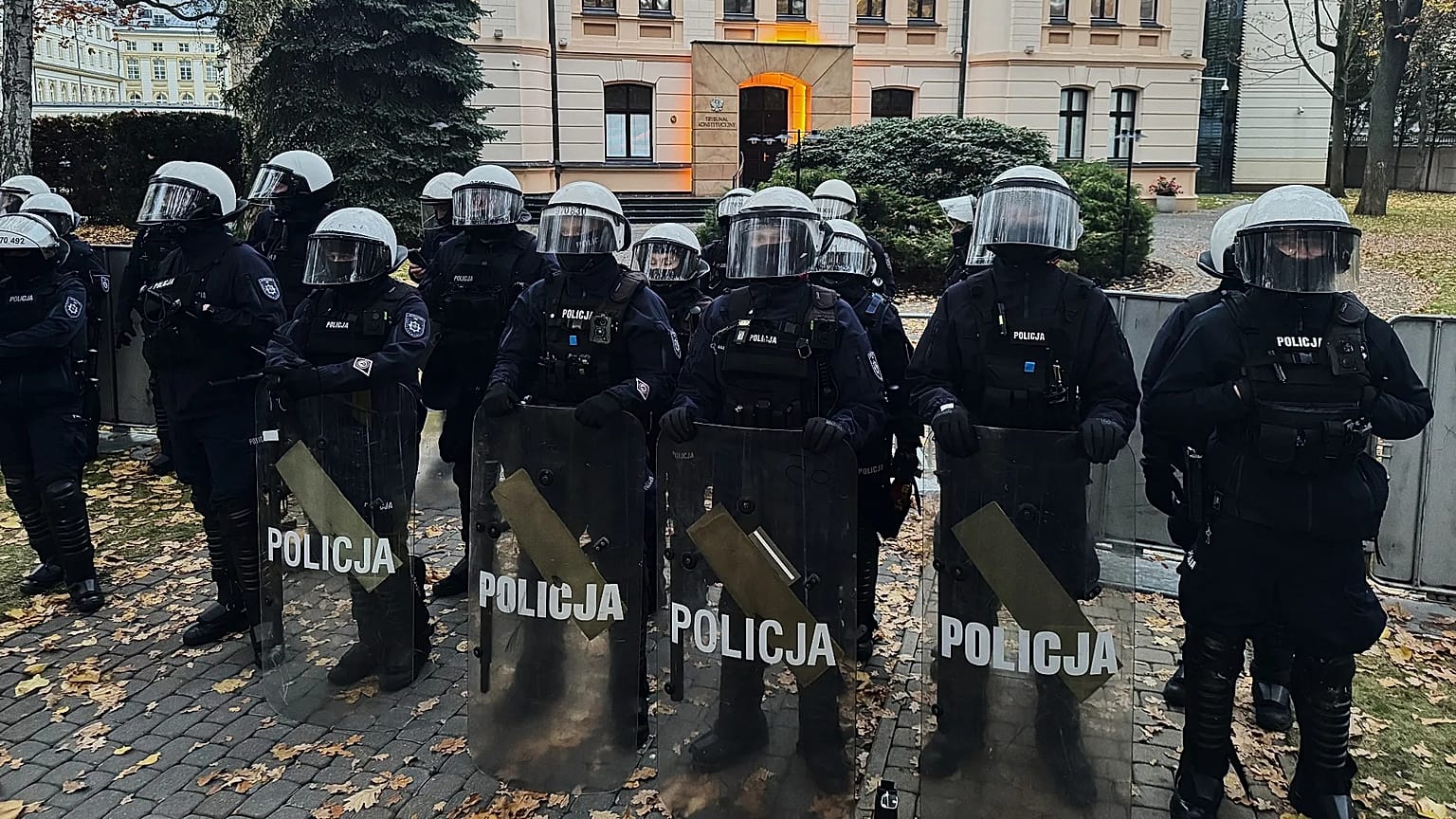
Riot police were deployed at Poland’s Constitutional Tribunal in Warsaw as a dispute over the court’s leadership escalated into a confrontation between Prime Minister Donald Tusk’s government and judges appointed during the rule of the right-wing Law and Justice (PiS) party. Justice Minister Waldemar Żurek said he had asked prosecutors to lift the immunity of court President Bogdan Święczkowski and Vice-President Bartłomiej Sochański so criminal charges could be brought against them. The government says the two are preventing newly elected judges from sitting on the court. Tusk defended the action as part of his pledge to restore the rule of law, while the Constitutional Tribunal described the actions as an attempted coup and maintained that Święczkowski and Sochański remained its legally appointed senior judges.
The conflict has roots in changes made by PiS after it took office in 2015, when it appointed judges to secure a majority on the tribunal. The European Court of Human Rights and the Court of Justice of the European Union later found that three appointments duplicated positions already validly filled and concluded that the tribunal was no longer an independent and impartial court. Tusk’s government has relied on those rulings, but efforts to reverse the changes have been obstructed by presidential vetoes and by President Karol Nawrocki’s refusal to swear in five judges elected by parliament since March. Nawrocki, who is backed by PiS, cut short a trip to Senegal and went to the court amid the standoff.
The Venice Commission recently urged Nawrocki to swear in the judges. Some Tusk supporters have criticized him for moving too slowly, while critics—including lawyer Marcin Matczak—argue that the latest intervention lacks a legal basis and could damage the rule of law for years. With parliamentary elections due next year, the move is also being viewed by some as an effort to improve Tusk’s standing with voters.
Entities: Donald Tusk, Karol Nawrocki, Waldemar Żurek, Bogdan Święczkowski, Bartłomiej Sochański • Tone: analytical • Sentiment: neutral • Intent: inform
31-10-2026
Protesters gathered outside Poland’s Constitutional Court on Friday night after a statement on the court’s website announced that its president, Bogdan Swieczkowski, and his deputy had been suspended for one month. Judge Anna Korwin-Piotrowska is to lead the institution during their suspension. Police said they responded after a judge raised concerns about possible threats to the safety of judges and court staff, and dozens of riot police were deployed to secure the site.
The dispute reflects a broader conflict over Poland’s judiciary. Swieczkowski was appointed during the rule of the right-wing Law and Justice Party (PiS), which governed from 2015 to 2023. Prime Minister Donald Tusk’s center-left alliance, which took office after the 2023 election, promised to reverse controversial judicial reforms introduced by PiS. Tusk defended the suspension as part of an effort to restore the rule of law, describing the process as difficult and requiring decisive action.
PiS supporters protested against Swieczkowski’s removal through the evening. The Constitutional Court’s official account on X characterized the move as a “coup d’etat,” while some protesters chanted “Tusk traitor.” President Karol Nawrocki, a right-wing politician, canceled a planned trip to Senegal, saying he needed to be in Poland during the crisis. His chief of staff said Nawrocki later entered the court building through a police barricade, accompanied by Supreme Court First President Zbigniew Kapinski.
The article also notes that Nawrocki had recently refused to swear in five senior court judges nominated by parliament. After those judges took their oaths before parliament instead, Swieczkowski denied them access to the court building. These events underline the ongoing institutional and political struggle over judicial appointments and authority in Poland.
Entities: Bogdan Swieczkowski, Donald Tusk, Karol Nawrocki, Anna Korwin-Piotrowska, Zbigniew Kapinski • Tone: analytical • Sentiment: neutral • Intent: inform
31-10-2026
Protests gathered outside Poland’s Constitutional Tribunal in Warsaw after the court announced that its president, Bogdan Swieczkowski, and deputy had been suspended for one month. Judge Anna Korwin-Piotrowska is to lead the court during their absence. Police said they responded after a judge reported possible threats to the safety of court judges and staff. Dozens of riot police were deployed as supporters of the right-wing Law and Justice party (PiS) protested the suspensions, and some demonstrators accused Prime Minister Donald Tusk of betrayal. The court’s official social media account characterized the move as a “coup d'etat.”
Tusk defended the action, saying that restoring the rule of law was a duty and that decisive steps were necessary after what he described as years of lawlessness under PiS. His center-left alliance took power after the 2023 election and pledged to reverse controversial judicial reforms made by the PiS government, which governed from 2015 to 2023. Swieczkowski is among the judges appointed during PiS’s time in office and regarded as politically aligned with the party.
The dispute reflects a broader struggle between Poland’s major political camps over the composition and authority of the Constitutional Tribunal. The European Court of Justice has ruled that the tribunal could not be considered independent and impartial because of serious irregularities in the appointment of some judges and its former president. More recently, President Karol Nawrocki refused to swear in five judges nominated by parliament. Those judges took their oaths before parliament instead, but Swieczkowski denied them access to the court building.
As tensions escalated, Nawrocki began consultations with political representatives. Defense Minister Władysław Kosiniak-Kamysz, leader of coalition partner the Polish People’s Party, was the first to meet him. Kosiniak-Kamysz said he planned to discuss state security, democracy, social peace and public order.
Entities: Donald Tusk, Bogdan Swieczkowski, Anna Korwin-Piotrowska, Karol Nawrocki, Władysław Kosiniak-Kamysz • Tone: analytical • Sentiment: neutral • Intent: inform
31-10-2026
Prime Minister Donald Tusk used a televised address on Saturday to respond to the escalating dispute over Poland’s Constitutional Tribunal. He said the rule of law must prevail over violence and accused the Law and Justice party (PiS) and President Karol Nawrocki of undermining legal institutions. Tusk pledged support for newly elected judges and the Tribunal’s work, while insisting that restoring calm could not mean accepting lawlessness.
The immediate confrontation followed Nawrocki’s visit to the Tribunal building on Friday night, amid a deadlock over the appointment of new judges. Police surrounded the building as events unfolded on television. The opposition accused Tusk’s government of attempting a coup; the government says it is pursuing reforms intended to reverse years of PiS interference in the judiciary.
The conflict has roots in a 2015 dispute between Civic Platform and PiS over judicial appointments and has broadened into questions about judicial independence, the Tribunal’s composition, and the authority of its decisions. Tusk said his government’s efforts to resolve the current impasse had been blocked by PiS and the president. After waiting for the terms of judges appointed under the previous PiS-led government to expire, the Sejm elected replacements, who took their oaths. Nawrocki did not formally receive the oaths, and Tribunal President Bogdan Święczkowski would not allow the judges to begin work.
Tusk called the new judges legally appointed and condemned attempts to use force or political pressure in the dispute. He said no politician, including the president, had the right to enter a court or tribunal to instruct or intimidate judges. He also warned that pro-Russian groups and online bots could exploit the conflict. Tusk promised the Tribunal security and conditions to operate independently under the constitution. His speech, however, set out no concrete agreement with Nawrocki or detailed plan for ending the crisis.
Entities: Donald Tusk, Karol Nawrocki, Bogdan Święczkowski, Poland, Constitutional Tribunal of Poland • Tone: analytical • Sentiment: negative • Intent: inform
31-10-2026
Poland’s dispute over the Constitutional Tribunal escalated into a confrontation at the court’s Warsaw headquarters on Friday, with protesters and riot police outside after the incumbent president, Bogdan Święczkowski, was suspended. The crisis stems from a long-running conflict over judicial appointments and the Tribunal’s leadership; the government has been seeking to remove judges appointed under the previous Law and Justice (PiS) administration.
The latest events began when seven people selected by the Sejm to serve as Tribunal judges entered the building. Tribunal spokesperson Weronika Ścibor said security guards had been ordered to leave, while Święczkowski and Vice-President Bartłomiej Sochański were reportedly denied entry. Judge Anna Korwin-Piotrowska then announced that she was taking over the Tribunal’s leadership and suspending Święczkowski. The existing leadership disputes the legality of those actions.
President Karol Nawrocki cut short a visit to Senegal and returned to Warsaw. After meeting Supreme Court First President Zbigniew Kapiński, he went to the Tribunal, where footage posted online showed a scuffle involving judges as he tried to enter. In a statement delivered by his chief of staff, Nawrocki called the events a breach of the constitutional order and a forcible takeover of a state institution. He demanded that government-deployed security forces leave the grounds and announced emergency talks with parliamentary groups, citing internal security and the need to stabilise the political situation.
Justice Minister Waldemar Żurek criticised Nawrocki’s conduct, saying footage appeared to show him forcing his way in and attacking judges. Żurek said talks had failed to produce a compromise and argued that the Tribunal should return to normal work and address citizens’ pending cases. Meanwhile, PiS politicians and right-wing supporters, including party leader Jarosław Kaczyński and former officials, protested outside. Kaczyński described the events as an assault on the Tribunal and warned Poland could become a police state; PiS MEP Patryk Jaki said the images could damage the government’s international standing.
Entities: Karol Nawrocki, Poland, Constitutional Tribunal, Bogdan Święczkowski, Anna Korwin-Piotrowska • Tone: analytical • Sentiment: neutral • Intent: inform
31-10-2026
The article traces Poland’s Constitutional Tribunal crisis from a 2015 dispute over judicial appointments to a confrontation over who has authority to govern the court. The initial clash involved rival appointments by the outgoing PO-PSL coalition and the incoming PiS majority. The Tribunal ruled that three of the outgoing coalition’s five appointments were valid, but PiS installed alternative judges in those seats; the disputed appointees later became known as “stand-in judges.” PiS’s subsequent changes to the Tribunal’s procedures, and the government’s refusal to publish a ruling against those changes, intensified concerns about judicial independence. European courts also questioned the Tribunal’s composition, while disputes over its leadership and the relationship between Polish and EU law added to the conflict.
After Donald Tusk’s coalition took office in 2023, it sought to reverse PiS-era reforms. Its efforts were obstructed when President Andrzej Duda referred reform bills to the Tribunal, and the government and Tribunal leadership disputed the publication and legal force of rulings. The crisis escalated again in 2026 after President Karol Nawrocki accepted the oaths of two of six judges elected by parliament but refused the other four. Those judges took oaths before a notary in parliament, a procedure rejected by Nawrocki and Tribunal president Bogdan Święczkowski. The European Court of Human Rights and Venice Commission took positions supporting the judges’ ability to assume their duties despite the dispute over the oath.
In October, judge Anna Korwin-Piotrowska declared a temporary suspension of Święczkowski and vice-president Bartłomiej Sochański and took over management of the institution. The Tribunal’s existing leadership rejected her action. A confrontation at the Tribunal’s headquarters followed, with scuffles after judges entered accompanied by State Protection Service officers. Nawrocki called the events an attempted takeover, while Święczkowski said he and the remaining judges would seek to regain control. The article presents the crisis as a continuing institutional standoff over legitimacy, judicial independence, and the authority of the court’s rulings.
Entities: Poland’s Constitutional Tribunal, Donald Tusk, Karol Nawrocki, Andrzej Duda, Bogdan Święczkowski • Tone: analytical • Sentiment: neutral • Intent: inform
31-10-2026
France 24 reports that police increased security around Poland’s Constitutional Tribunal after dozens of protesters gathered on Friday. The demonstrators opposed the government’s suspension of the Tribunal’s president, which they said was unlawful. Police reported that several people were detained after some protesters breached the court’s perimeter fence. The report is by Charlotte Hughes.
The article provides only a brief account of the gathering and its immediate aftermath. It does not identify the suspended president, explain the government’s reason for suspending the official, or provide further details about the legal dispute. It also does not say how many people were detained, describe any injuries or damage, or give a response from the government or the Tribunal. As a result, the report establishes the central dispute and the police response but leaves the wider political and legal context unspecified. Its focus is the protest, demonstrators’ claim that the suspension was unlawful, and the security measures taken after some crossed the court’s boundary.
Entities: Poland, Constitutional Tribunal, Charlotte Hughes, Polish police, Protesters • Tone: neutral • Sentiment: neutral • Intent: inform
31-10-2026
Polish President Karol Nawrocki cut short his flight to Senegal and returned to Poland on Friday after a judge suspended Constitutional Tribunal President Bogdan Swieczkowski, intensifying a prolonged struggle over control of the judiciary. The tribunal’s longest-serving judge, Anna Korwin-Piotrowska, announced Swieczkowski’s suspension and said she was taking charge of the court. Hundreds of protesters gathered outside the tribunal in Warsaw, where police were present. Right-wing politicians at the rally accused Prime Minister Donald Tusk’s government of staging a coup against the court. Nawrocki said on X that he needed to be in Poland during the crisis.
The dispute reflects a broader conflict that has left the Constitutional Tribunal effectively paralysed. Tusk’s pro-European government and Nawrocki, a nationalist president aligned with the Law and Justice Party, reject judicial appointments made by the opposing side. Tusk said his government was trying to restore the rule of law, which the European Union had accused the previous Law and Justice government of undermining. He described the process as difficult and painful but said decisive action was necessary.
The conflict dates to 2015, when Law and Justice sought to appoint judges to positions already filled by the previous government. Its nominees later gained a majority on the tribunal. Critics in Poland and abroad questioned whether the court remained an independent and impartial body established by law. After taking office in 2023, Tusk’s coalition promised to restore the rule of law and reform the court. Nawrocki, elected president in 2025, has resisted those efforts: earlier this year he declined to swear in three of six judges nominated by parliament, while Swieczkowski refused to seat judges chosen by the current parliamentary majority. Last month, parliament appointed Tusk ally Maciej Berek to the tribunal, a move critics said also undermined the government’s stated commitment to restoring checks and balances.
Entities: Karol Nawrocki, Donald Tusk, Anna Korwin-Piotrowska, Bogdan Swieczkowski, Maciej Berek • Tone: analytical • Sentiment: negative • Intent: inform
31-10-2026
Polish President Karol Nawrocki accused Prime Minister Donald Tusk’s government of forcibly taking control of Poland’s Constitutional Tribunal after the court’s longest-serving judge, Anna Korwin-Piotrowska, suspended its president, Bogdan Swieczkowski, late Friday. Swieczkowski is an appointee of the previous Law and Justice government, while Korwin-Piotrowska announced she was taking charge of the tribunal. Nawrocki described the move as a breach of public order and a forcible takeover of a constitutional body. He returned early from a trip to Africa, went to the court as riot police faced several hundred protesters calling for Swieczkowski’s reinstatement, and called for urgent political consultations.
Tusk said his government was trying to restore the rule of law, which the European Union had accused the previous Law and Justice administration of undermining. He argued that the process was difficult and required decisive action.
The confrontation is the latest development in a dispute that has effectively paralysed the Constitutional Tribunal. The conflict traces back to 2015, when Law and Justice sought to appoint judges to seats already occupied by judges selected by the preceding government. Its nominees subsequently gained a majority on the court. Critics in Poland and abroad questioned whether the tribunal remained independent and impartial.
After Tusk’s coalition took office in 2023, it promised to restore the rule of law and reform the court. Nawrocki, aligned with Law and Justice, has opposed those efforts since becoming president in 2025. He refused to swear in three of six judges nominated by parliament, while Swieczkowski declined to seat judges elected by the current parliamentary majority. The previous month, parliament appointed Tusk ally Maciej Berek to the tribunal, a move critics said conflicted with the government’s stated aim of restoring checks and balances.
Entities: Karol Nawrocki, Donald Tusk, Anna Korwin-Piotrowska, Bogdan Swieczkowski, Maciej Berek • Tone: analytical • Sentiment: neutral • Intent: inform