02-09-2026
The article examines whether a newly announced United States–Venezuela oil agreement will reduce American fuel prices. President Donald Trump described the arrangement as “the biggest oil deal in world history” and claimed it would more than double US oil reserves and substantially lower gasoline prices. The agreement reportedly gives the US control over more than 65 billion barrels of Venezuela’s proven reserves through a private joint venture involving North American Blue Energy Partners (NABEP), with the Pentagon’s Office of Strategic Capital taking a 35 percent stake. Chevron is also expected to expand its operations in Venezuela.
Despite the scale of Venezuela’s reserves, analysts say the deal is unlikely to provide meaningful near-term price relief. Venezuelan crude is heavy and sour, making it expensive to extract, transport, upgrade, and refine. The country’s oil industry also suffers from aging infrastructure, damaged pipelines, inadequate electrical capacity, and a shortage of specialized equipment. US Gulf Coast refineries can process Venezuelan crude, but they are already operating near maximum capacity, limiting the immediate impact on gasoline prices.
US crude prices rose after the deal was announced, largely because the closure of the Strait of Hormuz has caused major supply disruptions and heightened geopolitical risk. More than 20 percent of global oil and gas shipments normally pass through the strait. Analysts therefore characterize the deal’s short-term effect on global prices as neutral. Over several years, increased Venezuelan production could add supply and place downward pressure on prices, but Venezuela cannot quickly replace the roughly 10 million barrels per day removed from the market through Hormuz. Its heavy crude is also not a direct substitute for lighter Gulf oil. The article concludes that the agreement may support longer-term production and investment, but it is not an immediate solution to elevated fuel prices.
Entities: United States, Venezuela, Donald Trump, Delcy Rodriguez, Nicolas Maduro • Tone: analytical • Sentiment: neutral • Intent: analyze
02-09-2026
Chevron plans to invest more than $7 billion US through its Venezuelan joint ventures over the next five years, with the goal of doubling its crude production in the country to approximately 600,000 barrels per day. Under newly announced agreements, Chevron’s Petroindependencia joint venture will expand into two adjacent areas in the Carabobo region of the Orinoco Belt. CEO Mike Wirth said the company is confident in Venezuela’s resource potential and emphasized that existing roads, power, water, pipelines and other infrastructure should allow the projects to be developed at relatively low cost. Chevron estimates total production costs will be below $20 US per barrel.
The expansion comes amid a broader push by U.S. President Donald Trump to increase American involvement in Venezuela’s oil industry. The article says Trump recently announced a separate deal involving roughly one-fifth of Venezuela’s oil reserves and an American government equity stake in a private oil company. Chevron’s agreements are formally separate, but they align with the administration’s effort to expand Venezuelan production. U.S. Energy Secretary Chris Wright and Venezuelan officials were expected to oversee the signing of additional energy contracts involving companies including ENI, KEO Capital and Primavera.
Venezuela possesses the world’s largest oil reserves, but production has fallen to about 1.25 million barrels per day from more than three million two decades ago, following years of mismanagement and underinvestment by state oil company PDVSA. Chevron has operated in Venezuela since 1923 and currently has three joint ventures there. ExxonMobil and ConocoPhillips left after their assets were nationalized in 2007. The article also notes that a separate North American Blue Energy Partners plan covering 17 oilfields could create another major U.S. presence in Venezuela’s oil sector, further changing the country’s energy landscape.
Entities: Chevron, Venezuela, Donald Trump, Mike Wirth, Delcy Rodríguez • Tone: analytical • Sentiment: neutral • Intent: inform
02-09-2026
The article examines the potential impact of a newly announced U.S.-Venezuela oil agreement on Canada’s oil industry. U.S. President Donald Trump says the deal would give the United States majority control of about one-fifth of Venezuela’s oil reserves, or more than 65 billion barrels, through a direct equity stake in a private company led by a Venezuelan businessman. Venezuela’s acting president, Delcy Rodríguez, describes the arrangement as a major investment opportunity while insisting that the country will retain ownership and sovereignty over its natural resources.
Although a major increase in Venezuelan heavy-oil exports could compete with Alberta’s oilsands production at U.S. Gulf Coast refineries, Canadian industry experts say the threat is not immediate. Venezuelan production has fallen from a peak of 3.7 million barrels per day in 1970 to roughly 900,000 barrels per day last year. Years of sanctions, underinvestment, failed government policies and infrastructure deterioration have left the industry in need of extensive repairs and new investment. Experts estimate that a meaningful increase in exports could still be five to 10 years away.
The article also highlights the advantages of Canada’s oilsands sector. Its large facilities have already been built and paid for, production costs are relatively low, and Canada offers political stability. By contrast, investors in Venezuela face uncertainty about the condition of existing infrastructure, the terms of the agreement, future changes in government and whether a democratic successor would honour the deal. Venezuela has previously seized foreign-owned assets, including those belonging to ExxonMobil.
Some international companies, including Shell, Repsol and Chevron, have shown interest in Venezuela, but analysts remain doubtful that U.S. firms will invest on the scale envisioned by the Trump administration. Meanwhile, Canadian oil production is reaching records and new pipeline projects are expanding export capacity. The United States continues to rely heavily on Canadian crude, which represented more than 60 per cent of its oil imports last year.
Entities: Donald Trump, Delcy Rodríguez, Nicolás Maduro, Ed Sprague, Al Salazar • Tone: analytical • Sentiment: neutral • Intent: analyze
02-09-2026
Chevron plans to invest $7 billion to more than double its oil production in Venezuela over the next five years. The company has been assigned two additional oilfields in the Orinoco Belt, which contains most of Venezuela’s reserves of extra-heavy crude. Chevron expects production from its Venezuelan operations to rise from approximately 280,000 barrels per day to 600,000 barrels per day by 2031.
Chevron operates in Venezuela through joint ventures with the state-owned oil company Petróleos de Venezuela SA, or PDVSA, and is currently the only major U.S. oil company active in the country. CEO Mike Wirth said Venezuela has become more attractive to investors after the interim government enacted a new hydrocarbon law that altered taxes, royalties and other commercial terms. According to Wirth, the changes made Venezuela competitive with Chevron’s investment opportunities elsewhere.
The expansion comes as the U.S. government seeks to increase Venezuelan oil production through private investment. Venezuela’s oil infrastructure has deteriorated after years of mismanagement, creating both significant investment needs and potential opportunities for energy companies.
The article also describes a broader U.S. role in Venezuela’s energy sector and political transition. President Donald Trump reportedly said the U.S. had secured majority control over 65 billion barrels of Venezuelan crude reserves. Energy Secretary Chris Wright was visiting Venezuela, while Washington partnered with North American Blue Energy Partners to develop reserves and granted the company concessions to 17 oilfields for 100 years. The report further states that the U.S. Defense Department received a 35% equity stake in NABEP, that former President Nicolás Maduro was captured in a January military raid, and that Washington is working with interim President Delcy Rodríguez.
Chevron shares were little changed on the day, despite substantial gains over the previous three months and during 2026.
Entities: Chevron, Venezuela, Orinoco Belt, Petróleos de Venezuela SA (PDVSA), Mike Wirth • Tone: analytical • Sentiment: neutral • Intent: inform
02-09-2026
The supplied material does not contain the article’s body text. It includes only the publication domain, URL, and headline: “Donald Trump’s Venezuela deal is bold but dodgy.” As a result, a comprehensive and reliable 200–400-word summary cannot be produced without inventing details that are not present in the source material. Based solely on the headline, the article appears to examine a deal involving Donald Trump and Venezuela. The wording suggests that the deal is being presented as ambitious, consequential, or politically daring (“bold”), while also raising concerns about its legitimacy, soundness, risks, or ethical and legal implications (“dodgy”). The headline’s contrast indicates an editorial or analytical assessment rather than a neutral report. It likely frames the agreement as having potential strategic value but significant problems or questionable features. However, the supplied content provides no information about the deal’s terms, participants beyond Trump and Venezuela, timing, motivations, consequences, or the arguments and evidence used by The Economist. No claims about those matters should be inferred from the headline alone. The analysis below therefore extracts only information explicitly supported by the title and URL, and it identifies the absence of the article text as a material limitation.
Entities: The Economist, Donald Trump, Venezuela, Trump–Venezuela deal, U.S.–Venezuela relations • Tone: analytical • Sentiment: negative • Intent: critique
02-09-2026
France 24 reports that Chevron, Italy’s Eni and other foreign energy producers committed on Wednesday, September 2, 2026, to major expansions of oil projects in Venezuela. The stated objective of the projects is to increase Venezuelan oil production. The commitments were presented during a signing ceremony in Caracas attended by Venezuela’s interim President Delcy Rodriguez and overseen by U.S. Energy Secretary Chris Wright.
The event highlights renewed foreign involvement in Venezuela’s oil and gas sector while placing the planned expansions under visible U.S. supervision. Chevron’s participation represents the United States, while Eni represents Italy; the report does not identify the other participating companies. It also does not provide details about the projects, including their locations, investment values, expected production increases, implementation schedules, contractual terms or the regulatory and sanctions framework governing them.
The article is presented as a short France 24 video report by Maya Yataghene. Its associated keywords include Venezuela, energy, the oil and gas industry, Donald Trump, Nicolás Maduro, the Americas and Latin America. An image caption states that Wright’s visit was the first visit by a high-level official to Venezuela since Maduro’s capture, although the body of the article does not elaborate on that claim or provide additional context about Maduro’s status.
Overall, the report focuses on the announcement and political setting of the oil-project commitments rather than analyzing their economic consequences or explaining how the U.S. government’s oversight will operate. It presents the development in a factual, concise manner and offers no explicit assessment from the companies, Venezuelan officials or other observers.
Entities: Chevron, Eni, Venezuela, Caracas, Delcy Rodriguez • Tone: neutral • Sentiment: neutral • Intent: inform
02-09-2026
US Energy Secretary Chris Wright oversaw the signing of eight agreements between Venezuela and major energy companies Chevron, Italy’s ENI, and GE Vernova during a visit to Caracas on September 2, 2026. Wright said the agreements represented “tens of billions of dollars” in investment and described them as essential to promoting peace, opportunity, and prosperity in Venezuela. He argued that increasing energy production could transform Venezuela and improve living conditions for people in the country, the United States, and the wider hemisphere.
The agreements expand the role of US and European companies in Venezuela’s energy sector. Chevron is expected to increase operations and develop two additional oil fields in the Orinoco Belt under a deal it previously valued at approximately $7 billion. The company said it expects to more than double its Venezuelan oil output within five years. ENI received exclusive exploration rights for the Junin 5 oil field, while GE Vernova will assist in restoring Venezuela’s severely damaged electricity infrastructure.
The visit also addressed a separate and controversial oil agreement between Venezuela and the United States. Wright’s trip had been expected to finalize a deal reportedly giving the United States control over roughly one-fifth of Venezuela’s oil reserves. However, Interim President Delcy Rodriguez said that agreement had already been concluded on August 28, when US President Donald Trump announced it as the “biggest oil deal in world history.” Rodriguez referred to an agreement covering the production of 65 billion barrels of Venezuelan oil reserves and said she hoped it would benefit both Venezuelans and Americans. The article presents the agreements as a major expansion of foreign energy investment while noting the political controversy surrounding US involvement in Venezuela’s oil resources.
Entities: Venezuela, Caracas, US Energy Secretary Chris Wright, Interim President Delcy Rodriguez, US President Donald Trump • Tone: neutral • Sentiment: neutral • Intent: inform
02-09-2026
Chevron announced that it will expand its existing oil operations in Venezuela, increasing its presence in the Orinoco Belt, where much of the country’s vast crude reserves are located. The announcement follows a recently publicized U.S.-Venezuela agreement giving the United States access to an estimated 65 billion barrels of Venezuelan oil and comes as the Trump administration encourages American companies to invest in the country’s energy sector.
Chevron plans to invest more than $7 billion over the next five years through a joint venture, with the goal of increasing production to approximately 600,000 barrels per day. Chevron CEO Mike Wirth called the arrangement an important milestone that could support long-term investment, growth, and development. U.S. Energy Secretary Chris Wright described expanded energy production as a catalyst for improving conditions in Venezuela, the United States, and the broader hemisphere.
The deal comes amid significant political and economic uncertainty. Venezuela is being led by interim President Delcy Rodríguez, who assumed office after the United States captured former President Nicolás Maduro in January. Chevron is currently the largest foreign oil operator in Venezuela, while rivals ExxonMobil and ConocoPhillips withdrew in 2007 after contract renegotiations under Hugo Chávez. ExxonMobil CEO Darren Woods recently described Venezuela as “uninvestable.”
Although Venezuela possesses some of the world’s largest oil reserves, its production infrastructure has deteriorated after years of corruption, low oil prices, and neglect. Experts cite rusting equipment, leaks, damaged facilities, and theft as major obstacles. Rystad Energy estimates that restoring production to roughly 3 million barrels per day—the level reached in the 1990s—would require more than a decade and approximately $183 billion. The article therefore presents Chevron’s expansion as a potentially transformative investment, but one constrained by enormous technical, financial, and political challenges.
Entities: Chevron, Venezuela, Orinoco Belt, U.S.-Venezuela oil agreement, Chris Wright • Tone: analytical • Sentiment: neutral • Intent: inform
02-09-2026
Chevron has confirmed plans to significantly expand its oil operations in Venezuela following an agreement announced by US President Donald Trump to develop the country’s vast petroleum reserves, with the Pentagon reportedly receiving a share of the profits. Chevron, the only major US oil company with an established presence in Venezuela, has been assigned additional acreage in the Orinoco Belt, where it already operates.
The company intends to invest more than US$7 billion over the next five years. Its goal is to increase production from current levels to approximately 600,000 barrels per day, more than doubling its output. Chevron chief executive Mike Wirth said the company’s long history in Venezuela and its confidence in the country’s resource potential supported the expanded commitment.
Venezuela possesses the world’s largest proven crude-oil reserves, estimated at more than 303 billion barrels by Opec’s 2025 Annual Statistical Bulletin. Saudi Arabia ranks second with 267 billion barrels. However, Venezuela’s production remains relatively low because its oil infrastructure is severely deteriorated and the country continues to operate under international sanctions. Current output is slightly above 1 million barrels per day, compared with 10 million to 11 million barrels per day in Saudi Arabia and nearly 14 million barrels per day in the United States.
The article presents Chevron’s investment as a major attempt to revive Venezuela’s oil sector, while highlighting the substantial infrastructure and geopolitical obstacles that could delay or complicate the expansion. Analysts caution that repairing the country’s degraded energy system could take years, making the production target ambitious despite Venezuela’s enormous reserves.
Entities: Chevron, Venezuela, Donald Trump, Pentagon, Orinoco Belt • Tone: analytical • Sentiment: neutral • Intent: inform
02-09-2026
Chevron plans to invest more than US$7 billion over the next five years to expand its oil operations in Venezuela, following a new arrangement that gives the company additional acreage in the resource-rich Orinoco Belt. The US energy company said the joint-venture projects are expected to more than double production to approximately 600,000 barrels per day, compared with 2026 levels.
The announcement came shortly after President Donald Trump unveiled an ambitious agreement focused on developing Venezuela’s oil reserves and giving the Pentagon a stake in the resulting profits. Chevron is the only US oil company with a major operating presence in Venezuela and has worked there since 1923. Its expanded role follows discussions involving Chevron executives and US Energy Secretary Chris Wright, who was expected to visit the country for the formal investment announcement.
Chevron CEO Mike Wirth said the company’s expanded position reflected confidence in Venezuela’s substantial resources and its potential to attract investment. He argued that improved commercial terms and access to additional acreage could support low-cost oil production, strengthen energy supplies and generate long-term value for the company.
Venezuela possesses the world’s largest proven crude-oil reserves, estimated by Opec at more than 303 billion barrels in its 2025 statistical bulletin. However, analysts warn that the country’s severely deteriorated oil infrastructure could take years to repair, potentially complicating Chevron’s production goals.
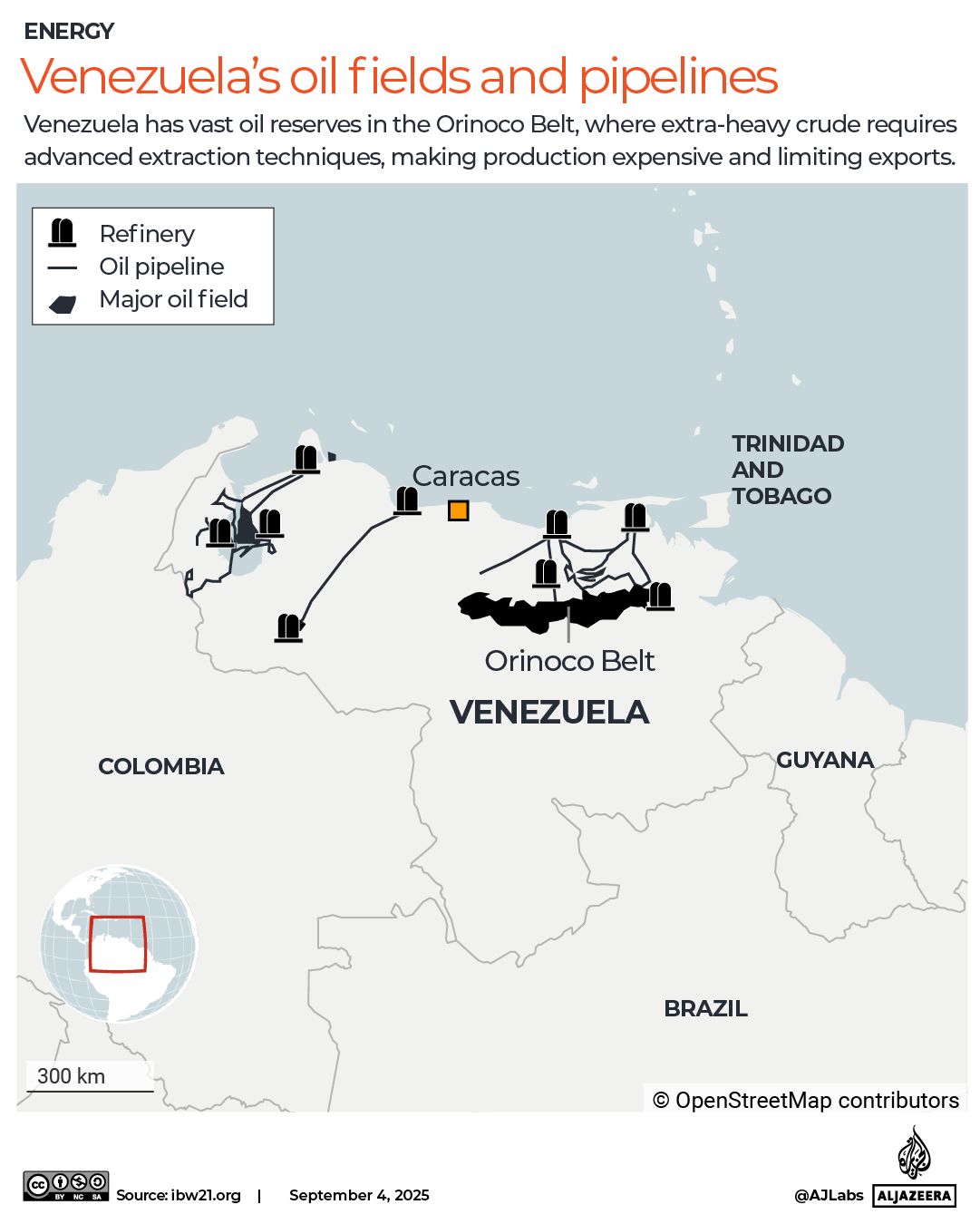
Chevron’s Venezuelan assets include the Petroindependencia and Petropiar joint ventures, which operate extra-heavy-oil projects in the Orinoco Oil Belt, and Petroboscan in western Venezuela’s Zulia state. The plan represents a major expansion of Chevron’s existing involvement in Venezuela and a potentially significant increase in the country’s oil output, but its success will depend on infrastructure repairs, investment conditions and the implementation of the new agreement.
Entities: Chevron, Venezuela, Donald Trump, Chris Wright, Mike Wirth • Tone: analytical • Sentiment: neutral • Intent: inform
02-09-2026
The article examines growing criticism of a major US-Venezuela oil agreement announced by Donald Trump, which the US president has described as the “biggest oil deal in world history.” US Energy Secretary Chris Wright defended the arrangement during a visit to Caracas, rejecting claims that Washington is attempting to seize Venezuela’s oil in violation of the country’s constitution. Wright characterized the agreement as a historic transformation of Venezuela and US-Venezuelan relations, and as part of Trump’s strategy to replace conflict with commerce.
The White House says the deal will advance US energy dominance, generate access to Venezuela’s estimated 65 billion barrels of oil, and limit Chinese and Russian influence in the country, which possesses the world’s largest proven oil reserves. Critics, however, argue that the agreement is not a normal commercial transaction because it was negotiated with Delcy Rodríguez, an unelected interim president installed after Nicolás Maduro was abducted by US special forces. The Wall Street Journal compared the arrangement to a scene from The Godfather Part II, while economist Francisco Rodríguez described it as “gunpoint diplomacy.”
The article says Rodríguez has made major concessions to the US since Maduro’s capture, despite the long-standing opposition of the Chavista movement to what it portrayed as US imperialism. Rodríguez has defended the deal as offering “endless” benefits and claimed it could produce more than $209 billion for healthcare and education.
The agreement has also weakened Venezuela’s political opposition, which fears Trump may no longer support democratic elections or a political transition because of the lucrative deal with Rodríguez. At a signing ceremony in Caracas, Rodríguez called the arrangement a “win-win deal” and expressed confidence that it represented Venezuela’s future and hope.
Entities: Venezuela, Caracas, United States, Donald Trump, Chris Wright • Tone: analytical • Sentiment: negative • Intent: analyze
02-09-2026
The article introduces Alejandro Betancourt as the person behind a company with which the United States is partnering in Venezuela. It frames Betancourt as a central figure in a Venezuelan oil arrangement associated with President Donald Trump, referring to him in the audio headline as “Trump’s fixer for the Venezuelan oil deal.”
The report’s principal concern is Betancourt’s legal and reputational history. According to the article, he has faced multiple money-laundering investigations in Spain, the United States, and Switzerland. The excerpt does not provide details about the allegations, the outcomes of those investigations, or whether Betancourt was charged or convicted. It also does not identify the company involved in the U.S. partnership, explain the terms of the deal, or describe the U.S. government’s rationale for working with it.
Published by NPR’s Americas section on September 2, 2026, the report was written by Julia Simon and featured on Morning Edition. The available content appears to be a short article and accompanying audio segment lasting 3 minutes and 42 seconds. Its focus is primarily introductory: it identifies Betancourt, establishes his connection to the Venezuelan oil arrangement, and highlights the investigations that have surrounded him.
Because the supplied text is brief, it offers limited context beyond those points. It does not include statements from Betancourt, U.S. officials, Venezuelan authorities, or representatives of the company. The article therefore functions as an overview of the businessman and a warning that his background includes scrutiny by authorities in three countries, rather than as a detailed account of the oil partnership or the investigations themselves.
Entities: Alejandro Betancourt, Venezuela, United States, Spain, Switzerland • Tone: analytical • Sentiment: negative • Intent: inform