05-11-2026
Five Republican candidates who questioned or challenged Joe Biden’s 2020 election victory lost their races for governor in battleground states in the 2026 US midterm elections. The defeated candidates were Andy Biggs in Arizona, John James in Michigan, Stacy Garrity in Pennsylvania, Tom Tiffany in Wisconsin, and billionaire Rick Jackson in Georgia. Each had cast doubt on the 2020 results or supported efforts to block Biden’s victory. Their records varied: Biggs and Tiffany voted in Congress to overturn the results and joined a lawsuit seeking to invalidate results in several states; Jackson criticized Georgia officials for not meeting Donald Trump’s demands to find votes; and Garrity urged Pennsylvania lawmakers to decertify the results at a rally shortly before the January 6 Capitol attack. James acknowledged Biden’s victory in 2020 but later described that election as “rigged and manipulated.” The article notes that Tiffany, Garrity, and Jackson have since acknowledged Biden won, while Biggs and James have not responded to Al Jazeera’s request for comment.
The results could shape the political landscape ahead of the 2028 presidential election. Arizona, Georgia, Michigan, Pennsylvania, and Wisconsin are closely contested states that have shifted between parties and are expected to play important roles in choosing the next president. Governors also influence voting access, election administration, and congressional redistricting. The article describes Trump’s efforts to encourage states to redraw congressional maps to favor Republicans, as well as Democratic-led states’ responses. Georgia Governor Brian Kemp said he would not call a special legislative session to redraw maps before his Democratic successor, Keisha Lance Bottoms, takes office. After the midterm losses, Trump said he was willing to accept the results and expressed interest in working with Democrats, who retook control of both chambers of Congress.
Entities: Andy Biggs, John James, Stacy Garrity, Tom Tiffany, Rick Jackson • Tone: analytical • Sentiment: neutral • Intent: inform
05-11-2026
Democratic victories in the 2026 midterms transformed Ohio and Texas from reliably Republican states into potential battlegrounds for the 2028 presidential election. Democrats won governorships and Senate seats in both states, while also making gains in state legislatures and, in Texas, the U.S. House. In Ohio, Sherrod Brown defeated incumbent Jon Husted for the Senate, and Amy Acton won the governorship, ending two decades of Republican control. In Texas, James Talarico became the state’s first Democratic senator since 1993, while Gina Hinojosa defeated incumbent Greg Abbott to become its first Democratic governor in more than 30 years. Democrats also took control of the Texas House for the first time in over two decades.
Observers describe the Texas results as a political earthquake, pointing to Democratic gains in suburbs and among Latino voters and so-called soccer moms. One political scientist suggested some voters who supported Donald Trump over economic promises have since become dissatisfied, making them more available to either party. But analysts caution that the results do not mean either state will remain blue. Texas still has a Republican senator, and its political shift may be gradual; one expert characterized it as less deeply red and moving toward competitive two-party politics. Ohio also remains competitive at state and local levels, where some Republican losses were narrow.
The article argues that Democratic candidates in both states connected with populist values, helping them win support even from voters who had backed Trump. Ohio is described as “more populist and purplish,” while Texas is increasingly open to Democratic competition. The scale of the midterm victories signals a changed political landscape, but analysts expect the 2028 contest in both states to be highly competitive rather than a guaranteed Democratic win.
Entities: Ohio, Texas, 2026 U.S. midterm elections, 2028 presidential election, Democratic Party • Tone: analytical • Sentiment: neutral • Intent: analyze
05-11-2026
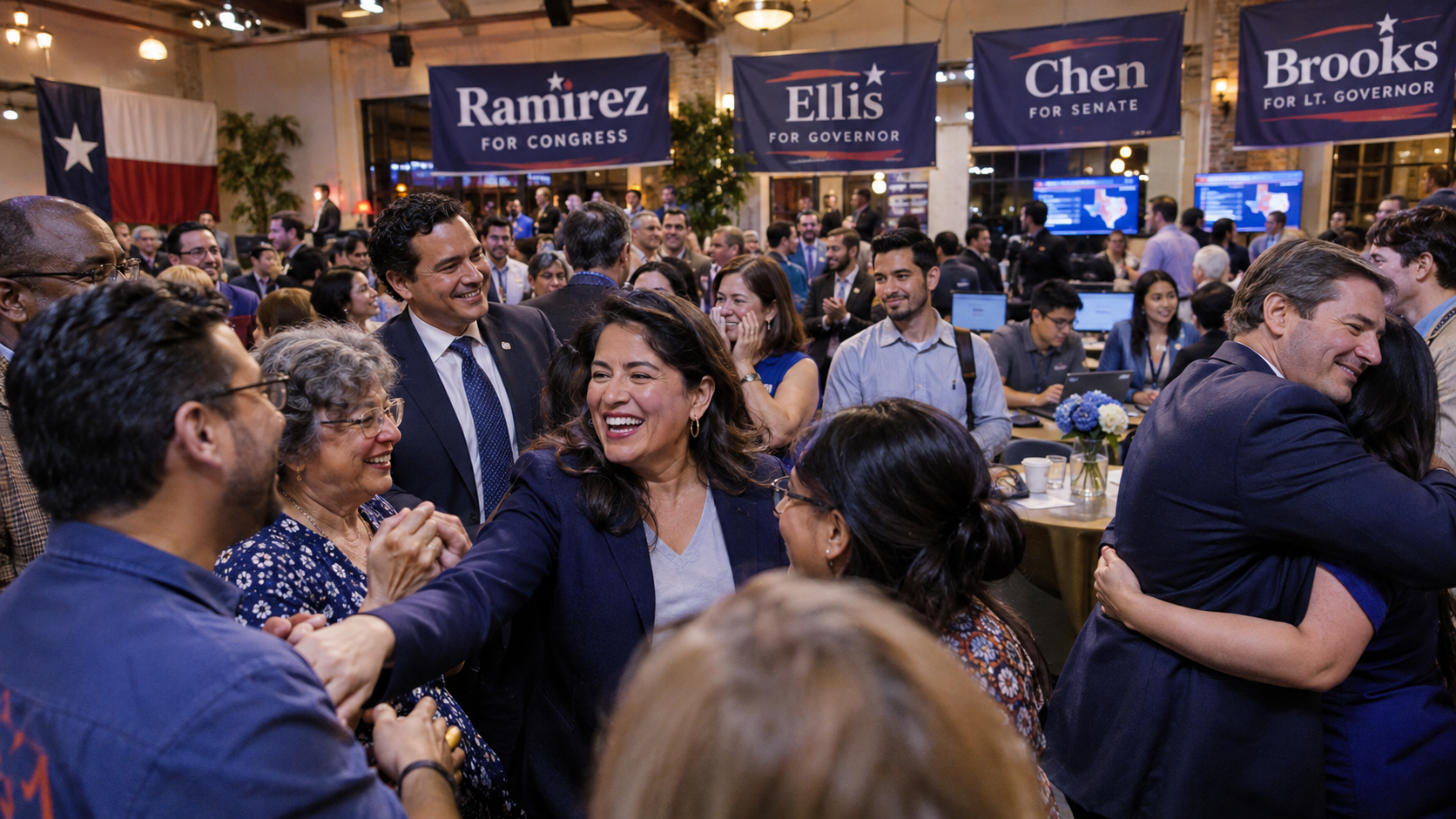
The article reports a sweeping Democratic victory in the 2026 midterm elections, with results still being counted as of Wednesday afternoon. Democrats had won seven Republican-held Senate seats, at least 24 House districts, five governorships and as many as 12 state legislative chambers. Republicans had not flipped any Democratic-held offices in those contests, despite an extensive effort to redraw congressional districts in Texas, Florida and North Carolina to protect their position.
The gains reached deep into traditionally Republican territory. Kansas elected its first Democratic U.S. senator since 1932, while Texas Democrats defeated three-term Gov. Greg Abbott and won a Senate seat the party had not held since 1988. Democrats also captured Republican Senate seats in Iowa, South Carolina and Ohio, as well as seats in Maine and North Carolina. They won gubernatorial races in Georgia, Iowa, Ohio and Nevada—states Donald Trump carried in 2024—giving Democrats a majority of the nation’s governorships for the first time since 2010.
At the state level, Democrats took the Texas House, both chambers of Wisconsin’s Legislature and the North Carolina House. They won Pennsylvania’s state Senate, reclaimed lower legislative chambers in Michigan and Minnesota, and appeared poised to take both chambers in Arizona. In several other states, they reduced Republican supermajorities enough to remove veto-proof control. The article describes the scale of these statehouse losses as comparable to the Republican reckoning after Watergate in 1974.
Several races remained uncalled, including two Senate contests, nine House races and two gubernatorial contests. Republicans’ remaining pickup prospects were limited, while they were still defending Senate seats in Alaska and Mississippi. The article says the election’s results demonstrated that Republican redistricting efforts did little to stop the Democratic wave.
Entities: 2026 U.S. midterm elections, Democratic Party, Republican Party, U.S. Senate, U.S. House of Representatives • Tone: analytical • Sentiment: negative • Intent: inform
05-11-2026
Illinois Democratic Congressman Raja Krishnamoorthi criticized Republican Bo French after French lost the November 3, 2026, Texas Railroad Commissioner election to Democratic state representative Jon Rosenthal. Writing on X, Krishnamoorthi posted, “Bye bye, Bo. Bigotry is a losing strategy,” linking the defeat to controversy over French’s comments about South Asian students at the University of Texas at Austin.
French had drawn criticism for social media posts about South Asian students, including a photograph showing a large crowd cheering at a football game. He questioned the students’ presence and suggested that their participation indicated Americans were being displaced by foreigners. In a separate post in September 2026, he shared an image of a predominantly South Asian crowd at a university event and described the situation as “far worse than anyone imagined.”
The article says French’s remarks attracted criticism from Democrats and Republicans and broadened attention beyond the state regulatory race, prompting debate about immigration, race, and diversity. Rosenthal, a Democratic state representative from the Houston area, defeated French and became the first Democrat elected to the Texas Railroad Commission in more than three decades.
Entities: Raja Krishnamoorthi, Bo French, Jon Rosenthal, Texas Railroad Commission, Texas • Tone: analytical • Sentiment: negative • Intent: inform
05-11-2026
Nathan Johnson, a Texas Democrat and longtime state senator, was elected attorney-general on Nov 3, defeating Republican Mayes Middleton. He won most of the vote in nearly all of the state’s southern border districts and major cities. Johnson will replace Republican Ken Paxton, who lost his bid for a US Senate seat to Democrat James Talarico despite receiving vocal support from US President Donald Trump.
Johnson’s election has drawn attention for his earlier career in entertainment: before entering politics, he composed music for the anime series Dragon Ball Z. He said he wrote scores for 67 episodes and five films, describing the work as both a “creative outlet” and a rare “cultural connection.” He recalled watching the show with his one-year-old child, who recognized its lead character, Goku, as action unfolded on screen.
Dragon Ball Z is a long-running Japanese anime about martial artists defending Earth from extraterrestrial invaders and other threats. The article reports that the online database IMDb lists Johnson as a composer on dozens of episodes between 1990 and 2008. He also worked as a voice actor on Berserk anime films.
A seasoned litigator with degrees in physics and law, Johnson has served in the Texas state Senate since 2019. His election will move him from the legislature to the state’s top prosecutorial office. The article presents the unusual contrast between his political and legal career and his work in anime music as its central point, while also placing his victory within the broader results of the US midterm elections.
Entities: Nathan Johnson, Mayes Middleton, Ken Paxton, James Talarico, Donald Trump • Tone: neutral • Sentiment: neutral • Intent: inform
05-11-2026
The France 24 video report looks ahead to the political consequences of the US midterm elections, focusing on what Democrats may do after their victory. With the midterms over, the party is turning toward the 2028 presidential race, which the article describes as potentially one of the most crowded and unpredictable Democratic primaries in decades. The contest could expose disagreements within the party about the best strategy for winning back the White House. France 24 International Affairs Commentator Douglas Herbert provides further analysis in the video.
The supplied page text does not include a transcript or additional details about the candidates, the election results, or the competing strategies within the party. Consequently, the report’s main point is its forward-looking framing: the midterm victory shifts attention toward a consequential presidential primary and the divisions that may shape Democrats’ approach to the next national election. The surrounding links to other US midterm coverage are recommendations on the webpage, not part of this video’s article content.
Entities: Democratic Party, United States, US midterm elections, 2028 presidential contest, Democratic presidential primary • Tone: analytical • Sentiment: neutral • Intent: analyze