05-11-2026
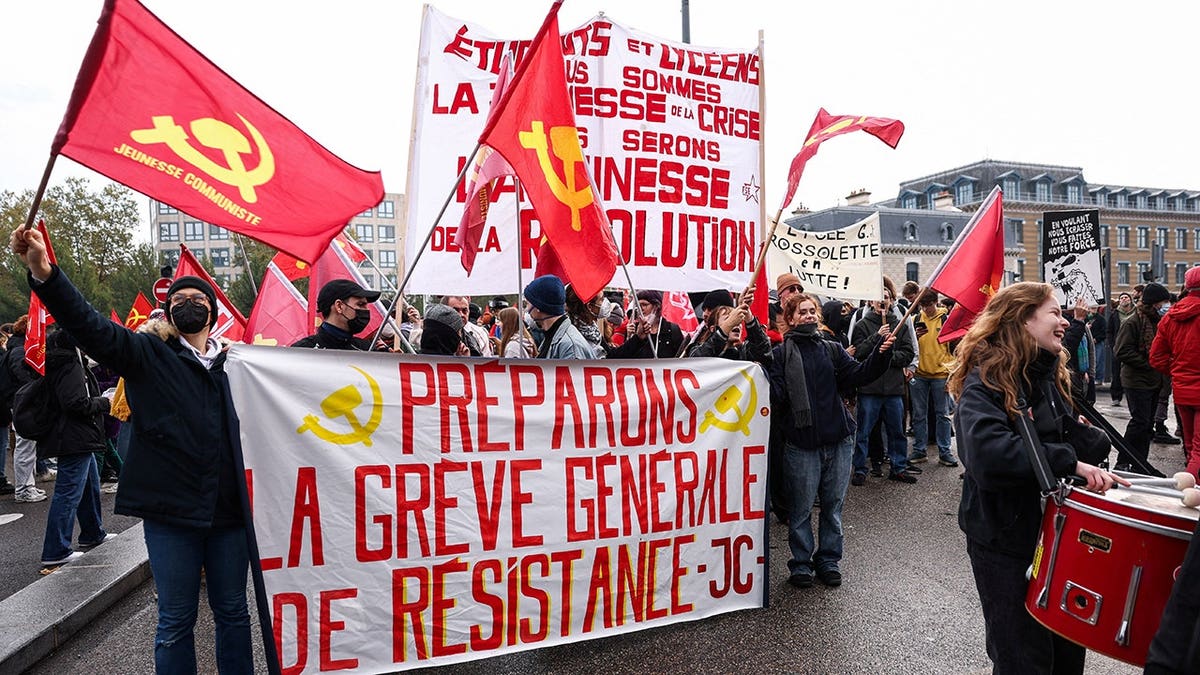
France experienced a nationwide day of strikes and demonstrations on Thursday, 5 November, as unions brought together workers, students and other protesters calling for higher wages, tax justice and improved public services. By 1 p.m., the Interior Ministry had recorded 270,000 demonstrators across 180 marches outside Paris. The CGT reported more than 250,000 participants in 73 cities. Authorities deployed approximately 70,000 police officers and gendarmes nationwide. The strike also affected schools: 81 secondary schools were blockaded, and 15.81% of teachers took part.
Protests unfolded in several cities. In Marseille, thousands marched from Les Réformés towards Place Castellane with union flags and flares, while police monitored the procession; 17 metro stations were closed. In Nantes, organisers estimated that about 30,000 people attended, while police put the number at 24,000. The march proceeded through the city centre after unions obtained permission.
In Paris, police used tear gas outside Lycée Honoré-de-Balzac in the 17th arrondissement to disperse students protesting what they said was a lack of educational resources. Footage showed a firework exploding above the crowd and cardboard burning in a bin near the school gates as officers moved in. Police also dismantled a separate student blockade on Rue de Rivoli. The capital’s main union march began at Place de la République at 2 p.m. and followed a route set by authorities towards Place de la Nation. The nationwide mobilisation was described as another major test for the autumn protest movement, bringing together workers, students and public-sector employees amid calls for better pay and working conditions.
Entities: France, 5 November nationwide strike and demonstrations, CGT, French Interior Ministry, Marseille • Tone: neutral • Sentiment: neutral • Intent: inform
05-11-2026
Tens of thousands of people marched through eastern central Lyon on Thursday during the fourth nationwide French union strike day of the autumn. The unions were protesting over pay and public services. The estimated size of the crowd differed: authorities counted 30,500 participants, while the CGT union put the number at 55,000. Demonstrators carried union banners and Palestinian flags as they followed a route set by local authorities. Officials had prohibited demonstrations in much of central Lyon, citing concerns about renewed vandalism and looting. Unions contested the restrictions in court but failed to overturn them, so the march proceeded along the imposed route.
Tensions rose near Pont Gallieni, where police said about 500 black-clad demonstrators threw projectiles and set off fireworks. Riot police responded by deploying tear gas, and six arrests were reported. The article does not specify the extent of any injuries or property damage. Disruption also affected public transport: all metro and funicular services in Lyon were suspended. The report presents the march as a large labor protest shaped by a dispute over the demonstration route and by clashes between some demonstrators and police. It provides competing crowd estimates and attributes the account of projectiles and fireworks to police, while noting the unions’ unsuccessful court challenge to the restrictions.
Entities: Lyon, France, French unions, CGT, Pont Gallieni • Tone: neutral • Sentiment: neutral • Intent: inform
05-11-2026
Workers across France went on strike on Thursday after trade unions called for a nationwide day of action, with hundreds of thousands expected to join demonstrations. Protests took place in Paris, Marseille, Lyon, Nantes and Lille, and organisers said rallies were planned in 260 cities and towns. The Education Ministry estimated that 16 percent of teachers nationwide would strike.
Demonstrators are calling for a higher minimum wage, increased salaries for all workers, tax reforms and improved conditions in schools. The unrest follows protests that began in September, when students demonstrated against conditions in public high schools, and has since grown to include broader concerns about the cost of living and public services. President Emmanuel Macron convened a defence and security meeting ahead of the demonstrations to address public order. In Lyon, Reuters reported, riot police fired tear gas at a demonstration.
A history student protesting in Lille described shared anger over low wages, rising living costs and shortages in schools and universities. Al Jazeera correspondent Rebecca Collard reported that the protests, which began with a student movement in Paris, had spread across the country, with Marseille among the cities seeing some of the largest demonstrations.
The strikes come as France prepares for a presidential election next April. Macron cannot seek another term under the two-term limit, and polls indicate that far-right candidate Marine Le Pen is the favourite. France has also faced allegations of police violence in its handling of demonstrations. Separately, Reuters reported that the G7 foreign ministers’ meeting was moved from Marseille to Paris at short notice after six weeks of protests. Diplomats described the decision as chaotic and said it could damage France’s image. The article places France’s unrest amid recent demonstrations in other European countries, including Germany and Portugal, over falling living standards and a shortage of affordable housing.
Entities: France, Paris, Marseille, Lyon, Nantes • Tone: analytical • Sentiment: neutral • Intent: inform
05-11-2026
More than 600,000 people took part in protests across France on Thursday, according to the interior ministry, while the CGT union estimated turnout at 1.57 million. Five unions coordinated strikes and demonstrations over wages, public services and the rising cost of living. The CGT described the mobilisation as the strongest since 2023, with large rallies in Paris, Marseille, Bordeaux and Lille. The protests began in September over conditions and resources in high schools, then spread to universities, workers and a revived yellow-vest movement. Unions are seeking an increase in the minimum wage, currently €12.31 an hour, and the CFDT has called for a net monthly increase of €100.
Entities: France, Sébastien Lecornu, Sophie Binet, Laurent Nuñez, Marylise Léon • Tone: analytical • Sentiment: neutral • Intent: inform
05-11-2026
Nationwide demonstrations and a one-day strike by some public sector workers took place across France on Thursday, largely peacefully but with clashes between protesters and police in Paris and Lyon. The demonstrations brought together workers, students and others concerned about wages, living costs, public services and education. Presidential candidates Jean-Luc Mélenchon and Raphaël Glucksmann attended. The Interior Ministry estimated that 575,000 people participated, while the CGT union, one of the organizers, put the figure at 1.6 million.
The protests come after weeks of unrest and months before a presidential election that President Emmanuel Macron cannot contest. They increase pressure on Prime Minister Sébastien Lecornu, who was due to meet workers’ and employers’ groups about living costs and salaries. The political contest could lead to a runoff between far-right candidate Marine Le Pen and hard-left candidate Mélenchon.
In Paris, the march began in a festive mood, but some participants clashed with police about two hours after it started. Officers used tear gas, and police reported vandalism. The Interior Ministry later said 53 officers were injured and 448 people arrested. In Lyon, riot police also used tear gas and charged protesters. Officials said the violence was contained, though tensions remained high. A strike by some energy workers and teachers shut the Eiffel Tower but caused no major transport disruption; it also reduced nuclear output, and just over 15 per cent of teaching staff joined the strike.
Authorities reported fires and damage at schools, including a high school in Toulouse where fireworks were used to start a fire, and a school in central Paris. The government deployed about 70,000 police officers nationwide. Officials defended police tactics while saying alleged abuses would be investigated. Union leaders criticized restrictions imposed after earlier riots, while participants described concerns about pay, public services and the future.
Entities: Emmanuel Macron, Sébastien Lecornu, Jean-Luc Mélenchon, Marine Le Pen, Sophie Binet • Tone: neutral • Sentiment: neutral • Intent: inform
05-11-2026
France's National Assembly unanimously rejected the government's proposed 2027 budget, deepening uncertainty over efforts to reduce the country's deficit just as nationwide strikes and protests were expected. Prime Minister Sébastien Lecornu had proposed €54 billion in spending cuts to reassure bondholders and address concerns about France's public finances. But the parliament has been fragmented since a 2024 snap election, making agreement on fiscal policy difficult. Previous governments have used Article 49.3 to pass budgets without a vote, while another constitutional option—passing a budget by ordinance—has never been used in the Fifth Republic.
The rejection was widely expected. Analysts said it could give the government time to prepare to use special powers, since passage through a normal parliamentary vote appeared unlikely. They also warned that the measures would probably not meet the government's deficit goals: weaker-than-expected economic growth means the deficit is likely to remain above 5% of GDP next year. France's deficit was 5.1% of GDP in 2025, while its public debt reached 115.6% of GDP. Rising borrowing costs have added pressure to French government bonds, known as OATs.
The budget dispute coincides with unrest over living costs and public spending. Protests that began with students opposing education funding cuts have included riots and looting, with estimated damage exceeding €1 billion. Hundreds of thousands of people were expected at nationwide strikes, and authorities planned to deploy 70,000 police and gendarmes. Reports described fires at demonstrations and tear gas used in Lyon.
Economists characterized France's outlook as difficult, citing weak growth, declining confidence, and softening domestic demand and investment. They said the government has limited scope to restore social calm by increasing spending, as it has done in the past. However, one analyst cautioned that the country was not on the verge of collapse and was not in a situation comparable to Greece before the euro-zone crisis.
Entities: France, National Assembly, Sébastien Lecornu, François Bayrou, Laurent Nuñez • Tone: analytical • Sentiment: negative • Intent: analyze
05-11-2026
Hundreds of thousands of people took part in nationwide demonstrations in France over the cost of living and deteriorating public services. Interior Minister Laurent Nunez said the number grew from 270,000 to 600,000 during Thursday, while estimates for earlier protests ranged from 550,000 to 800,000. Five unions representing public- and private-sector workers organized the action, joined by students. They called for increases in the minimum wage and wages more broadly, tax reforms, improved conditions for young people, and better public services. The protests also prompted strikes in education, rail, hospitals, postal services and the energy sector. The Education Ministry said just over 15% of teachers were on strike, and about a third of high schools were closed or affected by blockades.
Rallies took place in Paris, Lyon, Marseille and other cities. Most were described as peaceful, but police used tear gas in Paris and clashed with protesters in Lyon. Authorities also reported attempted roadblocks in Rennes and a fire at a high school near Toulouse. About 70,000 police and security personnel were deployed nationwide. The article also recounts violence during earlier weekend demonstrations: rioters set fire to Limoges’s historic town hall and attacked public buildings elsewhere; shops were looted and vehicles and buildings burned. President Emmanuel Macron condemned the violence and promised accountability, while officials blamed ultra-left groups and criminals. Around 2,400 people were arrested over that weekend, and roughly 500 police, firefighters and paramedics were reported injured.
The demonstrations take place amid tight public finances. France’s National Assembly is debating a 2027 budget with projected cuts of about €45 billion, limiting the government’s room to meet protesters’ demands. An estimated 1,500 businesses suffered damage, with losses potentially reaching hundreds of millions of euros. The article also describes related unrest in Milan, Italy, where a cost-of-living march escalated into clashes, looting and damage to property.
Entities: France, Paris, Lyon, Marseille, Limoges • Tone: analytical • Sentiment: negative • Intent: inform
05-11-2026
Hundreds of thousands of people took part in demonstrations across France on Thursday, as public-sector workers went on strike alongside students protesting education conditions and the rising cost of living. Trade unions called the mobilization to demand higher minimum and general wages, tax reforms, and improved learning conditions. The demonstrations followed weeks of youth-led protests that had grown to encompass concerns about living costs and inequality; some earlier actions culminated in serious rioting on October 17.
Authorities prepared a large security response, with Interior Minister Laurent Nunez announcing that about 70,000 police officers and security personnel would be deployed. Unions planned around 260 rallies. Officials anticipated 500,000 to 700,000 participants nationwide, including approximately 80,000 in Paris. An official cited by the Associated Press said roughly 270,000 people had joined 180 rallies by early afternoon. Most marches were peaceful, though violence and disruption were reported in several cities, including Lyon, Nantes, Pau, Orleans, Rennes, and Toulouse. Reports included attempts to block roads in Rennes and a fire at a high school near Toulouse.
Education, rail, hospital, postal, power, and air-traffic workers were among those called to strike. The Education Ministry said just over 15% of teaching staff had walked out, while about one-third of high schools were closed because of student blockades or teacher strikes. The Eiffel Tower also closed. SNCF expected only minor disruption to long-distance trains, while the impact of the air-traffic-control strike was unclear. The article describes a largely peaceful but tense nationwide mobilization, with some clashes and property damage, amid wider public anger over wages, education, living costs, and inequality.
Entities: France, Laurent Nunez, Marseille, Paris, Lyon • Tone: neutral • Sentiment: neutral • Intent: inform
05-11-2026
France saw its fourth nationwide day of strikes and demonstrations on Thursday, 5 November 2026, as trade unions brought together workers, students and other protesters. Demonstrators called for higher wages, tax justice, better public services, and improved pay and working conditions. Participation figures varied by source: by 1 pm, the Interior Ministry counted 270,000 people across 180 marches outside Paris, while the CGT reported more than 250,000 participants in 73 cities. Authorities deployed about 70,000 police officers and gendarmes nationwide. The strike also affected schools: 81 secondary schools were blockaded, and 15.81% of teachers joined the walkout.
Large demonstrations took place in Marseille and Nantes. In Marseille, thousands marched between Les Réformés and Place Castellane, while 17 metro stations were closed. In Nantes, organisers estimated that about 30,000 people marched, compared with a police estimate of 24,000; unions had secured permission to use a route through the city centre.
Tensions arose in Paris outside Lycée Honoré-de-Balzac, where police used tear gas to disperse students protesting a lack of educational resources. Video showed a firework exploding over the crowd and cardboard burning in a bin as officers moved in. Police also dismantled a separate student blockade on Rue de Rivoli. The capital’s main union march began at Place de la République at 2 pm, following a route set by authorities towards Place de la Nation. The protests were described as a major test of the autumn mobilisation, which united workers, students and public-sector employees.
Entities: France, CGT, French Interior Ministry, Paris, Marseille • Tone: neutral • Sentiment: neutral • Intent: inform
05-11-2026
Tens of thousands of people marched through Lyon on Thursday, 5 November 2026, during France’s fourth nationwide strike day of the autumn. The strike was called by unions over wages, purchasing power and public services. Estimates of the Lyon crowd differed: authorities counted 30,500 participants, while the CGT union put the number at 55,000.
Demonstrators carried union banners and Palestinian flags along a route set by local authorities. Officials had banned demonstrations across much of central Lyon, citing concerns about renewed vandalism and looting. Unions challenged the restrictions in court but failed to overturn them.
Clashes broke out near Pont Gallieni. Police said that around 500 black-clad demonstrators threw projectiles and set off fireworks. Riot police responded with tear gas, and six arrests were reported. The protest also caused major disruption to local transport: all metro and funicular services were suspended.
The report describes a large, contentious demonstration and the response by police and local authorities. It gives competing estimates of attendance and outlines the reasons for the strike, restrictions on the march, reported clashes, arrests and transport shutdown. It does not provide further details about injuries, the duration of the service suspension or the demonstrators’ specific demands beyond the broader issues of pay, purchasing power and public services.
Entities: Lyon, France, CGT union, French unions, Pont Gallieni • Tone: neutral • Sentiment: negative • Intent: inform
05-11-2026
France deployed 70,000 police officers on Thursday as nationwide strikes and demonstrations drew tens of thousands of people, following a call for mobilization by left-wing groups and labor unions. Authorities equipped police with armored vehicles, drones and helicopters. By early Thursday, about 270,000 people had joined union actions at 180 rallies outside Paris, according to an official close to Interior Minister Laurent Nuñez. Around a third of the country’s high schools were closed or unable to operate, either because of student blockades or teacher strikes.
The demonstrations disrupted daily life and included violent incidents. Paris’s Eiffel Tower closed, riot police fired tear gas and charged protesters in Lyon, and a high school near Toulouse was set on fire, Reuters reported. Authorities in Brittany said masked people attempted to block roads in Rennes and that some threw steel balls at police. The unrest follows violent protests in October, which President Emmanuel Macron blamed on ultra-left groups seeking to bring down the Republic.
Unions said France was at risk of recession and pointed to rising prices and multiplying layoff plans, arguing that wages and pensions had not kept pace with costs. The U.S. Embassy had issued a security alert advising Americans to prepare for major disruptions, possible sudden curfews and violence. Tourists interviewed in Paris expressed mixed practical reactions: one supported the political action, while another said a planned visit to the opera was prevented by the strike.
The protests are taking place as political parties position themselves ahead of next May’s presidential election. Macron cannot seek a third consecutive term, and the Associated Press reported that far-right candidate Marine Le Pen is the favorite to win.
Entities: France, Emmanuel Macron, Sophie Binet, Laurent Nuñez, Marine Le Pen • Tone: neutral • Sentiment: negative • Intent: inform
05-11-2026
France is facing another wave of strikes and protests, and Gaëlle Martinez, National Secretary of the trade union Solidaires, describes the general strike as part of a broader conflict than a dispute over wages, public spending, or the cost of living. In her view, the protests reflect a struggle over economic dignity, the future of public services, and the right to demonstrate collectively.
Martinez points to low salaries, schools in very poor condition, and the deterioration or dismantling of public services as connected problems rather than isolated failures. She argues that political and economic priorities have put fiscal restraint ahead of social welfare, leaving people feeling that they are merely surviving rather than able to live securely.
Her proposed response includes a new budget that does not rely on cuts. She also calls for the largest and most profitable companies to be taxed, presenting this as a way to fund public needs without placing the burden on services and workers. The article thus frames the strike as both a protest against material hardship and a challenge to the policies shaping France’s public services and economic priorities. It presents Martinez’s perspective on the protests and their underlying causes, rather than offering a detailed account of negotiations or the government’s response.
Entities: Gaëlle Martinez, Solidaires, France, French strikes and protests, General strike • Tone: analytical • Sentiment: negative • Intent: analyze
05-11-2026
The France 24 video examines French protests and the political challenges they pose for the government. Lecturer in French and politics Ariane Bogain of Northumbria University argues that repression cannot resolve the underlying causes of public anger: “You can be as repressive as you want. The grievances are still here.” Her observation frames the central question discussed in the segment: how can political authority be restored if social and economic grievances remain unresolved?
Bogain and France 24 French politics editor Marc Perelman join presenter Delano D'Souza to discuss how the protest movement has expanded beyond its initial concerns about purchasing power, fuel prices and education. It has become a wider challenge to the French government. The article’s description does not provide detailed accounts of particular demonstrations or specific government measures, but it emphasizes the persistence and broadening of discontent.
Perelman also highlights a political paradox: Marine Le Pen and Jean-Luc Mélenchon are ideological opponents, yet he characterizes them as “objective allies” because both have an electoral interest in weakening the political centre. The discussion therefore connects street-level grievances with political competition, suggesting that unresolved public concerns may have consequences for the balance of power in France. The segment’s central message is that lasting change requires more than a forceful response to protests; Bogain’s title quotation emphasizes the importance of public and private sectors acting together.
Entities: Ariane Bogain, Marc Perelman, Delano D'Souza, Northumbria University, France • Tone: analytical • Sentiment: negative • Intent: analyze
05-11-2026
A France 24 liveblog report describes nationwide demonstrations and strikes held across France on Thursday, November 5, 2026. Estimates of participation differed sharply: the hard-left labour union said nearly 1.6 million people joined protests, while the Interior Ministry reported approximately 600,000 participants. The headline gives the ministry's figure as 575,000 and contrasts it with the union's claim of “close to 1.6 million.” Demonstrators called for higher wages and expressed support for a high school protest movement. The report says student-led demonstrations and strikes had gripped the country for weeks, and that the latest mobilization renewed pressure on the government. Prime Minister Sébastien Lecornu was scheduled to meet trade unions on Monday. The article includes a photograph caption describing demonstrators gathered at Place de la République in Paris before a march began. It provides only a brief account and directs readers to a liveblog for the sequence of events; the liveblog itself is not included in the supplied text. The report is attributed to France 24, with AFP, AP and Reuters also credited. No further details about the demonstrations, the unions’ demands beyond higher wages, or the government’s response are provided in the available article text.
Entities: France, Paris, Place de la République, Sébastien Lecornu, French Interior Ministry • Tone: neutral • Sentiment: neutral • Intent: inform
05-11-2026
More than 600,000 people demonstrated across France on Thursday, according to provisional figures from the Interior Ministry, demanding higher wages and pensions, better school funding, and support for a student-led protest movement. Large marches took place in Paris, Lyon, Marseille and other cities after more than a month of recurring demonstrations. Most gatherings were peaceful, but authorities reported clashes and violence in several locations. The Paris march was peaceful and included students, workers and retirees. Protest-related disruptions closed or affected about a third of the country’s high schools, interrupted public transportation in some areas and led to the Eiffel Tower’s closure.
Interior Minister Laurent Nuñez said 70,000 police officers were deployed, with armored vehicles, drones and helicopters. Authorities cited incidents including attempted roadblocks in Rennes and violence against police, while recent demonstrations have also been criticized for police use of force. Unions said France was nearing recession and warned that layoffs were increasing as living costs rose faster than wages and pensions. Protesters described concerns about job prospects, school resources, hospital staffing and working conditions. A rail union official defended strikes as a response to what he called unreasonable decisions by the government and SNCF.
The movement began in September over staffing shortages at a high school southeast of Paris, then expanded to include demands for more education funding, better pensions and relief from rising fuel and other costs. The government had been negotiating with unions in an effort to contain the protests, which the article describes as producing France’s most violent civil unrest in years. The demonstrations are also unfolding as campaigning intensifies to succeed President Emmanuel Macron, who cannot seek a third consecutive term. Far-right candidate Marine Le Pen is described as the favorite, while candidates from the left and Green parties joined the Paris march. A political scholar said frustration with the government was widespread and warned that whoever wins the presidency will inherit serious problems.
Entities: France, Paris, Lyon, Marseille, French Interior Ministry • Tone: analytical • Sentiment: negative • Intent: inform
05-11-2026
France is preparing for large demonstrations and strikes on Nov 5, as unions, student groups and public-sector workers challenge President Emmanuel Macron over living costs, public services and education. The protests come after weeks of unrest, including riots and looting on Oct 17 that damaged shops and public buildings and exposed security forces to criticism for being caught off guard. The government is trying to prevent a repeat of that violence as the presidential election approaches in five months.
Authorities plan to deploy around 70,000 police nationwide. France’s domestic intelligence service estimates that 500,000 to 700,000 people could demonstrate outside Paris. The Education Ministry expects 17.5 per cent of public primary-school teachers to strike, while unions anticipate disruption to rail and other public transport. Power-sector unions are also expected to participate.
Students say worsening school conditions and uncertainty about their futures remain central concerns. One Paris student, Irma de Banville, said some people were reluctant to mobilise because they feared police violence. The government has defended police tactics but says alleged abuses will be investigated.
Macron convened a defence and security meeting ahead of the protests. An official close to him described the government’s objective as restoring calm and ensuring the presidential campaign begins in stable conditions. Although protests on Oct 31 were generally peaceful, with some clashes at their edges, the political climate remains tense as candidates and opposition parties respond to public dissatisfaction with living standards and government policy. A previous power-sector strike in September reduced electricity supply and limited delivery capacity at the Dunkirk LNG terminal, raising the prospect of further disruption.
Entities: Emmanuel Macron, Maud Bregeon, Irma de Banville, France, Paris • Tone: analytical • Sentiment: negative • Intent: inform
05-11-2026
France faced another nationwide round of protests on November 5, after weeks of unrest that began with student demonstrations over underfunded schools and expanded into broader anger about the cost of living and public services. Trade unions and student groups mobilised demonstrators, while the government deployed 70,000 police and security officers to oversee 220 planned demonstrations and prevent a repeat of the October 17 clashes and looting.
The government is considering raising the minimum wage, currently €1,478 net per month, but has resisted wider cost-of-living measures while trying to control the budget deficit. The CFDT union wants an increase of at least €100. For schools, the government has promised 3,000 qualified teachers, smaller classes, more staff next year and €4 billion in renovation loans.
Protests are expected to continue: grassroots groups plan another demonstration on Saturday, and some unions and housing associations have called for pan-European protests from November 20 to 22. The unrest has weakened household and business confidence and worsened pressure on France’s fiscal outlook. Higher energy prices linked to the Iran war and a divided parliament’s struggle over the 2027 budget add to the strain. Investor concerns have weighed on stocks and French government debt; the 10-year bond yield reached 5.14% last month, its highest level since 2002.
The article places France’s unrest within a wider wave of Gen Z-led protests across Europe, with demonstrations over education, living costs, public services and housing reported in Germany, Italy, Spain and Portugal. Politically, polls suggest the crisis is benefiting far-right candidate Marine Le Pen and hard-left candidate Jean-Luc Melenchon. Centre-right candidate Edouard Philippe is trailing them ahead of the 2027 presidential election, in which Emmanuel Macron will step down after a decade in office.
Entities: France, Paris, Emmanuel Macron, Marine Le Pen, Jean-Luc Melenchon • Tone: analytical • Sentiment: negative • Intent: inform
05-11-2026
The France 24 report says France is facing new protests as the government seeks to prevent a repeat of unrest that occurred in October. Protesters are calling for better public services, with education specifically mentioned, and are also criticizing the cost of living. The report is attributed to France 24 journalist Claire Paccalin, who reports from the scene. The supplied page contains only a short description of the video report; it does not include a transcript, details about the planned demonstrations, the government’s specific preventive measures, or further accounts from protesters. The summary is therefore limited to the information available in the article text provided.
Entities: France, France 24, Claire Paccalin, October unrest, Protests • Tone: neutral • Sentiment: neutral • Intent: inform