05-11-2026
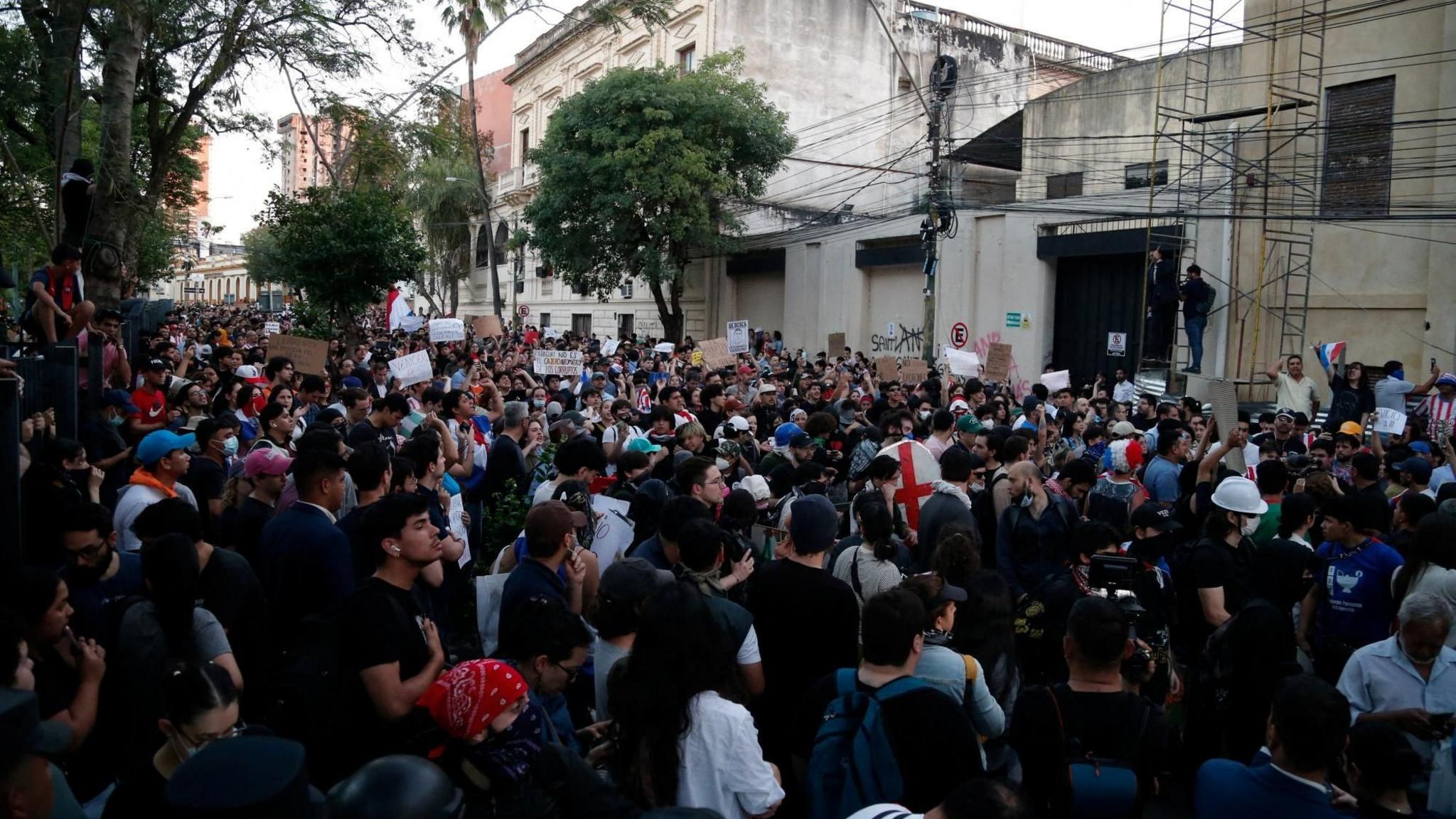
The article reports that Ueno Bank in Paraguay was shut down in the middle of the night amid a solvency crisis. The closure left customers unable to access their money and was followed by protests across the country. The report says an estimated 60% of Paraguay’s adult population banks with Ueno, indicating that the shutdown affects a large share of residents who use banking services. The headline characterizes the collapse as involving “half of the population’s savings,” while the accompanying description specifically states the 60% figure refers to adults who bank with Ueno; it does not provide a separate estimate of the amount of savings held there.
The available article text offers only a brief account. It does not explain the causes or financial details of the solvency crisis, identify who made the closure decision, or describe what arrangements may be made for customers to recover or access their funds. It also gives no details about the protests, such as their locations, size, or response from authorities. Accordingly, the report establishes the central event and its immediate effects—Ueno Bank’s shutdown, customers’ loss of access to money, and public demonstrations—but leaves the broader financial and political consequences unclear. Its primary function is to inform readers of a rapidly developing banking crisis and its potential reach, rather than provide an in-depth account of the resolution or the bank’s financial condition.
Entities: Paraguay, Ueno Bank, banking crisis, bank collapse, solvency crisis • Tone: urgent • Sentiment: negative • Intent: inform
05-11-2026
Paraguayan President Santiago Peña announced his resignation after the collapse of Ueno Bank triggered a political crisis. In a video message, Peña apologized to the public if he had failed them and said he had not intended to betray their trust. He had been a shareholder until the previous year in the company that owned the bank, prompting lawmakers to allege conflicts of interest and misconduct. Peña denied impropriety.
The resignation came as Paraguay’s lower house voted to pursue an impeachment trial. Although Congress must approve a president’s resignation, a special session held on Thursday was adjourned so lawmakers could continue with the impeachment process. Congress scheduled another special session for Friday, when Peña was expected to present his defence. He said on X that he would attend Senate proceedings and provide requested information, arguing that citizens deserved the truth and that no one should be above the law. He had earlier said stepping down would protect stability, social peace and democratic institutions.
The bank’s collapse has affected millions. Ueno Bank reportedly served about three million customers—around 60% of Paraguay’s adult population—and held pensions and other public funds. After the bank entered insolvency and its operations were frozen, many customers were unable to access their accounts. The central bank seized the digital lender, while protests took place in the streets and near Congress, with demonstrators demanding Peña’s removal. A new central bank president was appointed, and Congress approved a process to pay depositors.
Peña was elected in 2023 as the candidate of the ruling conservative Colorado Party. The party also dropped impeachment proceedings against Vice President Pedro Alliana, who is next in line for the presidency. The article describes an unfolding confrontation involving the bank’s failure, public hardship, street protests and congressional scrutiny of the president.
Entities: Santiago Peña, Paraguay, Ueno Bank, Central Bank of Paraguay, Paraguayan Congress • Tone: neutral • Sentiment: negative • Intent: inform
05-11-2026
Paraguayan President Santiago Pena resigned Thursday as a banking crisis involving digital lender Ueno intensified and lawmakers considered impeaching him. Ueno’s accounts were frozen after the central bank found the bank’s solvency ratio had fallen below half the required minimum. The disruption left millions of customers unable to access money, including pension payments, and prompted protests in Asuncion. Ueno served about 2.94 million customers—roughly 60% of Paraguay’s adult population—and held approximately $800 million in public-sector deposits, including funds connected to the country’s hydroelectric dams.
Pena faced accusations of conflicts of interest, misuse of pension funds and efforts to cover up institutional failures. The impeachment articles were submitted by opposition lawmakers and ruling-party dissidents after Congress President Basilio Nunez and Colorado Party leader Horacio Cartes withdrew their support for the president. Allegations included that Pena received two loans from Ueno, interfered improperly in the Social Security Institute (IPS), and favored the bank. IPS held $355 million at Ueno, about 9% of its investments. Lawmakers also questioned Pena’s appointment of central bank chief Carlos Carvallo, a former chair of Financiera Ueno; the central bank approved the company’s conversion into a bank 83 days after Carvallo’s appointment.
The central bank ordered a resolution or closure process, while Ueno’s app, card payments and transfers stopped and its branches closed. Depositors, retirees, students and workers marched demanding their money back and Pena’s impeachment; Ueno and conglomerate employees also protested over unpaid wages and severance. Authorities detained eight senior executives, including founder Miguel Vazquez and bank president Juan Manuel Gustale, and prosecutors charged 27 bank officials and associates with offenses including breach of trust and attempted fraud. Pena had promised legislation to return savers’ money quickly, and the crisis led him to cancel a planned trip to an Ibero-American summit in Madrid. He had taken office in August 2023 for a five-year term.
Entities: Santiago Pena, Paraguay, Ueno Bank, Ueno Holding, Colorado Party • Tone: analytical • Sentiment: negative • Intent: inform
05-11-2026
Paraguayan President Santiago Peña resigned as lawmakers prepared to impeach him over an alleged conflict of interest connected to the collapse of Ueno Bank. The Chamber of Deputies voted unanimously to impeach him, and Vice President Pedro Alliana is set to take office. Peña announced his resignation in a video, invoking national stability and social peace, apologizing to the public but not accepting responsibility for the banking crisis.
Paraguay’s central bank took control of Ueno earlier in the week after an investigation found poorly documented loans and expenses incorrectly recorded as assets. Correcting the accounts revealed that the bank’s capital had fallen to half the legal minimum. The intervention shut down its app, cards, transfers and branches, leaving nearly three million customers unable to access deposits, pensions or other funds. The closure also affected 7,000 employees, while public panic and attempts to open accounts elsewhere strained other banks’ mobile services. Protests and long queues formed in Asunción.
The article describes concerns about Peña’s links to Ueno and the political relationships that may have enabled its rapid growth. Peña held a stake in a company related to the bank until last year, appointed a former Ueno executive to lead the central bank, and his government placed substantial public funds with the lender. Regulators had reportedly warned of risky insider lending, including loans to companies tied to the bank’s owners, but Peña publicly defended Ueno and dismissed concerns. Protesters accused the governing Colorado Party of benefiting from decades of corruption. The crisis has shaken confidence in a country known for economic stability and has become both a financial emergency and a political scandal.
Entities: Santiago Peña, Pedro Alliana, Ueno Bank, Paraguay, Asunción • Tone: analytical • Sentiment: negative • Intent: inform
05-11-2026
The liquidation of Ueno Bank has plunged Paraguay into a financial and political crisis. On 3 November, the bank’s app stopped showing customer balances, and the Banco Central del Paraguay announced that it had intervened in the institution and begun winding it up after its solvency ratio fell below 50%. The shutdown left millions of customers unable to access accounts or use cards and services. Crowds gathered at branches across the country, with some customers urgently needing money for food, medicine, and other essentials.
Ueno held about $850 million in public resources, including funds associated with Paraguay’s social security institute that support pensions and healthcare. Authorities said a guarantee fund would reimburse customers up to a specified limit, but the announcement did little to ease public distrust. The crisis has also prompted fears of a “corralito,” a restriction on access to deposits reminiscent of Argentina’s financial crisis.
Opposition legislators have targeted President Santiago Peña, accusing his administration of failing to oversee the bank and alleging conflicts of interest, misuse of pension funds, and protection of the central bank. At the request of 35 legislators, the Chamber of Deputies is due to consider whether to open impeachment proceedings; the measure requires 53 votes in the lower house and subsequent approval by two-thirds of the Senate. Peña cancelled his official schedule, later announced the central bank chief’s departure, and called for judicial accountability. Eight senior Ueno executives, including CEO Miguel Vázquez, were arrested.
The shutdown is already affecting the wider economy: importers and retailers reported a 35% drop in sales as customers’ money became inaccessible. The article describes Ueno’s rapid expansion, prominent advertising and football sponsorship, and an ambitious $100 million capitalisation plan, set against regulators’ finding that it could not meet a required $70 million reserve. The crisis threatens Peña’s political standing despite Paraguay’s strong recent economic growth.
Entities: Ueno Bank, Santiago Peña, Banco Central del Paraguay (BCP), Liana Caballero, Miguel Vázquez • Tone: urgent • Sentiment: negative • Intent: inform
05-11-2026
Paraguay’s lower house voted unanimously to begin impeachment proceedings against President Santiago Peña on Thursday, shortly after Peña announced his resignation on X amid a banking crisis. His resignation has not yet taken effect: Congress put it on hold while the impeachment process moves forward, leaving him provisionally in office. An extraordinary congressional session intended to decide whether to accept the resignation failed to reach a quorum, while a later session scheduled the impeachment trial for Friday.
The crisis followed the Central Bank’s takeover of Ueno Bank, which it said was necessary because of a severe capital shortfall and to protect depositors and financial stability. The seizure froze deposits belonging to around three million people, including pensioners, and prompted protests and long queues at bank branches. Demonstrators demanded their money back; earlier protests included clashes in which police used tear gas and water cannons. People affected described being unable to access cash or complete a home purchase.
Lawmakers allege misconduct and a conflict of interest in Peña’s dealings with the bank. Peña had owned shares in a group that controlled Ueno, though he sold them last year. He apologized to the public and said his priority was restoring the peace of mind of people who had entrusted their savings to the financial system. His efforts to ease tensions—including requesting the Central Bank president’s resignation and setting a five-day limit for funds to be returned—did not satisfy the public. Peña said he would attend the impeachment trial. His Interior Minister, Enrique Riera, also resigned, with Carlos Benítez named as interim replacement. Vice President Pedro Alliana is expected to take over as national leader. Opposition lawmaker Raúl Benítez accused Peña of allowing a scheme to drain the bank, while ruling-party Senator Derlis Maidana said the trial should conclude quickly to reassure the public.
Entities: Santiago Peña, Paraguay, Ueno Bank, Paraguay's Central Bank, Congress of Paraguay • Tone: analytical • Sentiment: negative • Intent: inform
05-11-2026
Paraguayan President Santiago Peña announced his resignation after the collapse of Ueno Bank, a fast-growing digital lender closely connected to his government, sparked protests and froze depositors’ savings. Minutes after his announcement, the lower house voted unanimously to impeach him and sent charges to the Senate. Congressional leaders were expected to accept his resignation, allowing Vice President Pedro Alliana to take office without a Senate trial. Opposition senators nevertheless called for a trial, arguing that resignation could preserve Peña’s eligibility for a lifetime Senate seat and its legal protections.
The bank’s failure has shaken Peña’s Colorado Party, whose leader and Peña’s mentor, former President Horacio Cartes, supported impeachment. The crisis also weakened Paraguay’s currency. Ueno had attracted more than 60% of adults as customers and held about $800 million in public deposits, including pension and health-fund money. Its rapid expansion took place amid concerns about the closeness of the governing party, regulators and business interests. Central bank inspectors reportedly found risky insider lending, and regulators later said loans were poorly documented and expenses had been improperly counted as assets. After corrections, Ueno’s capital fell below half the legal minimum, prompting its seizure and the shutdown of its app, cards, transfers and branches.
A new state guarantee process is meant to repay depositors, with payments beginning with smaller accounts; officials say the insurance limit will cover the full balances of about 97% of customers. A judge ordered six executives jailed pending trial, while prosecutors charged 27 bank officials and associates over alleged improper lending and diversion of funds. Executives’ lawyers disputed responsibility for individual loan decisions. Protests continued after Peña’s resignation, with workers demanding unpaid wages and severance and depositors calling for accountability and the return of their money. The Labor Ministry estimated that about 7,000 direct and indirect jobs were affected.
Entities: Santiago Peña, Ueno Bank, Colorado Party, Pedro Alliana, Horacio Cartes • Tone: analytical • Sentiment: negative • Intent: inform
05-11-2026
Paraguay’s Congress began a session on Thursday, November 5, to consider whether to initiate impeachment proceedings against President Santiago Peña. The political effort follows the collapse of digital lender ueno, which has left millions of Paraguayans unable to access their accounts and prompted protests and demands that Peña resign. To begin impeachment proceedings, at least two-thirds of lawmakers participating in the session must support the move.
The drive gained momentum as Congress President Basilio Nuñez and Colorado Party leader Horacio Cartes withdrew their backing for Peña on Thursday, weakening the president’s position ahead of the vote. Congress had convened an extraordinary session late Wednesday after 35 lawmakers submitted articles of impeachment in the 80-seat lower house.
The lawmakers accuse Peña of conflicts of interest, misuse of pension funds and institutional cover-ups connected to ueno’s collapse. The article notes that Peña held a share in the group controlling the lender until last year. It does not report the outcome of the session or establish that the allegations have been proven. The central development is therefore a move to debate the president’s possible removal, amid public anger over the lender’s failure and a loss of support from prominent political allies.
Entities: Santiago Peña, Paraguay, Paraguay Congress, Basilio Nuñez, Horacio Cartes • Tone: analytical • Sentiment: negative • Intent: inform
05-11-2026
Paraguayan President Santiago Peña resigned amid a banking and political crisis after the central bank placed Ueno Bank into resolution over insolvency. The move froze deposits belonging to about three million customers, leaving many families unable to access money for food and everyday needs. The bank had grown rapidly from a little-known digital lender into one of the country’s largest, following its acquisition by Grupo Vázquez and authorization to operate as a digital bank during Peña’s administration. It attracted customers through promotions and managed hundreds of millions of dollars in deposits from state and pension entities.
The bank’s rapid expansion and its handling of public and pension funds drew scrutiny because Peña had previously held shares in Ueno Holding. Peña said he had made an investment and sold his shares, denied wrongdoing, and described accusations of favoritism as a false media campaign. As the crisis unfolded, bank executives were arrested and large protests took place. Opposition lawmakers and members of Peña’s own Colorado party filed an impeachment motion, while former president and political ally Horacio Cartes publicly endorsed impeachment.
In a resignation video, Peña said he was stepping down to protect stability, social peace and democratic institutions, and apologized to Paraguayans if he had failed them. He said his priority was ensuring the return of depositors’ funds. Opposition senator Rafael Filizzola described the scandal as a major fraud enabled by political power.
Peña, a former finance minister and close US partner, had been in office since August 2023, with a term scheduled to run until 2028. His successor was uncertain: Congress would need to accept the resignation, after which Vice-President Pedro Alliana would take over, though Alliana has also been suspected of involvement and denies it. The lower house unanimously approved the impeachment motion shortly after Peña’s announcement; it then moved to the Senate. If approved, impeachment could cost Peña his Senate seat and parliamentary immunity, potentially exposing him to criminal proceedings in ordinary courts.
Entities: Santiago Peña, Paraguay, Ueno Bank, Grupo Vázquez, Paraguay Central Bank • Tone: analytical • Sentiment: negative • Intent: inform