22-10-2026
The article reports that Stephen Hubbard, a 74-year-old US citizen, has been released from a Russian prison after spending four years behind bars. Hubbard had been convicted in Russia of serving as a mercenary for Ukraine, an accusation he denies. The article does not provide further details about the circumstances of his arrest, trial, imprisonment, or release, nor does it say what happens next for Hubbard.
His release coincided with a visit to Russia by US envoy Steve Witkoff. According to the report, Witkoff was seeking to persuade Moscow to rejoin peace talks. The article notes this timing but does not explicitly state that the envoy’s visit or diplomatic efforts caused Hubbard’s release, or that the two matters were directly linked.
Overall, the report presents a brief account of Hubbard’s release and the diplomatic context in which it occurred. It foregrounds the central dispute surrounding his imprisonment: Russian authorities convicted him of mercenary activity connected to Ukraine, while Hubbard denies the claim. The article offers no additional comment from Hubbard, Russian officials, the US government, or the parties involved in the peace talks. Its focus is therefore limited to the reported release, the length of his imprisonment, the conviction and denial, and Witkoff’s concurrent visit and stated diplomatic objective.
Entities: Stephen Hubbard, Steve Witkoff, Russia, Ukraine, United States • Tone: neutral • Sentiment: neutral • Intent: inform
22-10-2026
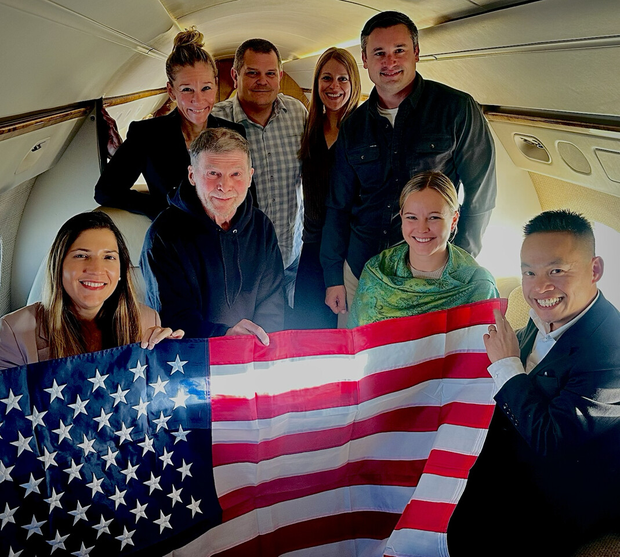
Stephen Hubbard, a 74-year-old American released from a Russian prison after more than four years, had sounded profoundly exhausted during a conversation with his son, Fr. Joseph Coleman, who feared he might not see his father again. Coleman said the call suggested Hubbard was experiencing an extreme weariness with life, though he stopped short of describing it as suicidal. Hubbard was released after U.S. special envoy Steve Witkoff met with Russian President Vladimir Putin, and returned to the United States on Wednesday. President Trump said Putin agreed to release Hubbard at his request without a prisoner swap, while also saying that his decision to waive new sanctions against Russia helped make the release possible.
Hubbard had been detained after Russia accused him of fighting for Ukraine. He was captured in Ukraine after the 2022 invasion and, following a closed-door trial, sentenced to nearly seven years in a penal colony. His family disputes the allegations. Attorney Martin De Luca said that when his team began working on the case in February 2025, neither the family nor the U.S. Embassy knew where Hubbard was held. Russian lawyers eventually located him and arranged legal visits and assistance with basic necessities. De Luca said Hubbard’s isolation had taken a serious toll, and that his team found no evidence he had served in Ukraine’s military.
Coleman and De Luca credited the Trump administration’s engagement with Moscow for Hubbard’s freedom. Coleman called the release a small step toward peace and thanked Putin, while also acknowledging that his father had remained in a war zone after foreign nationals were told to leave. He emphasized that this did not make the detention justifiable. Witkoff’s praise of Putin as a “humanitarian” drew criticism from lawmakers, particularly given Putin’s International Criminal Court warrant over alleged war crimes and accusations of Russian abuses in Ukraine.
The article also notes questions about whether U.S. policy concessions were linked to Hubbard’s release. De Luca saw no direct connection, while Trump said new sanctions would have prevented it. As many as 20 Americans remain imprisoned in Russia, and the State Department warns against travel there because of wrongful-detention risks. Russia has not been designated a state sponsor of wrongful detention under the new administration policy.
Entities: Stephen Hubbard, Fr. Joseph Coleman, Martin De Luca, Steve Witkoff, Donald Trump • Tone: analytical • Sentiment: neutral • Intent: inform
22-10-2026
Stephen Hubbard, a 74-year-old American from Michigan who had been imprisoned in Russia for more than four years, was released and returned to the United States on Wednesday. Russian authorities had accused him of fighting for Ukraine; Hubbard was captured there after Russia’s 2022 full-scale invasion and sentenced in 2024 to nearly seven years in a penal colony. His family has maintained his innocence, and he was the last American formally designated by the State Department as wrongfully detained in Russia. Because he is reportedly in poor health, he was expected to receive treatment at a military hospital in Texas.
President Donald Trump said Russian President Vladimir Putin agreed to free Hubbard after Trump raised the case directly, and initially insisted that no prisoner exchange or other concession was required. Trump later argued that his administration’s decision to delay or waive some sanctions helped secure Hubbard’s return, saying sanctions would have derailed negotiations. That decision, announced five days before Hubbard’s release, had been praised by Putin and sharply criticized by members of Congress, including Republicans. Trump’s statements thus presented the release both as a personal diplomatic success and as evidence for his approach to negotiations with Russia.
The announcement came during U.S. special envoy Steve Witkoff’s meeting with Putin in St. Petersburg, where discussions focused on the Ukraine war. Witkoff thanked Putin and called him a “humanitarian,” remarks that drew attention alongside the release. The article also notes that up to 10 other Americans, including dual nationals, remain in Russian custody; some have not been formally designated as wrongfully detained. Previous releases include Robert Gilman, Marc Fogel, Evan Gershkovich and Paul Whelan. The State Department continues to warn Americans not to travel to Russia because of risks including wrongful detention and limited consular assistance. Despite Russia’s record of detaining Americans, it has not been designated a state sponsor of wrongful detention, a status applied to Iran and Afghanistan.
Entities: Stephen Hubbard, Donald Trump, Steve Witkoff, Vladimir Putin, Russia • Tone: analytical • Sentiment: neutral • Intent: inform
22-10-2026
The article reports that Russia freed Stephen Hubbard, a 74-year-old retired American schoolteacher, on October 21, 2026, after he served a prison sentence following a conviction on mercenary charges. His release came as Russian and US officials held another round of talks about resolving the war in Ukraine. Hubbard had been formally designated by the US State Department as wrongfully detained, placing his case within a dedicated government effort to secure his release. The article says at least nine publicly identified Americans are believed to remain imprisoned in Russia, though the total could be higher, and notes that some do not have the wrongful-detention designation.
It profiles those nine people and describes the charges, sentences and, where reported, their responses or circumstances. The cases include Aleksandr Antonov, a dual US-Russian-Ukrainian citizen sentenced for online comments characterized as inciting terrorism and extremism; Navy veteran Chuck Zimmerman, imprisoned for arms smuggling after a rifle was found aboard his sailboat; and active-duty Army staff sergeant Gordon Black, convicted of stealing money from his Russian girlfriend and threatening her. Daniel Joseph Schneider received a sentence for attempting to take his young son out of Russia without the mother’s permission. Musician and former serviceman Michael Travis Leake was sentenced on drug charges, while English teacher Robert Romanov Woodland was convicted of attempting to sell drugs.
The remaining profiles are Eugene Spector, sentenced for espionage after an earlier bribery case; David Barnes, who received a lengthy sentence on child-abuse charges that he denied and that Texas authorities had previously investigated without bringing charges; and Andre Khachatoorian, sentenced for arms smuggling after a firearm was found in his luggage. Khachatoorian said the firearm was legally owned in the United States and that he was misled into seeking a Russian visa. The article presents the cases as varied in their allegations, convictions and circumstances, without suggesting that all are formally recognized by Washington as wrongful detentions.
Entities: Stephen Hubbard, Steve Witkoff, Kirill Dmitriev, Aleksandr Antonov, Chuck Zimmerman • Tone: analytical • Sentiment: neutral • Intent: inform