22-10-2026
Iran’s Islamic Revolutionary Guard Corps says the country has shifted from a primarily defensive military doctrine to an “offensive and asymmetrical” one. Under the announced approach, Iran could respond to attacks not only with retaliation but with offensive operations, including against countries that enable US military action. The announcement comes amid a prolonged war, stalled diplomacy, threats of renewed US-Israeli attacks, and escalating incidents around the Strait of Hormuz. The IRGC also claims Iran’s missile stockpile has grown since the 2025 Iran-Israel war and that its missiles have improved in range, accuracy, and destructive power; it offered no figures to support the stockpile claim.
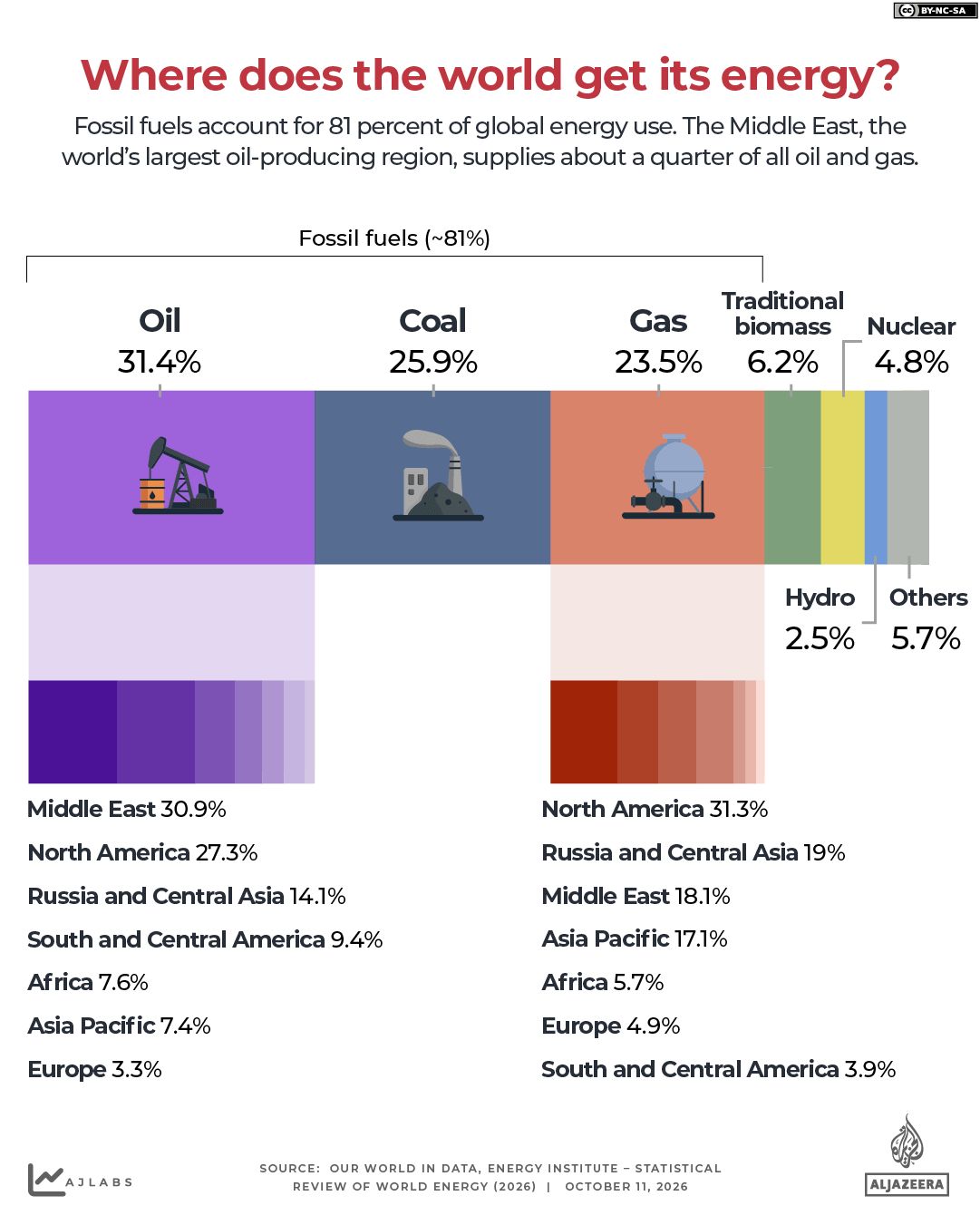
Attacks on vessels in and near the Strait of Hormuz are disrupting a waterway that carried about one-fifth of global oil and natural gas supplies before the war. Although exporters have found alternative routes and regional oil shipments had recovered, renewed attacks and fighting involving Yemen’s Houthis have pushed Brent crude above $110 a barrel.
Analysts quoted by Al Jazeera interpret Iran’s shift as an effort to deter future attacks by making their military, economic, and political costs greater. They point to Iran’s reliance on missiles, drones, and leverage over the strait, and say the consequences could reach global energy, transport, insurance, and goods shipments. One analyst also suggests Tehran hopes economic fallout could affect the US midterm elections.
US President Donald Trump has sent mixed signals, saying negotiations have ended and developments may come soon, while also saying Washington wants a durable outcome. Secretary of State Marco Rubio says a deal is difficult and must prevent Iran from obtaining nuclear weapons; Iran says its enrichment rights are protected under the Non-Proliferation Treaty. Iran has proposed reopening shipping for seven days in exchange for an end to the US blockade of Iranian ports, sanctions relief, and the release of frozen assets. Separately, Washington has ordered nonemergency diplomatic personnel and their families to leave Saudi Arabia after Houthi attacks. The supplied article ends mid-sentence while describing US personnel departure orders.
Entities: Iran, Islamic Revolutionary Guard Corps (IRGC), Hossein Mohebi, Donald Trump, Marco Rubio • Tone: analytical • Sentiment: negative • Intent: analyze
22-10-2026
An attack on King Fahd International Airport in Dammam, eastern Saudi Arabia, killed one person and injured eight, according to the country’s General Authority of Civil Aviation (GACA). The injured had injuries ranging from minor to critical and were taken to hospitals for treatment. The report did not specify who carried out the airport attack or what weapon was used.
The airport incident came amid a series of attacks in Saudi Arabia as conflict intensifies between Houthi forces and Yemen’s Saudi-backed internationally recognised government. Earlier the same day, Saudi air defences intercepted a drone attempting to strike a facility at the Shaybah oilfield, operated by Saudi Aramco. Saudi Arabia’s Ministry of Energy said two people were killed in that incident.
The article also recalls recent attacks on Riyadh’s King Khalid International Airport. Saudi Arabia reported that a projectile strike on October 11 killed one person and injured 11. A separate attack on the same airport on October 10 reportedly killed 12 people and injured more than 300.
The security situation prompted the United States to order diplomats and their family members to leave US missions in Saudi Arabia. US officials told Reuters that there were also plans to withdraw family members from a number of other US missions in the region. The US embassy in Riyadh issued a security alert warning of possible further Houthi attacks on Saudi Arabia. The article presents the airport attack as part of a worsening pattern of violence, while reporting the casualties and official responses without assigning responsibility for the Dammam incident.
Entities: King Fahd International Airport, Dammam, Saudi Arabia, General Authority of Civil Aviation (GACA), Shaybah oilfield • Tone: neutral • Sentiment: negative • Intent: inform
22-10-2026
A Houthi attack on King Fahd International Airport in Dammam killed two people—a Saudi citizen and an Indian resident—and injured eight, Saudi authorities said. The Houthis claimed they had targeted the airport with drones and missiles as part of attacks across Saudi Arabia over a 48-hour period. They also said they targeted the Saudi defence ministry in Riyadh, an Aramco facility in Yanbu and Abha International Airport. Saudi authorities reported intercepting several drones over Eastern Province, Riyadh and Medina.
Separately, a drone intercepted near an Aramco processing facility in the Shaybah oil field caused debris to kill two people from the Philippines and Nepal; a contractor’s vehicle was set ablaze. The Houthi spokesman did not claim responsibility for that incident. The article says at least 21 people have been killed in attacks on Saudi airports since early October, including 13 killed in a missile strike on Riyadh’s airport on 10 October.
The Houthis describe their attacks as retaliation for Saudi air strikes and what they call a blockade of Houthi-controlled territory. The renewed escalation follows the unraveling of an informal ceasefire that began four years earlier. Yemen’s civil war started in 2014, intensified after a Saudi-led coalition intervened in 2015, and has caused substantial deaths and displacement. The conflict has spread around the strategically important Bab al-Mandab Strait, a major global shipping chokepoint. Government forces have reportedly retaken some territory near the strait with Saudi air support, but fighting continues in several parts of Yemen.
Entities: Yemen, Saudi Arabia, Houthi movement, King Fahd International Airport, Dammam • Tone: neutral • Sentiment: negative • Intent: inform
22-10-2026
The US State Department has ordered non-emergency government employees and their families to leave Saudi Arabia as Houthi attacks on the kingdom intensify. The order follows strikes in which three people were killed: Saudi authorities said debris from a drone intercepted near an oil field killed two, while one person died in an attack at King Fahd International Airport in Dammam. Eight people were injured in the airport incident, with injuries ranging from minor to serious. Officials have not provided details about that attack or identified who launched the drone aimed at the Shaybah oil field near the United Arab Emirates border.
The State Department said the Iran-backed Houthis had increasingly attacked civilian airports and other critical infrastructure, causing casualties and serious travel disruption. It warned that the hostilities could escalate quickly. Houthi missile and drone attacks have targeted Saudi airports, energy facilities and military bases, following Saudi strikes in Yemen. A recent attack on Riyadh’s international airport was described as the deadliest in Saudi Arabia in years.
The conflict is rooted in Yemen’s civil war, which began in 2014 when the Houthis ousted the government from Sanaa. Fighting escalated in 2015 after a Saudi-led coalition intervened to restore the government. An informal ceasefire had held for four years before breaking down in July. The Houthis said their attacks were retaliation for a Saudi blockade and an air strike on Sanaa airport, which they blamed on Saudi Arabia.
The group’s declared maritime embargo in the Bab al-Mandab Strait has also contributed to higher global oil prices. Saudi Arabia had been using the Red Sea to export oil after the US-Israel war with Iran effectively closed the Strait of Hormuz.
Entities: US State Department, Saudi Arabia, Yemen, Houthis, King Fahd International Airport • Tone: neutral • Sentiment: negative • Intent: inform
22-10-2026
The live update reports escalating security and economic pressure across the Middle East as the U.S. and Iran continue indirect discussions over a proposed seven-day ceasefire. Brent crude rose about 3% to $112 a barrel after Iran’s Revolutionary Guard said it attacked four vessels near the Strait of Hormuz, alleging they used a route Tehran rejects. The IRGC also said three other ships struck sea mines and stopped. Separately, U.S. forces have quietly reduced their presence at some Middle Eastern posts because of continuing threats from Iran and its Houthi allies. An attack on King Fahd International Airport in Dammam, Saudi Arabia, reportedly killed at least two people and wounded eight.
Iranian Foreign Minister Abbas Araghchi said negotiations with Washington are continuing, although the U.S. is seeking additional clauses in the ceasefire proposal President Trump rejected last month. Iran’s army chief said the country is prepared for asymmetric warfare and has developed its drone capabilities. Meanwhile, a Saudi-led coalition said it intercepted four drones over Riyadh and Medina, while the Houthis have denied targeting the two holy cities. The Houthis also accused Saudi Arabia of attacking an Indian yacht near Zuqar Island; the claim had not been independently corroborated.
The update describes wider diplomatic and commercial consequences. Kpler told The Wall Street Journal that Iran’s offshore oil stocks held on tankers in Asian waters had run out in mid-October, with a U.S. naval blockade preventing replenishment and costing Iran at least $25 billion in oil revenue, according to U.S. Central Command. Egypt called for a political solution between Saudi Arabia and the Houthis, while a group of European and Middle Eastern diplomats is scheduled to meet in Istanbul to discuss Yemen, the Strait of Hormuz, Palestine and other issues. Reuters also reported that Saudi Aramco instructed staff to leave its Dhahran headquarters and work remotely amid Houthi attacks.
Entities: Iran, United States, Saudi Arabia, Yemen's Houthi movement, Strait of Hormuz • Tone: analytical • Sentiment: negative • Intent: inform
22-10-2026
The U.S. State Department has ordered non-emergency embassy staff and their families to leave Saudi Arabia following escalating Houthi attacks, while the U.S. military is also reducing its presence at some Middle East posts amid threats from the Houthis and Iran. State Department spokesperson Tommy Pigott said the ordered departure applies only to Saudi Arabia, despite reports that it could extend to other Gulf states. Other U.S. embassies have reduced staffing and services under a “restricted operations” status without ordering personnel to evacuate.
The decision follows recent warnings from U.S. embassies in Saudi Arabia, Bahrain, Qatar, the United Arab Emirates and other countries advising Americans to take precautions and prepare for travel disruptions. Houthi drones and missiles have targeted Saudi airports and oil infrastructure. A strike on Riyadh’s King Khalid International Airport earlier in the month killed 12 people, including one American, and injured more than 300. Further drone attacks were reported over the following days; Saudi air defenses also intercepted drones, including one targeting the Shaybah oil field, where falling debris killed two people and injured two others. Authorities did not identify the source of that drone.
The Houthis control a large part of Yemen, including the capital, Sanaa. Saudi officials have accused Iran of supporting the group, while Iran denies involvement in the escalation. The conflict also threatens shipping and energy flows because the Houthis are near the Bab al-Mandab Strait, an important maritime chokepoint. Its importance has increased amid disruption to the Strait of Hormuz during the U.S.-Iran war.
Yemeni political adviser Marwan Ali Noman warned that Houthi attacks could expand unless the group is confronted and said Yemen’s government is seeking international assistance. The United Kingdom has offered Saudi Arabia support, including defensive air operations. The article says it is unclear whether the Trump administration plans to assist. President Trump has left open the possibility of strikes and said the U.S. is communicating with the Houthis.
Entities: U.S. State Department, Saudi Arabia, Houthi militants, Tommy Pigott, U.S. military • Tone: analytical • Sentiment: negative • Intent: inform
22-10-2026
Oil prices rose Thursday amid concerns that the Middle East conflict could escalate and that the U.S. may resume strikes against Iran. Brent crude gained 3.3% to $112.37 a barrel by 9:15 a.m. ET after briefly approaching $113, while U.S. West Texas Intermediate rose 2.8% to $99.88 after earlier topping $100. The New York Times, citing unnamed U.S. officials, reported that U.S. and Israeli militaries had developed plans for renewed strikes on Iran following next month’s midterm elections. Officials described preparations for a possible “short but intensive” operation. President Donald Trump said the U.S. was not negotiating with Iran and that “something one way or the other” would happen “fairly soon,” while noting that many expected developments after the election. Separately, the U.S. ordered non-emergency government employees and their families to leave Saudi Arabia. State Department spokesman Tommy Pigott said the directive applied only to Saudi Arabia, not the wider Gulf region, and cited rising attacks by Iran-aligned Houthi forces on Saudi civilian targets. The article also examines the potential economic impact of higher oil prices. David Wagner of Aptus Capital Advisors argued that consumers may be less exposed to energy shocks than in past decades. He noted that oil remains below its inflation-adjusted historical highs and cited government data showing gasoline’s share of average disposable income has fallen from about 5% a decade ago to roughly half that level today. Wagner said households may therefore be better able to withstand elevated energy costs.
Entities: Brent crude, West Texas Intermediate (WTI), Iran, Saudi Arabia, United States • Tone: analytical • Sentiment: neutral • Intent: inform
22-10-2026
The United States has ordered non-emergency government employees and their families to leave Saudi Arabia, citing escalating attacks by Iran-aligned Houthi forces on civilian targets. The withdrawal comes amid reports that U.S. and Israeli militaries have developed plans for renewed strikes on Iran after the November 3 midterm elections. The New York Times, citing unnamed U.S. officials, described preparations for a possible “short but intensive” operation, although President Donald Trump has not approved new strikes and has previously rejected plans to resume major combat this year. U.S. and Iranian officials are still negotiating over Tehran’s nuclear program and the Strait of Hormuz, even as threats and military preparations raise concern that the nearly eight-month conflict could expand.
Recent attacks in Saudi Arabia have killed at least three people: a strike at King Fahd International Airport in Dammam killed one and injured eight, while a drone attack on the Shaybah oil field killed two. Saudi authorities said the oil field’s operations were unaffected. The article also reports stepped-up U.S.-Israeli military exercises and an unannounced visit by U.S. Defense Secretary Pete Hegseth to meet Israeli Prime Minister Benjamin Netanyahu. Potential targets in any renewed strikes could include Iran’s energy infrastructure, nuclear facilities, and missile and drone arsenal. Iranian officials, meanwhile, have threatened to widen attacks to data centers and undersea internet cables and have refused nuclear concessions.
The developments are affecting energy markets. Brent crude rose above $110 per barrel, while West Texas Intermediate gained 1% to $98.12. Although oil flows through the Strait of Hormuz have recovered to near pre-war levels, Kpler analyst Muyu Xu said recovering Chinese demand could support prices. China’s crude inventories have been falling sharply, but the country retains an estimated 1.1 billion barrels in reserves. Chinese refiners may increasingly seek Middle Eastern crude and alternatives to Iranian oil, potentially limiting further declines in Dubai crude pricing.
Entities: United States, Saudi Arabia, Iran, Houthi attacks, Strait of Hormuz • Tone: analytical • Sentiment: negative • Intent: inform
22-10-2026
The United States has ordered non-essential employees and family members to leave its embassy in Riyadh as Houthi attacks on Saudi Arabia intensify. The announcement came on Wednesday, the same day a strike at King Fahd International Airport in Dammam killed two people and injured eight. Saudi Arabia’s Civil Aviation Authority said the airport was assessing material damage. It did not identify who carried out the attack, and the Houthis did not claim responsibility. Flightradar24 reported that flights were diverted as airport operations halted.
Separately, Saudi Arabia’s Energy Ministry said forces intercepted a drone targeting an oil facility. Falling debris killed two people and injured two others; those killed were identified as Filipino and Nepali nationals.
US State Department spokesperson Tommy Pigott said the departure order applied to staff and family members in Saudi Arabia. He cited increasingly hostile actions by Iranian-supported Houthis, including attacks on civilian airports and critical infrastructure that have caused casualties and severe travel disruption. Reports by Reuters and AFP said a similar order had been issued for other Gulf countries, with AFP naming the UAE, Jordan, Qatar and Bahrain. Pigott called those reports inaccurate and said only US employees in Saudi Arabia were ordered to leave.
The article notes that Washington has issued similar evacuation orders more than once this year amid the Iran war and Iranian strikes on Saudi Arabia, which were described as retaliation for the US-Israeli war against Tehran. A four-year truce between Saudi Arabia and the Houthis has collapsed during the broader conflict, and Saudi Arabia has faced near-daily attacks this month. The developments heighten concerns about the security of civilian infrastructure and travel in the region.
Entities: Saudi Arabia, Riyadh, Dammam, King Fahd International Airport, United States Department of State • Tone: analytical • Sentiment: negative • Intent: inform
22-10-2026
The article describes growing fears that the United States and Israel could resume major military strikes on Iran, potentially triggering a wider conflict across the Gulf. The concern is fueled by election timing in Israel and the United States, a substantial US military build-up, heightened readiness by Israeli and Iranian forces, and reports that Washington and Jerusalem have developed plans for new strikes. The US State Department ordered non-emergency government personnel and their families to leave Saudi Arabia, citing the possibility that hostilities could escalate rapidly. Although reports suggested similar departures elsewhere, a State Department spokesperson said the order applied only to Saudi Arabia and attributed it to increasing Houthi attacks. A separate US warning urged citizens in 12 Middle Eastern countries to remain alert to threats against US interests.
Iran says it has reorganized its defences and would respond severely to any attack, including against US interests and civilian infrastructure around the region. Reports say Iran has activated a decentralized defence doctrine intended to allow local forces to continue fighting if central command is destroyed. Meanwhile, media reports identify Iranian energy infrastructure, nuclear facilities, and missile and drone arsenals as possible targets of US-Israeli strikes intended to force Tehran into a deal and reopen the Strait of Hormuz. President Donald Trump has said decisions about a new attack would come after US midterm elections. Israeli Prime Minister Benjamin Netanyahu has called for the overthrow of Iran’s government, while opposition leader Yair Lapid has argued against an attack before Israel’s election.
The article also reports that seven oil tankers were damaged or caught fire in the Strait of Hormuz, with Iran attributing the incidents to attacks or naval mines. French President Emmanuel Macron urged extreme caution, warning that election-related tensions could lead to renewed conflict. Qatar and Pakistan are working as mediators, but uncertainty remains. A return to all-out war, the article warns, would put civilians at risk, disrupt energy and other global supplies, and could drive another rise in worldwide energy prices.
Entities: United States, Iran, Israel, Persian Gulf, Strait of Hormuz • Tone: urgent • Sentiment: negative • Intent: inform
22-10-2026
Iranian state television reported that seven oil tankers caught fire or were damaged overnight in the Strait of Hormuz after being hit by Iran or striking naval mines. The Associated Press said it could not independently verify the claims, and the report cited Iran’s Revolutionary Guard Corps navy without mentioning casualties. Iran again threatened U.S. military bases in the region if Washington continues helping commercial ships navigate the strait, which Tehran considers a key source of leverage in negotiations.
The reported attacks come amid fears that the conflict could return to full-scale fighting. Those concerns are heightened by an upcoming Israeli election and the U.S. midterm election, where war-related price increases have angered voters. Danny Citrinowicz, a former Israeli military and intelligence Iran specialist, said Israeli Prime Minister Benjamin Netanyahu wants to attack Iran and argued that a clear Netanyahu victory could make an attack almost certain. Citrinowicz also accused Israel of moving toward another confrontation without revising its strategy. He expects the region to face another escalation, although opposition candidates may initially focus on domestic issues.
A British maritime monitor, United Kingdom Maritime Trade Operations, said October had seen the most reported attacks on commercial shipping since the war’s opening weeks in March. It did not report the latest incidents and has observed that some shipping companies are becoming less willing to report attacks. Experts say oil producers have managed to keep crude flowing, but at increasing cost.
Iran’s Foreign Minister Abbas Araghchi said Tehran remains open to diplomacy while preparing to defend itself. Iran says it learned military lessons from the war, which began with U.S. and Israeli attacks on February 28, and has suggested it might target infrastructure such as undersea cables and data centers. The United States is sending a third aircraft carrier, thousands of troops, and other military assets to the region. Mediators are seeking to restart formal U.S.-Iran talks. Iran has proposed ending the war and reopening the strait within a week if the United States meets conditions including ending its blockade of Iranian ports; the article’s final sentence is cut off after saying President Donald Trump rejected a proposal in late September.
Entities: Iran, Strait of Hormuz, Seven reported tanker attacks, Danny Citrinowicz, Israel Institute for National Security Studies • Tone: analytical • Sentiment: negative • Intent: inform
22-10-2026
The United States and Israel are preparing for a possible attack on Iran in early November, after the U.S. midterm elections, according to a person briefed on their war planning who spoke anonymously to NPR. The source said Israel had originally planned to strike in mid-October, before Israeli elections, but President Trump objected. U.S. forces are now gathering in the region, though the preparations could also be intended to pressure Iran into a diplomatic agreement. The U.S. midterms are scheduled for Nov. 3, and Prime Minister Benjamin Netanyahu is campaigning for reelection while threatening to topple Iran’s government.
Iranian Foreign Minister Abbas Araghchi said his country was prepared for diplomacy as well as war. Iranian state media reported that a security source warned Iran would retaliate against U.S. interests and the infrastructure and assets of countries involved if Iranian officials or civilian infrastructure were attacked. The report situates these threats within a conflict that began on Feb. 28, when the U.S. and Israel struck Iran, killing its supreme leader and other senior officials. A ceasefire has not held, and the sides have exchanged strikes amid a struggle over the Strait of Hormuz. Iran has targeted commercial shipping and the U.S. has blockaded Iranian ports and oil shipments.
Although U.S. strikes have weakened Iran’s military, Iran remains a threat to Gulf states and other countries, NPR reports. The Revolutionary Guard has threatened Gulf data centers and undersea internet cables, and Iranian state media said seven oil tankers in the Strait of Hormuz were targeted on Thursday, with four catching fire and three striking mines. The conflict has also damaged regional economies. The International Monetary Fund expects Iraq, Kuwait and Qatar to contract by about 16% this year, and says Saudi Arabia and the United Arab Emirates are also in recession. If the war and energy disruptions continue, the IMF projects oil will average $130 a barrel in 2027.
Entities: United States, Israel, Iran, Donald Trump, Benjamin Netanyahu • Tone: analytical • Sentiment: negative • Intent: inform
22-10-2026
A resident of Saudi Arabia was killed and eight people were injured in a late-Wednesday attack on King Fahd International Airport in Dammam, according to the Saudi Civil Aviation Authority. The airport, located in the kingdom’s Eastern Province near Bahrain and Qatar, also sustained material damage. Flight-tracking service Flightradar24 reported that flights were diverted away from the airport overnight. The attack occurred amid a broader wave of Houthi strikes on Saudi infrastructure, including airports. The Houthis, who are backed by Iran, had not commented on the airport attack at the time of the report. Saudi authorities said the coalition intercepted four drone attacks in the Eastern region.
The report also describes other recent incidents linked to drone attacks and interceptions. Saudi Arabia’s Energy Ministry said debris from an intercepted drone killed two people and injured two others at the Shaybah oil field, which is operated by Aramco. The people killed were Nepali and Filipino nationals; those injured were Pakistani and Indian nationals. Falling debris also ignited a contractor’s vehicle at the oil field.
In the previous month, debris from an intercepted Houthi drone killed a Yemeni resident of Saudi Arabia, described in the article as the first civilian casualty since the Houthis intensified attacks against the kingdom, including strikes targeting shipping and oil facilities. Earlier in the current month, a limited fire broke out in an administrative building at an Aramco facility in the Eastern Province after it was targeted in an attack, the Energy Ministry said. Together, the incidents underscore the risks to civilians and critical infrastructure from the expanding campaign of attacks and interceptions across Saudi Arabia.
Entities: King Fahd International Airport, Dammam, Saudi Arabia, Saudi Civil Aviation Authority, Iranian-backed Houthis • Tone: neutral • Sentiment: negative • Intent: inform
22-10-2026
The United States and Israel have developed plans for renewed strikes on Iran following the American midterm elections, according to officials and people familiar with the discussions. The proposed operation would be short but intensive, with potential targets including Iran’s energy infrastructure, nuclear facilities, and missile and drone capabilities. The two militaries have increased exercises, including flights over Iraq to practise strike manoeuvres, and US Defence Secretary Pete Hegseth reportedly discussed possible attacks with Israeli Prime Minister Benjamin Netanyahu during an October visit.
Some officials believe another major round of strikes could put further pressure on Iran’s economy and encourage diplomatic concessions. However, the article outlines substantial doubts about whether renewed attacks would achieve more than the earlier US-Israeli campaign, which lasted from February to April. That fighting raised energy prices and inflation internationally, weakened regional security, and depleted US missile-interceptor supplies. President Donald Trump has also repeatedly rejected plans to resume major combat operations, so his approval is uncertain.
Iranian officials have threatened broader retaliation, potentially targeting data centres and underwater internet cables in addition to commercial shipping and energy infrastructure. Meanwhile, the United States is building up its military resources as diplomats use the prospect of renewed war to press Iran on its nuclear programme and control of the Strait of Hormuz. Iran’s negotiators have so far resisted nuclear concessions, preferring to defer the issue.
Israel’s October 27 election could further complicate the plans. If Netanyahu loses, his status as caretaker prime minister may make it difficult to launch a war. Alternatively, analysts say, he could use the prospect of joint strikes to push political rivals into a unity government, potentially extending his time in power. The article presents renewed conflict as a possibility shaped by military preparations, stalled diplomacy, political calculations, and significant risks.
Entities: United States, Israel, Iran, Donald Trump, Benjamin Netanyahu • Tone: analytical • Sentiment: negative • Intent: inform
22-10-2026
The supplied page is a live Middle East news update from The National, dated October 22, 2026, and marked updated at 4:20 a.m. Its headline reports that one person was killed in an attack on Dammam airport in Saudi Arabia. The extracted page text does not include a full report describing the incident, identifying the victim, or giving details about the attacker, the weapon, or the circumstances. It therefore supports only the limited conclusion that the outlet was reporting a fatal attack at the airport.
The page’s other headlines indicate a wider regional-security focus. They mention Iranian President Masoud Pezeshkian saying negotiations cannot proceed under sanctions and threats, Foreign Minister Abbas Araghchi seeing little prospect of progress in US talks, and Saudi-led forces intercepting drones launched toward Madinah and the Eastern Province. Other listed updates concern Middle East oil exports recovering to prewar levels through alternatives to the Strait of Hormuz, Israeli Prime Minister Benjamin Netanyahu describing regime change in Iran as a key objective, and a report that Donald Trump opposed a multi-day Israeli bombing campaign.
The page also promotes related video coverage, with titles about Saudi forces striking vessels carrying Houthi weapons, the UAE president meeting Saudi Arabia’s defence minister, Egypt’s president pledging to defend Saudi Arabia, and an Egyptian flight attendant killed in a Riyadh attack. These are headlines and video teasers, not detailed accounts in the provided text. Overall, the material presents a fast-moving picture of conflict, diplomacy, drone threats, and regional economic disruption. Because the underlying live-update entries are absent from the supplied content, further specifics or connections among the events cannot be verified from this page extract.
Entities: Dammam airport, Saudi Arabia, Madinah, Eastern Province, Iran • Tone: analytical • Sentiment: negative • Intent: inform
22-10-2026
Brent crude rose above $110 a barrel on Thursday after a Houthi drone strike near Saudi Aramco’s Shaybah oilfield heightened fears about threats to Saudi energy infrastructure and global oil supplies. Brent was up 1.7 per cent to $110.63 a barrel, while West Texas Intermediate gained 1.4 per cent to $98.52. At Shaybah, Saudi air defences intercepted a drone targeting a processing plant. Debris fell near the facility, killing two people and injuring two others, and caused a fire after striking a contractor’s vehicle. Saudi authorities said oilfield operations were unaffected. Shaybah produces about one million barrels of crude a day and lies in the Empty Quarter near the UAE border. The strike was followed by an attack on King Fahd International Airport in Dammam, where one person was killed and eight injured. The Houthis had not commented on that airport attack. The incidents form part of a widening campaign against Saudi infrastructure. Earlier in the month, an attack on Riyadh’s main international airport was described as the kingdom’s deadliest in more than a decade. The East-West pipeline, an alternative route for crude exports that avoids the Strait of Hormuz, was also damaged in a Houthi strike on a pumping station east of Riyadh. Crude flows were reportedly halted on October 5. The pipeline can carry about seven million barrels a day from eastern oilfields to Red Sea export terminals. The United States ordered non-emergency government employees and their families to leave Saudi Arabia, citing attacks on civilian airports and critical infrastructure. With Saudi production facilities and alternative export routes under threat—and routes already strained by the Iran war—the repeated attacks are adding a geopolitical risk premium to oil prices.
Entities: Jennifer Gnana, Saudi Arabia, Shaybah oilfield, Saudi Aramco, Houthi movement • Tone: analytical • Sentiment: negative • Intent: inform
22-10-2026
The United States has ordered non-essential diplomatic personnel and their families to leave Saudi Arabia as Houthi attacks on the kingdom intensify. State Department spokesman Tommy Pigott said the order applies only to non-emergency US government employees and their relatives in Saudi Arabia, rejecting reports of a broader withdrawal from Gulf countries. However, four US officials told Reuters that diplomatic missions in other Gulf states would also direct family members to depart, and a diplomatic source told AFP that families in the UAE, Jordan, Qatar and Bahrain had been told to leave.
The security measures followed attacks on Saudi infrastructure. A strike on King Fahd International Airport in Dammam on Wednesday killed one person and injured eight. The airport suspended operations at about 11.15pm local time, according to flight-tracking service Flightradar24. Earlier that day, two people were killed when Saudi air defences intercepted a drone targeting the Shaybah oilfield, according to the Energy Ministry. The State Department cited increasingly frequent Houthi hostilities, including attacks on civilian airports that have caused deaths and severe travel disruption. The US embassy in Riyadh also warned of possible further attacks.
The airport strike pushed oil prices higher: Brent crude rose above $110 a barrel, while West Texas Intermediate traded at about $98. The article places the latest attacks within a broader regional escalation. It says fighting in Yemen has opened another front in a conflict that has disrupted global energy trade and harmed Gulf economies. US diplomatic personnel had previously been withdrawn after Iran attacked US sites following the start of the US-Israeli war on Iran in late February; some staff returned to the region in recent months. The latest departures therefore add to a series of security-related evacuations, even as Washington disputes claims that its current order extends across the Gulf.
Entities: Tommy Pigott, United States Department of State, Saudi Arabia, King Fahd International Airport, Dammam • Tone: analytical • Sentiment: negative • Intent: inform
22-10-2026
The article reports that the United States and Israel have prepared options for renewed military strikes against Iran, potentially after the US midterm elections. According to The New York Times, the proposed campaign could be brief but intense, targeting Iran’s energy infrastructure, nuclear facilities, and missile and drone capabilities. US and Israeli forces have reportedly increased exercises, and Washington is assembling a substantial military presence, including aircraft carriers, Marines, fighter jets, and special operations forces. President Donald Trump has not decided whether to authorize an operation, while the White House says it is keeping options open to prevent Iran from obtaining nuclear weapons.
Iran has warned that it would respond to any new attack. IRGC spokesperson Hossein Mohebbi said Tehran was preparing to unveil a weapon dubbed the “Father of All Bombs,” but provided no details. He also claimed that Iran’s missile stockpile and capabilities had grown since the 12-day war with Israel in June 2025, and described a shift toward deterrence and asymmetric warfare. Iranian officials have rejected the prospect that a new conflict could be ended quickly, warning that attacks could extend to shipping, energy infrastructure, data centres, and undersea internet cables.
The article also examines speculation that the US might use its GBU-43/B MOAB, or “Mother of All Bombs,” against Iran’s deeply buried Pickaxe Mountain nuclear facility. Experts question whether the surface-blast weapon could penetrate the site’s granite protection, and officials have raised concerns about the vulnerability of the aircraft needed to deliver it.
Diplomatic efforts continue alongside military preparations. Washington reportedly hopes the threat of force will influence negotiations over Iran’s nuclear programme and the Strait of Hormuz, but Iranian negotiators have resisted concessions. The article notes that earlier strikes raised global energy prices and inflation and strained US missile-interceptor supplies. Iranian President Masoud Pezeshkian described the situation as a “super-challenge” for Iran and said the country would remain firm.
Entities: United States, Israel, Iran, Donald Trump, Pete Hegseth • Tone: analytical • Sentiment: negative • Intent: inform
22-10-2026
Egyptian President Abdel Fattah al-Sisi has clarified that Egypt’s proposed military support for Saudi Arabia would be limited to defending Saudi territory and would not involve attacking Yemen. Sisi had asked parliament to authorize support if Riyadh requested it; lawmakers have held two rare closed sessions and postponed further deliberations until next week. After Sisi’s Wednesday remarks, senior Egyptian officials traveled to Riyadh and delivered a letter to Saudi Crown Prince Mohammed bin Salman, though its contents were not disclosed.
The article describes escalating Houthi attacks on Saudi Arabia, which have disrupted the kingdom’s aviation and investment plans and threatened its oil exports. Saudi allies have offered support: France said its troops would help protect the Yanbu oil terminal, while the United Kingdom announced plans to deploy fighter jets. In Egypt, some parliamentarians have called for clear objectives and an assessment of risks to soldiers before any deployment. Public opposition to direct involvement is shaped in part by Egypt’s costly military campaign in Yemen during the 1960s.
Cairo’s position reflects competing pressures. Saudi Arabia is a close ally and major financial backer of Sisi’s government, and Egypt previously contributed naval and air forces to the Saudi-led coalition in Yemen. At the same time, Egypt has pursued a more cautious foreign policy, emphasizing national security, strategic autonomy, and mediation across regional conflicts. Iranian officials have warned that Egyptian involvement could worsen the situation, while Egypt has continued to urge restraint amid attacks on Gulf allies. Egypt has not joined a recent regional defense pact and must also consider the economic impact of disruptions near Bab al-Mandab, which affect both Saudi exports and traffic—and revenue—through the Suez Canal.
Entities: Abdel Fattah al-Sisi, Egypt, Saudi Arabia, Houthis, Yemen • Tone: analytical • Sentiment: neutral • Intent: inform
22-10-2026
CNBC’s Daily Open surveys geopolitical, technology and labor-market developments, with uncertainty over a possible renewed U.S.-Israeli campaign against Iran at its center. Although Washington says it does not plan to strike before the Nov. 3 midterms, The New York Times reported that military plans for strikes afterward have been drawn up, potentially targeting energy infrastructure, nuclear facilities, and missile and drone arsenals. Oil has remained above $108 a barrel, while gas prices in Asia and Europe are at multiyear highs, raising the prospect of prolonged pressure on households.
The briefing also describes damage to Russian oil infrastructure from Ukrainian drone attacks and the collapse of a short-lived energy ceasefire declared by Donald Trump. In a separate dispute, The Wall Street Journal reported that Elon Musk ordered a Starlink slowdown affecting Ukraine; Trump denied involvement, while the article notes that both men have criticized Ukrainian President Volodymyr Zelenskyy.
Corporate and technology news includes a strong SpaceX earnings reaction and Musk’s hint at a possible Tesla tie-up; Meta CEO Mark Zuckerberg’s eight-year residency commitment, linked to the creation of non-voting Class C shares; and Anthropic’s preview of Claude Duet, an AI agent designed to perform tasks while seeking approval before sending messages or making payments. EBay, meanwhile, plans to eliminate about 1,000 jobs, or 9% of its workforce, as it streamlines operations and focuses on priority areas. The article connects this announcement to growing central-bank concern about AI and employment.
The briefing additionally reports that PHP vulnerabilities briefly took government websites offline and that South Korea is expected to leave interest rates unchanged. In its closing item, BlackRock fixed-income chief Rick Rieder argues that high-quality bonds offer an unusually attractive opportunity: he says a diversified portfolio could yield more than 7% with short duration and A- average credit quality.
Entities: Anniek Bao, Donald Trump, Elon Musk, Volodymyr Zelenskyy, United States and Israel • Tone: analytical • Sentiment: neutral • Intent: inform
22-10-2026
The National’s October 22, 2026 opinion-cartoon page presents a cartoon by Shadi about oil shipments passing through the Strait of Hormuz. Its brief caption, “Shadi’s take on oil shipments getting through the Strait of Hormuz,” identifies the subject, while the accompanying topic labels connect it with the Strait of Hormuz, the United States, Iran, and the Middle East. The supplied article text does not include the cartoon image or any further explanation, so it is not possible to determine what argument, joke, or specific development the cartoon depicts. The page therefore offers a topical pointer rather than a reported account: it signals that oil transit through the strategically significant strait is the focus of the cartoon, without providing details about shipment volumes, disruptions, policy decisions, or the positions of the countries named in the tags.
A list of related cartoons places this item among Shadi’s recent work on international and regional affairs. Those subjects include World Food Programme cutbacks, Syria and a proposed national recovery fund with the World Bank, the collapse of an energy truce between Ukraine and Russia, and US considerations regarding Iran. The page also links the cartoon to broader themes such as energy prices and US elections. These surrounding headlines establish the editorial context of an ongoing series, but they do not add reporting or evidence about the October 22 cartoon itself.
Overall, the available content identifies the cartoon’s creator, publication date, and subject, but leaves its visual message unstated. Any interpretation beyond the stated focus on oil shipments moving through the Strait of Hormuz would require access to the cartoon image.
Entities: Shadi, The National, Strait of Hormuz, oil shipments, Iran • Tone: analytical • Sentiment: neutral • Intent: analyze