02-11-2026
Russia and Ukraine reported cyberattacks affecting their emergency alert systems within hours of each other, shortly after a localized ceasefire ended in the Russian-occupied part of Ukraine’s Kherson region. Russia’s Emergencies Ministry said its warnings app had suffered a “massive cyberattack” that caused false information to circulate. The app alerts users to incoming drone attacks, but the ministry did not identify who was responsible.
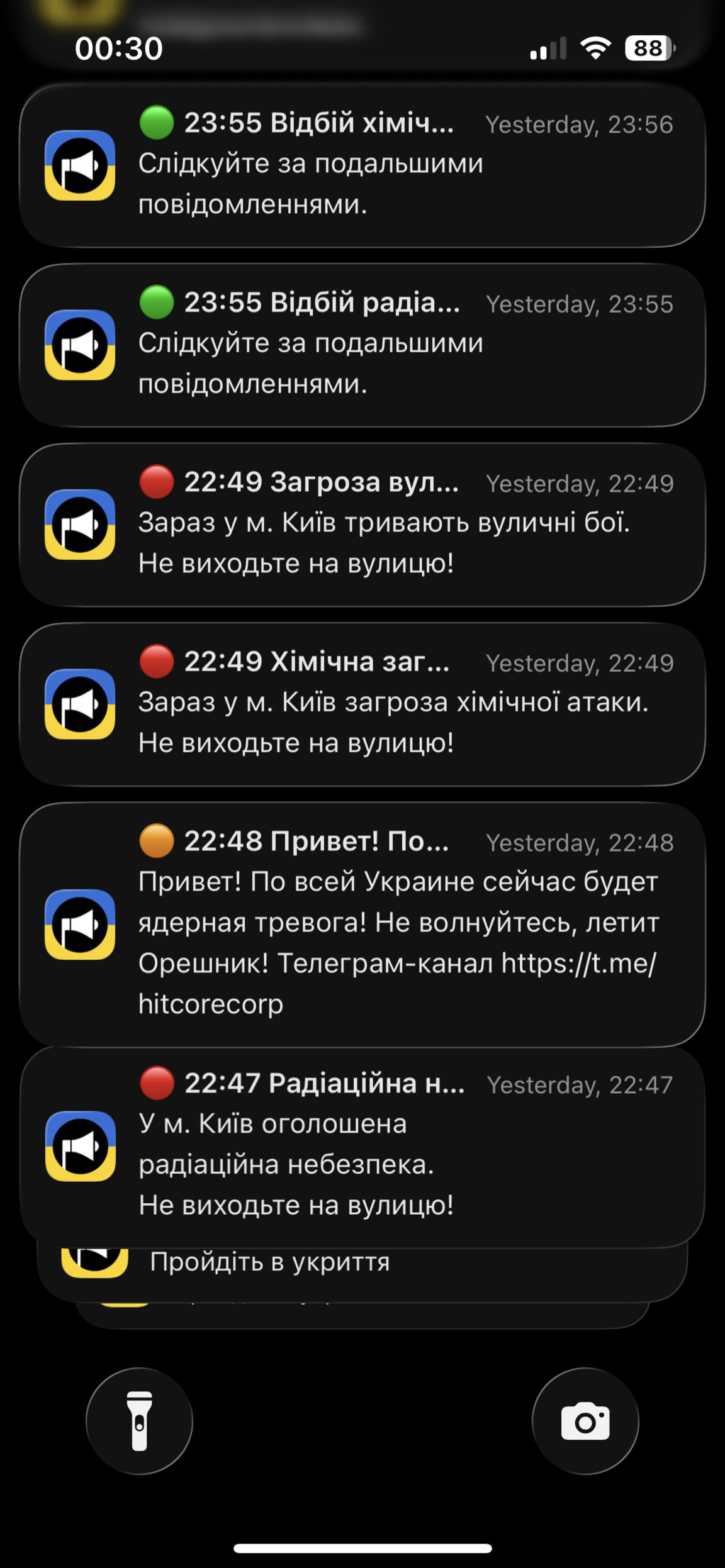
Earlier on Sunday evening, Ukraine’s Air Force said users of the national air raid alert app had received false warnings of nuclear and chemical threats around Kyiv, possible street combat, and the deployment of Russia’s hypersonic Oreshnik missile. The Air Force said the app appeared to have been subjected to enemy influence, denied that there was a radiation threat, and urged people to remain calm and follow official updates. Ukraine’s Centre for Strategic Communications, known as SPRAVDI, directly blamed Russia for the hack in a post on X.
Ukraine’s national app is used to warn people in real time of incoming Russian air attacks. Authorities in Kyiv said a separate alert app designed specifically for the capital was functioning normally.
The reports came as a local ceasefire in part of the Russian-occupied Kherson region ended on Sunday. The truce began on Tuesday and was described as the longest of the war so far. The article reports the competing claims about the attacks but does not establish who carried them out.
Entities: Russia, Ukraine, Kyiv, Kherson region, Russian Emergencies Ministry • Tone: neutral • Sentiment: negative • Intent: inform
02-11-2026
A cyberattack on Ukraine’s emergency alert system sent false warnings of nuclear strikes, chemical attacks and street fighting on Sunday night, briefly alarming residents but failing to cause widespread panic. Many Ukrainians questioned the alerts’ credibility, in part because some messages were in Russian and one referred to fighting in Kyiv. The Air Force said within 15 minutes that the alert app had been compromised and that there was no radiation threat, although more than an hour passed before “all clear” messages were issued.
Residents described a mix of fear, disbelief and stress. Sofia Kochmar, in Lviv, was initially frightened by the word “nuclear” but then doubted the warning. Anastasiia Romanytska, in Kyiv, said the alerts caused a physical stress response even though she quickly suspected they were not real. People also shared the messages in work chats and soon began joking about the incident.
Cybersecurity expert Yevhen Baliutov of Kyiv School of Economics said the attack appeared to have been carried out by Russians. He warned that links in the alerts, including one to a Russian Telegram channel, could expose people to disinformation, phishing or data breaches. However, the informal wording could point to hacktivist groups rather than a state-directed operation. Baliutov also said Ukraine could logically have retaliated against Russia’s emergency alert system, noting that both countries have similar cyber capabilities.
Although the disruption had limited impact, the incident exposed vulnerabilities in a system people rely on for safety. Ukraine’s authorities must address security weaknesses while maintaining public trust and attention after years of frequent air-raid warnings. The episode underscores the need to build strong security into essential alert services from the outset.
Entities: Sofia Kochmar, Anastasiia Romanytska, Yevhen Baliutov, Kyiv School of Economics, Ukraine • Tone: analytical • Sentiment: neutral • Intent: inform
02-11-2026
Air alert apps in Ukraine and Russia were hacked on Sunday night, sending users false warnings that included claims of radiation, chemical attacks, street fighting and nuclear strikes. Ukraine’s widely used app issued red-level air raid alerts nationwide. Some residents received additional warnings, while Russian users were sent fake messages containing profanities. Authorities said it was unclear who carried out the attacks or whether the incidents were connected.
Ukraine’s government temporarily disabled its app, describing it as apparently compromised. The air force told people there was no radiation threat and urged them to follow official updates on Telegram. A Kyiv resident told the BBC that the nuclear warning initially frightened her, though she became suspicious after receiving a Russian-language message, unlike the app’s usual Ukrainian notifications. Ukrainian officials said the alerts did not cause widespread panic and that people were accustomed to frequent warnings amid the war.
Russia’s emergencies ministry said a similar app had been hit by a “massive cyberattack” but that the wider alert system was unaffected. It expected the app’s full functionality to be restored by the end of Monday. The Kremlin spokesman did not discuss the breach specifically, but said Russian government internet resources face constant cyberattacks and that AI technology is contributing to their increase. No widespread panic was apparent in Russia, and the incident received little prominence in local media.
The article says the informal language in the hoax messages could point to hacktivists, who may be aligned with either side but are not formally directed by either government. Cyber experts suggested those behind the attack on Russia’s app may have been capable of doing so earlier but waited until Ukraine’s app was compromised. A Ukrainian lawmaker and a Stanford cyber-policy scholar described the incidents as part of cyberwarfare and warned that similar attacks could happen again.
The alerts came shortly before a localized ceasefire in Ukraine’s Kherson region ended. The ceasefire had been brokered in part by US First Lady Melania Trump to allow civilians to leave Russian-occupied Oleshky. Fighting continued elsewhere during the pause; an attack on a train platform in Dnipro killed 15 people on Thursday.
Entities: Ukraine, Russia, Kyiv, Kherson region, Oleshky • Tone: analytical • Sentiment: negative • Intent: inform
02-11-2026
Emergency alert apps in Ukraine and Russia were hacked hours apart on Sunday night, sending false warnings about nuclear, chemical, and radiation threats to civilians. Ukraine’s Air Alert app began issuing bogus alerts at 10:47 p.m. local time, including claims of a nuclear attack, chemical danger, radiation, and street fighting in Kyiv. The app, developed by Ajax Systems and Stfalcon with support from Ukraine’s Ministry of Digital Transformation, is used by some residents to decide when to seek shelter from Russian missile and drone attacks. Many Ukrainians also consult Telegram for updates from the Air Force and security analysts.
The Ukrainian Air Force said about 10 minutes after the alerts began that they were false, that there was no radiation threat, and that residents should remain calm and follow official information. Some Kyiv residents told CBS News they recognized the messages as fake after checking Telegram. The app’s developers described the incident as unauthorized interference and temporarily disabled push notifications and the app. Air Force spokesman Yurii Ihnat said the hack did not affect Ukraine’s security operations and that the app is not connected to military command systems.
Russia’s Emergencies Ministry app was also hacked, at 2:45 a.m. in Moscow. False messages reportedly reached users in 33 regions, warning that nuclear warheads were being launched and telling residents to stock food for three weeks and take shelter in basements. The ministry said attackers exploited a vulnerability in the app’s administrative panel, leading officials to disconnect and isolate affected services.
The incidents occurred as a temporary ceasefire around the Russian-occupied Ukrainian city of Oleshky expired. The truce, which began October 27, had enabled humanitarian aid deliveries and civilian evacuations. Ukraine’s human rights commissioner, Dmytro Lubinets, said both sides had observed the agreement and were discussing further humanitarian measures.
Entities: Air Alert, Russia's Emergencies Ministry app, Ajax Systems, Stfalcon, Ukraine's Ministry of Digital Transformation • Tone: neutral • Sentiment: neutral • Intent: inform
02-11-2026
Ukraine’s air force said its Air Alert app was compromised on Sunday after it displayed false warnings of nuclear and chemical threats, as well as street fighting, in Kyiv and other areas. The air force said unauthorized people had interfered with the app and temporarily disabled push notifications. It urged the public to remain calm, stating there was no radiation threat. About two hours later, Russia’s Ministry for Emergency Situations reported that its own mobile app had suffered a “massive cyberattack” that enabled attackers to send false information to the public. It was not immediately clear whether the two incidents were connected, and CNBC said it had sought comment from Russian and Ukrainian authorities.
The reported cyberattacks coincided with the expiration of a temporary ceasefire in Oleshky and nearby areas of the Kherson region. The pause had allowed humanitarian aid into the Russian-occupied city and hundreds of people, who had been largely without food, water, electricity, or medicine, to be evacuated. It was described as the longest local ceasefire since Russia’s full-scale invasion began in early 2022, and both sides appeared to have observed it until it ended at midnight Moscow time.
After the ceasefire expired, local media reported that Russian forces had struck a hospital in central Kherson. Ukraine’s General Staff said Russian forces had used the pause to rotate units, reinforce positions, expand anti-drone measures, and bring in ammunition and other supplies. Separately, President Volodymyr Zelenskyy said October was Russia’s deadliest month of the war so far. He claimed Russia lost 54,400 troops killed or badly wounded, while Ukrainian forces liberated 96.2 square kilometers of Ukrainian territory—10.4 square kilometers more than Russia captured during the month.
Entities: Ukraine, Russia, Kyiv, Oleshky, Kherson region • Tone: analytical • Sentiment: negative • Intent: inform
02-11-2026
Ukraine officials said the country’s official air-raid alert app was apparently hacked after it sent residents false warnings on Sunday about radiation and a chemical attack in Kyiv. The alerts urged people to stay indoors, and a public air-alert map showed Kyiv and other areas under a nuclear alert. The app also carried false warnings about Russia’s hypersonic Oreshnik missile and alleged street fighting in Kyiv. Recorded messages containing precautionary instructions were broadcast through street loudspeakers.
Ukraine’s Air Force said there was no radiation threat and advised people to remain calm and follow its updates on Telegram. Ukraine’s Center for Strategic Communications blamed Russia for the incident, but no group had publicly claimed responsibility. The article does not report an independent confirmation of who carried out the hack.
The incident came amid ongoing Russian attacks on Ukraine, but the article presents the cyberattack and the false alerts as distinct events. It also reports a separate cyberattack in Russia: the Russian Emergencies Ministry said its mobile app had been hit by a “massive cyberattack” that enabled attackers to send false information to the public. The article does not identify the attackers in that case either. Taken together, the reports describe cyberattacks affecting public-warning applications in both countries, with officials warning that false emergency information had reached the public.
Entities: Kyiv, Ukraine, Russia, Ukrainian Air Force, Ukraine’s Center for Strategic Communications • Tone: neutral • Sentiment: negative • Intent: inform
02-11-2026
Ukrainian President Volodymyr Zelenskyy warned that Russia is preparing a large-scale attack on Ukraine during the U.S. midterm elections, when international attention may be focused elsewhere. He said the expected targets include energy infrastructure and logistics, and raised particular concern about Ukraine’s difficulties obtaining air-defense systems and Patriot missiles. His warning followed a Russian strike on a school in Komyshuvakha, in the Zaporizhzhia region, where humanitarian aid was being distributed. Ukrainska Pravda reported at least 26 people killed, five injured and others missing, including police officers and first responders among the casualties.
Zelenskyy urged the United States and its allies to increase pressure on Russian President Vladimir Putin, including by imposing serious economic consequences and limiting Russia’s revenue from oil and gas. He argued that pressure should leave Moscow with no alternative but to end the war. The article also describes ongoing U.S. diplomatic efforts led in part by special envoy Steve Witkoff and Jared Kushner, and reports Zelenskyy’s proposal to pause Ukrainian attacks on Russian oil refineries for a month in exchange for Patriot missile interceptors during that period.
The State Department has approved a potential sale of 500 Patriot PAC-3 interceptors to Ukraine, estimated at $2.1 billion, though the sale is not final and delivery timing remains uncertain. Separately, Ukraine accused Russian forces of using a U.S.-backed humanitarian pause in Oleshky, in the Kherson region, to rotate troops and strengthen their positions. Nearly 800 people were evacuated during the six-day pause, according to First Lady Melania Trump, whom the White House said helped broker the arrangement. The supplied article ends mid-sentence while describing Ukraine’s accusation about Russian military activity during the pause.
Entities: Volodymyr Zelenskyy, Vladimir Putin, Donald Trump, Steve Witkoff, Jared Kushner • Tone: urgent • Sentiment: negative • Intent: inform
02-11-2026
Emergency alert systems in Russia and Ukraine were targeted in overnight cyberattacks that caused fake warnings about possible nuclear strikes to be broadcast to users in both countries. The alerts were false, and the systems have since been brought back under control. However, key details about the incidents remain unclear, including who carried out the attacks.
The France 24 report focuses on the potential purpose and consequences of this kind of disruption. Presenter Sharon Gaffney speaks with Dr Melanie Garson, an associate professor in international security at University College London. Garson says such attacks are designed to undermine public faith in the government’s ability to provide trustworthy information and protection.
The report therefore frames the incidents not only as attacks on technology but also as attempts to damage confidence in public institutions. Emergency alert systems are meant to communicate reliable, urgent information; false messages about a nuclear strike can exploit the fear and uncertainty associated with a crisis. While the broadcast notes that the systems were restored, it does not establish the perpetrators, explain the technical method used, or provide further details about the scope of the disruption. The central point is the broader threat to trust: cyberattacks on public warning systems can create confusion and make people doubt whether official emergency communications are dependable.
Entities: Russia, Ukraine, France 24, Sharon Gaffney, Dr Melanie Garson • Tone: analytical • Sentiment: neutral • Intent: inform
02-11-2026
France 24 reports that emergency alert systems in Russia and Ukraine were hit by cyberattacks overnight, resulting in fake warnings about possible nuclear strikes being broadcast to users in both countries. The report says the systems have since been brought back under control, but key details about the attacks remain unclear, including who carried them out. In an interview for the programme *A propos*, France 24 journalist Sharon Gaffney speaks with Dr Melanie Garson, an associate professor in international security at University College London, about the significance of the incident. Garson says attacks of this kind are designed to undermine public faith in the government’s ability to provide trustworthy information. The report therefore frames the false alerts not only as a disruption to emergency communications but also as an effort that could damage confidence in government institutions. It does not identify a perpetrator, describe how the systems were compromised, or provide further details about the warnings or their effects. The central emphasis is on the use of emergency alert infrastructure to broadcast alarming, fabricated information and the potential trust-related consequences. The systems’ restoration is noted, while attribution and other circumstances surrounding the cyberattacks remain unresolved.
Entities: Russia, Ukraine, France 24, Sharon Gaffney, Dr Melanie Garson • Tone: analytical • Sentiment: negative • Intent: inform
02-11-2026
Russia and Ukraine accused each other of cyberattacks on emergency alert applications as a limited ceasefire in Ukraine’s Kherson region ended. Ukraine said its Air Alarm app had been compromised after it displayed false radiation-threat alerts; the air force confirmed a hack and said there was no radiation threat. Hours later, Russia’s emergencies ministry reported a “massive cyberattack” on its public-warning app, where attackers were able to post false information. Moscow did not identify who was responsible, while Ukraine’s Centre for Strategic Communications SPRAVDI blamed Russia for the attack on Ukraine’s system.
The Kherson truce ran from October 27 to November 1. Kyiv said Russia declined to extend it. Brokered by US First Lady Melania Trump, the pause enabled a humanitarian mission to Russian-occupied Oleshky. Ukraine’s human rights commissioner called it an important step in joint humanitarian efforts. With the ceasefire over, regional governor Oleksandr Prokudin urged residents to heed warnings, and a Ukrainian military officer warned that fighting could become “worse than before,” alleging Russian forces had used the lull to reinforce troops, move ammunition and conduct surveillance.
The article also describes wider military and diplomatic developments. US-mediated talks are expected to resume this month after being frozen since US-Israeli strikes on Iran in February. President Volodymyr Zelensky said Ukraine could stop striking Russian oil refineries if the United States supplied Patriot interceptor missiles, or if Russia stopped attacking Ukraine’s energy infrastructure. Russia and Ukraine exchanged strikes on Sunday, including a reported drone strike on an industrial enterprise east of Moscow and a Ukrainian attack on the Kstovo refinery. Ukrainian authorities also reported new power outages following Russian attacks. The article presents the app hacks and renewed fighting as part of a broader conflict marked by civilian danger, infrastructure attacks and uncertain prospects for dialogue.
Entities: Russia, Ukraine, Kherson region, Oleshky, Dnipro River • Tone: analytical • Sentiment: negative • Intent: inform
02-11-2026
Ukraine and Russia reported that cyberattacks had targeted their emergency-alert mobile apps. In Ukraine, users received false warnings suggesting that an imminent nuclear threat was underway. The report does not provide details about how many people received the alerts, who was responsible, or whether the false warnings caused disruption or public alarm.
Moscow separately said hackers had gained access to the Russian Emergency Situations Ministry’s mobile app and sent fake emergency alerts through it. Russian authorities said they were working to restore the app’s functionality. The article does not specify the nature or duration of the service interruption, the content of the Russian alerts, or whether any data was accessed or altered beyond the messages.
The report describes incidents affecting emergency communication tools in both countries, but it does not establish whether the attacks were connected or identify the attackers. It provides no further technical or official details. Its central point is that users in Ukraine and Russia received fraudulent alerts after their respective emergency apps were targeted, while Russian authorities were still working to restore their service. The limited information underscores the potential for cyberattacks on public-warning systems to spread misleading information during a conflict, without the article claiming any wider consequences.
Entities: Ukraine, Russia, Moscow, Russian Emergency Situations Ministry, Emergency alert mobile apps • Tone: neutral • Sentiment: negative • Intent: inform
02-11-2026
Emergency alert apps in Ukraine and Russia were hit by cyberattacks that sent false warnings of nuclear attacks, causing alarm among users. Ukraine’s air raid alert channel said unauthorized parties had breached its app and that the service was temporarily suspended. Ukrainians rely on the app for daily warnings about Russian missile and drone strikes. Before it was restored, the app circulated false claims about high radiation levels and chemical attacks in Kyiv.
The fake messages, written in Russian and containing spelling errors, mentioned the hacking group Hitcore. The Russian Telegram channel Mash, which the article describes as having ties to Russia’s security services, said its representatives had spoken with people from the group who claimed responsibility. One false alert claimed Russia had launched an Oreshnik hypersonic missile, which can carry a nuclear warhead, and declared a nuclear alert across Ukraine. Ukraine’s air force said the app appeared to have been subjected to “enemy influence,” denied that there was a radiation threat, and urged people to stay calm and follow official updates. Officials later issued all-clear messages and said public warning systems, including air raid sirens, were operating properly.
Several hours later, Russia’s Ministry of Emergency Situations reported that its own mobile app had been struck by a major cyberattack. False messages warned that nuclear warheads had been launched against the country and urged people to stock up on three weeks of food and take shelter in cellars. The ministry played down the incident, describing the app as a supplementary information source rather than one of its main public warning channels. Reuters reviewed one bogus message that did not try to resemble an official announcement; it used colloquial language and expletives and called Russia a “swamp.”
Entities: Ukraine, Russia, Ukraine’s air raid alert channel, Russian Ministry of Emergency Situations, Ukrainian air force • Tone: urgent • Sentiment: negative • Intent: inform
02-11-2026
Hackers sent false emergency notifications through government-run mobile alert apps in Ukraine and Russia, prompting temporary disruption to the services but apparently causing little public panic. The attacks occurred late Sunday in Ukraine and early Monday in Russia; authorities said it was not immediately clear whether they were connected.
In Ukraine, the compromised app normally warns residents about Russian missile and drone attacks. The false messages, delivered in Ukrainian, Russian and English, claimed there was an imminent nuclear threat, high radiation, a chemical danger or public disturbances in Kyiv. One Russian-language notification referred to the Russian ballistic missile Oreshnik. English-language alerts contained spelling and grammar errors. Ukraine temporarily suspended the app, later restoring it. Officials advised people to avoid links in suspicious notifications and consult other emergency channels while the breach was addressed. Air force spokesman Yurii Ihnat said the incident had not affected security or defence operations. A Russian Telegram channel associated with the country’s security services attributed the breach to hacking group Hitcore, though that claim was not independently verified.
Russia’s Emergency Situations Ministry said a false alert was sent at about 2:45 a.m. Moscow time across 33 of the country’s 89 regions. The ministry said it had identified the exploited vulnerability and was working to prevent another breach. Other public-warning methods, including text messages, broadcasts, sirens and loudspeakers, remained operational. Kremlin spokesman Dmitry Peskov described cyberattacks against government agencies as a constant threat and called for stronger cybersecurity, noting that some attacks increasingly involve artificial intelligence.
The incidents occurred as a limited ceasefire in Ukraine’s southern Kherson region expired. The ceasefire, in effect since October 27, had enabled humanitarian aid deliveries and evacuation missions in front-line areas, including Russian-occupied Oleshky.
Entities: Ukraine, Russia, Oreshnik ballistic missile, Hitcore, Yurii Ihnat • Tone: neutral • Sentiment: neutral • Intent: inform