06-11-2026
European newsrooms and passenger airlines have received a series of bomb threats, prompting evacuations, flight disruptions and military escorts, though no explosives have been found and all affected aircraft have landed safely. On Friday, emails addressed to Bulgaria’s Nova TV and Ireland’s public broadcaster, RTÉ, claimed to come from a person using the name “Mikhail Andropov.” RTÉ evacuated its offices. Britain’s Sky also reported receiving a security threat. The messages described the threats as a prelude to attacks on transport across Europe. Reuters could not verify the sender, the emails’ origin or whether the newsroom threats were connected to threats affecting flights since Tuesday.
The flight disruptions have spread across several countries. On Friday, fighter jets escorted aircraft travelling through Hungarian airspace, and Hungary’s defence minister said NATO had ordered an air patrol near the Hungarian-Romanian border. Authorities also reported threats involving Copenhagen airport, nine flights to or from Prague, aircraft over France and a Wizz Air flight diverted from Prague to Rome. Other aircraft made unplanned landings or were escorted, while some airports and airlines reported normal operations. Officials said there was no danger to passengers in some cases; no flight cancellations were reported in Prague.
The threats follow a spate of similar messages to airlines and airports, including emails in Italy that purported to come from the banned Russian campaign group Male State. The origin of those messages was also unverified. Security experts said the pattern could indicate a coordinated “hybrid attack,” while cautioning that copycats or individuals acting on personal grievances were also possible.
The incidents come amid wider sabotage attacks and attempted disruptions across Europe, including at electricity, defence, retail and airport facilities. Some officials have linked this activity to Russia’s opposition to European support for Ukraine, describing it as low-cost, deniable “hybrid” interference. Moscow has denied involvement. Spain’s foreign minister, José Manuel Albares, called the pattern a likely attempt at “hybrid aggression” and “psychological warfare,” while saying it would take time to establish what had happened. Reuters could not confirm the source of the threats, and Vladislav Pozdnyakov, who founded Male State, said the group no longer existed and had no involvement.
Entities: Mikhail Andropov, Nova TV, RTÉ, Sky, NATO • Tone: analytical • Sentiment: neutral • Intent: inform
06-11-2026
European airlines faced another wave of bomb threats on Friday, the third such episode in a week. Flights to and from Lisbon, Rome, Prague and Sofia were targeted, and Hungarian fighter jets escorted three aircraft. A Ryanair flight scheduled to travel from Lisbon to Rome was among those threatened. AFP reported that at least 11 flights in the Czech Republic and Bulgaria were targeted, while France reported threats against at least four flights. All affected French flights landed safely, and no explosives had been found on any aircraft by Friday.
The disruption coincided with threats against media organisations. RTÉ, Ireland’s public broadcaster, evacuated its Dublin headquarters, as did staff at the Irish Independent and radio stations NewstalkFM and TodayFM. UK broadcaster Sky also reported receiving a security threat. Irish police said they were aware of threats against media organisations in Ireland and elsewhere in Europe. Authorities have not established a connection between the airline and media threats, but the Irish government described the events as a likely coordinated campaign of disruption.
Irish Prime Minister Micheál Martin called the situation worrying and said public safety was the government’s first priority. He said efforts to disrupt air travel appeared coordinated the previous day, while noting that it remained unclear whether the threats came from individuals or a coordinated attack. Ireland is due to host two high-profile EU meetings in Dublin the following week.
The latest incidents followed threats affecting nearly 30 aircraft and several European airports earlier in the week, which the UK described as a “malicious hoax.” The Russian extremist group Male State, which had been named in connection with threats to Italian airports, denied involvement. An account on Telegram linked to the group and its founder, Vladislav Pozdnyakov, mocked suggestions that it had sent the messages. The identity of those responsible remains unknown.
Entities: European airline bomb threats, Lisbon, Rome, Prague, Sofia • Tone: neutral • Sentiment: negative • Intent: inform
06-11-2026
A Russian extremist group known as “Male State” has denied responsibility for a series of hoax bomb threats that disrupted air travel in Europe, despite an email to Rome airports claiming the group had planted explosives on incoming flights. An account on Telegram linked to the group and its founder, Vladislav Pozdnyakov, dismissed the allegation and questioned the BBC’s inquiry. The group was banned in Russia in 2021 and has since used the name “Male Legion” in some places; Pozdnyakov is believed to live abroad.
The threats prompted flight diversions and security responses. An Aer Lingus flight was diverted to a French military base, a Ryanair flight from Rome to Lisbon and a Wizz Air flight from Prague to Rome were also reported to have received threats, and Italian air force jets escorted another plane into Rome. No explosives were found on any of the aircraft. The initial email, sent Thursday to Rome airport operator Aeroporti di Roma and accounts at Fiumicino airport, was written in fluent Italian and invoked an attack on Italy’s “feminist regime.” Its originating address appeared linked to state health services in Bogotá, Colombia. At least one later warning was reportedly made by phone.
Bomb scares also led to evacuations at prominent Irish media organisations. The Irish government described the incidents as a possible coordinated campaign of disruption. Italian newspaper La Stampa suggested Male State could be involved, while Bellingcat had previously characterized the group as an extremist far-right, pro-Russian online supporter of Russia’s invasion of Ukraine. The BBC notes that investigators have not established who is behind the threats or whether they are coordinated or copycat incidents. Italy’s defence minister, Guido Crosetto, warned that the events could form part of a broader strategy to increase chaos and fuel tensions, citing other recent disruptions and cyberattacks.
Entities: Male State, Vladislav Pozdnyakov, Aeroporti di Roma (ADR), Bellingcat, La Stampa • Tone: analytical • Sentiment: negative • Intent: inform
06-11-2026
A wave of bomb threats has disrupted air travel and news operations across Europe over the past week. The threats began Tuesday and affected at least seven flights and a cruise ship, leading to emergency landings, fighter jet escorts, and temporary airport closures in several countries. A second wave on Thursday reportedly affected at least 27 flights. On Friday, Prague’s Vaclav Havel Airport said nine flights had been threatened. No explosives were found, and all affected planes landed safely, but authorities treated each threat seriously and conducted security checks.
The disruptions spread beyond transport when Ireland’s RTÉ and Bulgaria’s Nova TV received emailed threats from someone using the name “Mikhail Andropov.” RTÉ evacuated its offices and suspended programming; British broadcaster Sky also reported receiving a security threat. Investigators have not established who sent the messages, where they originated, or whether the newsroom threats came from the same source as the flight threats.
Threats are commonly delivered by anonymous email or phone. Aviation security teams assess reports and notify authorities, who may divert flights or scramble fighter jets while aircraft are searched. Experts say false alarms are common, but every threat must be treated as real until investigated. Although Eurocontrol said the overall impact on aviation was limited, diversions and searches can cause delays and additional costs for airlines.
No group or state has been identified as responsible, and authorities have not produced evidence linking the incidents to a government. The threats come amid broader European concern about hybrid disruptions, including sabotage, drone incursions, cyber breaches, and election interference. Some European officials have accused Russia of such activity, which Moscow denies. An Italian airport source said some threats invoked the banned far-right group Male State, but Reuters could not verify the sender, and the group’s founder denied involvement. Experts say possible motives range from political grievances and criminal activity to activism or state-linked operations. The article emphasizes that the incidents’ connection and purpose remain uncertain.
Entities: Sara Jabakhanji, Vaclav Havel Airport, Prague, RTÉ, Nova TV • Tone: analytical • Sentiment: negative • Intent: inform
06-11-2026
At least 20 commercial flights across Europe faced bomb threats on Thursday, with reports covering at least 27 affected journeys that day. The threats prompted diversions, fighter-jet escorts, emergency landings, airport disruptions and searches of aircraft. No explosives or suspicious items were reported on the planes described, and authorities treated the threats as hoaxes. At least two more flights and several Irish and British news outlets reportedly received similar threats on Friday. Officials have not confirmed whether the incidents are connected, but the scale and timing have raised concern about a possible coordinated effort to disrupt travel.
Among the incidents, an Aer Lingus flight from Dublin to Rome diverted to a military air base in France, where all 151 passengers and six crew members safely disembarked while bomb-disposal teams examined the aircraft. Other affected flights involved Finnair, Wizz Air, LOT Polish Airlines, Ryanair, EasyJet, Aegean Airlines, Iberia, Air Europa and Air Serbia. Threats also affected airports in Vienna, Warsaw, Sofia, Prague, Milan, Madrid and Bucharest; Rome’s main airport paused flights for 30 minutes.
Air transport editor David Kaminski-Morrow said the cluster was unusual, while cautioning that it was difficult to establish how organized the threats were and that publicity could prompt copycat or unrelated threats. Security expert Paul Mason told the BBC that the incidents appeared credible and widespread enough to suggest a deliberate act. Spain’s foreign minister described Europe as facing “hybrid aggression and a form of psychological warfare.” The article notes broader European concerns about state-linked sabotage, including possible operations by Russia or Iran, but says no official has attributed these threats to any person, group or government. Aviation procedures require crews and airlines to take threats seriously because of the potential consequences, even when a threat proves false.
Entities: David Kaminski-Morrow, Paul Mason, Jose Manuel Albares, Tasos Chatzivasileiou, Aer Lingus • Tone: analytical • Sentiment: negative • Intent: inform
06-11-2026
A series of suspected hoax bomb threats disrupted flights across Europe during the week, affecting air travel in London, Copenhagen, Dublin, Helsinki, Prague and other cities. Danish police said they were investigating threats directed at air traffic at Copenhagen Airport on Friday, but reported no immediate danger to passengers. Czech police also reported threats involving planes arriving in and departing from Prague. Reuters reported that at least 27 flights were affected Thursday, with some making unexpected landings and others being escorted by fighter jets.
Several airlines confirmed incidents. Finnair said threats against two flights from Helsinki—to Rome and Vienna—were unfounded; both aircraft landed safely, and inspections in Rome and Vienna found nothing unusual. Wizz Air reported threats against flights from Milan to Bucharest and Warsaw. The Bucharest-bound plane landed safely and was cleared after checks, while the Warsaw flight was diverted. Aer Lingus diverted a Dublin-to-Rome flight to Normandy, and LOT said two Warsaw flights were subject to threats; both airlines said their aircraft were cleared after inspections.
Separately, a French prosecutor opened an investigation into whether the Aer Lingus pilot’s reported refusal to land at Evreux, as French authorities directed, constituted a criminal offense. Reports said two fighter jets subsequently compelled the plane to land. Air France CEO Ben Smith said his airline was unaffected, while describing the coordinated threats as unprecedented and expressing hope that they would not deter travelers.
U.S. Transportation Secretary Sean Duffy characterized the incidents as appearing to be “false attacks” and said the United States was coordinating with European partners. EU transport commissioner Apostolos Tzitzikostas cautioned that it was too early to determine whether the incidents were connected. The article notes that seven passenger planes, including two departing from the U.K., had also faced suspected threats on Tuesday, which the U.K. government called malicious hoaxes.
Entities: Copenhagen Airport, Prague, Aer Lingus, Finnair, Wizz Air • Tone: analytical • Sentiment: neutral • Intent: inform
06-11-2026
A wave of bomb threats that has disrupted air travel across Europe expanded on Friday to media organizations in Ireland and the United Kingdom. Ireland’s public broadcaster, Raidió Teilifís Éireann (RTÉ), evacuated its buildings after receiving a threat, and UK broadcaster Sky reported a security threat. An RTÉ reporter said the group claiming responsibility for Friday’s threats was the same group that had targeted airlines earlier in the week.
Irish Deputy Prime Minister Simon Harris said authorities had not determined whether the threats came from one person or a coordinated effort, describing the situation as serious and evolving. Prime Minister Micheál Martin called the developments worrying and said the Gardaí and Defense Forces were investigating. He urged organizations receiving threats to take them seriously and inform police, explaining that authorities need an overall picture of the incidents. Martin said such actions can disrupt society and cause fear and anxiety. He also emphasized that security preparations for an upcoming high-level EU meeting in Dublin should not prevent the meeting from going ahead.
Threats against flights continued on Friday. More than two dozen flights had been affected during the week, and police in Denmark and the Czech Republic responded to additional threats that were ultimately judged false. A Tarom flight from Prague to Bucharest received a threat but landed at its destination before officials determined it was not credible. Copenhagen police said they had responded at the airport for a second consecutive day in connection with threats to air traffic, while reporting no danger to passengers and no flight disruption.
The article notes that individual bomb threats are not unusual, but says the concentration of threats in a short period is unusual. It places the incidents amid rising geopolitical tensions with Russia and a broader wave of hybrid attacks causing disruption in Europe.
Entities: Raidió Teilifís Éireann (RTÉ), Sky, Simon Harris, Micheál Martin, Gardaí • Tone: analytical • Sentiment: neutral • Intent: inform
06-11-2026
France 24 reports that European aviation faced another wave of bomb threats on Friday, November 6, 2026. Officials across Europe said multiple flights were targeted, following a series of hoax threats earlier in the week that had already caused flight diversions. The report also notes that two broadcasters received security threats, raising the possibility that the threat activity was spreading beyond aviation. France 24 International Affairs Editor Rochelle Ferguson Bouyahi provides the report.
The supplied page identifies the video as 4 minutes and 35 seconds long, but does not include a transcript or further details. It therefore does not specify which flights or countries were affected, the number or source of the threats, whether any threat was deemed credible, or what actions authorities took beyond the diversions mentioned. The headline characterizes the situation as “chaos within aviation industry,” while the available article text supports a more limited account: repeated threats and hoaxes disrupted air travel, and security threats were also reported at broadcasters. The page’s keyword list includes Europe, air strikes, and France, though the article text does not describe air strikes. Related-story links and site notices have been excluded from this summary.
Entities: Europe, France, Rochelle Ferguson Bouyahi, FRANCE 24, European air traffic • Tone: analytical • Sentiment: negative • Intent: inform
06-11-2026
The France 24 report describes a widening series of bomb-threat hoaxes affecting Irish media outlets, European airlines and broadcasters. According to the Irish government, the threats are likely part of a coordinated campaign intended to cause disruption. The report says dozens of commercial flights received emailed threats, which authorities characterized as more specific than typical hoax messages. Ireland’s public broadcaster, RTÉ, evacuated its premises after receiving a threat that morning. Several Italian airlines also reported receiving a message that claimed to come from a Russian extremist group calling itself the Fighters of the Male State; the group denied involvement. The report does not establish who sent the threats or confirm that the named group was responsible. France 24 correspondent Jean-Emile Jammine discusses the situation with Eric Schouten, founder and CEO of Dyami Security Intelligence. The item is presented as a video report and provides little further detail about the investigation, the number of affected airlines, or the operational consequences beyond the reported flight threats and evacuation. Its central focus is the possibility that the separate hoaxes form a coordinated effort to unsettle aviation and media organizations across Europe.
Entities: France 24, Ireland, RTÉ, European airlines, Italian airlines • Tone: analytical • Sentiment: negative • Intent: inform
06-11-2026
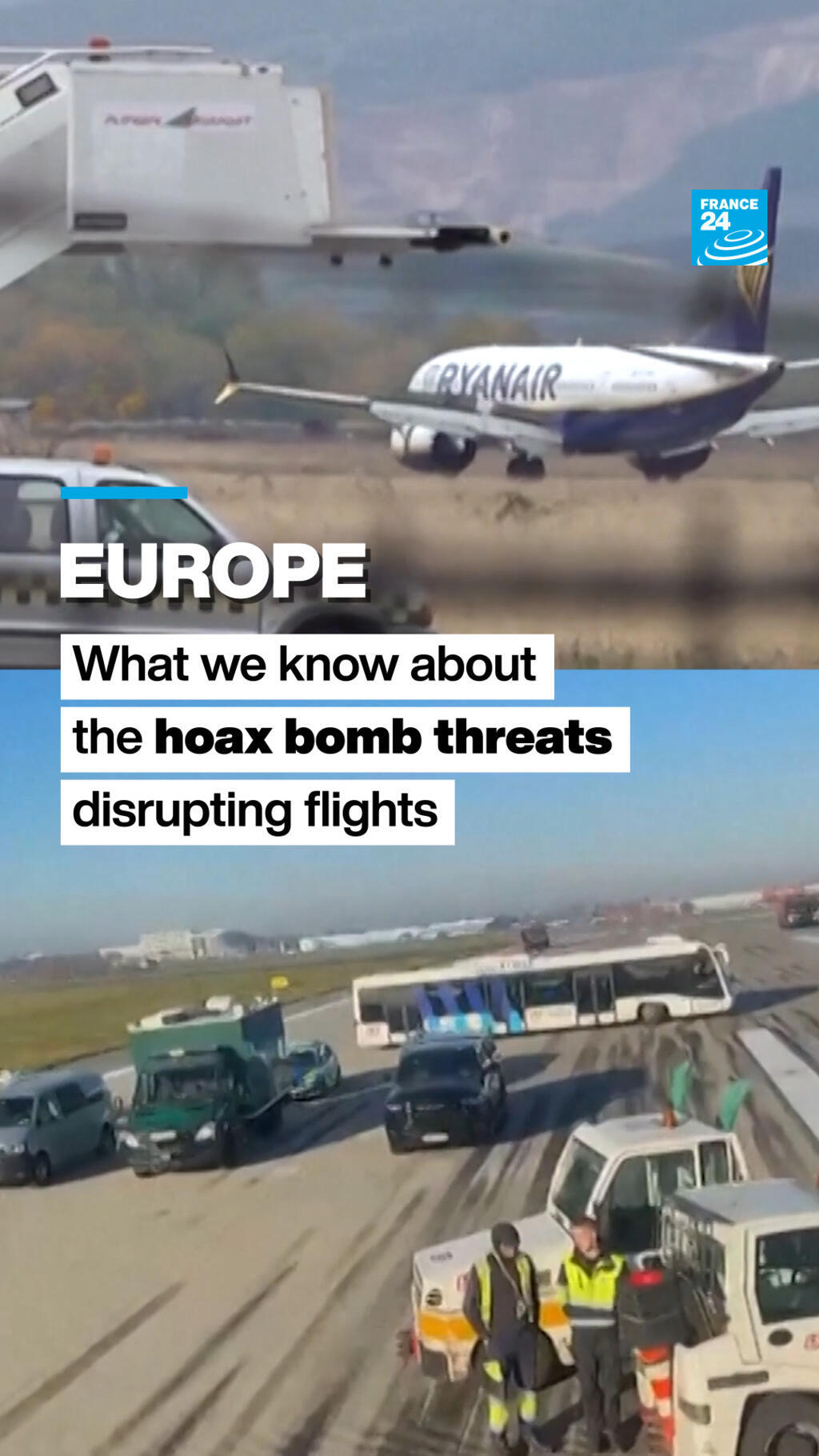
The France 24 item reports that dozens of flights across Europe were disrupted during the week after bomb threats were sent to several airports. It also says threats were made while some aircraft were already in flight, prompting fighter planes to escort many civilian aircraft. The item is presented as a short video explainer titled “Europe: What we know about the hoax bomb threats disrupting flights,” issued on November 6, 2026, and credited to video journalist Tanishk Saha.
The supplied page text does not provide further details about where the threats originated, which airports or airlines were affected, how many flights were diverted or delayed, whether any threat was considered credible, or who was responsible. It also does not include interviews, official statements, or additional explanation of the incidents. Although the headline calls the threats hoaxes, the provided description gives no supporting details about how that was established. The page includes a related headline about disruption to European air traffic, as well as a headline about multiple flights being diverted after earlier hoaxes, but these are links to other coverage rather than substantive content in this item.
Overall, the available article content is a brief factual introduction to an accompanying video. Its central point is the scale of the reported disruption and the unusual response of fighter escorts for civilian aircraft. The source text is too limited to establish the full chronology, causes, or consequences of the threats.
Entities: Europe, France 24, Tanishk Saha, European flights, Airports • Tone: neutral • Sentiment: neutral • Intent: inform
06-11-2026
The France 24 report describes a continuing wave of hoax bomb threats affecting countries across Europe. On Friday, several Irish media outlets said they had received threats, while more than a dozen additional flights were affected. The incidents had so far mainly targeted airlines, indicating that the threats were not confined to a single location or type of organization. The report says no explosives had been found in any of the incidents at the time of publication.
European authorities were trying to identify who was behind the threats. The headline’s qualification, “Too early to draw conclusions,” underscores that the source, motive, and broader significance of the incidents had not yet been established. The report does not name suspects, describe specific security measures, or provide further details about the affected flights or media outlets. It attributes its coverage to FRANCE 24’s Brussels correspondent, Dave Keating, who reports on the developing situation. Overall, the article presents the threats as an ongoing cross-European investigation, while emphasizing that the alerts had not resulted in the discovery of explosives and that conclusions about their origins would be premature.
Entities: FRANCE 24, Dave Keating, Brussels, Europe, Irish media outlets • Tone: neutral • Sentiment: neutral • Intent: inform
06-11-2026
A wave of bomb threats against European flights continued Friday, following numerous hoaxes earlier in the week that led to diversions and inspections. Three broadcasters also received threats, raising concern that disruption was spreading beyond aviation. No suspicious items have been found and no injuries have been reported. Eurocontrol said it was aware of threats against 14 flights Thursday and seven Tuesday, while the EU transportation commissioner reported 11 additional threats Friday. The total represented a small fraction of European air traffic, but airlines and authorities must treat each threat seriously because passenger safety is paramount. EU and aviation officials plan to meet in Brussels next week to discuss responses.
Several flights were escorted by Hungarian fighter jets, while aircraft affected by threats in France landed safely at Paris Orly Airport for inspections. Other incidents involved flights connected to Prague, Bucharest, Lisbon, Rome, and Venice; one Wizz Air flight was diverted to Venice and its passengers evacuated. Authorities said security measures caused little disruption to normal airport operations, although diversions and inspections impose costs on airlines. Police in Denmark also took precautionary measures at Copenhagen Airport and found no danger.
Who is behind the threats remains unknown. Authorities have not linked them to any government or group, despite heightened geopolitical tensions and warnings about possible Russian hybrid activity. An email reviewed by the Associated Press claimed to come from an anti-feminist group, but it is unclear whether the same sender was responsible for other threats. Pilots and crews are prepared to follow procedures, including identifying diversion airports and carrying extra fuel.
In Ireland, broadcaster RTE evacuated its Dublin headquarters before staff returned after police searched the site. U.K.-based Sky and Bulgarian broadcaster NOVA TV also reported threats; their operations continued, and NOVA said it followed standard safety procedures. Irish Prime Minister Micheál Martin said such unconventional actions can cause fear and disrupt society, and noted that heightened security would be in place for upcoming European political meetings in Dublin.
Entities: European flight bomb threats, Eurocontrol, Apostolos Tzitzikostas, Royal United Services Institute, Robert Jordan • Tone: analytical • Sentiment: neutral • Intent: inform
06-11-2026
Newsrooms in Ireland and Bulgaria received emailed bomb threats on Friday, and British broadcaster Sky also reported a security threat. Ireland’s public broadcaster, RTE, evacuated its offices and suspended programming. The emails, attributed to someone using the name “Mikhail Andropov,” described the threats as the beginning of attacks on transport across Europe. Reuters could not verify who sent them, where they originated, or whether they were linked to a series of threats that disrupted flights earlier in the week. No explosives were found, and all threatened aircraft landed safely.
The threats added to concern among European officials that a broader campaign of “hybrid” disruption may be targeting countries that have supported Ukraine. Russia has denied involvement, and officials have not publicly assigned responsibility for the threats. Spanish Foreign Minister Jose Manuel Albares described the situation as “hybrid aggression” and psychological warfare. Security experts said the hoaxes might be intended to punish countries that have armed or funded Ukraine, while also cautioning that copycats or individuals acting on personal grievances could be responsible.
Flight disruption was less extensive on Friday than on earlier days. Around six flights were disrupted on Tuesday and more than two dozen on Thursday, with some diverted or escorted by fighter jets. A Wizz Air flight from Prague to Rome was diverted to Venice. Hungarian jets escorted several airliners through Hungarian airspace, and Hungary’s defense minister said NATO had ordered air patrols in the area.
The article places the hoaxes within a wider pattern of suspected sabotage and other “grey zone” activity across Europe, including attacks on infrastructure, drone incursions, cyber breaches and election interference. European technology commissioner Henna Virkkunen said such operations seek to destabilize societies and foster mistrust, and that Russia is often responsible, though not always. Separately, threats sent to Italian airlines and airport operators in Rome and Milan claimed to come from the “Male State” movement. Reuters could not verify the sender, and the group’s founder said it no longer existed and had no involvement.
Entities: RTE, Nova TV, Sky, Reuters, Mikhail Andropov • Tone: analytical • Sentiment: negative • Intent: inform
06-11-2026
A wave of bomb threats disrupted air travel and prompted heightened security measures across Europe on Friday, November 6, 2026. At least 25 hoax alerts targeted airlines that day, bringing the reported weekly total to nearly 30 affected flights. Several aircraft were diverted, escorted by fighter jets, or inspected after landing; authorities said the affected planes landed safely and reported no explosives in completed searches.
A Wizz Air flight from Prague to Rome diverted to Venice after a phone call to Rome Fiumicino Airport prompted a bomb scare. Two flights bound for Bulgaria—Wizz Air flight W64328 from Brussels and Ryanair flight FR1730 from London Stansted—received emailed threats while in the air. Hungary sent fighter jets to escort the Brussels–Sofia flight through its airspace and also escorted civilian flights from Prague to Cyprus and Romania. French authorities said four additional threats involved aircraft over French territory, and bomb-disposal teams inspected the planes after they landed. An Aer Lingus flight from Dublin to Rome had been diverted to an airbase in northern France the previous day; French police opened an investigation after its pilot reportedly resisted calls to divert.
Security measures also affected Copenhagen Airport, where Danish police deployed specialist teams after receiving hostile intelligence about air traffic. Operations included rescreening baggage and establishing a special security perimeter, although authorities said there was no immediate indication that passengers were in danger. Czech police had also cleared four aircraft at Prague’s Václav Havel Airport following inspections that found no explosives or dangerous items.
The threats extended beyond aviation. Irish media organizations, including national broadcaster RTÉ and the Irish Independent, evacuated their Dublin offices after receiving emailed threats. The alert to RTÉ reportedly warned that a bomb would go off within 45 minutes. Some staff were later told they could return, and a Newstalk presenter said the calls had been deemed a hoax. Irish Prime Minister Micheál Martin said the threat was worrying and was being taken seriously. The article describes the incidents as part of a broader series of hoax alerts that had also affected flights and a cruise ship earlier in the week.
Entities: Damien McElroy, Micheál Martin, European bomb-threat alerts, Wizz Air, Ryanair • Tone: neutral • Sentiment: negative • Intent: inform