06-11-2026
After Democrats won majorities in both chambers of Congress in the 2026 midterm elections, President Donald Trump said he was willing to work with them rather than spend the next two years vetoing legislation. Democrats have secured at least 253 of 435 House seats and 54 of 100 Senate seats, but they lack the two-thirds majorities needed to override presidential vetoes. Trump can also rely on executive orders, while Senate Republicans may use the filibuster to prevent bills from reaching his desk.
The article examines whether bipartisan deals are nevertheless possible. Andrew Proctor, a University College London lecturer in US politics, expects significant gridlock and considers cooperation unlikely in light of recent history. Some Democrats, including newly elected Michigan Senator Abdul El-Sayed, have expressed willingness to work with Trump on shared priorities such as healthcare, affordability, and ending the war and tariffs involving Canada. Bernie Sanders has also suggested Trump might sign a Medicare for All bill, though Proctor considers passage of that proposal unlikely. He sees more limited healthcare measures, such as restoring subsidies cut under earlier Trump legislation, as a more plausible area for agreement.
The article also reviews Trump’s use of vetoes: twice in his current term and 10 times in his first, compared with 12 vetoes by Joe Biden in one term and 12 by Barack Obama over two. It notes that veto use has declined over time, while Senate filibusters can stop legislation before it reaches the president. Finally, Democrats’ midterm gains have prompted calls for investigations and subpoenas. Two House impeachments occurred during Trump’s first term, and reports suggest Defence Secretary Pete Hegseth could face impeachment proceedings over the Iran war. The White House has rejected allegations of wrongdoing and warned Democrats against pursuing what it called sham investigations.
Entities: Donald Trump, Democratic Party, Republican Party, 2026 United States midterm elections, United States Congress • Tone: analytical • Sentiment: neutral • Intent: analyze
06-11-2026
The article examines how the 2026 US midterm elections may shape the 2028 presidential race, while warning that midterm success does not guarantee victory in a subsequent presidential election. Although ballots were still being counted, major Democratic gains gave the party momentum and brought potential presidential contenders into sharper focus. Democratic Senator Jon Ossoff, Pennsylvania Governor Josh Shapiro and Illinois Governor JB Pritzker emerged from their races with strong results; California Governor Gavin Newsom was also politically invested in a high-profile state ballot initiative. On the Republican side, Senator Tom Cotton and Governor Sarah Huckabee Sanders held office in Arkansas but with narrower margins than before.
The results may complicate ambitions for Vice-President JD Vance and other figures associated with the Trump administration. Exit polls indicated that voter anger over the administration contributed to the Republican swing, and Vance publicly blamed the Iran war for the losses. Senator Ted Cruz and Florida Governor Ron DeSantis, who are outside the administration, criticized aspects of the party’s approach and discussed what Republicans should do next.
Within the Democratic Party, both moderates and progressives claimed the results supported their political strategies. Left-wing candidates point to El-Sayed’s Michigan victory as evidence that populist candidates can win in competitive states, while moderate Democrats cite gains by the Blue Dog Caucus as evidence that pragmatic candidates can attract voters. The article suggests that economic concerns, especially the cost of living, will remain central in 2028, alongside emerging issues such as data centres.
Finally, the election highlighted a changing electoral map and the need for both parties to earn support from voters they may once have taken for granted. Texas’s political shift could put its 40 electoral votes in play, while the Trump coalition’s working-class and Latino support weakened. A conservative commentator argued that Republican messaging on deportations may have alienated Latino voters. Overall, the article presents the midterms as an early test of candidates, coalitions and campaign themes—not a definitive forecast of the 2028 outcome.
Entities: 2026 US midterm elections, 2028 US presidential election, Democratic Party, Republican Party, Donald Trump • Tone: analytical • Sentiment: neutral • Intent: analyze
06-11-2026
European leaders have rejected President Donald Trump’s suggestion that the United States and Russia may reach a sweeping security agreement covering Ukraine and “all of Europe” without European participation. Trump described the prospective deal as “very big” and “a big, beautiful agreement,” while his special envoy Jared Kushner said Washington was working on a broader European security framework alongside efforts to end the war in Ukraine.
EU foreign policy chief Kaja Kallas said Europe already has a security architecture, arguing that Russia—not NATO—is undermining it by breaking treaties. She stressed that Putin has no veto over European security and that the EU must be included in any agreement. Poland’s foreign minister, Radoslaw Sikorski, likewise said an arrangement concerning Ukraine and Europe made “above our heads” would be impossible. Ukraine’s foreign minister, Andriy Sybiha, argued that European countries should focus on protecting themselves from Russian aggression rather than negotiating spheres of influence with Moscow. He and Kallas emphasized that Ukraine’s future and Europe’s security cannot be decided without their direct involvement.
The dispute comes as US representatives prepare to resume Ukraine negotiations with Kyiv and Moscow in Abu Dhabi. Recent US discussions with NATO, EU and European officials addressed security guarantees for Ukraine and the continent’s wider security arrangements. Kushner said Washington would consult European partners and could pursue a broader multilateral format if negotiations progress. The European Commission also said substantial work remains before a peace agreement can be reached, while NATO reiterated its aim of a “just and sustainable” end to the conflict.
The article places the disagreement in the context of Russia’s pre-invasion demands for changes to Europe’s security order, including limits on NATO forces in countries that joined after 1997. Ukraine seeks credible guarantees against future attacks; Moscow has sought restrictions on NATO; and European governments oppose any settlement that rewards aggression or compromises Ukraine’s sovereignty. The Abu Dhabi talks will test whether Washington can reconcile these positions. European objections indicate that a US-Russia deal made without the countries directly affected would face significant resistance.
Entities: Donald Trump, Jared Kushner, Vladimir Putin, Kaja Kallas, Radoslaw Sikorski • Tone: analytical • Sentiment: negative • Intent: inform
06-11-2026
France 24 reports that US Defence Secretary Pete Hegseth is facing increased political pressure after Republicans suffered election losses. Democrats who won are planning to target him in Congress, while Republicans have connected their losses to the Iran war that Hegseth advocated and publicly represented. The report describes Hegseth as a key supporter and spokesman for the war, placing him at the center of criticism over its political consequences.
President Donald Trump has continued to support Hegseth, saying that he is doing “a very good job.” However, Trump and Vice President JD Vance have also blamed the Iran war for the midterm setbacks. Their comments underscore the tension in the administration’s position: Trump has defended the defence secretary personally while also pointing to the war he championed as a cause of the election losses.
The article’s focus is the uncertainty surrounding Hegseth’s political standing as Democrats prepare congressional scrutiny and Republican criticism grows. It does not report that Hegseth has been dismissed or that a specific congressional action has already taken place. Instead, it presents mounting pressure and questions about his future following the election result. The item is a short France 24 video report, issued on 6 November 2026, with video by Daniel Whittington.
Entities: Pete Hegseth, Donald Trump, JD Vance, United States, France 24 • Tone: analytical • Sentiment: negative • Intent: inform
06-11-2026
In an interview with FRANCE 24, John Bolton, who was national security adviser during Donald Trump’s first presidential term, described the Democrats’ gains in the 2026 US midterm elections as “the beginning of the end” of Trump’s dominance over the Republican Party. Democrats regained control of both the House of Representatives and the Senate, in what the article characterizes as the Republicans’ worst performance since the 1974 elections after the Watergate scandal.
Bolton argued that Trump’s campaign choices underscored his focus on himself rather than on voters’ concerns or the party. He pointed to Trump’s final public address before voting, saying it emphasized his construction projects and repairs to the Reflecting Pool rather than the cost of living and affordability. Bolton said Republicans increasingly recognize that Trump is acting for his own benefit, not to advance ideas or help the party.
Trump claimed Republicans lost because his name was not on the ballot. Bolton rejected that explanation, arguing that Trump had repeatedly made himself a central part of the campaign and urged voters to treat him as if he were on the ballot.
The interview also considers Vice President JD Vance’s post-election statement blaming the war in Iran for the Republican defeat. Bolton called the remark notable and said it could shape political debate in the two years before the next presidential election. He interpreted Vance’s claim that he had opposed the war from the outset as an effort to distance himself from Trump and appeal to the Republican Party’s isolationist wing. Bolton suggested that Vance may be positioning himself for a 2028 presidential nomination bid by presenting himself as more aligned with the MAGA movement than Trump.
Entities: John Bolton, Donald Trump, JD Vance, FRANCE 24, Washington • Tone: analytical • Sentiment: negative • Intent: analyze
06-11-2026
The article examines whether the Democrats’ sweeping victory in the US midterm elections will change American support for Ukraine. Ukrainian President Volodymyr Zelensky expressed optimism, citing Democratic statements in support of Ukraine and a renewed US-Europe relationship. He hopes the new congressional majority can secure more funding and military aid. In Kyiv, however, expectations are cautious: Ukrainians recognize that foreign policy remains largely directed by the White House, and Trump’s recent relationship with Ukraine has been tense.
A Democratic-controlled Congress could pursue financial assistance for Ukraine and tougher sanctions on Russia, but its ability to turn those priorities into policy is constrained. Council on Foreign Relations senior fellow James M. Lindsay says the president retains significant authority over foreign policy, including deciding whom the United States negotiates with and what is discussed. Congress can criticize or try to persuade the president, but it cannot dictate negotiations.
The outcome therefore depends heavily on Trump’s response to his party’s defeat. He might treat it as a reason to work with Democrats, potentially enabling a tougher approach to Russia and greater aid for Ukraine. Alternatively, Lindsay says, Trump may double down on his existing policies, including what the article describes as hostility toward Ukraine. US-mediated talks between Russia and Ukraine are scheduled to take place in Abu Dhabi, while Trump has claimed a broad agreement to end the war is close. The European Union has cautioned that substantial work remains and emphasized that the EU will decide on matters affecting its security.
Lindsay also warns that expectations of a Democratic Congress redirecting US foreign policy may become difficult to meet, causing disappointment in the United States and abroad. Democrats will not take office until January, leaving a transition period in which Congress may struggle to influence policy. If Trump continues his disruptive approach, the new majority may have limited power to rein him in.
Entities: Donald Trump, Volodymyr Zelensky, James M. Lindsay, Emmanuelle Chaze, Paula Pinho • Tone: analytical • Sentiment: neutral • Intent: analyze
06-11-2026
The supplied excerpt describes a major midterm defeat for President Donald Trump’s Republicans. Democrats reportedly won a large House majority and control of the Senate, making substantial gains even in traditionally Republican strongholds. The excerpt characterizes the outcome as the party’s worst loss in roughly 50 years.
Several factors are identified as contributing to the Republican setback: Trump’s war in Iran, rising gasoline prices, corruption claims, and voters’ dissatisfaction with unmet promises on costs and wars. The campaign was also weakened by Republican infighting, poor candidate choices, and delayed spending. By contrast, Democrats benefited from redistricting and strong candidates who helped them broaden their electoral map.
The article’s opening scene shifts to the final days before the election. Six days before voters went to the polls, more than two dozen of Trump’s senior strategists joined a private video call. The mood was described as grim, and the discussion reportedly opened with talk of cyanide. This detail sets a stark, dramatic tone and signals the campaign team’s perception of the crisis.
The supplied material is only a short excerpt and does not provide the full account promised by the headline. It establishes the scale of the reported electoral collapse and names political, economic, and organizational explanations, but offers little detail about the strategists’ discussion or how the campaign reached its final position. The analysis therefore reflects only the information included in the provided text.
Entities: Donald Trump, Shane Goldmacher, Jonathan Swan, Maggie Haberman, Democratic Party • Tone: analytical • Sentiment: negative • Intent: analyze
06-11-2026
Germany says the results of the US midterm elections have brought “new urgency” to efforts to end the war in Ukraine. The elections, held on Nov 5, resulted in a major setback for President Donald Trump’s Republicans. That night, Trump and German Chancellor Friedrich Merz spoke by phone about the conflict, according to Merz’s spokesman, Stefan Kornelius.
The comments come as US-mediated talks to end the war are scheduled to take place in Abu Dhabi the following week. Germany is “closely involved” in preparations, working with the E3 and other European partners. Kornelius said Berlin and Washington agree on central points, including that NATO partners must be involved. He argued that discussions about European security and peace in Ukraine affect Europe directly and are not useful without European participation.
Trump had said he expected a “very big” deal with Russia involving Ukraine and “all of Europe,” after meeting an envoy of Russian President Vladimir Putin. Jared Kushner, Trump’s envoy and son-in-law, said the United States would consult European partners on the sidelines of the Abu Dhabi talks. If the negotiations make progress, Washington would aim to move toward a broader multilateral format with Europe’s direct participation. The article presents the midterm results as adding pressure or urgency to diplomacy, while emphasizing the dispute’s European stakes and the planned role of European allies in the talks.
Entities: Donald Trump, Friedrich Merz, Stefan Kornelius, Jared Kushner, Ukraine war • Tone: analytical • Sentiment: neutral • Intent: inform
06-11-2026
The article reports that baseless claims of voter fraud largely faded after Democrats won both chambers of Congress in the 2026 US midterm elections, a result described as a decisive “blue tsunami.” Although observers had expected election deniers to challenge results or for Donald Trump to try to influence the outcome, neither happened. Trump accepted the defeat, and many of his supporters followed his lead. The University of Washington’s Center for an Informed Public said election denialism did not become a central explanation for the Democratic victories, noting that such claims lacked a political elite to organize and amplify them.
Analysts offered several possible explanations. The scale of the Democratic win may have made challenges less likely, though David Becker of the Center for Election Innovation and Research argued that large margins had not stopped fraud claims in the past. He suggested political incentives may have changed. Many election-denying candidates also lost and did not contest their results. Andy Biggs, who had challenged the 2020 election, conceded his Arizona gubernatorial race to Katie Hobbs and blamed inadequate turnout rather than fraud.
Some conservative influencers who had previously promoted election skepticism were also subdued. Rogan O’Handley said Republicans lost because they failed to address voters’ concerns, including prices and the Iran war, not because of election fraud. However, Media Matters for America’s John Knefel warned against assuming election denialism has permanently weakened, saying rejection of Democratic victories remains foundational to Trump’s movement. Other experts expressed cautious optimism: voters may be tiring of unsupported claims, and polling suggests election fraud is not a major factor in how most people decide their votes. The article concludes that the movement may persist even as its claims receive less traction in this election.
Entities: Donald Trump, Democratic Party, Republican Party, 2026 US midterm elections, Blue tsunami • Tone: analytical • Sentiment: neutral • Intent: analyze
06-11-2026
The article examines the consequences of Democrats’ reported takeover of both chambers of Congress in the 2026 midterm elections, describing it as a major setback for President Donald Trump and the Republican Party. It attributes the Republican losses to voter dissatisfaction over the economy, rising living costs, the war in Iran and the administration’s immigration crackdown, and notes Democratic gains in several traditionally Republican states and gubernatorial races.
Once the 120th Congress takes office on January 3, 2027, Democrats will be able to lead congressional committees, conduct investigations, shape legislation and scrutinise or reject presidential nominees. Their priorities include healthcare support, the cost of living, Trump’s tariffs and oversight of the Iran war. But a Democratic majority will not let them enact an agenda without limits: Trump can veto bills, and overriding a veto requires two-thirds support in both chambers. The article therefore anticipates legislative gridlock and negotiations with the White House or Republican lawmakers.
Oversight could become a major source of conflict. Democrats have signalled inquiries into the Department of Homeland Security, Immigration and Customs Enforcement, alleged corporate corruption and the release of the Epstein files. The article also considers the possibility of another impeachment effort. The House could impeach Trump, as it did twice in his first term, but conviction and removal would require a two-thirds Senate majority, making removal unlikely without substantial Republican support. Senate control could also delay or block Trump’s Cabinet, judicial and other nominees, potentially affecting the federal courts. The available article text ends as it begins discussing immigration’s implications for Indian professionals, students and families in the United States.
Entities: Donald Trump, Hakeem Jeffries, Robert Garcia, Democratic Party, Republican Party • Tone: analytical • Sentiment: neutral • Intent: analyze
06-11-2026
The supplied material is only the headline and opening sentence, not the full Washington Post article, so a comprehensive account of the article’s reporting and conclusions cannot be established from it. The excerpt says that Ukraine’s embattled leadership sees a limited reason for hope after what it describes as a historic Republican Party defeat in the U.S. midterm elections. That hope concerns continued aid to Ukraine. The same sentence sets this against a countervailing development: President Donald Trump appeared to be drawing closer to Russia, creating uncertainty about U.S. policy toward Ukraine. The headline frames Ukrainians’ reaction as cautious rather than confident and highlights the contrast between the election result and Trump’s dealings with Russian President Vladimir Putin. The dateline places the report in Kyiv, and Francesca Ebel is identified as the author. Beyond those points, the provided text gives no details about the election results, Ukrainian officials’ statements, the scale or type of aid at stake, Trump’s specific actions, or the article’s broader evidence and analysis. Those details should not be inferred or invented. The summary therefore reflects only the available headline and lead, rather than claiming to represent the full article.
Entities: Ukraine, Ukrainians, Kyiv, Francesca Ebel, Donald Trump • Tone: analytical • Sentiment: neutral • Intent: inform
06-11-2026
The article reports President Donald Trump’s renewed attacks on the integrity of US elections as Democrats’ sweeping midterm victories reshape Congress and threaten Republican control in several traditionally conservative states. Speaking at the White House, Trump called elections “crooked” and criticized the Los Angeles mayoral victory of a democratic socialist. His remarks followed a result in which Democrats won control of both chambers of Congress, a major rejection of his presidency and the Republican Party. Trump has not accepted responsibility for the losses and has sought to redirect votes from two minor candidates to Republican incumbent Dan Sullivan in Alaska’s still-undecided Senate race. Vice President JD Vance, meanwhile, has distanced himself from Trump and blamed the Iran war for the party’s performance.
Democrats had secured at least 54 Senate seats to Republicans’ 44, while their House majority had passed 250 seats. Senate Democratic leader Chuck Schumer warned that Republican prospects could worsen in 2028 if Trump vetoes legislation addressing costs and corruption. The closest remaining contest was Mississippi, where Democrat Scott Colom held a narrow lead over Republican Cindy Hyde-Smith. A Colom victory would make him the state’s first Democratic senator since 1982 and its first African American senator since 1874. In Alaska, Democrat Mary Peltola narrowly led Sullivan.
The article also highlights candidates who broke racial, religious, and regional barriers: Keisha Lance Bottoms became Georgia’s first Black woman governor, and Michigan’s Abdul El-Sayed became the first Muslim elected to the Senate. Democrats also won Senate seats in Texas and Kansas, states long dominated by Republicans. Ohio Republican Warren Davidson attributed his party’s losses to the Iran war and global trade conflicts, saying young voters felt betrayed.
Entities: Donald Trump, JD Vance, Chuck Schumer, Scott Colom, Cindy Hyde-Smith • Tone: analytical • Sentiment: negative • Intent: inform
06-11-2026
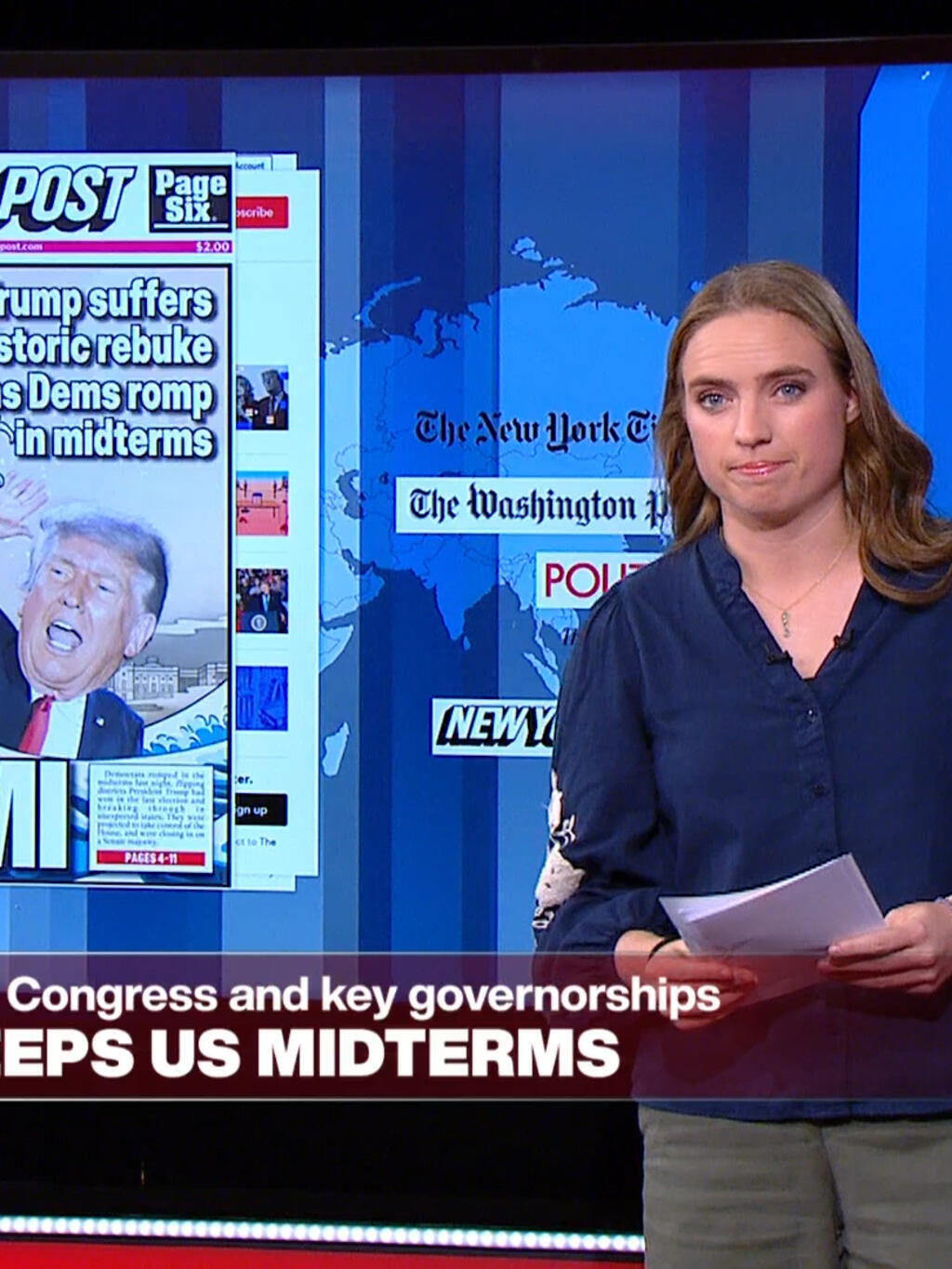
France 24’s “The World This Week” presents a midterms special examining the political consequences of what the programme describes as the Republican Party’s worst election result since the 1970s, in the post-Watergate era. Host Gavin Lee is joined by four international correspondents to assess the result and consider whether it signals that “peak MAGA” has passed. The discussion is framed around possible changes in US domestic and foreign policy, as well as the question of which political figure may emerge as the leading contender for the 2028 presidential election. The supplied page description does not name the panelists or provide their conclusions, so it offers no further detail on their assessments.
The programme’s second topic is protest activity across Europe. Housing organisations, trade unions and activist groups from seven countries met in Paris and issued a joint call for demonstrations. The show asks whether separate national protest movements are beginning to coordinate and develop into a wider European movement. It does not specify the groups’ demands or report the outcome of any demonstrations.
Written and presented by Gavin Lee, the 47-minute programme was produced by Alessandro Xenos, Théophile Vareille, Guillaume Gougeon and Laura Burloux. The page identifies the segment as a “Mid Terms Special” and lists related topics including Donald Trump, the US midterm elections, the Republican and Democratic parties, French student protests and the Yellow Vest protests. The available material is a programme description rather than a full transcript, so it outlines the questions the broadcast explores without supplying the panel’s detailed arguments or answers.
Entities: Gavin Lee, Alessandro Xenos, Théophile Vareille, Guillaume Gougeon, Laura Burloux • Tone: analytical • Sentiment: neutral • Intent: analyze