10-09-2026
The article reports that Morocco has denied any involvement in the mass movement of migrants into Ceuta, Spain’s North African exclave, on July 30 and 31. More than 70,000 migrants reportedly crossed from Morocco into the territory, an incident that left scores of people dead and intensified disagreements within the European Union over migration policy.
Morocco’s foreign ministry issued its first official response to the episode, saying there were “no facts” demonstrating that Rabat had played a role. The ministry also rejected the idea that Morocco should serve as a “scapegoat for political score-settling” in Spain. The denial followed a Spanish police report alleging that Moroccan security forces had acted with “total permissiveness” during the mass crossing, implying that authorities may have allowed or failed to prevent the movement of migrants.
Spain’s prime minister has so far avoided directly accusing Morocco. Instead, he has emphasized that there is no evidence proving that the Moroccan government organized or orchestrated the influx. This position leaves the responsibility for the incident politically contested, with allegations from Spanish investigators countered by Morocco’s categorical denial.
The article presents the crossing as both a bilateral dispute between Spain and Morocco and a broader European migration crisis. It highlights the human cost of the event, as well as the diplomatic and political consequences, including renewed conflict among EU countries over how migration should be managed. The report remains focused on official statements and competing claims rather than reaching an independent conclusion about Morocco’s role.
Entities: Ceuta, Morocco, Spain, Rabat, Spanish Foreign Ministry • Tone: analytical • Sentiment: negative • Intent: inform
10-09-2026
Spain’s intelligence services warned the government and Moroccan authorities about planned mass crossings into Ceuta one day before more than 72,000 migrants and asylum seekers entered the Spanish enclave from Morocco in late July, according to 40 declassified documents. A July 29 National Intelligence Center (CNI) message alerted Spain’s government delegation in Ceuta to social media calls for an assault on the border fence and an attempted sea crossing the following evening. The message said two groups promoting the action had a combined 180,000 followers. The CNI also informed Morocco’s intelligence agencies that people might climb the fence or swim around it, potentially using Morocco’s Throne Day celebrations on July 30 as an opportunity.
The documents were released amid frequent protests in Ceuta and continuing debate over the Spanish government’s handling of the crisis and Morocco’s conduct. Prime Minister Pedro Sánchez rejected the claim that the warnings demonstrated Spain had advance knowledge of the crisis’s scale or likelihood. He said the social media campaign was known and monitored but did not indicate what ultimately occurred. Morocco did not immediately comment.
A separate CNI assessment issued on July 30 said Moroccan authorities were probably not actively encouraging the crossings, but had responded negligently and passively. It said Moroccan security forces had failed to control the crowd and that several hundred people had already swum toward Ceuta that night. A leaked Spanish police report had previously alleged “total permissiveness” by Moroccan police.
More than a month later, about 5,000 migrants and asylum seekers, including 1,200 minors, remained in Ceuta, although local officials estimated the figure could be as high as 10,000. Madrid pledged $357m in assistance while some people remained unhoused. The opposition Popular Party accused the government of ignoring warnings and being directly responsible for the crisis.
Entities: Ceuta, Fnideq, Morocco, Spain’s National Intelligence Center (CNI), Morocco’s DGST and DGED intelligence agencies, Spain–Morocco border crisis • Tone: analytical • Sentiment: negative • Intent: inform
10-09-2026
Declassified Spanish government documents indicate that the National Intelligence Center (CNI) issued several warnings before the late-July 2026 mass migrant crossing into Ceuta, a Spanish exclave on Morocco’s northern coast. On July 29, the CNI warned Spanish officials in Ceuta about social-media calls for an assault on the border fence and an attempted entry by sea the following evening. The agency said two online groups promoting the action had a combined 180,000 followers. It also alerted Moroccan intelligence services and Spain’s Civil Guard about plans to enter Ceuta by climbing the fence or swimming around it, potentially taking advantage of Morocco’s Throne Day.
The documents appear to challenge Prime Minister Pedro Sánchez’s characterization of the government’s prior knowledge. A Defense Ministry intelligence report issued as the crossing began said Moroccan forces had acted passively and negligently and suggested Morocco might exploit the crisis for strategic purposes. The disclosures have intensified criticism of Sánchez’s handling of the episode, including allegations that he minimized the warnings and was too accommodating toward Morocco. Sánchez responded that authorities knew about the social-media campaign but that it did not indicate the scale, nature, or likelihood of the eventual influx.
The article reports that more than 72,000 people entered Ceuta between July 30 and 31, overwhelming authorities. Weeks later, thousands remained in the city, with estimates ranging from about 5,000 by the national government to as many as 10,000 according to local officials. Many migrants, including unaccompanied minors, were living in makeshift camps or on streets and beaches. The report also recalls that NGOs said more than 140 migrants died in Spain’s deadliest mass crossing, while officials acknowledged that hundreds had already been swimming from Morocco in the days beforehand.
Entities: Ceuta, Spain, Morocco, Pedro Sánchez, National Intelligence Center (CNI), Spanish Civil Guard • Tone: analytical • Sentiment: negative • Intent: inform
10-09-2026
Declassified Spanish intelligence and police documents indicate that authorities were warned at least 24 hours before a mass migrant crossing into Ceuta on 30 July 2026, contradicting some public claims made by Prime Minister Pedro Sánchez and Interior Minister Fernando Grande-Marlaska. An urgent National Intelligence Centre (CNI) memo dated 29 July warned Moroccan intelligence agencies about WhatsApp groups allegedly preparing an attempt to enter Ceuta during Morocco’s Throne Day celebrations. The National Centre for Immigration and Borders (CENIF) separately assessed a high likelihood of people entering by swimming and medium likelihoods for crossings over the land fences or by sea.
The documents also show that the CNI contacted the Government Delegation in Ceuta and the Guardia Civil. Messages referred to social-media calls involving groups with approximately 180,000 followers and warned of coordinated attempts to swim around the fence and climb over it. The disclosures support Defence Minister Margarita Robles’s claim that the government delegation had received a warning, although Grande-Marlaska has maintained that he received no official communication about a possible mass crossing.
Sánchez argued that the authorities could not have anticipated the eventual scale of the crisis, despite earlier smaller arrivals. He said approximately 80,000 people reached Ceuta on 30 and 31 July, while government and police estimates suggest that between 5,000 and 10,000 may still remain there. The article characterizes some of the president’s figures and claims about the speed of returns and evacuations as misleading.
The prime minister acknowledged that Spain needs better preparation for future “hybrid attacks,” stronger border infrastructure and greater reception capacity. The article also notes continuing disagreement over Morocco’s role in the crisis and criticizes an Interior Ministry document that listed journalists and commentators according to their presumed political ideology. Sánchez called that document inappropriate.
Entities: Pedro Sánchez, Margarita Robles, Fernando Grande-Marlaska, National Intelligence Centre (CNI), National Centre for Immigration and Borders (CENIF) • Tone: analytical • Sentiment: negative • Intent: analyze
10-09-2026
The article reports a heated confrontation in Spain’s Parliament over the government’s handling of a major migrant influx into Ceuta, a Spanish enclave in North Africa bordering Morocco. Santiago Abascal, leader of the conservative Vox party, accused Prime Minister Pedro Sánchez of betraying Spain and questioned whether Morocco was blackmailing his government during the border crisis. Abascal called Sánchez both a “traitor” and “a dog,” while holding up individual sheets of paper spelling “Traidor,” the Spanish word for traitor.
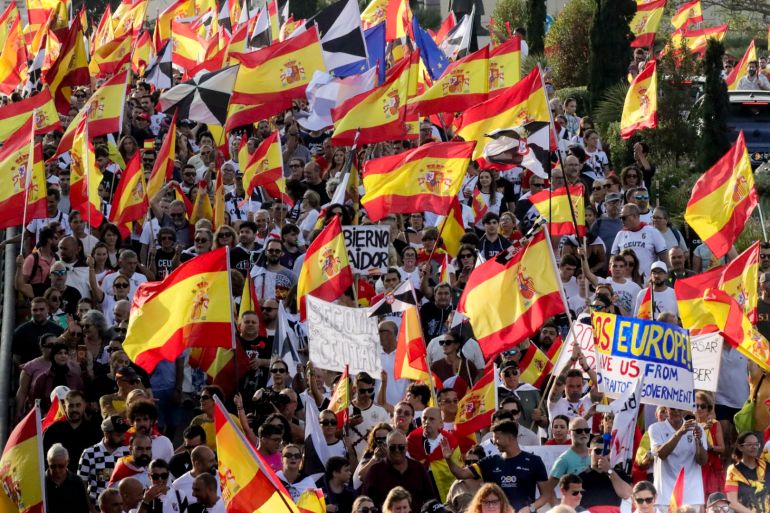
Sánchez responded sharply, saying, “I may be a dog, but I have no master,” before sitting down. The exchange took place amid protests in Ceuta, where critics have blamed the prime minister for failing to prevent the mass arrival of migrants and for allegedly accommodating Morocco.
The article states that more than 70,000 migrants entered Ceuta in July. Although most later returned to Morocco, many remained in the enclave, including people living in tent encampments on the beach. The report also notes that some local residents believe the Spanish government has not done enough to prevent another large-scale influx.
According to declassified government documents cited by The Associated Press, Spain’s National Intelligence Center warned officials about the risk of a mass crossing before it occurred. On July 29, one day before the crossings began, the agency sent a WhatsApp alert to the Spanish government’s delegation in Ceuta. The message warned of social-media calls for an assault on the border fence and an attempted sea crossing the following evening. It said two groups involved in the calls had a combined 180,000 followers, indicating the potential scale of the mobilization.
Entities: Santiago Abascal, Pedro Sánchez, Vox party, Spain, Ceuta • Tone: emotional • Sentiment: negative • Intent: inform
10-09-2026
Morocco has rejected allegations that its authorities enabled or encouraged the mass migrant crossing into Spain’s North African exclave of Ceuta in late July. The Moroccan foreign ministry said there were “no facts or reports” demonstrating any involvement by Moroccan authorities and accused Spain of attempting to make Morocco a “scapegoat for political score-settling.” The statement was Rabat’s first official response to a Spanish police report that described Moroccan security forces as showing “total permissiveness” during the crossings.
More than 70,000 migrants reportedly entered Ceuta from Morocco on July 30 and 31 in an unprecedented and chaotic surge. The incident left scores dead, increased tensions in the small Spanish territory and triggered political disagreement within the European Union over migration policy. Spain had previously released intelligence documents warning of possible mass entries. One military intelligence assessment said it was highly likely that Morocco was not actively encouraging the movement but had acted negligently and passively.
Spanish Prime Minister Pedro Sanchez has repeatedly said there is no “solid proof” that Morocco planned or orchestrated the crisis. After the intelligence reports were declassified, he said the available information could not have enabled anyone to foresee the scale of the events.
Morocco also questioned Spain’s treatment of migrants, asking why people were not being returned under existing readmission agreements and why unaccompanied minors were being separated from their families. Although Rabat called the crisis regrettable and supported a thorough investigation, it emphasized the importance of maintaining strong relations with Madrid, including economic and security cooperation. Most migrants have returned to Morocco, but thousands remain in difficult conditions in Ceuta. The EU has allocated Spain €115 million in emergency assistance for border security and returns.
Entities: Morocco, Spain, Ceuta, Pedro Sanchez, Moroccan foreign ministry • Tone: analytical • Sentiment: neutral • Intent: inform
10-09-2026
Spain’s National Intelligence Center (CNI) issued several warnings before a mass migrant crossing from Morocco into the Spanish exclave of Ceuta on July 30, 2026, according to 40 declassified government documents released Wednesday. The documents include intelligence alerts, reports, charts and communications involving multiple Spanish law enforcement and intelligence agencies. They indicate that officials were warned about social-media calls for migrants to assault Ceuta’s border fence and attempt to enter by sea.
A CNI alert sent on July 29 to Spain’s government delegation in Ceuta cited calls for an assault “tomorrow at 8 p.m.” and said two groups involved had a combined 180,000 followers. The agency also warned Moroccan intelligence services and Spain’s Civil Guard that migrants might climb the fence or swim around it, potentially taking advantage of Morocco’s Throne Day holiday. These disclosures appear to challenge Prime Minister Pedro Sánchez’s previous statements about the extent of the government’s prior warning.
Sánchez rejected that interpretation, saying the social-media campaign was known and monitored but did not indicate the scale, nature or likelihood of the mass crossing that followed. He has defended his government’s response and avoided accusing Morocco of organizing the incident, drawing criticism from political opponents who say he is pandering to Rabat.
More than 72,000 people reportedly entered or attempted to enter Ceuta beginning July 30, while nongovernmental organizations say more than 140 people died. Thousands of migrants reached the exclave in the days before the main surge, which Interior Minister Fernando Grande-Marlaska described as an extraordinary situation. Weeks later, about 5,000 migrants remained in Ceuta according to the national government, although local officials cited a higher number. The document release follows protests and continuing political controversy over the government’s handling of the border crisis.
Entities: Ceuta, Morocco, Spain, National Intelligence Center (CNI), Pedro Sánchez • Tone: analytical • Sentiment: negative • Intent: inform