10-09-2026
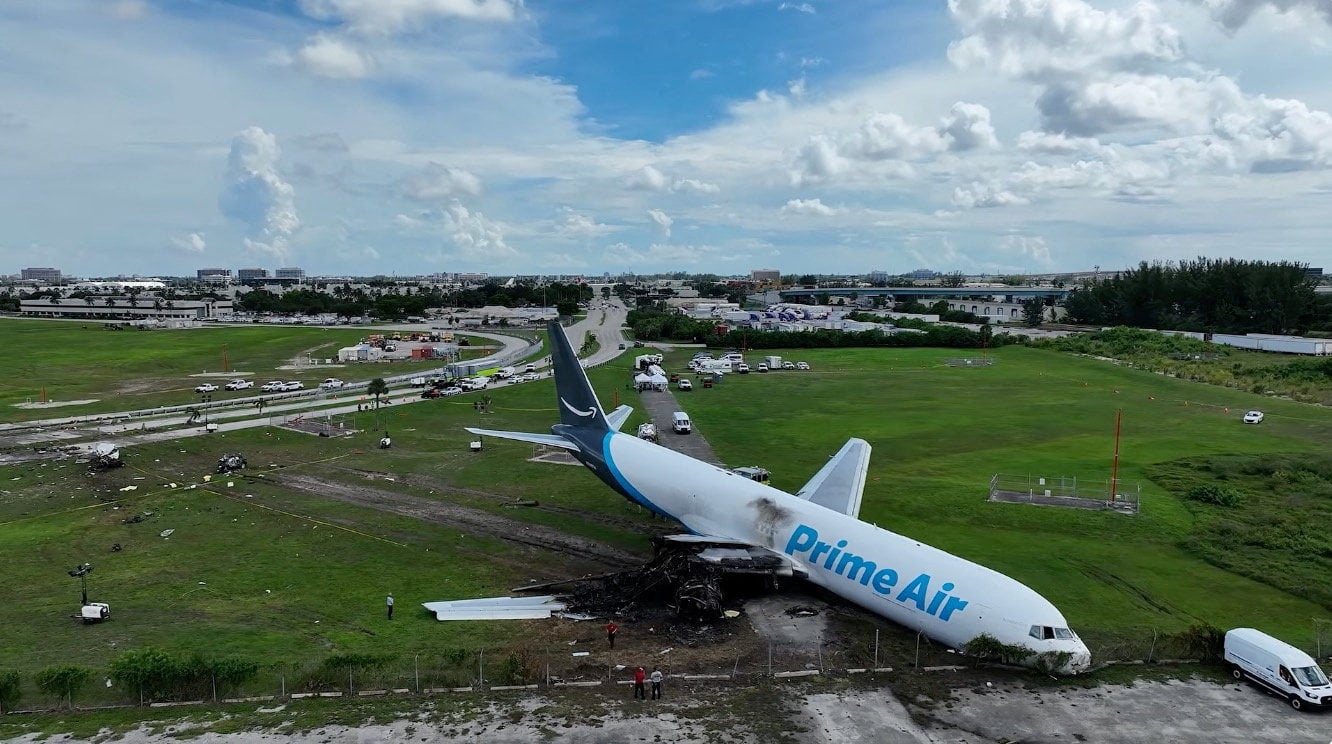
The widow of Yoel Rodrigues Naranjo, who was killed when an Amazon cargo plane crashed at Miami International Airport, has filed a wrongful-death lawsuit against Amazon, the aircraft operator 21 Air and the two pilots. The lawsuit seeks at least US$50,000 in damages and alleges that multiple operational and pilot failures caused an avoidable disaster. Naranjo was driving a van carrying a cleaning crew when the Boeing 767 freighter overran the runway, struck vehicles and caught fire. Five people died and five others were injured, with two still in critical condition on Tuesday.
The lawsuit was filed as the US National Transportation Safety Board released a summary of cockpit recordings and flight-recorder data. The recordings indicate that one pilot repeatedly warned the other for nearly two minutes that the aircraft was travelling too fast during its approach and after touchdown. The NTSB said there was no consistent verbal response to those warnings. The aircraft reportedly made an unstable approach in strong winds, touched down nearly halfway along the 2,853-metre runway, briefly disengaged its brakes and increased engine power in an apparent attempt to take off again, then abandoned that attempt about four seconds later. Automated alerts also warned of excessive descent and proximity to terrain.
Aviation experts said the crew had opportunities to slow down or initiate a go-around, and questioned the cockpit’s communication, leadership, pilot seniority and adherence to company procedures. Investigators are expected to examine the aircraft’s maintenance history, the weather, 21 Air’s operations and the plane’s previous service. The 32-year-old aircraft began as a passenger jet and was converted to a freighter in 2015. The NTSB has not yet determined the cause of the crash.
Entities: Yaraisi Santiso Morejon, Yoel Rodrigues Naranjo, Amazon and Amazon Prime Air, 21 Air, Boeing 767 freighter • Tone: analytical • Sentiment: negative • Intent: inform
10-09-2026
The supplied content appears to be an AP News page extraction, but it does not include the body of the article. The available article-specific text consists of the title and a repeated headline stating that a pilot of an Amazon cargo plane warned the aircraft was approaching too fast before it careened off a runway in Miami. The title describes the event as a crash on a Miami runway, while the headline emphasizes the pilot’s warning and the aircraft’s excessive approach speed. Together, these details indicate that the report concerns a runway accident or excursion involving an Amazon-operated or Amazon-associated cargo aircraft and that investigators or witnesses had access to a warning made during the approach.
The extract does not provide essential facts needed for a complete account, including the date and time of the incident, the airport’s formal name, the aircraft type, flight number, crew and passenger information, injuries or fatalities, the extent of damage, weather conditions, the exact wording of the warning, or statements from Amazon, aviation authorities, emergency responders, or investigators. The surrounding material is almost entirely AP News navigation, newsletter promotion, topic links, and unrelated headlines. Consequently, this summary is limited to the facts explicitly present in the supplied text and does not infer additional circumstances. The central reported point is that a pilot warned the Amazon cargo plane was coming in too fast before it left the Miami runway, making the warning a potentially important detail in understanding the incident.
Entities: Amazon, Associated Press (AP News), Miami, Amazon cargo plane, Pilot warning • Tone: urgent • Sentiment: negative • Intent: inform
10-09-2026
A pilot on Amazon Prime Air Flight 7598 repeatedly warned the other pilot that the Boeing 767-300 was approaching Miami airport at excessive speed shortly before the aircraft overshot the runway and crashed, according to newly released flight data from the US National Transportation Safety Board (NTSB). The crash killed five members of a plane-cleaning crew and injured five other people.
The aircraft’s recorded landing speed was 158 knots, or approximately 292 km/h, which aviation experts described as being at the high end. The NTSB’s preliminary update included data on speed, altitude and flap deployment, as well as a summary of the cockpit conversation. It said the warnings about speed continued through the remainder of the recording, while the other pilot’s verbal responses were inconsistent. Automated warnings, including “sink rate, sink rate” and “too low terrain,” also sounded during the final approach.
Aviation attorney Pablo Rojas told CBS News that the findings appeared to confirm that the approach was seriously compromised, although the precise meaning of the inconsistent verbal response could not be determined without the cockpit recording. He also identified the late deployment of the aircraft’s flaps as a possible area of concern. Flaps help slow an aircraft and support a controlled landing, but they were deployed much later in the sequence, possibly because the pilots were attempting to respond to the excessive speed.
After leaving the runway, the aircraft struck ground equipment, a white Ford van and a Toyota Corolla before passing through a perimeter fence and stopping about 1,300 feet beyond the runway. The five people killed were in the van. Miami authorities identified them as Rolando Aleman Leon, Yoel Rodriguez Naranjo, Julio C. Pineda, Carlos Acosta Fajardo and Javierkys Reyes Quevedo. The NTSB continues to lead the investigation.
Entities: US National Transportation Safety Board (NTSB), Amazon Prime Air Flight 7598, Amazon, Boeing 767-300, Miami, Florida • Tone: analytical • Sentiment: negative • Intent: inform
10-09-2026
Investigators say one of the pilots aboard an Amazon cargo plane that crashed at Miami International Airport repeatedly warned the crew that the aircraft was approaching too quickly, beginning nearly two minutes before the attempted landing. According to details released Wednesday by the U.S. National Transportation Safety Board (NTSB), the pilot also urged the crew to abort the landing at the last moment. The other pilot did not consistently respond to the speed warnings, the agency said. The full cockpit voice-recording transcript has not yet been released, although investigators have interviewed both pilots, who survived the crash.
The plane came in fast on Sunday, overshot the runway by approximately 400 metres, and struck a van carrying workers for an aircraft-cleaning company. It then hit a compact SUV while sliding across a public road before catching fire. All five people killed were inside the van. Five other people were injured, including two who remained in critical condition on Tuesday.
Mike O’Donnell, a former Federal Aviation Administration official who oversaw airport safety and crash investigations, said the pilots had several options to reduce the aircraft’s speed when the first warning was issued. These included deploying spoilers, reducing engine power, lowering the landing gear, or abandoning the approach and making a go-around. O’Donnell said that, with roughly two minutes remaining, the crew had sufficient time either to slow the aircraft or to discontinue the landing and try again. The NTSB continues to investigate the cause of the crash, including the crew’s response to the speed warnings and the aircraft’s approach and landing performance.
Entities: Amazon Prime Air cargo plane, Miami International Airport, Miami, Florida, U.S. National Transportation Safety Board (NTSB), Federal Aviation Administration (FAA) • Tone: analytical • Sentiment: negative • Intent: inform
10-09-2026
The National Transportation Safety Board (NTSB) has released cockpit voice-recording transcripts from an Amazon Prime Air cargo plane that overran a runway at Miami International Airport. The 32-year-old Boeing 767, operated by 21 Air, crashed on Sunday after continuing an approach that several indications suggested was unstable. The accident killed five people on the ground and injured five others.
According to the NTSB’s investigative update, one of the pilots warned that the aircraft was flying “too fast” slightly more than a minute before touchdown. The same pilot continued commenting on the plane’s speed while automated cockpit alerts sounded. The other pilot did not provide a clear verbal response, and the NTSB did not identify which pilot made each statement.
The aircraft also generated repeated warnings about its descent and proximity to the ground. “Sink rate sink rate” sounded twice after the plane descended 400 feet in only four seconds. Five additional “too low terrain” warnings followed. Despite these cues, the crew continued the approach rather than initiating a go-around.
The aircraft ultimately overran the runway by approximately 396 metres, or 1,300 feet, and struck two vehicles on the ground. Aerospace safety consultant Anthony Brickhouse questioned why the approach was continued, saying the crew had several indications that it was not stable. The NTSB’s release of the cockpit recordings provides investigators with details about the pilots’ exchanges and the sequence of warnings before the crash, but it does not establish a final cause.
Entities: National Transportation Safety Board (NTSB), Amazon Prime Air, 21 Air, Boeing 767, Miami • Tone: analytical • Sentiment: negative • Intent: inform
10-09-2026
The National Transportation Safety Board (NTSB) has released preliminary findings into the Sept 6 crash of an Amazon Prime Air cargo plane at Miami International Airport. The Boeing 767, operated by Miami-based 21 Air, overran the runway by approximately 396 metres and struck two vehicles, killing five people and injuring five others.
According to cockpit voice-recorder data, one pilot repeatedly warned the other about excessive speed during the final one minute and 42 seconds before the crash. The NTSB said the responses to those warnings were inconsistent and did not identify which pilot made the comments. A “Too low terrain” alert was also heard several times before the aircraft touched down and overshot the runway.
Fifteen seconds before the recording ended, one pilot called for the landing to be aborted. The engine throttles were then increased to a level consistent with go-around thrust, but four seconds later they were reduced to idle power. Sounds resembling the aircraft leaving the paved runway followed. Earlier NTSB analysis of recorded flight data found no indication that speed brakes or thrust reversers were deployed to help slow the plane.
Investigators interviewed the captain and first officer on Sept 9 before releasing the cockpit-recording details. The aircraft was completing its third flight of the day, having previously flown from Cincinnati to Miami and then Miami to San Juan before returning to Miami. The 32-year-old aircraft was operated by 21 Air. The 55-year-old captain had 7,145 flight hours and received his Boeing 767 type rating in May. The 37-year-old first officer had 2,655 flight hours and received his 767 rating in April 2025. The NTSB’s findings remain part of an ongoing investigation.
Entities: National Transportation Safety Board (NTSB), Amazon Prime Air, 21 Air, Boeing 767, Miami International Airport • Tone: analytical • Sentiment: negative • Intent: inform