10-09-2026
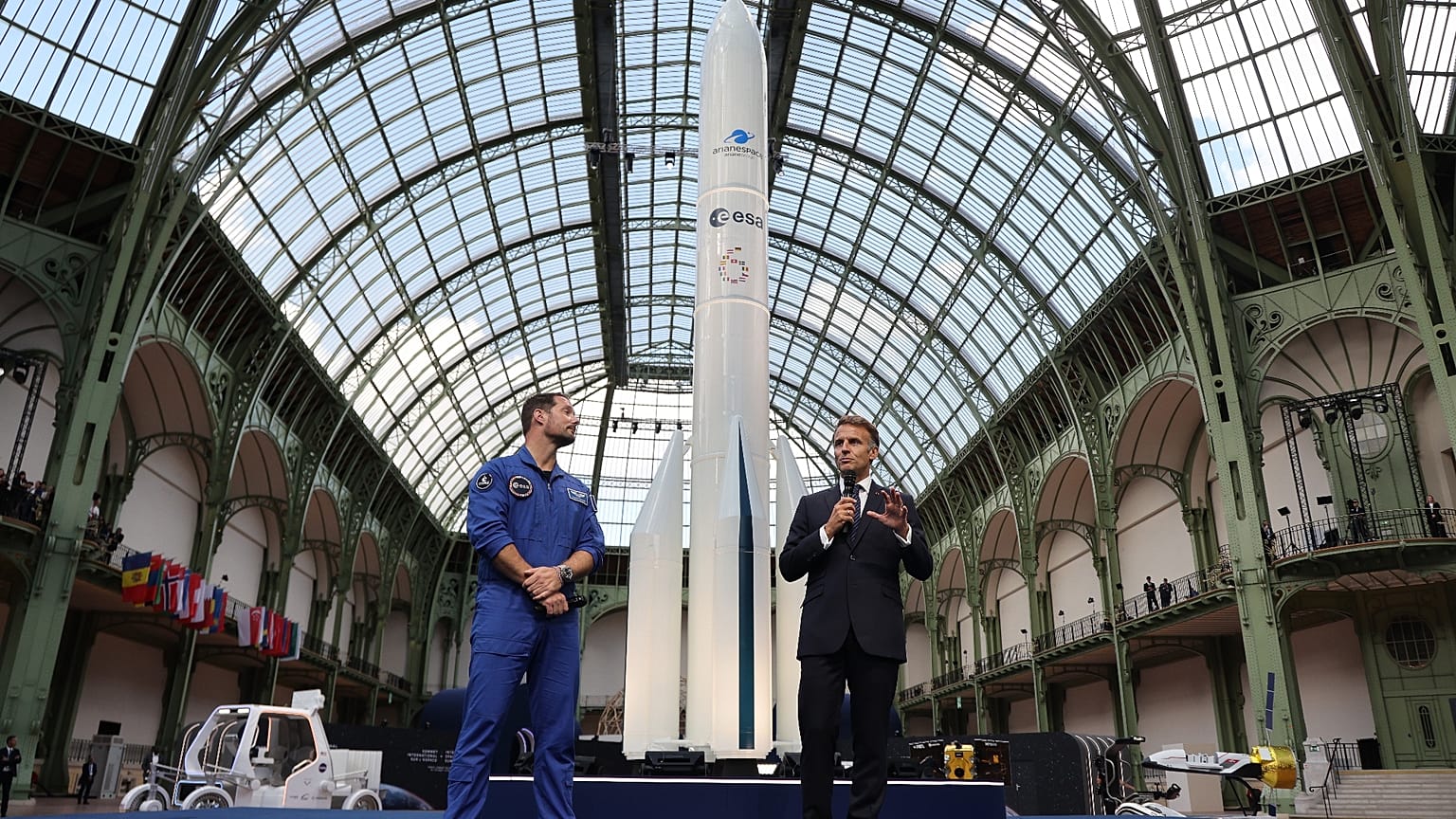
French President Emmanuel Macron has called on Europe to significantly strengthen its space sector and develop independent capabilities to compete with the United States and China. Speaking at the International Space Summit in Paris, Macron said that Europe’s space sector remains weak and that its space program is fragile, particularly in crewed spaceflight.
Macron outlined a series of ambitions for European space exploration. Within two years, he wants the European cargo capsule Nyx to dock with the International Space Station. Within five years, he hopes the Argonaut lunar lander will reach the Moon. Within a decade, he wants a European crewed capsule to launch from Kourou in French Guiana, carrying European astronauts and astronauts from other countries.
The French president also urged Europe to reduce its reliance on American and Russian services. European space exploration currently depends on rockets and satellites from the United States and Russia for communications and surveillance. Although the European Space Agency secured a record budget of more than €22 billion in 2025 for programs covering three years, Europe has never conducted a crewed space mission.
ESA Director General Josef Aschbacher asked whether Europe wants to remain a “passenger” or become a “pilot” in the rapidly developing space sector. He said Europe must build its own capabilities, including critical satellite infrastructure and lunar exploration systems, to become an indispensable partner. Aschbacher estimated that achieving greater independence would require approximately €1 billion in additional annual investment. He warned that Europe’s financial and technological gap with global space leaders is widening and that dependence on other countries carries a cost.
Entities: Emmanuel Macron, Josef Aschbacher, European Space Agency (ESA), European Union, International Space Summit • Tone: analytical • Sentiment: neutral • Intent: inform
10-09-2026
French President Emmanuel Macron and European Commission President Ursula von der Leyen have called for a stronger, more coordinated European space sector at an international summit co-hosted by France and Germany at Paris’s Grand Palais. Macron described Europe’s space industry as fragile and urged shared governance of space activities, arguing that outer space lacks regulations proportionate to its strategic importance. He said more than 51 agreements, representing approximately €20 billion in investment, were expected during the summit. Macron also outlined long-term ambitions, including docking the European Nyx cargo capsule with the International Space Station within two years, landing the Argonaut lunar lander on the Moon within five years, and launching a European crewed capsule from Kourou within a decade.
Von der Leyen emphasised that space is increasingly essential not only to scientific research and economic prosperity but also to defence, security and European independence. Referring to Russia’s war in Ukraine, she highlighted the role of satellite communications in connecting soldiers and satellite imagery in tracking military movements. She also announced plans to accelerate the European Union’s IRIS² satellite constellation by expanding it to more than 350 satellites.
The leaders called for closer cooperation among the European Commission, the European Space Agency and national governments, as well as investment at a much larger scale. Europe’s space push is partly motivated by the desire to reduce its longstanding dependence on the United States. Several US companies reportedly withdrew from the summit amid alleged pressure from Washington over European Union policy positions. The article notes that Europe has historically invested a smaller share of GDP in space than the US, although the ESA approved a record €22.3 billion budget for 2026–2028. The summit also included ESA Director General Joseph Aschbacher and a live call with French astronaut Sophie Adenot aboard the International Space Station.
Entities: Emmanuel Macron, Ursula von der Leyen, France-Germany international space summit, Paris Grand Palais, European space sector • Tone: analytical • Sentiment: neutral • Intent: inform
10-09-2026
This France 24 segment examines Europe’s position in the expanding global space race, particularly in relation to the United States and China. It follows a call by French President Emmanuel Macron and European Commission President Ursula von der Leyen for European countries to act on a much larger scale if they want to secure a meaningful role in space. The areas mentioned include communications and crewed spaceflight.
The report features an interview with Svetla Ben-Itzhak, an assistant professor of space and international relations at Johns Hopkins University and deputy director of the West Space Scholars Programme. She acknowledges that Europe possesses world-class scientific and industrial capabilities, as well as ambitions in space. However, she argues that these strengths are not currently matched by the resources and coordination needed to compete with the United States and China.
According to Ben-Itzhak, Europe’s main weaknesses include insufficient investment, a lower launch cadence, limited scale, and less political integration. These shortcomings affect Europe’s ability to develop an independent and competitive presence across the space sector. The segment therefore presents the issue as both a technological and political challenge: Europe has the expertise to participate, but it must coordinate more effectively and commit greater resources.
The short report does not provide specific funding proposals, timelines, or policy measures. Instead, it combines the statements from European leaders with an expert assessment of the structural barriers facing Europe. Its central message is that Europe must determine its own strategic path in space rather than remain dependent on or overshadowed by the United States and China.
Entities: Europe, United States, China, European Commission, Emmanuel Macron • Tone: analytical • Sentiment: neutral • Intent: analyze
10-09-2026
French President Emmanuel Macron has urged Europe to develop an independent crewed space-flight capability within the next decade, framing the goal as part of a wider effort to strengthen the continent’s space sector. He made the remarks at an international space summit in Paris, an event that several major US aerospace companies, including SpaceX and Blue Origin, reportedly declined to attend.
Macron said Europe needed to “assert its ambition in crewed space flight,” arguing that the European space programme remained fragile and required significantly greater effort. His comments echoed a call made by Josef Aschbacher, director general of the European Space Agency (ESA), who appealed to European ministers and other officials for additional resources to build an independent space industry.
Aschbacher posed the strategic question of whether Europe would remain dependent on other powers or become a leader in space, asking: “Will we be passengers or pilots?” He highlighted the rapid pace of international development across the space sector, including advances in satellite technology and exploration missions targeting the Moon and Mars.
The article presents the French and ESA positions as part of a broader debate over Europe’s strategic autonomy in space. Macron’s proposed ten-year timeframe would require sustained political backing, investment and cooperation among European countries. The summit’s limited participation by some US companies also underscores the challenge facing Europe as it seeks to expand its capabilities in an increasingly competitive global space industry. The report does not detail a specific European crewed-flight programme, funding package or technical roadmap, but it establishes the ambition and urgency expressed by Macron and Aschbacher.
Entities: Emmanuel Macron, Europe, European Space Agency (ESA), Josef Aschbacher, Thomas Pesquet • Tone: analytical • Sentiment: neutral • Intent: inform